portalId 145238543 hublet eu1 environment prod defaultChatFlow ----

Insurance API marketplaces: the executive guide

Insurance API marketplaces: the executive guide

Executive reviews insurance API marketplace workflow

Most insurance leaders, when asked about digital transformation, immediately think of core system replacements, cloud migrations, or legacy policy administration overhauls. Those efforts matter enormously. But the next frontier of competitive differentiation is not inside your core platform. It is in how your systems connect outward, to brokers, partners, embedded distribution channels, and the broader insurance ecosystem. Insurance API marketplaces are reshaping that connectivity layer entirely, and the carriers who understand this shift earliest will claim the distribution advantages that others will spend years trying to recover.

Table of Contents

Key Takeaways

Point Details
Marketplace advantage Insurance API marketplaces enable one integration for multiple providers, streamlining distribution and partner engagement.
Operational efficiency APIs reduce integration burden, but standardising data formats and workflows is still crucial for success.
Strategic rollout Treating new partner APIs as business experiments links technology change to tangible underwriting and distribution goals.
Continuous evolution Ongoing testing and adaptation keep API marketplaces relevant as partner requirements and market opportunities shift.

Understanding insurance API marketplaces

To grasp why API marketplaces are so significant, you first need a clear definition of what they actually are, and how they differ from the point-to-point integrations that most P&C insurers have been building for the past decade.

An insurance API marketplace is a unified digital environment where multiple carriers, MGAs, and product providers expose their capabilities through standardised application programming interfaces. Rather than a broker or distribution partner needing to build a separate technical connection to each carrier individually, they connect once to the marketplace layer and immediately gain access to a wide catalogue of quotes, products, and binding workflows. The API-first approach in insurance principles that underpin these marketplaces mean the architecture is designed from the ground up for interoperability, not bolted on as an afterthought.

This is a fundamentally different model from traditional API integration. In conventional B2B API integrations, each connection is bespoke. A broker integrates with Carrier A through one schema, then builds an entirely separate integration for Carrier B with different fields, different response formats, and different authentication flows. The maintenance burden alone can consume significant engineering resource over time. Insurance ecosystems, by contrast, build marketplace-like API layers where partners can submit once, receive multiple quotes, compare, and bind in their own workflow.

Key components of a mature insurance API marketplace:

  • A standardised schema layer that normalises data across carrier-specific formats
  • A catalogue of available products and carriers accessible through a single entry point
  • Real-time quoting engines that return comparable results simultaneously
  • Binding and policy issuance workflows integrated directly into the API responses
  • Authentication, logging, and audit trails supporting regulatory compliance
  • Versioning controls that allow marketplace updates without breaking partner integrations

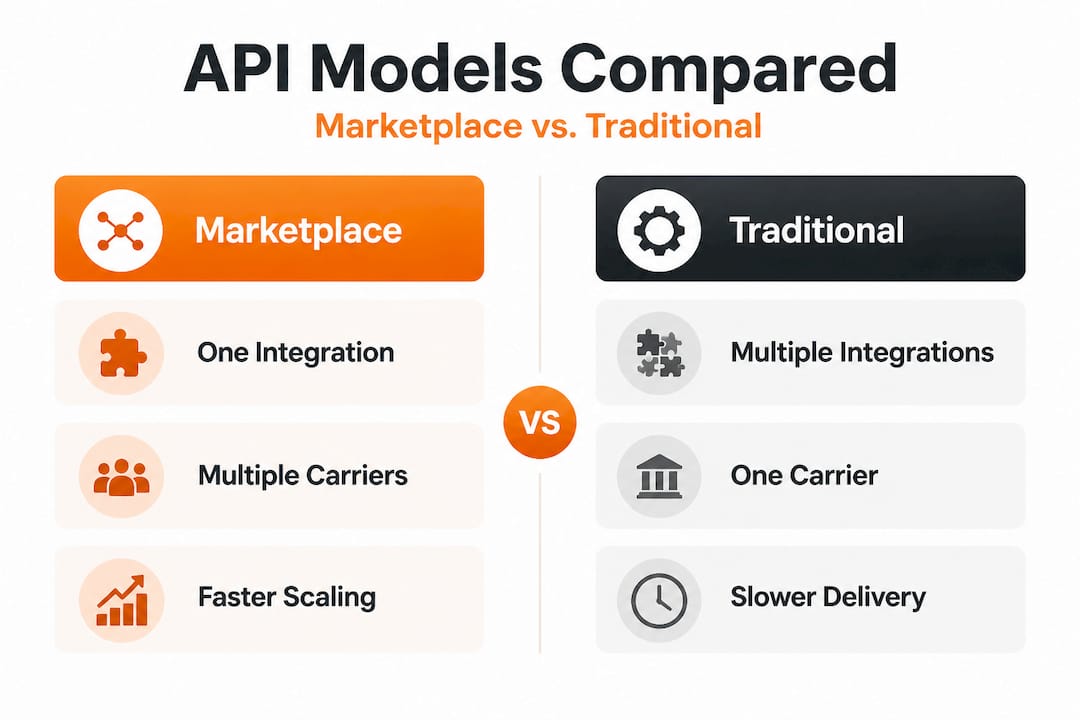
The table below shows how this model compares to traditional integrations at a glance.

Feature Traditional API integrations Insurance API marketplace
Number of connections One per carrier/partner One integration, multiple carriers
Schema standardisation Carrier-defined, bespoke Normalised across the marketplace
Maintenance burden High, duplicated per partner Centralised, shared maintenance
Time to add a new carrier Weeks to months Days, sometimes hours
Quoting workflow Sequential, separate systems Simultaneous, unified comparison
Broker/partner experience Fragmented, inconsistent Consistent, streamlined

Infographic comparing API marketplace and traditional models

Developing a robust API strategy for insurers means recognising that the marketplace model is not just a technical convenience. It is a strategic enabler of distribution scale.

How insurance API marketplaces work in practice

Defining the concept is one thing. Seeing how it operates in a live distribution context is where the value becomes tangible for executives making investment decisions.

Consider the management liability market. Limit, a specialist platform, launched API-enabled access to Cowbell and Counterpart, allowing brokers to submit a single application, receive multiple quotes, compare, and bind instantly across both offerings. That workflow, which previously required two separate submissions with different forms and different follow-up processes, collapsed into one. The time saving per transaction is significant, but the cumulative effect across thousands of submissions is transformational.

Here is how a typical API marketplace workflow operates from submission to binding:

  1. Partner submission: A broker or distribution partner submits a standardised risk application through their own platform or workflow tool, which connects to the marketplace via a single API endpoint.
  2. Normalisation layer: The marketplace receives the submission and translates it into each carrier’s specific data requirements, handling the schema mapping behind the scenes.
  3. Simultaneous quoting: The marketplace sends requests to multiple carriers concurrently and collects responses in real time, rather than sequentially.
  4. Comparison and selection: The broker receives a normalised comparison view, showing premiums, coverage terms, and carrier ratings side by side within their own workflow.
  5. Binding: Once a selection is made, the binding instruction is passed back through the API to the selected carrier, triggering policy issuance and documentation without manual re-entry.
  6. Confirmation and audit trail: Policy documents and confirmation data are returned to the broker’s system automatically, with a full audit record maintained for compliance purposes.

This is precisely the kind of architecture underpinning the most innovative insurance marketplace models emerging across the industry. The financial API innovation driving fintech broadly applies here too: standardised connectivity reduces friction, and reduced friction drives volume.

Team discussing insurance API integration

Embedded insurance is another compelling application. When a digital property platform wants to offer landlord liability insurance at the point of lease signing, or when an e-commerce platform wants to bundle goods-in-transit cover at checkout, an API marketplace makes this commercially viable. The embedding partner does not need to understand the intricacies of each carrier’s underwriting rules. They connect once, and the marketplace handles the rest.

Pro Tip: Before committing to an API marketplace architecture, map the compliance touchpoints in your distribution workflow carefully. Jurisdictions may require explicit disclosure at specific steps, and your API design should accommodate these requirements natively rather than retrofitting them later.

Understanding what to look for in modern insurance platforms when evaluating marketplace capability is essential at this stage, particularly around latency standards, error handling, and regulatory logging built into the platform by design.

Benefits and strategic value for property and casualty insurers

The business case for insurance API marketplaces becomes clearest when you examine the value from the perspective of each stakeholder group involved in the distribution chain.

Marketplace adoption reduces time to market and integration cost, but the real competitive advantage lies in the compounding network effect: every new carrier or partner added to the marketplace increases its value exponentially for all existing participants.

The table below maps specific benefits to each stakeholder category.

Stakeholder Primary benefit Secondary benefit
Insurance executives Faster product launch cycles Lower cost of distribution expansion
IT and architecture teams Reduced point-to-point integration debt Centralised version and schema control
Brokers and MGAs Single workflow for multiple markets Improved comparison and selection speed
End clients/policyholders Faster quotes and binding More competitive options in one place
Compliance and operations Centralised audit trail Standardised regulatory reporting inputs

Core digital transformation advantages for P&C carriers:

  • Distribution reach without headcount: Adding a new distribution channel through a marketplace API connection does not require proportional growth in your integration or operations teams.
  • Reduced time to market: New products or endorsements can be made available to all marketplace partners simultaneously, rather than rolling out sequentially across individual connections.
  • Data quality improvements: Standardised submission schemas reduce incomplete applications and data errors that slow underwriting workflows.
  • Competitive intelligence: Aggregate marketplace data reveals where your products are winning, where they are being displaced, and why, at a granularity that bilateral integrations cannot provide.
  • Ecosystem flexibility: As distribution channels shift, whether to embedded, digital MGA, or direct digital, the marketplace layer adapts without requiring a full re-architecture.

It is worth noting, as integration complexity research makes clear, that API marketplaces reduce integration complexity, but handling carrier-specific variants still requires mapping and translation layers. This is not a reason to avoid the marketplace model. It is a reason to invest in getting the normalisation layer right from the outset, with proper governance and schema discipline. Understanding API integration types helps architects choose the right approach for each carrier relationship within the marketplace.

The competitive edge through APIs that leading carriers are building right now is not primarily about technology. It is about the business operating model that the technology enables. Carriers who treat their API layer as a strategic asset, rather than an IT deliverable, are the ones compounding distribution advantages quarter after quarter. Robust API testing in microservices architectures also plays a critical role in maintaining marketplace reliability as the partner catalogue grows.

Implementation insights and transformation challenges

Knowing the value is one thing. Knowing how to realise it without accumulating new forms of technical debt is quite another.

Here are the key implementation steps for launching or maturing an insurance API marketplace capability:

  1. Define your marketplace scope: Decide upfront whether you are building a carrier-side API to expose your products to a marketplace, or whether you are building the marketplace layer itself to aggregate multiple carriers. These are distinct architectural decisions with different governance implications.
  2. Establish a canonical data model: Before connecting any partners, define your normalised schema. Every carrier-specific data requirement will be mapped against this canonical model, so it must be designed with flexibility in mind.
  3. Build the normalisation and translation layer: This is the engine room of any API marketplace. Invest in robust mapping tools and version-controlled transformation rules for each carrier relationship.
  4. Implement centralised testing frameworks: Use insurance software testing disciplines to validate each new carrier integration against your canonical model before going live. Regression testing after schema changes is non-negotiable.
  5. Design for failure and latency: Define what happens when a carrier API returns slowly or errors. Client-facing workflows must degrade gracefully rather than breaking entirely when a single carrier has an outage.
  6. Establish KPIs before launch: Define success metrics for each new carrier or partner integration before switching it on, covering underwriting outcomes, conversion rates, and operational throughput.
  7. Create a governance model for ongoing schema change: Carrier APIs evolve. Build a process for managing schema updates, communicating changes to all downstream partners, and testing changes before they reach production.

The most instructive example here comes from how Markel approaches new API integrations. Rather than treating each new partner connection as a routine IT delivery, many insurers treat new API integrations as hypotheses tested against underwriting, distribution, and claims outcomes. Each integration is a business experiment with a hypothesis, a measurement framework, and a defined decision point. That discipline is what separates carriers building genuine competitive capability from those simply accumulating integrations.

Pro Tip: Assign a named business owner, not just a technical lead, to each new API partner relationship. When an integration’s business KPIs are owned by someone in underwriting or distribution rather than IT alone, the quality of requirements, testing, and ongoing governance improves dramatically.

Aligning core system modernisation with API marketplace ambitions from the start avoids the common pitfall of building a modern API layer on top of a policy administration system that cannot support the data or workflow requirements the marketplace creates.

Our perspective: what most insurance leaders miss about API marketplaces

After working with P&C insurers through multiple waves of digital transformation, we have seen a pattern that limits the value most carriers capture from API marketplace investments. The technology is rarely the problem. The organisational model is.

Most carriers approach API marketplace initiatives as IT projects with a defined endpoint. A platform is selected, integrations are scoped, and a delivery date is set. When the integrations go live, the project is closed. What gets missed is that a marketplace is not a destination. It is a continuously evolving operating model. Partners change their schemas. New carriers join and old ones are retired. Underwriting rules shift. Regulatory requirements in different jurisdictions create new data obligations. A marketplace that is not actively governed becomes a liability faster than most executives anticipate.

The carriers who extract sustained competitive value from their marketplace investments treat the API layer as a living product with its own roadmap, its own user research (conducted with brokers and distribution partners), and its own executive sponsorship. The commercial shifts enabled by API-first platforms go far beyond technology. They touch distribution strategy, product design, underwriting authority structures, and partner commercial models.

The uncomfortable truth is that most API marketplace failures are failures of organisational will rather than technical capability. When no one in the business owns the broker experience across the marketplace, when schema changes are driven by IT convenience rather than distribution outcomes, and when carrier additions are measured by go-live dates rather than business performance, the marketplace becomes a cost centre rather than a growth engine.

Our strongest recommendation: appoint a marketplace product owner at a senior level, give them a cross-functional team, and hold them accountable for distribution outcomes. That single structural decision will do more for your marketplace’s long-term value than any technology choice you make.

Ready to modernise your insurance partnerships?

If this article has clarified what insurance API marketplaces can deliver for your organisation, the next step is understanding how your current core platform positions you to pursue that opportunity. IBSuite, IBA’s API-first, cloud-native insurance platform, is built precisely to enable the kind of marketplace connectivity and distribution agility described throughout this guide. From standardised API layers to evergreen integrations and end-to-end support across the full insurance value chain, IBSuite gives P&C carriers the foundation to build and scale marketplace capabilities without accumulating technical debt. Book a demo with our team to explore how a proven modernisation framework can accelerate your API marketplace journey.

Frequently asked questions

What is an insurance API marketplace?

It is a unified digital platform where insurers, brokers, and partners access multiple products, quotes, and binding workflows through standardised application programming interfaces. Insurance ecosystems build marketplace-like API layers where partners can submit once, receive multiple quotes, compare, and bind within a single workflow.

How does an API marketplace differ from traditional insurance integrations?

An API marketplace offers a single integration point for multiple carriers or partners, drastically reducing complexity compared to building separate connections for each party. As integration research confirms, API marketplaces reduce integration complexity, though carrier-specific variants still require careful mapping layers.

What are the business benefits of adopting an insurance API marketplace?

Key benefits include faster time to market, simplified partnerships, improved distribution reach, and operational scalability for property and casualty insurers, as well as compounding network effects as the partner catalogue grows.

What are common challenges with API marketplace deployment?

Differing data requirements, response formats, and integration discipline across carriers require careful schema design and ongoing testing. Carriers and partners frequently differ in required fields, response formats, underwriting rules, and timing, which must be handled by a robust normalisation layer.

How should new API integrations be rolled out?

Insurers should treat new integrations as business experiments, measuring outcomes across underwriting, distribution, and claims rather than simply tracking go-live dates. Many leading insurers already treat new API partner integrations as hypotheses tested against defined business outcomes.

Top advantages of cloud-native platforms for P&C insurers

Top advantages of cloud-native platforms for P&C insurers

Insurance team reviewing cloud-native platform diagram

Legacy core systems are quietly costing property and casualty insurers more than they realise. Whilst competitors launch new products in weeks and settle claims digitally within hours, carriers still running monolithic platforms face mounting IT costs, slow release cycles, and an inability to connect with the modern digital ecosystem. Cloud-native platforms built on microservices, container orchestration, and CI/CD pipelines represent a fundamentally different operating model. This article sets out the concrete, board-level advantages and gives you a practical framework to evaluate your options.

Table of Contents

Key Takeaways

Point Details
True cloud-native essentials Microservices, containers, CI/CD, and API-first design are non-negotiables for modern insurance platforms.
Accelerated product launches Insurers can rapidly design, test, and deploy products—outpacing legacy rivals.
Seamless ecosystem integration APIs enable insurers to easily connect with digital partners, distribution, and data sources.
Resilience and scalability Cloud-native ensures robust, elastic operations even under extreme demand or outages.
Business-led transformation Success depends on leadership prioritising business value, not just technology migration.

Selection criteria: What makes a platform truly cloud-native?

Not every platform marketed as “cloud” is genuinely cloud-native. This distinction matters enormously to insurance executives because the wrong choice locks you into the same operational constraints you were trying to escape, whilst adding cloud infrastructure costs on top.

The most common trap is the lift-and-shift approach. This is where a vendor takes an existing monolithic policy administration system and runs it on cloud servers, rather than redesigning it for cloud principles. The result is a platform that retains monolith issues and often costs more than on-premises hosting, without delivering the agility or resilience benefits you need.

A genuinely cloud-native platform must meet these criteria:

  • Microservices architecture: Each business function, such as rating, billing, or claims, runs as an independent service that can be updated, scaled, or replaced without touching the rest of the system.
  • Container orchestration: Platforms using Kubernetes for independent scaling can automatically manage workloads, recover from failures, and deploy updates reliably.
  • CI/CD pipelines: Continuous integration and continuous deployment pipelines allow development teams to ship features, compliance fixes, and new products without scheduled downtime windows.
  • API-first design: Every service exposes a well-documented API, enabling fast integration with external partners, distribution channels, and data providers.
  • Evergreen updates: The platform vendor manages ongoing updates so your team is never running outdated software or facing costly upgrade projects.

When evaluating platforms, ask vendors to demonstrate each of these capabilities specifically in insurance workflows. Understanding the modern insurance platform benefits that flow from these architectural choices will sharpen your procurement criteria considerably.

Pro Tip: During an RFP process, ask vendors to show you a live deployment pipeline. If they cannot demonstrate a zero-downtime update in a test environment, treat that as a significant red flag.

Advantage 1: Elastic scalability and resilience

Insurance operations are inherently uneven. Renewal seasons, catastrophe events, and regulatory deadlines create dramatic spikes in system demand. A platform that cannot scale to meet these peaks either fails under pressure or forces you to maintain expensive over-provisioned infrastructure year-round.

Cloud-native architecture solves this through auto-scaling. Specific microservices, such as the pricing engine or claims intake service, can auto-scale during surges and then scale back down automatically, paying only for what you use. This is a fundamentally different cost model from legacy systems, where you provision for peak and pay for it constantly.

The resilience advantage is equally important. In a monolithic system, a single defect in one module can bring down the entire platform. In a microservices architecture, failure is contained. If the fraud detection service encounters an issue, claims intake continues to function. Policyholders and agents never see the problem.

Engineer troubleshooting servers for insurance platform

Consider a real scenario: a major hurricane makes landfall across a coastal portfolio. Within hours, your claims intake volumes surge tenfold. Your digital FNOL (first notice of loss) channel, your adjuster assignment service, and your customer communications module all face simultaneous pressure. A cloud-native platform scales each of these independently, routes workloads intelligently, and maintains performance. A legacy platform either crashes or queues requests for hours.

Key resilience capabilities to look for include:

  • Automatic failure recovery at the service level, not just the infrastructure level
  • Geographic redundancy with active-active failover
  • Circuit breaker patterns that prevent cascading failures across services
  • Real-time observability dashboards so operations teams see issues before customers do

Building digital agility in insurance operations starts with a platform that does not buckle under pressure.

Pro Tip: Ask your platform vendor for their published SLA during peak catastrophe events, not just standard operating conditions. The gap between those two numbers tells you everything about their architecture.

Advantage 2: Rapid product innovation and zero-downtime deployments

Speed to market is no longer a competitive differentiator. It is a survival requirement. Insurtechs and digital-first MGAs are launching niche products in weeks. If your product team identifies a market opportunity and your IT team tells you it will take eighteen months to configure and test, you have already lost.

Cloud-native platforms change this equation through composability. Because each business function is an independent microservice, product teams can assemble new coverages by connecting existing services rather than rebuilding from scratch. Launching new products in weeks rather than years becomes achievable when your rating, policy issuance, and billing services are already built and simply need to be configured for a new product line.

Here is how a typical rapid product launch looks on a cloud-native platform:

  1. Product configuration: Underwriting rules, coverage terms, and rating factors are configured in the platform’s product engine, not hard-coded by developers.
  2. API connection: If the product requires a new data source, such as telematics or weather data, the API-first architecture connects it within days.
  3. Testing and compliance: Automated test suites run against the new configuration, and compliance rules are validated before any code reaches production.
  4. Deployment: Zero-downtime updates mean the new product goes live mid-week, mid-day, without a maintenance window or customer disruption.
  5. Iteration: If the market responds differently than expected, pricing and coverage terms can be adjusted within days, not quarters.

Consider parametric insurance as a concrete example. A carrier wanting to launch a parametric flood product, where payouts trigger automatically when a rainfall threshold is met, needs to connect weather data APIs, configure trigger logic, and automate payment processing. On a legacy system, this requires custom development across multiple modules. On a cloud-native platform, each of these is an API connection and a configuration change.

“The carriers winning in 2026 are not necessarily the ones with the best actuarial models. They are the ones who can get those models into production and in front of customers faster than anyone else.”

Understanding the broader digital transformation drivers helps frame why this speed advantage compounds over time. Every product cycle where you move faster than a competitor widens the gap.

Advantage 3: Open ecosystem integration and API-first strategies

Modern insurance does not happen in isolation. Your platform must connect to telematics providers, fraud detection engines, payment processors, digital distribution platforms, reinsurance portals, and an expanding range of AI-powered services. An API-first architecture makes this possible without expensive custom integration projects.

API-first design decouples the backend core system from every frontend channel and external partner. This means you can update your customer portal, launch a new broker extranet, or connect a new AI damage estimation service without touching your core policy or claims logic.

Integration type Business capability enabled Typical legacy approach
Telematics providers Usage-based insurance, real-time risk scoring Custom point-to-point integration, months of development
AI damage estimation Faster claims settlement, reduced loss adjustment costs Manual photo review, adjuster dependency
Payment processors Flexible premium collection, instant claims payments Batch processing, limited payment options
Fraud detection AI Real-time fraud scoring at FNOL Retrospective fraud review, higher leakage
Digital distribution platforms Embedded insurance, affinity partnerships Manual scheme setup, slow partner onboarding
Reinsurance portals Automated bordereau submission, treaty management Spreadsheet-based reporting, reconciliation errors

The strategic implication here is significant. An API strategy for insurers is not a technical project. It is a business model decision. Carriers who build open, well-governed API ecosystems can onboard new distribution partners in days, launch embedded insurance products through retail or automotive partners, and plug in best-of-breed AI services as they mature.

The API-first approach in insurance also protects your investment. When a better fraud detection provider emerges, you swap the API connection rather than undertaking a system replacement. This modularity is what gives cloud-native platforms a compounding advantage over time.

Comparison: Cloud-native versus legacy and ‘cloud-washed’ platforms

With the advantages clear, it is worth making the comparison explicit. Many executives are presented with three apparent options: stay on legacy, move to a cloud-hosted version of their existing system, or adopt a genuinely cloud-native platform. The differences are stark.

Capability Cloud-native Legacy (on-premises) Cloud-washed (lift-and-shift)
Scalability Automatic, per-service Manual, whole-system Limited, infrastructure-level only
Update frequency Continuous, zero downtime Quarterly or annual, downtime required Infrequent, still requires downtime
Integration speed Days via APIs Weeks to months, custom development Weeks to months, unchanged
Cost model Consumption-based, scales with demand Fixed capital expenditure High cloud costs, no agility benefit
Failure resilience Service-level containment System-wide risk System-wide risk, cloud overhead added
Product launch speed Weeks Months to years Months to years

The cloud-washed category deserves particular attention. Vendors who move legacy monoliths to cloud infrastructure often present this as digital transformation. It is not. As the evidence shows, lift-and-shift retains monolith issues and frequently results in higher costs than on-premises hosting, without any of the agility benefits.

“Buying cloud infrastructure without cloud-native architecture is like installing a jet engine in a horse-drawn carriage. The power is there; the structure cannot use it.”

Executives evaluating end-to-end insurance solutions must insist on architectural transparency. Ask vendors to explain their deployment model, their microservices boundaries, and how they handle updates. Vague answers about “cloud-based” infrastructure without specifics about architecture are a warning sign.

Risks and mitigations: Cloud-native adoption challenges

Intellectual honesty requires addressing the risks alongside the advantages. Cloud-native adoption introduces genuine challenges that insurance executives must plan for, particularly around cyber concentration and supply chain exposure.

Cyber aggregation risk increases when a significant proportion of the insurance industry relies on a small number of cloud providers. A major outage or security incident at a hyperscale provider could simultaneously affect multiple carriers, creating systemic risk that is difficult to model and price. Tier-2 and tier-3 supply chain dependencies, such as the software libraries and services your cloud provider relies upon, add further layers of exposure.

Practical mitigations that leading P&C carriers are implementing today include:

  • Multi-cloud strategy: Distributing workloads across two or more cloud providers reduces single-vendor dependency, though it adds operational complexity.
  • Vendor due diligence: Conducting thorough security assessments of cloud providers, including their own supply chain dependencies, not just their headline certifications.
  • Supply chain mapping: Maintaining a detailed inventory of all third-party services and libraries in your technology stack, with clear escalation paths for incidents.
  • Business continuity testing: Running regular failover exercises that simulate cloud provider outages, not just internal system failures.
  • Contractual protections: Ensuring SLAs with cloud providers include meaningful financial remedies and clear incident notification timelines.

The good news is that the insurance platform benefits of cloud-native architecture, particularly the resilience and modularity, actually make it easier to implement multi-cloud and failover strategies than legacy systems allow. The risks are manageable when they are planned for explicitly.

Why cloud-native success in insurance is about business outcomes, not buzzwords

After working with insurers across multiple markets and transformation programmes, one pattern stands out clearly: the carriers who fail to realise value from cloud-native investments almost always made the same mistake. They treated it as a technology procurement decision rather than a business transformation.

Cloud-washing is rampant in the insurance technology market. Vendors apply the language of cloud-native, microservices, and API-first to platforms that are, at their core, unchanged legacy architectures running on rented servers. Executives who do not look beneath the surface end up paying transformation budgets for incremental improvements.

But the subtler failure mode is more interesting. Some carriers genuinely adopt cloud-native platforms and still do not realise the full advantage. Why? Because the technology enables speed and flexibility, but the business processes and governance structures remain unchanged. If your product launch process still requires twelve approval stages and a quarterly release committee, a CI/CD pipeline will not save you.

The deeper advantages of modern platforms only materialise when executives pair technology investment with process redesign. That means empowering product teams to configure and launch without IT dependency, building cross-functional squads that own outcomes rather than handoffs, and creating governance that enables rapid experimentation rather than preventing it.

The most underappreciated advantage of cloud-native architecture in insurance is what we call business risk agility. When your platform can be updated continuously and rolled back instantly, the cost of being wrong drops dramatically. Teams experiment more confidently. Products are launched into limited markets, tested, and refined before full rollout. This is how insurtechs operate, and it is now available to established carriers who choose the right platform and the right operating model to go with it.

Accelerate your digital insurance strategy with IBSuite

If the advantages outlined here resonate with your strategic priorities, IBSuite offers a proven path to realising them. Built on AWS and designed specifically for P&C insurers, IBSuite delivers the full cloud-native architecture described throughout this article, including microservices, API-first design, and Evergreen updates, across the complete insurance value chain. Whether you are looking to modernise your policy administration platform or transform your digital claims management capabilities, IBSuite provides the operational foundation to move faster, integrate more broadly, and scale with confidence. The most effective next step is to see it in action. Book a platform demo and bring your specific product and operational challenges to the conversation.

Frequently asked questions

How is a cloud-native platform different from traditional cloud hosting?

Cloud-native platforms are purpose-built with microservices, containers, and CI/CD pipelines, delivering genuine resilience and agility, whilst traditional cloud hosting simply moves legacy monoliths to rented servers without changing their fundamental limitations.

How quickly can insurers launch new products on a cloud-native platform?

With microservices composability and CI/CD pipelines, insurers can launch products in weeks rather than years, with no customer-facing downtime during deployment.

What are the cyber risks with cloud-native adoption?

Cyber aggregation risk increases when multiple carriers rely on the same cloud providers, so insurers must actively map supply chain dependencies and implement multi-cloud strategies.

Can cloud-native solutions integrate with AI, telematics, and legacy systems?

Yes. API-first architecture decouples core systems from external services, enabling fast, secure integration with telematics providers, AI damage estimation tools, payment processors, and existing legacy data sources.