13.03.26
Why automated underwriting matters for P&C insurers in 2026

Traditional underwriting processes create inconsistent decisions ranging from 15-25% amongst underwriters assessing identical risks. This variability drives up costs, delays customer service, and exposes insurers to compliance risks. Automated underwriting transforms these inefficiencies by leveraging artificial intelligence and structured decision frameworks to deliver faster, more consistent, and cost-effective risk assessment. This article explores why automated underwriting has become essential for property and casualty insurers seeking competitive advantage through digital transformation in 2026.
Table of Contents
- The Challenges With Traditional Underwriting Processes
- How Automated Underwriting Transforms Insurance Operations
- Advanced AI Technologies Empowering Agentic Underwriting
- Real-World Impact Of Automated Underwriting: Case Study And Metrics
- Explore IBSuite’s Automated Underwriting Solutions
- FAQ
Key takeaways
| Point | Details |
|---|---|
| Processing speed | Automated underwriting cuts processing times by 40-60%, enabling faster policy issuance and improved customer satisfaction. |
| Cost reduction | Insurers achieve approximately 30% operating cost reductions through automation whilst reducing manual administrative overhead. |
| Decision consistency | AI-driven automation eliminates human variability, delivering standardised risk assessments across all policies. |
| Customer loyalty | Faster turnaround and reduced errors significantly enhance policyholder retention and conversion rates. |
| Legacy integration | Modern automation platforms layer onto existing systems without requiring disruptive wholesale replacements. |
The challenges with traditional underwriting processes
Manual underwriting creates substantial inefficiencies that undermine insurer profitability and customer satisfaction. High-value underwriting talent spends approximately 40% of their time completing administrative work rather than sophisticated risk assessment. This misallocation of skilled resources represents a significant opportunity cost for insurers.
Human judgement variability produces inconsistent decisions ranging from 15-25% amongst underwriters evaluating identical risks. Different underwriters apply varying interpretations of guidelines, leading to pricing inconsistencies and potential regulatory exposure. This lack of standardisation creates audit challenges and makes it difficult to analyse portfolio performance accurately.
Policy management involves extracting data manually from PDFs, emails, and faxes, introducing delays and errors throughout the workflow. Underwriters must re-enter the same information across multiple disconnected systems, creating bottlenecks that slow processing and increase operational costs. These repetitive tasks prevent underwriters from focusing on complex risk evaluation where their expertise adds genuine value.
Traditional processes struggle to scale efficiently during peak periods or rapid growth phases. Manual workflows cannot easily accommodate increased volume without proportional staffing increases, limiting operational flexibility. Optimising underwriting workflows becomes critical as insurers seek to modernise operations and remain competitive.
Specific challenges include:
- Decision variability across underwriters assessing similar risks
- Administrative overhead consuming nearly half of underwriting capacity
- Manual data entry errors reducing accuracy and customer confidence
- Delayed turnaround times frustrating customers and reducing conversion
- Audit difficulties stemming from inconsistent documentation practices
- Scalability constraints limiting growth potential during expansion
How automated underwriting transforms insurance operations
Automated underwriting deploys artificial intelligence and structured decision frameworks to create explainable, trusted decisions that eliminate human variability. These systems analyse risk factors consistently, applying the same logic and criteria to every submission regardless of volume or complexity. This standardisation dramatically improves decision quality whilst reducing processing times.
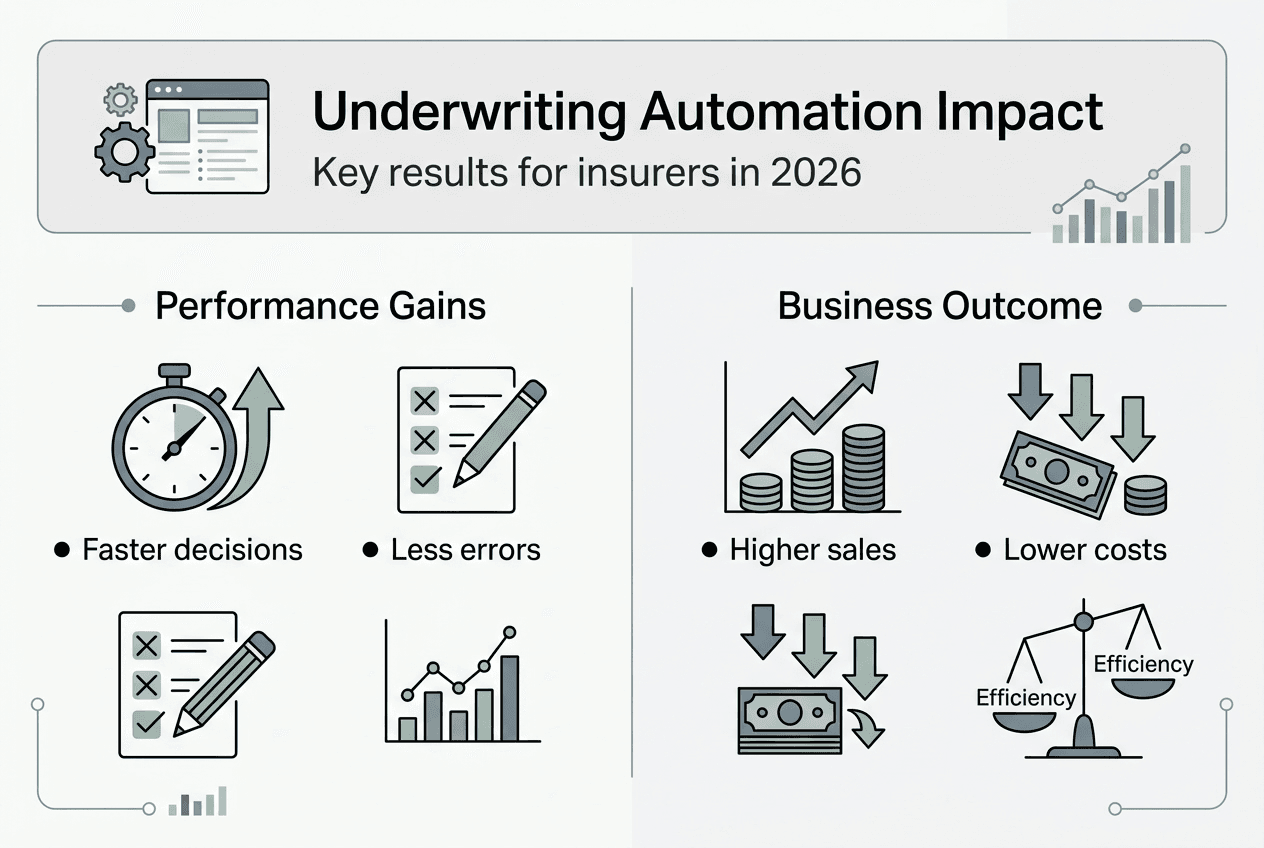
Intelligent automation achieves processing time cuts of 40-60% and operating cost reductions around 30% by eliminating repetitive manual tasks. Automated workflows extract data from submissions, validate information against multiple sources, and route cases appropriately without human intervention. This efficiency allows underwriters to focus exclusively on complex cases requiring expert judgement.

Policy management inefficiencies disappear as automation handles data entry, document processing, and system updates simultaneously. AI in P&C insurance streamlines these workflows without requiring disruptive platform replacements. Insurers can layer intelligent automation onto existing infrastructure, maximising return on investment whilst minimising deployment risk.
Customer experiences improve dramatically through faster turnaround and reduced errors. 87% of policyholders say claims experience affects their loyalty to insurers, making speed and accuracy critical competitive differentiators. Automated underwriting delivers instant decisions for straightforward cases, meeting customer expectations for digital-first service.
Core advantages of automated underwriting include:
- Processing speed improvements of 40-60% enabling same-day policy issuance
- Operating cost reductions approaching 30% through administrative efficiency
- Decision consistency eliminating human variability and regulatory risk
- Compliance enhancement through standardised documentation and audit trails
- Customer satisfaction gains driving higher conversion and retention rates
Pro Tip: Integrate AI models with existing core systems to maximise efficiency gains without undertaking expensive, risky platform replacements that disrupt operations.
The impact of AI in insurance extends beyond underwriting to claims processing, fraud detection, and customer engagement. Insurers adopting automation position themselves to capture market share from competitors still relying on manual processes.
Advanced AI technologies empowering agentic underwriting
Agentic AI systems operate as intelligent, self-directed agents managing complex underwriting tasks autonomously. Unlike basic chatbots that respond to simple queries, agentic AI persists across sessions, continuously learning from new data to refine decision accuracy. These systems handle data-heavy evaluation tasks that previously required significant human effort.
These advanced platforms integrate large language models, machine learning, and structured decision frameworks to create governed, explainable underwriting decisions. The combination provides both the flexibility to handle unstructured data and the rigour to meet regulatory requirements. Explainability features allow underwriters to understand precisely why the system reached specific conclusions, building trust and facilitating oversight.
Agentic AI adapts to changing risk patterns and market conditions without manual reprogramming. The systems identify emerging trends in claims data, adjust risk scoring models accordingly, and flag unusual patterns for human review. This continuous learning capability ensures underwriting criteria remain current and accurate as external conditions evolve.
Regulatory compliance improves as agentic AI maintains comprehensive audit trails documenting every decision factor and data source. The technology reduces bias by applying consistent criteria across all submissions, eliminating subjective judgements that can introduce discrimination. Automated decision-making technologies support governance requirements whilst accelerating processing.
Agentic AI is revolutionising insurance decision-making by moving beyond simple automation to create intelligent systems that learn, adapt, and improve autonomously whilst maintaining transparency and regulatory compliance.
Key features distinguishing agentic AI include:
- Persistence across sessions enabling continuous learning and improvement
- Explainability providing clear reasoning for every underwriting decision
- Integration of multiple AI techniques combining strengths of different approaches
- Autonomous learning adapting to new data without manual intervention
- Governance frameworks ensuring regulatory compliance and audit readiness
- Bias reduction through consistent application of objective criteria
Real-world impact of automated underwriting: case study and metrics
Zurich Australia demonstrated compelling results by implementing automated underwriting across their life insurance operations. The insurer cut average turnaround time by 7.3 days, dramatically improving customer response speed and satisfaction. This reduction allowed the company to issue policies faster than competitors, creating a significant market advantage.
Policy conversion rates rose by 4.8% as faster, more consistent decisions reduced customer drop-off during the application process. Applicants appreciated immediate feedback and streamlined workflows, leading to higher completion rates. The improvement translated directly to revenue growth without additional marketing expenditure.
Straight-through processing for medical assessments improved from 0% to over 60%, eliminating manual review for the majority of standard cases. This efficiency freed underwriters to focus on complex applications requiring expert judgement. The metric became a vital key performance indicator for measuring automation success.
Financial returns exceeded expectations, with Zurich Australia achieving more than 9x return on investment over three years. The combination of cost savings, revenue growth, and efficiency gains delivered substantial value to the business. These results demonstrate that automated underwriting generates measurable financial benefits beyond operational improvements.
| Metric | Before automation | After automation | Improvement |
|---|---|---|---|
| Average turnaround time | 14.6 days | 7.3 days | 7.3 days faster |
| Policy conversion rate | Baseline | +4.8% | 4.8% increase |
| Straight-through processing | 0% | 60%+ | 60+ percentage points |
| Return on investment | N/A | 9x+ | Over 900% ROI |
Pro Tip: Monitor straight-through processing rates as a vital KPI for measuring automated underwriting success, as this metric directly reflects efficiency gains and cost reduction.
Underwriting workflow optimisation delivers these results by eliminating bottlenecks and streamlining decision paths. Insurers implementing similar automation can expect comparable benefits scaled to their operational context.
Explore IBSuite’s automated underwriting solutions
IBApplications delivers comprehensive digital transformation capabilities through IBSuite, a cloud-native platform designed specifically for property and casualty insurers. The digital insurance sales and underwriting platform integrates automated decision-making, intelligent workflows, and seamless data management to modernise operations without disruptive replacements.
IBSuite layers onto existing legacy systems, enabling insurers to adopt automation incrementally whilst preserving investments in current infrastructure. This approach reduces deployment risk and accelerates time to value compared to wholesale platform replacements. The IBSuite insurance platform supports the full insurance value chain from sales through claims and billing.
Clients benefit from improved operational efficiency, reduced costs, and elevated customer engagement through faster processing and consistent service delivery. The platform’s API-first architecture facilitates integration with third-party data sources, rating engines, and distribution channels. Insurers gain the flexibility to innovate rapidly whilst maintaining regulatory compliance and governance standards.
Discover how IBSuite can transform your underwriting operations and accelerate digital transformation. Book a demo to experience tailored capabilities designed for modern P&C insurers seeking competitive advantage through intelligent automation.
FAQ
What is automated underwriting and why is it important?
Automated underwriting uses artificial intelligence and digital workflows to assess risks and issue policies faster and more consistently than manual processes. It eliminates human variability, reduces processing times by up to 60%, and cuts operating costs by approximately 30%. The technology improves decision accuracy whilst freeing underwriters to focus on complex cases requiring expert judgement.
How does automated underwriting improve customer experience?
Faster turnaround times and reduced errors create smoother policy issuance and claims processing, meeting customer expectations for digital-first service. Immediate decisions for straightforward cases eliminate frustrating delays that cause applicants to abandon applications. Since 87% of policyholders say claims experience affects their loyalty, improved experiences directly increase retention and lifetime value.
Can automated underwriting integrate with existing systems?
Modern automation platforms layer onto existing core systems, enabling insurers to modernise workflows without wholesale replacements. AI can streamline underwriting without replacing legacy platforms, reducing deployment risk and preserving infrastructure investments. Next-generation insurance platforms use API-first architectures to integrate seamlessly with existing technology stacks.
What key metrics should insurers track to measure automation success?
Critical metrics include processing time reductions, straight-through processing rates, operating cost savings, and policy conversion rate improvements. Regular monitoring of these indicators helps insurers maximise benefits and identify optimisation opportunities. Return on investment calculations should encompass both direct cost savings and revenue growth from improved conversion and retention.
Recommended
- Automation and Artificial Intelligence in P&C Insurance – Digital Insurance Platform | IBSuite Insurance Software | Modern Insurance System
- 7 Best Underwriting Process Best Practices for P&C Firms
- Underwriting Defined: Boosting Agility in P&C Insurance
- How European Insurers Use Data & Automation in 2025 – Digital Insurance Platform | IBSuite Insurance Software | Modern Insurance System