08.05.26
How to streamline billing operations for insurance efficiency

Billing operations sit at the heart of every P&C insurer’s financial health, yet they remain one of the most overlooked sources of operational drag. When premium collections are delayed, costs spiral and policyholders grow frustrated, often before a single claim is filed. Delayed premium collections increase operational costs and erode the trust that keeps renewal rates strong. The good news is that targeted improvements to your billing processes, from automation to self-service portals, can produce measurable gains in efficiency and customer satisfaction without requiring a full system replacement.
Table of Contents
- Review your current billing operations landscape
- Digitise and automate your billing processes
- Empower policyholders with self-service and transparency
- Monitor success: KPIs and continuous improvement
- Rethinking insurance billing: what most managers miss
- Transform your billing operation with expert support
- Frequently asked questions
Key Takeaways
| Point | Details |
|---|---|
| Map your current landscape | A clear overview exposes bottlenecks and helps you choose priority areas for streamlining. |
| Automate for efficiency | Digital integrations and automation can cut costs and speed up collections dramatically. |
| Empower your policyholders | Self-service billing tools boost customer satisfaction and free up internal resources. |
| Measure and adapt | KPI-driven improvement ensures billing remains efficient and competitively aligned. |
Review your current billing operations landscape
To fix inefficiencies, first clarify your current billing operations structure. It sounds obvious, but most managers underestimate how fragmented their billing environment actually is. Payment methods, legacy platforms, and manual touchpoints often exist in silos, with different teams owning different pieces and nobody holding the complete picture.
Start by listing every element that touches your billing cycle. This includes the payment methods you accept (cheque, direct debit, card, digital wallet), the platforms managing each stage, and every manual handoff between teams. You cannot optimise what you cannot see, and a full map almost always reveals redundant steps or data gaps that nobody knew existed.
A structured overview of your environment might look like this:
| Billing element | Current state | Common gap |
|---|---|---|
| Payment methods | Card, direct debit, cheque | No digital wallet support |
| Collection platform | Legacy on-premise system | No automated retry logic |
| Reconciliation process | Manual spreadsheet matching | High error rate, slow close |
| Reporting cadence | Monthly manual reports | No real-time visibility |
| Customer communication | Outbound calls and letters | No self-service option |
Once you have this map, trace the flows for collection, reconciliation, and reporting. Where do items sit waiting for human action? Where do errors consistently appear? These are your highest-priority bottlenecks. Common culprits include manual payment posting, paper-based reconciliation, and disconnected reporting tools that force staff to compile data from multiple sources.
You should also be tracking billing KPIs such as days premium outstanding, collection efficiency, electronic payment adoption, and lapse rates as part of any honest diagnostic. If you are not measuring these today, establishing a baseline is your first deliverable. These numbers tell you where money is leaking and where customers are most likely to lapse.
Understanding the full insurance billing process from issuance to reconciliation gives you the vocabulary and the framework to prioritise fixes. Paired with a clear view of what insurance billing automation can realistically achieve, your diagnostic becomes an action plan rather than a complaints list.
Key bottlenecks to look for during your diagnostic:
- Manual payment allocation taking more than one business day
- Reconciliation errors requiring rework across multiple departments
- Premium notices sent by post with no electronic alternative
- No automated follow-up on failed payment attempts
- Separate systems for billing, policy, and claims with no shared data layer
Pro Tip: Involve staff from claims through to receivables when building your billing map. Frontline teams know where work actually stalls, not where the process is supposed to stall. Their input closes gaps that a process diagram alone will miss.
Digitise and automate your billing processes
Once you have mapped your environment, it is time to upgrade with automation and integrated payments. Automation does not mean replacing your team. It means removing the repetitive, low-judgement tasks that consume skilled staff time and introduce human error.
Here is a practical step-by-step approach:
- Assess your automation needs. Using your billing map, rank manual touchpoints by frequency and error rate. The highest-volume, highest-error processes are your first targets.
- Select appropriate automation tools. Look for billing platforms that offer configurable workflows, native payment gateway integrations, and rules-based exception handling.
- Integrate with payment solutions. Connect payment gateways, digital wallets, and direct debit schemes directly into your billing platform, removing manual payment posting entirely.
- Enable smart payment retries. Rather than writing off a failed payment immediately, automated retry logic attempts collection again at optimised intervals, recovering revenue that would otherwise be lost to administrative inertia.
- Automate premium notices and reminders. Triggered communications via email or SMS replace manual outbound calls and ensure consistent, timely contact with policyholders.
- Build automated reconciliation routines. Match payment receipts to policy records automatically at each end-of-day cycle, flagging only genuine exceptions for human review.
The results from these steps are not theoretical. Embedded payments deliver direct ROI through lower processing costs, faster cash flow, and reduced manual task volumes. Digital integration can cut payment processing expenses by up to 67%, and organisations that have automated their billing reporting have seen cycle times improve by around 60%.
Statistic callout: Insurers who integrate payment gateways with smart retry logic recover significantly more failed premiums than those relying on manual follow-up, with some reporting a 20 to 30 per cent reduction in lapse rates within the first year of deployment.
These gains compound over time. Each automated step reduces the opportunity for error in the next step, creating a cleaner, faster data trail from premium collection through to financial close. Explore the billing automation advantages in detail to understand which processes yield the fastest returns for P&C insurers specifically.
If you are building the business case internally, a practical billing automation guide can help you frame the investment in terms that resonate with finance and IT stakeholders. And when evaluating platforms, consider the broader modern insurance platform benefits beyond billing alone, as a connected core system amplifies every efficiency gain you make in one area.
Pro Tip: Automate recurring tasks aggressively, but schedule a weekly exception review. Automation surfaces the anomalies; your team’s job becomes investigating those anomalies rather than processing routine transactions.
Empower policyholders with self-service and transparency
With efficient backend automation in place, enabling front-end user empowerment delivers additional gains. The best billing operation is one where policyholders can answer their own questions without calling your contact centre.

Self-service portals allow policyholders to view their bills, update payment methods, switch payment frequencies, and manage instalments at their convenience. For agents, portals provide visibility into client accounts without requiring a call to your billing team. The result is fewer inbound queries, faster resolution for policyholders, and significantly less time spent by your staff on routine account enquiries.
The comparison between manual and self-service billing processes is stark:
| Metric | Manual process | Self-service process |
|---|---|---|
| Average inbound call volume | High (billing queries, payment updates) | Reduced by up to 40% |
| Net Promoter Score (NPS) | Typically lower | Measurably higher |
| Payment update speed | 1 to 3 business days | Immediate |
| After-hours availability | None | 24 hours a day, 7 days a week |
| Agent enquiry resolution | Requires billing team call | Self-served via portal |
Providing self-service portals for policyholders and agents to view bills, update payment details, and manage plans directly reduces service call volumes and improves satisfaction scores. This is not a soft benefit. Reduced call volume translates directly into lower contact centre costs and faster average handling times for the complex queries that do require human attention.
Implementation tips for a secure and user-friendly self-service portal:
- Use multi-factor authentication to protect payment and personal data
- Ensure the portal is fully responsive across mobile, tablet, and desktop
- Provide plain-English explanations of billing terms and instalment structures
- Enable in-portal payment updates without requiring a call or paper form
- Offer real-time confirmation messages for every action taken
- Integrate the portal with your core billing system to eliminate manual data syncing
“Self-service reduces service calls and improves satisfaction. When policyholders feel in control of their accounts, they are less likely to lapse and more likely to renew.”
Reviewing billing optimisation tips specifically designed for billing managers will help you prioritise which portal features deliver the strongest early impact. You might also consider how the self-service approach connects to broader customer experience improvements across claims and policy management, since customers who self-serve in one area quickly expect it everywhere.
Monitor success: KPIs and continuous improvement
After self-service is enabled, closing the loop with performance monitoring ensures lasting benefits. Many insurers make significant improvements and then fail to capitalise on them because they do not track outcomes rigorously enough to know what is working and what needs further adjustment.
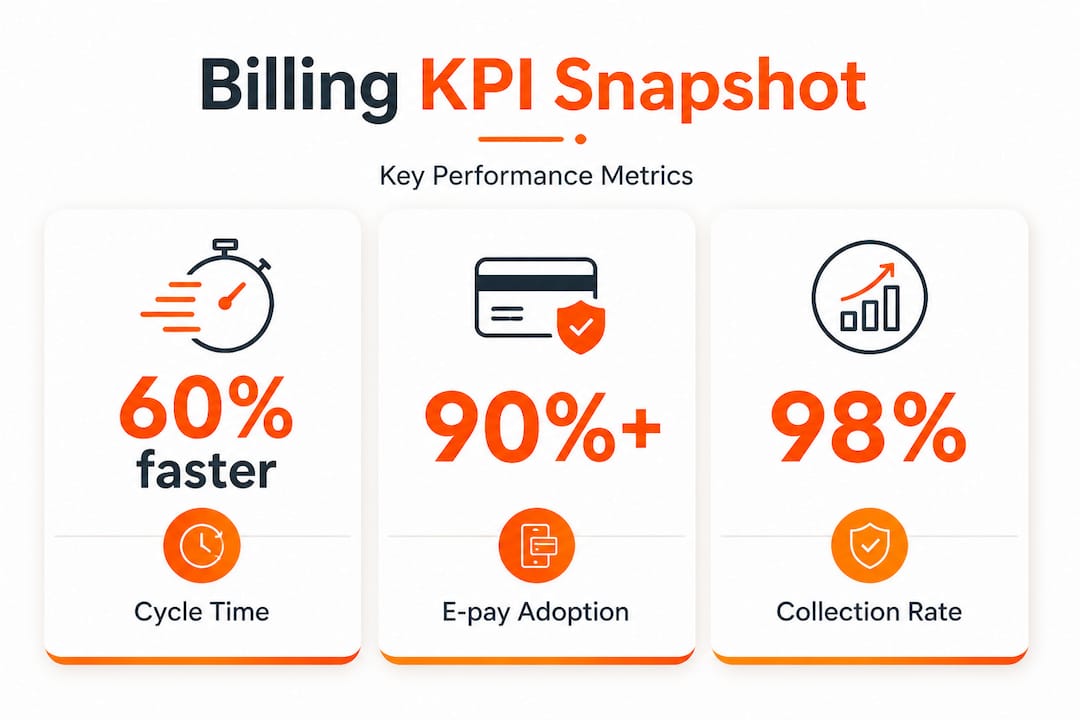
Define your critical KPIs before you launch any new capability, not after. This gives you a baseline and makes it far easier to attribute changes in performance to specific interventions. Industry benchmarks provide useful context: revenue per employee of £150,000 to £290,000 and an operating profit margin of 15 to 26 per cent are typical ranges for well-run P&C billing operations. Days premium outstanding, collection efficiency ratios, electronic payment adoption rates, and lapse rates are your core operational metrics.
| KPI | Definition | Industry benchmark |
|---|---|---|
| Days premium outstanding | Average days from invoice to collection | Under 30 days |
| Collection efficiency | Premiums collected vs. billed | Above 97% |
| Electronic payment adoption | % of payments made electronically | Above 70% |
| Lapse rate | % of policies lapsing due to non-payment | Below 5% |
| Revenue per employee | Total billing revenue divided by billing FTEs | £150k to £290k |
Here is a practical approach to ongoing monitoring:
- Define KPIs and assign ownership before any system change goes live.
- Establish data collection routines by connecting your billing platform to a real-time dashboard.
- Set weekly check-ins on leading indicators such as failed payment volumes and portal login rates.
- Conduct monthly KPI reviews with your full billing team, comparing actuals to targets.
- Run quarterly strategic reviews to assess trends, update benchmarks, and plan the next improvement cycle.
- Document what changed and why, so future teams can learn from the evidence you build.
Proactive metrics tracking prevents small issues from escalating, enabling data-driven optimisations over reactive fixes. This is the difference between a billing operation that continuously improves and one that only reacts when something breaks badly enough to reach the executive team.
Strong KPI monitoring practices are also closely linked to how effectively you can manage the broader policy lifecycle. When billing data is clean and current, it feeds better policy administration decisions around renewals, endorsements, and cancellations.
Rethinking insurance billing: what most managers miss
Here is the uncomfortable truth about billing transformation projects: most of them focus on the wrong thing. Teams spend months evaluating platforms, negotiating vendor contracts, and running technical implementations, then declare success when go-live happens without incident. But go-live is not success. It is the starting line.
The genuine competitive advantage in billing operations does not come from having the newest software. It comes from building a culture of measurement-led iteration. Insurers who treat their billing KPIs as living performance signals, adjusting processes, communications, and workflows based on what the data shows each month, consistently outperform those who treat modernisation as a one-time project.
Proactive metrics tracking prevents small issues from escalating. But the deeper point is this: the insurers who monitor closely are also the ones who catch the early signals of changing customer behaviour, new payment preferences, and emerging lapse patterns. They are the ones who respond in weeks rather than quarters.
The second thing most managers miss is the competitive signal embedded in customer-facing transparency. When a policyholder can log in, see exactly what they owe, why it changed, and update their payment details in under two minutes, that experience shapes their perception of your brand as much as any claims interaction. Benchmarking your billing experience only against other insurers sets a low bar. The policyholders you serve compare your portal to their bank, their energy provider, and their streaming service. That is the standard worth targeting.
Pro Tip: Review advanced optimisation tips and then benchmark your billing NPS against customer experience leaders outside insurance. The gap is often surprising and always instructive.
The most successful billing transformations we have seen combine a rigorous metrics framework with an iterative mindset. They do not attempt to fix everything at once. They pick the highest-impact KPI, run a focused intervention, measure the result, and move on to the next. Continuous small improvements, grounded in data, outperform large-scale overhauls almost every time. Explore how a platform-led approach makes this kind of iterative progress structurally easier by reducing the cost of change across your core systems.
Transform your billing operation with expert support
Turning these strategies into operational reality requires more than a good plan. It requires the right platform and the right implementation partner working alongside your team. At IBA, IBSuite is built specifically to support P&C insurers through exactly this journey, from billing automation and self-service portals through to real-time KPI monitoring and seamless payment gateway integrations. If you want to see these capabilities in action, including how smart retries, embedded payments, and self-service billing portals perform in a live environment, we would be glad to show you. Arrange a tailored demonstration with our team and walk away with a clear picture of what your billing operation could look like within your own technology landscape.
Frequently asked questions
What is the fastest way to reduce billing cycle times for insurers?
Integrating payment gateways and automating retry logic can cut processing time by up to 60%, as collections no longer depend on manual posting or follow-up calls.
How do self-service billing portals impact customer support workload?
Self-service portals allow policyholders and agents to view bills, update payment details, and manage plans independently, directly reducing inbound query volumes and improving satisfaction scores.
Which KPIs should a billing operations manager monitor?
Track days premium outstanding, collection efficiency, electronic payment adoption, revenue per employee, and lapse rates as your core billing performance indicators.
Can small insurers achieve the same billing efficiency gains as larger firms?
Yes. Embedded payment gains including lower costs, faster cash flow, and reduced manual tasks are available to insurers of all sizes, as cloud-native platforms scale to fit smaller operational environments just as effectively.
How often should insurance billing KPIs be reviewed?
KPIs such as collection efficiency and electronic payment adoption should be reviewed at least monthly, with quarterly strategic reviews to identify longer-term trends and plan the next optimisation cycle.