07.04.26
Billing automation guide: streamline insurance operations

TL;DR:
- Billing automation reduces errors by up to 70% and lowers operational costs.
- Successful implementation requires deep process redesign and strong cross-team collaboration.
- Key KPIs include Days Premium Outstanding, straight-through processing rates, and e-payment adoption.
Manual billing in property and casualty insurance is a quiet drain on performance. Errors compound, payments stall, and policyholders grow frustrated with processes that feel decades old. Billing automation can reduce errors by up to 70% and is strongly preferred by customers who expect digital-first experiences. This guide walks P&C insurance executives and technology leaders through the business case, core components, implementation roadmap, common pitfalls, and the metrics that prove success. Whether you are planning your first automation project or refining an existing one, what follows is a practical framework built for the realities of modern insurance operations.
Table of Contents
- Why billing automation matters for P&C insurers
- Core components and tools for billing automation
- Step-by-step: Implementing automated billing workflows
- Troubleshooting and compliance: Navigating pitfalls
- Measuring success: KPIs and business impact
- What most insurers get wrong about billing automation
- Accelerate your insurance billing transformation
- Frequently asked questions
Key Takeaways
| Point | Details |
|---|---|
| Error reduction possible | Billing automation can reduce manual errors by up to 70% in P&C insurance. |
| Customer preferences | 83% of insurance customers favour digital payment options, making automation vital. |
| Integration essentials | Seamless billing automation requires integration with policy admin, claims, and finance systems. |
| Stepwise rollout works best | Phased implementations and thorough testing avoid pitfalls and maximise results. |
| Continuous optimisation needed | Regularly monitor KPIs and adapt to ongoing regulatory and business changes. |
Why billing automation matters for P&C insurers
Manual billing workflows carry a cost that rarely appears on a single line in your accounts. It shows up in staff overtime, rework after errors, delayed cash collection, and policyholders who lapse because a payment reminder never arrived. These are not edge cases. They are systemic problems that compound as your book of business grows.
The numbers make the case plainly. Automation reduces billing errors by up to 70%, lowers operating costs, and 83% of insurers’ customers prefer digital payment options. That last figure matters enormously for retention. When customers cannot pay the way they want, they find a carrier who lets them.
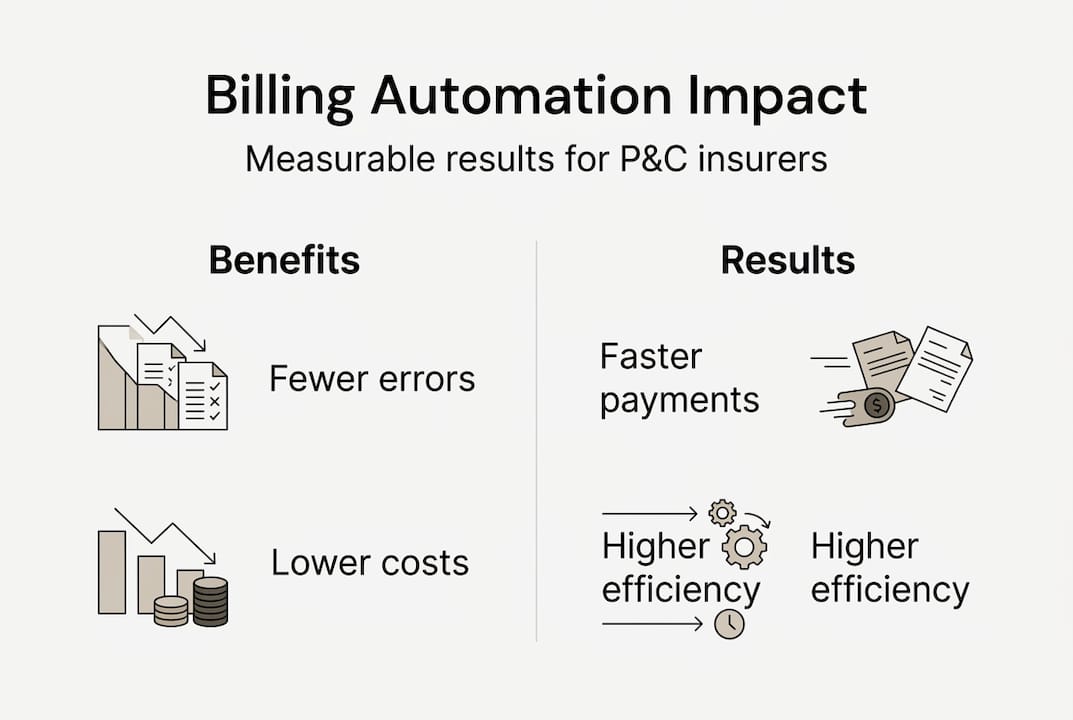
Beyond the customer experience, consider the billing process impact on your operations team. Manual reconciliation, paper invoicing, and phone-based payment collection consume hours that could be redirected to exception handling and strategic work. Automation does not simply speed up what already exists. It changes the nature of the work entirely.
Here are the key business benefits that make automation a board-level conversation:
- Reduced error rates: Automated rules engines eliminate manual keying mistakes and misapplied payments
- Lower operating costs: Straight-through processing (STP) cuts the labour required per transaction significantly
- Improved compliance: Automated audit trails and configurable rules support multi-jurisdictional regulatory requirements
- Faster cash collection: Automated reminders and retry logic reduce days premium outstanding (DPO)
- Higher customer retention: Self-service portals and flexible payment options reduce friction-driven lapses
- Scalability: Automated workflows handle volume spikes without proportional headcount increases
“The real cost of manual billing is not just the errors you catch. It is the customers you lose before you realise anything went wrong.”
For insurance executives, the business case is not theoretical. It is measurable, and the benchmarks are now well established across the industry.
Core components and tools for billing automation
Knowing why automation matters is one thing. Knowing what you actually need to build it is another. Billing automation requires integration with policy administration, general ledger, and claims systems to create a seamless workflow. Without these connections, you are automating fragments rather than the full billing cycle.
The table below outlines the core components, their function, and the key integration considerations for each.
| Component | Function | Integration consideration |
|---|---|---|
| Policy administration | Source of truth for premium, coverage, and endorsements | Real-time sync required for mid-term changes |
| General ledger | Financial sub-ledger reconciliation and reporting | Automated journal entries on payment events |
| Claims system | Offset billing against claims payments where applicable | Bidirectional data flow for accurate balances |
| Payment gateway | Processes card, ACH, and direct debit transactions | PCI-DSS compliance and retry logic essential |
| CRM | Customer communication and self-service portal | Triggers for reminders, confirmations, and escalations |
Beyond the integrations, the architecture itself matters. A flexible rules engine lets you configure billing plans, instalment schedules, and dunning sequences (the automated process of chasing overdue payments) without custom development for every product line. API-first design ensures that as your ecosystem evolves, new tools can connect without rearchitecting the core.
Must-have technologies for a scalable billing automation rollout include:
- API-first billing engine with configurable instalment and payment plan logic
- Real-time event processing for policy changes that affect premium mid-term
- Automated dunning and retry workflows for failed payments
- Digital self-service portal for policyholders to manage payment methods and view statements
- Audit logging for regulatory compliance and dispute resolution
For billing process efficiency, your policy administration tools and claims management integration must operate as a unified system, not separate silos passing files overnight.

Pro Tip: Insurance billing has unique requirements that generic accounts receivable platforms were not designed to handle. Start with an insurance-specific platform that already understands endorsements, pro-rata calculations, and regulatory variance. Retrofitting a generic tool costs far more in time and customisation than choosing the right platform from the outset.
Step-by-step: Implementing automated billing workflows
A clear sequence prevents the most common implementation failures. Best practice favours phased rollouts, starting with simpler policy types and engaging cross-functional teams throughout. Here is a practical roadmap.
- Assess and prepare: Audit your current billing data quality, map existing workflows, and identify integration points. Assign a cross-functional project team including finance, IT, operations, and compliance.
- Define requirements: Document billing rules, instalment options, payment methods, dunning logic, and regulatory constraints for each product line and jurisdiction.
- Select your platform: Evaluate insurance-specific platforms against your requirements. Prioritise API flexibility, configurability, and vendor track record with P&C carriers.
- Run a pilot: Choose a single, lower-complexity product line. Configure, test, and validate against real billing scenarios before expanding.
- Phased rollout: Expand to additional product lines incrementally, incorporating lessons from the pilot. Maintain parallel processing briefly to catch discrepancies.
- Governance and optimisation: Establish ongoing monitoring, KPI tracking, and a regular review cadence to refine rules and address emerging edge cases.
The choice between a phased rollout and a big-bang approach is worth examining carefully.
| Approach | Advantages | Risks |
|---|---|---|
| Phased rollout | Lower risk, faster learning, easier rollback | Longer overall timeline, temporary complexity |
| Big-bang | Single cutover, uniform experience from day one | High risk, difficult to isolate issues, staff strain |
For most P&C carriers, phased rollout is the safer path. The automation benefits compound over time, and a controlled expansion protects both data integrity and customer experience during transition. Refer to billing process guidance for additional sequencing detail.
Pro Tip: Before go-live on any phase, run your automated workflows against a full set of real historical billing scenarios, including edge cases like mid-term cancellations, partial payments, and reinstatements. Surprises in production are far more costly than surprises in testing.
Troubleshooting and compliance: Navigating pitfalls
Even well-planned automation projects encounter problems. Knowing what to expect reduces the time you spend firefighting and increases the time you spend improving.
Common pitfalls in P&C billing automation include:
- Poor data quality: Legacy systems often contain duplicate records, inconsistent formats, and missing fields. Data cleansing before migration is not optional.
- Change management gaps: Staff who relied on manual processes need retraining and clear communication about new workflows. Resistance is predictable; plan for it.
- Failed payment handling: Automated dunning must be configured carefully. Overly aggressive retry logic can trigger bank flags; too passive and you lose premium.
- Regulatory variance: Different jurisdictions have different rules on instalment fees, notice periods, and cancellation procedures. These must be embedded in your rules engine, not managed manually.
- Legacy system integration failures: Older policy admin systems may not support real-time APIs. Middleware or event-driven architecture may be required.
Complex commercial policies and legacy systems present unique challenges that require configurable rules and deep integration. Compliance must be embedded throughout, not bolted on afterwards.
“Generic automation platforms treat insurance billing like any other accounts receivable process. The moment you encounter a mid-term endorsement on a commercial package policy, that assumption falls apart entirely.”
Consider a practical example. A commercial property insurer adds a new location to an existing policy mid-term. The billing system must calculate pro-rata additional premium, generate a revised invoice, update the instalment schedule, and notify the policyholder, all automatically and in compliance with the applicable jurisdiction’s notice requirements. Embed regulatory compliance in your automation rules logic from the start, particularly for multi-jurisdictional operations.
Ongoing optimisation matters as much as the initial build. Schedule quarterly reviews of exception reports, failed payment rates, and customer complaints to identify rules that need adjustment as your product mix and regulatory environment evolve. Review compliance in billing requirements regularly to stay current.
Measuring success: KPIs and business impact
Automation without measurement is just activity. The goal is demonstrable, quantifiable improvement. With proper implementation, up to 70% error reduction and 83% digital payment adoption are achievable benchmarks for P&C carriers.
The KPIs that matter most for billing automation include:
- Days premium outstanding (DPO): Measures how quickly premium is collected after billing. Lower is better.
- Straight-through processing (STP) rate: The percentage of transactions completed without manual intervention. Target above 85% for mature programmes.
- E-payment adoption rate: Tracks the shift from cheque and manual payments to digital channels.
- Lapse rate due to payment failure: Isolates involuntary lapses caused by billing friction rather than customer intent to cancel.
- Billing error rate: Tracks incorrect invoices, misapplied payments, and reconciliation discrepancies.
- Customer satisfaction score (CSAT) for billing interactions: Measures the policyholder experience directly.
Track DPO, e-payment adoption, lapse rates, and STP as your primary indicators of automation health. High STP rates and growing digital payment adoption are the clearest signals that your project is delivering.
Building a regular audit cadence into your governance model ensures you catch drift early. Billing rules that worked well at launch may need adjustment as new products launch, regulations change, or customer behaviour shifts. Review your billing optimisation tips regularly and treat automation as a living system rather than a one-time deployment.
What most insurers get wrong about billing automation
The most common mistake we see is treating billing automation as a technology project rather than a business transformation. Executives approve a platform, IT deploys it, and six months later the error rates have barely moved. The technology worked. The transformation did not.
True automation success requires redesigning the underlying processes before you automate them. Automating a broken workflow produces broken results faster. Executives often mistake automation for simple tech deployment, ignoring the deep process changes required to realise the full benefit.
Cross-silo collaboration is equally underestimated. Finance, operations, IT, and compliance each own a piece of the billing workflow. When they are not aligned on requirements and governance, the automation serves one team well and creates problems for the others. The technology is rarely the bottleneck. Stakeholder alignment almost always is.
Post-go-live governance is where most programmes quietly lose momentum. The teams move on to the next project, and the billing automation runs without oversight until a significant failure surfaces. Sustained improvement requires sustained attention. Explore how AI in insurance automation is extending what is possible for carriers who have already built strong automation foundations.
Accelerate your insurance billing transformation
If you are ready to move beyond manual billing and build a genuinely automated, compliant, and customer-friendly billing operation, IBSuite is designed for exactly this challenge. IBA’s policy administration solution and claims management solution are built to work together as part of a unified, API-first platform that supports the full P&C insurance value chain. From configurable billing rules to real-time payment processing and regulatory compliance, IBSuite gives your team the tools to automate with confidence. Book a demo to see how IBSuite handles real-world billing complexity and delivers measurable results from day one.
Frequently asked questions
What are the key KPIs for billing automation in P&C insurance?
Track DPO, e-payment adoption, lapse rates, and STP as your primary performance indicators, with high STP rates and growing digital adoption signalling a successful programme.
How does automation improve customer experience for P&C insurers?
Automation enables self-service portals, flexible payment options, and automated retry logic that reduces churn from payment friction, making billing a retention tool rather than a liability.
What is a common pitfall when implementing billing automation?
Insufficient data cleansing and rushed timelines are the most frequent causes of integration failure; a phased, insurance-specific approach significantly reduces this risk.
What systems must billing automation integrate with?
Billing automation must connect with policy administration, general ledger, claims, and payment systems to support a seamless, end-to-end workflow.
What error reduction can you expect from billing automation?
Insurers that implement automation properly can achieve up to 70% error reduction compared to manual billing workflows, alongside significantly lower operating costs.
Recommended
- What is insurance billing automation? P&C benefits 2026
- Insurance Billing Processes Explained: Complete Guide – Digital Insurance Platform | IBSuite Insurance Software | Modern Insurance System
- Understanding the insurance billing process for efficiency
- Insurance CRM workflow guide for P&C firms: cut costs 65%