04.03.26
Insurance marketplace models 2026: 50% faster launches

By 2026, over 70% of insurers are modernising core systems to escape legacy constraints. Insurance marketplace models now define competitive advantage for P&C insurers across Central Europe. Cloud-native platforms, API-first architecture, and AI automation deliver measurable gains in speed, cost, and customer satisfaction. This article explores how modern marketplace models accelerate digital transformation, streamline operations, and enhance regulatory compliance for insurers seeking operational excellence.
Table of Contents
- Introduction To Insurance Marketplace Models
- Technological Evolution: From Legacy Systems To Cloud-Native Platforms
- Role Of Api-First Architecture In Integration And Product Innovation
- Impact Of Ai And Automation In Underwriting And Claims Processing
- Regulatory Compliance Challenges And Solutions In Central Europe
- Operational Benefits And Efficiency Gains From Modern Marketplaces
- Customer Experience Improvements And Market Adaptation
- Common Misconceptions About Insurance Marketplace Models
- Conclusion And Practical Recommendations For Insurers
- Discover Modern Insurance Platforms Designed For Your Success
Key takeaways
| Point | Details |
|---|---|
| Cloud-native platforms | Reduce product launch time by up to 50% through microservices and rapid deployment capabilities. |
| API-first architecture | Cuts integration project time by 30% enabling faster ecosystem connections. |
| AI automation | Enhances underwriting speed and claims accuracy whilst reducing operational costs significantly. |
| Regulatory compliance | DORA and Solvency II frameworks drive secure innovation rather than stifling it. |
| Customer expectations | Over 65% of European policyholders demand seamless omnichannel service from insurers. |
Introduction to insurance marketplace models
Insurance marketplace models are integrated digital platforms enabling product distribution, underwriting, claims processing, and partner ecosystem management. These platforms serve as the operational backbone for P&C insurers navigating digital transformation.
For insurance executives, marketplace models represent strategic infrastructure. They determine how quickly you launch products, how efficiently you process claims, and how effectively you meet customer expectations. In 2026, competitive agility depends on platform architecture.
Several market forces drive marketplace evolution. Digital customer expectations demand instant quotes and transparent pricing. Regulatory complexity requires real-time compliance monitoring. Cost pressures force operational efficiency improvements. Omnichannel distribution models necessitate seamless partner integrations.
Key trends shaping insurance marketplace models include:
- Shift from monolithic legacy systems to modular cloud-native platforms
- API-first design enabling rapid third-party integrations
- AI-driven automation reducing manual processing workloads
- Embedded insurance expanding distribution beyond traditional channels
- Real-time data analytics informing underwriting and pricing decisions
These trends converge to create marketplace models that balance innovation speed with regulatory compliance. Insurers adopting modern platforms gain measurable advantages in time-to-market, operational cost, and customer satisfaction metrics.
Technological evolution: from legacy systems to cloud-native platforms
Legacy insurance systems create substantial barriers to innovation. Monolithic architectures resist change. Integration projects stretch across months. Maintenance consumes IT budgets. Legacy core systems are frequently cited as barriers to operational efficiency, with inflexible designs and high maintenance costs driving modernisation investments.
Cloud-native platforms solve these limitations through fundamentally different architecture. Microservices modularity allows independent component updates. Elastic scaling adjusts resources to demand. Lower infrastructure complexity reduces IT overhead. Cloud-native insurance platforms accelerate product launch times by up to 50% by enabling rapid configuration through microservices and API-first design.
API-first design amplifies these benefits. Standardised interfaces simplify integrations with distribution partners, data providers, and regulatory systems. Pre-built connectors reduce custom development. Version management maintains stability during platform evolution.
| Attribute | Legacy Systems | Cloud-Native Platforms |
|---|---|---|
| Architecture | Monolithic, tightly coupled | Microservices, modular |
| Deployment speed | Months for major changes | Days or weeks for new products |
| Integration approach | Custom point-to-point | Standardised API connections |
| Scaling capability | Fixed capacity, manual upgrades | Elastic, automatic scaling |
| Maintenance cost | High, dedicated resources | Lower, shared services |
Modern cloud-native insurance platforms deliver measurable improvements. Product launches accelerate. Integration complexity decreases. Operational costs decline. These platforms support innovation velocity required in competitive markets.

Pro Tip: Prioritise modular, API-first platforms to shortcut integration complexity and accelerate time-to-market for new products.
For further reading on modernisation trends, see the OECD insurance modernisation report.
Role of API-first architecture in integration and product innovation
API-first architecture transforms how insurers connect with partners and deploy products. Rather than custom integrations for each relationship, standardised APIs create reusable connections. This approach delivers speed and consistency across ecosystem interactions.
API-first design in insurance platforms enables seamless integration with digital distribution channels, third-party data providers, and partner ecosystems. Integration project time drops 30% compared to traditional custom development approaches.
Rapid product iteration becomes feasible with API-based architectures. Insurers configure new offerings using existing platform services. Testing cycles shorten. Deployment risks decrease. Market feedback loops accelerate product refinement.
Key integration benefits include:
- Ecosystem connectivity enabling multi-channel distribution without custom builds
- Real-time data access from credit bureaus, weather services, and IoT devices
- Product scalability supporting rapid market expansion
- Partner onboarding measured in weeks rather than months
- Consistent security and compliance across all integrations
Practical API use cases in P&C marketplaces demonstrate versatility. Distribution partners access quoting and policy issuance through standardised interfaces. Claims systems integrate with repair networks and medical providers. Underwriting engines pull risk data from multiple external sources simultaneously.
API-first core insurance platforms support innovation velocity required in competitive markets. They reduce technical debt whilst expanding capability. Insurers gain flexibility without sacrificing stability.
For regulatory context, review the EIOPA 2025 report on digital infrastructure requirements.
Impact of AI and automation in underwriting and claims processing
AI and automation technologies deliver measurable improvements in underwriting speed, claims accuracy, and operational cost for insurance marketplaces. These tools augment human expertise rather than replacing it.
Operational improvements manifest across key processes. Underwriting decisions that required days now complete in minutes. Claims triage identifies complex cases requiring human review whilst automating straightforward approvals. Error rates decline through consistent rule application.
Cost savings accumulate from reduced manual handling. Fewer staff hours per transaction. Lower error correction costs. Faster cycle times improving customer satisfaction. AI-driven automation reduces operational expenses whilst improving decision accuracy across P&C processes.
Practical AI applications include:
- Risk scoring engines analysing hundreds of variables in seconds
- Fraud detection identifying suspicious patterns across claims data
- Claims automation routing straightforward cases to instant approval
- Natural language processing extracting structured data from unstructured documents
- Predictive analytics forecasting loss trends to inform pricing
These applications deliver tangible business value. Risk scoring improves underwriting profitability by 15-25%. Fraud detection prevents losses totalling millions annually. Automation in claims processing reduces cycle time by 40-60% for routine cases.
The combination of AI and automation in P&C insurance creates competitive differentiation. Insurers process higher volumes with consistent quality. Customer satisfaction improves through faster service. Operating ratios benefit from lower expense bases.
Pro Tip: Combine AI with human expertise for optimal decision quality. Use automation for routine cases whilst directing complex scenarios to experienced underwriters and adjusters.
For industry analysis on AI adoption, see the Morgan Philips report on AI in insurance.
Regulatory compliance challenges and solutions in Central Europe
Regulatory compliance shapes insurance marketplace design across Central Europe. Requirements extend beyond traditional solvency rules to encompass operational resilience and data protection.
Compliance with the Digital Operational Resilience Act (DORA) and evolving Solvency II requirements necessitates marketplace models built for secure data exchange and real-time risk monitoring. These frameworks set minimum standards for system reliability, incident response, and third-party risk management.
Modern marketplace platforms address compliance through embedded capabilities. Secure data exchange protocols protect customer information. Real-time monitoring identifies operational anomalies before they escalate. Audit trails document decision processes for regulatory review.
Key compliance challenges and marketplace responses include:
- Data residency requirements addressed through regional cloud deployment options
- Incident reporting obligations met via automated monitoring and alerting systems
- Third-party risk management supported by API security controls and vendor assessments
- Business continuity planning enabled through redundant infrastructure and failover capabilities
- Regulatory reporting automated via pre-configured templates and data extraction tools
Compliance becomes an innovation enabler when embedded early in platform architecture. Insurers meeting regulatory standards gain customer trust. They access new markets confidently. They avoid costly remediation projects.
Embracing compliance through next-generation insurance platforms positions insurers for sustainable growth. Regulatory alignment supports rather than constrains innovation.
For detailed compliance requirements, review DORA and Solvency II compliance guidance.
Operational benefits and efficiency gains from modern marketplaces
Modern insurance marketplace models deliver quantifiable operational improvements. These gains manifest in streamlined workflows, reduced manual processing, and lower IT complexity.
Operational improvements include faster policy issuance cycles, automated premium calculations, and integrated document management. Claims workflows route cases efficiently. Commission calculations complete automatically. Renewal processes require minimal manual intervention.
IT maintenance and complexity costs decline substantially. Cloud infrastructure eliminates hardware refresh cycles. Automated updates reduce manual patching. Consolidated platforms replace fragmented systems.
| Metric | Legacy Systems | Cloud-Native API-First Platforms |
|---|---|---|
| Product launch time | 6-12 months | 2-8 weeks |
| Integration duration per partner | 3-6 months | 2-4 weeks |
| Annual IT maintenance cost | 20-30% of platform value | 10-15% of platform value |
| System availability | 95-97% | 99.5-99.9% |
| Manual processing rate | 40-60% of transactions | 10-20% of transactions |
Efficiency gains accumulate across multiple dimensions:
- IT cost savings from consolidated infrastructure and reduced maintenance
- Increased productivity through automation of routine tasks
- Improved scalability supporting business growth without proportional cost increases
- Enhanced data quality from integrated systems eliminating duplicate entry
- Faster decision cycles enabling market responsiveness
Operational efficiency with API-first platforms transforms cost structures. Fixed expenses decline. Variable costs scale with volume. Margins improve through operational leverage.
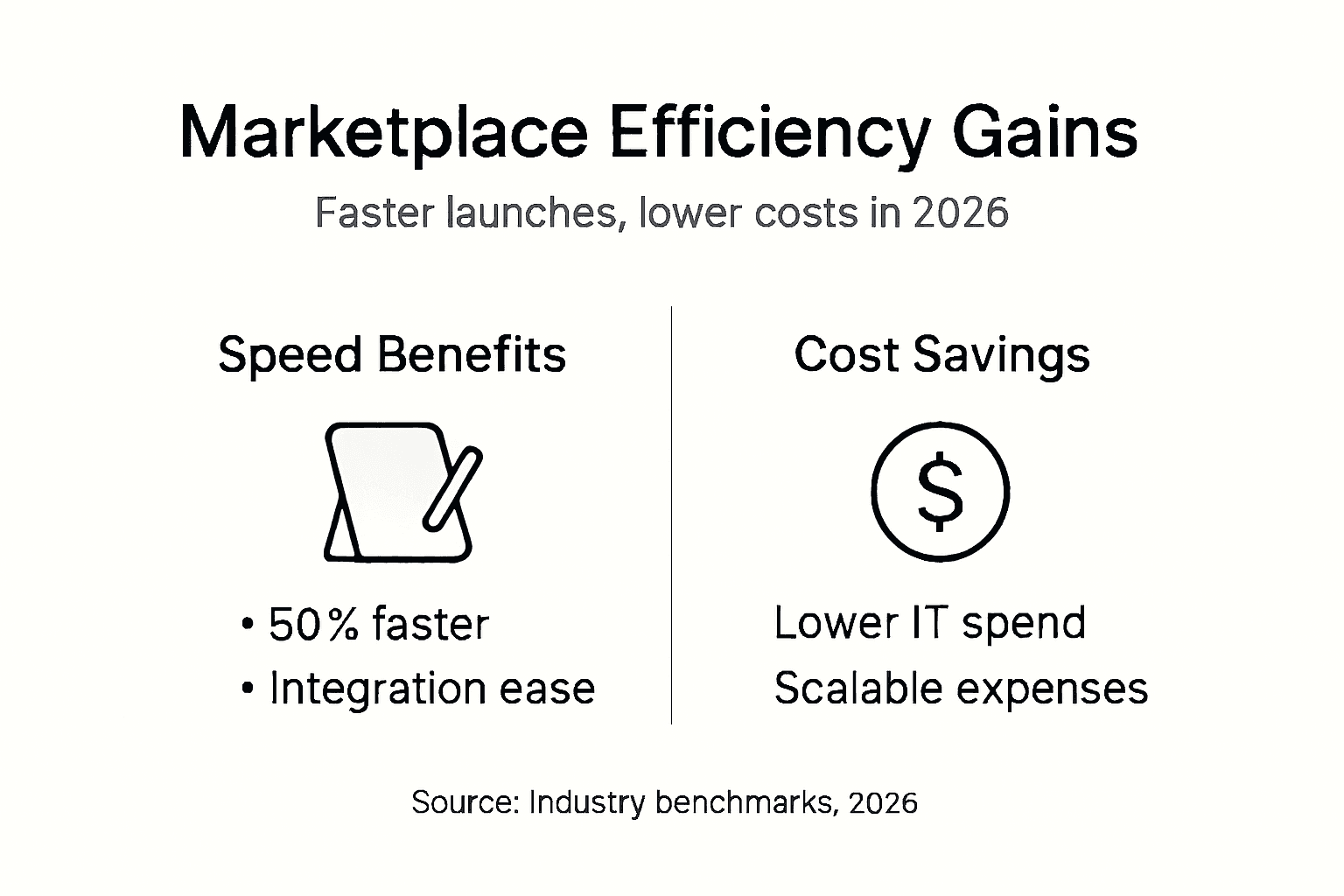
The benefits of modern insurance platforms extend beyond immediate cost savings. Improved agility enables faster market adaptation. Better data visibility supports strategic decision-making. Enhanced customer experience drives retention.
Pro Tip: Invest in holistic platform redesign rather than piecemeal upgrades to realise full efficiency gains and avoid integration complexity.
Customer experience improvements and market adaptation
Customer expectations drive insurance marketplace evolution. Digital natives demand instant quotes, transparent pricing, and omnichannel service. Traditional distribution models no longer satisfy these requirements.
Over 65% of European policyholders demand seamless omnichannel service from insurers. They expect consistent experiences across web, mobile, agent, and phone channels. Marketplace models enabling this consistency gain competitive advantage.
Embedded insurance and integrated digital ecosystems improve cross-sell rates by 15-20% by offering tailored products at point of need. Purchase journeys shorten. Conversion rates increase. Customer lifetime value grows.
Modern marketplace models enable personalised, transparent, and interactive customer experiences. Real-time pricing reflects individual risk profiles. Self-service portals allow policy modifications without agent intervention. Mobile apps provide instant proof of coverage.
Customer experience benefits include:
- Quick quotes delivered in seconds rather than hours
- Multi-channel support maintaining context across touchpoints
- Product relevance through personalised recommendations
- Transparent pricing explaining premium calculations
- Instant policy changes without paperwork delays
These improvements translate to business outcomes. Customer acquisition costs decline. Retention rates improve. Net promoter scores increase. Digital-first insurers capture market share from traditional competitors.
Market adaptation requires continuous platform evolution. Customer preferences shift. New channels emerge. Competitive offerings raise expectations. Marketplace models built on flexible architecture adapt quickly.
For customer expectation trends, see the EIOPA customer expectations report and BCG report on embedded insurance.
Common misconceptions about insurance marketplace models
Several misconceptions limit insurer adoption of modern marketplace models. Addressing these misunderstandings accelerates transformation initiatives.
Misconception 1: Digital transformation is just a technology upgrade. Digital transformation requires holistic business model redesign incorporating customer-centric strategies. Technology enables change but doesn’t define it. Successful transformations align operating models, distribution strategies, and product portfolios with platform capabilities.
Misconception 2: AI replaces human underwriters and adjusters. AI augments human expertise rather than replacing it. Automation handles routine decisions freeing experienced staff for complex cases requiring judgement. The combination delivers superior outcomes compared to either approach alone.
Misconception 3: Regulatory compliance stifles innovation. Compliance frameworks drive secure, sustainable innovation. Marketplace models meeting regulatory standards gain customer trust and market access. Compliance becomes competitive advantage rather than constraint.
Key corrections include:
- Digital transformation requires cultural change and process redesign beyond technology implementation
- AI and automation complement human expertise by handling routine work efficiently
- Regulatory compliance enables innovation through standardised security and governance frameworks
- Cloud-native platforms reduce rather than increase operational complexity
- Modern marketplace models support traditional distribution whilst enabling new channels
Regulatory frameworks like DORA and Solvency II establish foundations for innovation by ensuring operational resilience and customer protection. Insurers viewing compliance as enabler rather than burden gain strategic advantage.
Clearing these misconceptions removes barriers to modernisation. Insurance executives gain realistic expectations. Transformation initiatives focus on strategic business outcomes rather than technology specifications alone.
Conclusion and practical recommendations for insurers
Insurance marketplace models determine competitive position for P&C insurers in 2026. Cloud-native platforms, API-first architecture, and AI automation deliver measurable improvements in speed, cost, and customer satisfaction.
Key learnings emphasise technology as enabler of business transformation. Legacy constraints limit innovation velocity. Modern architectures remove these barriers whilst embedding compliance and security. Customer expectations require digital-first experiences across channels.
Practical recommendations for insurance executives:
- Prioritise cloud-native API-first platforms providing scalability and regulatory compliance foundations.
- Invest strategically in AI and automation for underwriting and claims processes to improve efficiency.
- Align compliance strategy with innovation goals viewing regulations as enablers rather than constraints.
- Maintain customer-centric marketplace design ensuring seamless omnichannel experiences.
- Plan holistic transformation rather than piecemeal upgrades to maximise efficiency gains.
- Engage experienced platform providers with proven P&C expertise to accelerate implementation.
Successful marketplace transformation balances innovation speed with operational stability. Insurers adopting modern platforms gain flexibility without sacrificing reliability. They respond to market changes quickly whilst maintaining regulatory compliance and customer trust.
Discover modern insurance platforms designed for your success
IBSuite delivers cloud-native, API-first platform capabilities supporting P&C insurers across digital transformation journeys. Our solutions embed AI and automation whilst ensuring compliance with Central European regulatory requirements including DORA and Solvency II.
Explore how modern insurance platform benefits apply to your organisation. See how API-first core insurance platforms accelerate product innovation and ecosystem integration.
Ready to modernise your insurance marketplace model? Book a demo to discuss tailored solutions for your digital transformation requirements.
Frequently asked questions
What are insurance marketplace models?
Insurance marketplace models are integrated digital platforms enabling product distribution, underwriting, claims processing, and partner ecosystem management. They serve P&C insurers by supporting multi-channel access and rapid product innovation whilst maintaining operational efficiency.
How do cloud-native platforms improve insurance marketplaces?
Cloud-native platforms enable modular microservices architecture, faster product deployment, and easier third-party integrations. They support rapid product launches reducing time-to-market by up to 50% whilst lowering operational costs through elastic scaling and reduced IT complexity.
What role does AI play in modern insurance marketplaces?
AI accelerates underwriting and claims decisions, reduces processing errors, and cuts operational costs significantly. It complements human expertise by handling routine cases efficiently whilst directing complex scenarios requiring judgement to experienced professionals for optimal decision quality.
How does regulatory compliance impact insurance marketplace design?
Compliance ensures secure data handling, operational resilience, and real-time risk management across marketplace operations. It supports innovation by fostering customer trust and operational stability rather than constraining capability. Modern platforms embed compliance requirements enabling insurers to meet regulatory standards efficiently.
What are common pitfalls in modernising insurance marketplace models?
Underestimating integration complexity and neglecting customer experience design are frequent errors. Piecemeal upgrades create technical debt rather than solving underlying architectural limitations. Early compliance engagement and modular platform selection mitigate these risks whilst accelerating transformation timelines.
Recommended
- Insurance Product Launch Steps for Fast Market Success – Digital Insurance Platform | IBSuite Insurance Software | Modern Insurance System
- How Insurers Can Launch Digital Products Fast – Digital Insurance Platform | IBSuite Insurance Software | Modern Insurance System
- Modern Insurance Platforms: What to look for – Digital Insurance Platform | IBSuite Insurance Software | Modern Insurance System
- Insurance Market Trends 2026: Accelerating P&C Innovation