12.02.26
Insurance Market Trends 2025 – Impact on P&C Insurers

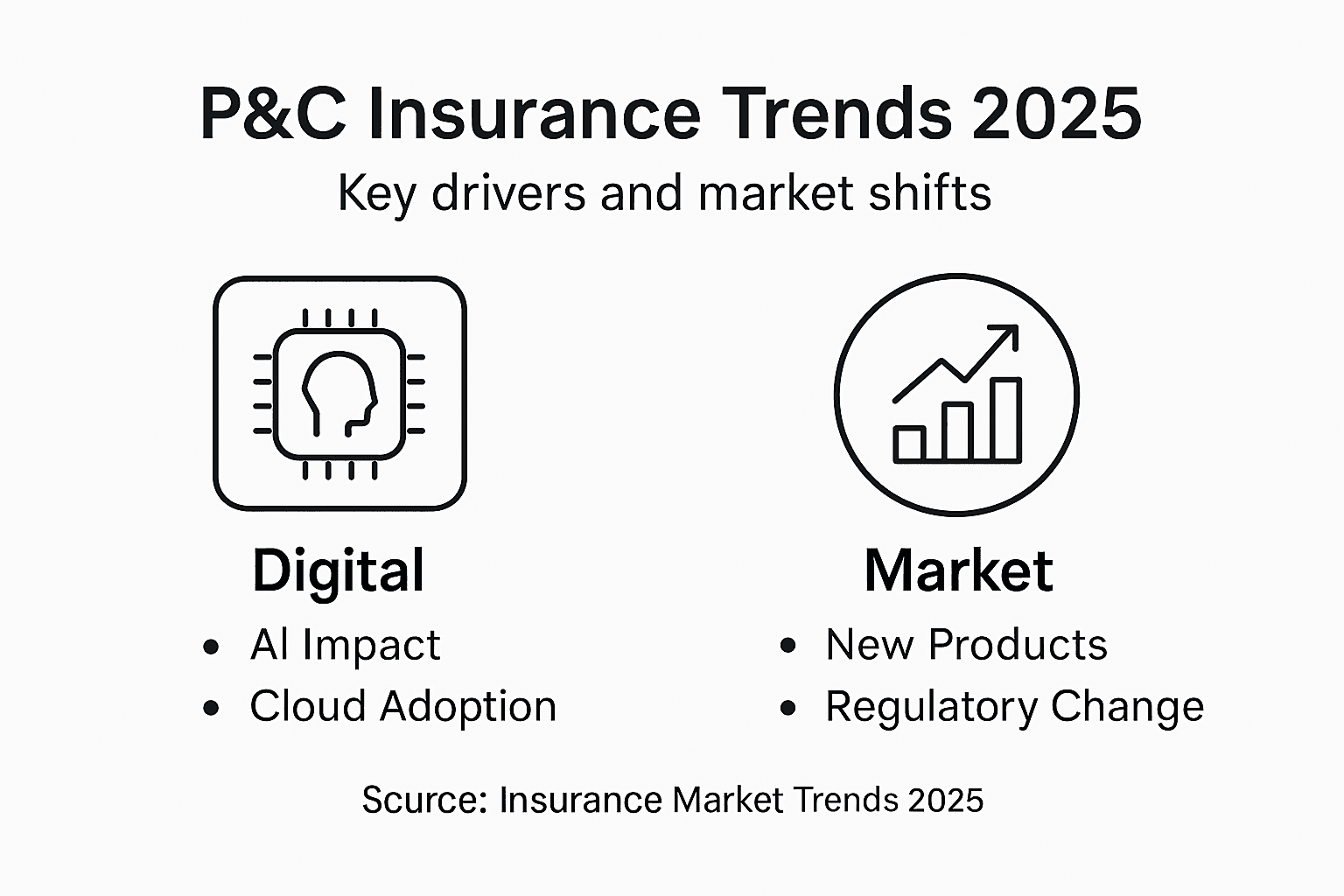
Facing mounting pressure from rapid technological innovation and evolving regulatory frameworks, Property and Casualty insurance leaders across Central Europe know that 2025 will demand more than traditional thinking. The shift to data-driven ecosystem platforms is transforming how insurers assess risk, personalise products, and strengthen customer relationships. This article explores the strategic market trends and digital transformation drivers reshaping policy development and customer engagement as the European insurance sector enters a new era of competition and complexity.
Table of Contents
- Defining Insurance Market Trends 2025
- Key Digital Transformation Drivers In P&C
- Shifting Distribution Models And Partnerships
- Regulatory Changes Shaping Central Europe
- Customer Expectations And Product Innovation
- Risks, Compliance, And Competitive Strategies
Key Takeaways
| Point | Details |
|---|---|
| Technological Integration is Crucial | Insurers must adopt advanced digital platforms to enhance risk assessment and customer engagement in the evolving market. |
| Regulatory Adaptation is Imperative | Developing agile compliance strategies is essential as regulatory environments grow more complex and demanding. |
| Customer Expectations are Rising | Insurers need to create personalised and seamless experiences to meet the heightened expectations of policyholders. |
| Strategic Partnerships are Key | Embracing collaborative models with fintech and technology firms will enhance distribution strategies and customer access. |
Defining Insurance Market Trends 2025
The European insurance market is undergoing significant transformation as we approach 2025, driven by complex technological, regulatory, and economic dynamics. Global insurance market trends indicate profound shifts that will reshape how P&C insurers operate and deliver value.
Key market trends emerging in 2025 encompass several critical dimensions:
- Technological Integration: Advanced digital platforms enabling real-time risk assessment
- Regulatory Adaptation: Evolving compliance frameworks across European jurisdictions
- Customer Experience: Heightened expectations for personalised, seamless insurance interactions
- Risk Management: Sophisticated data analytics driving more precise underwriting strategies
The technological landscape is particularly transformative. Insurers are rapidly transitioning from traditional models to data-driven ecosystem platforms that leverage artificial intelligence, machine learning, and comprehensive risk modelling techniques. This shift allows for more granular risk evaluation, dynamic pricing, and proactive customer engagement.
European insurers must embrace technological innovation to remain competitive in the rapidly evolving 2025 market landscape.
Regulatory environments are simultaneously becoming more complex, requiring insurers to develop agile compliance strategies. The OECD’s market analysis highlights increasing regulatory scrutiny around data protection, transparency, and customer rights.
Pro tip: Invest in flexible technology platforms that can rapidly adapt to emerging regulatory and market requirements.
Key Digital Transformation Drivers in P&C
Digital transformation has become a critical imperative for Property and Casualty (P&C) insurers navigating the complex landscape of technological innovation. Global insurance digital strategies are fundamentally reshaping how insurers approach risk management, customer engagement, and operational efficiency.
The primary digital transformation drivers in P&C insurance encompass several interconnected domains:
- Data Analytics: Leveraging big data for sophisticated risk assessment
- Artificial Intelligence: Enhancing underwriting precision and claims processing
- Customer Experience Technologies: Creating personalised, seamless digital interactions
- Automation Platforms: Streamlining operational workflows and reducing manual interventions
Technological advancements are driving unprecedented changes in insurance ecosystems. Generative AI technologies are particularly transformative, enabling insurers to develop more nuanced risk models, predict customer behaviours, and create dynamic pricing strategies that respond in real-time to complex market conditions.

The following table highlights the strategic benefits of key digital transformation drivers for P&C insurers:
| Transformation Driver | Main Benefit | Example Business Impact |
|---|---|---|
| Data Analytics | Enhanced risk assessment | Lower claim ratios and targeted pricing |
| Artificial Intelligence | Precision in underwriting | Faster approvals, reduced error rates |
| Customer Experience Tech | Seamless digital engagement | Increased policyholder retention |
| Automation Platforms | Streamlined processes | Operational cost reduction |
Digital transformation is no longer optional – it’s a fundamental survival strategy for P&C insurers in 2025.
Regulatory landscapes are simultaneously evolving, compelling insurers to adopt more sophisticated digital transformation approaches. These technological integrations not only improve operational efficiency but also enhance compliance mechanisms, data protection protocols, and customer trust.
Pro tip: Prioritise flexible technology platforms that can integrate multiple digital capabilities while maintaining robust security and regulatory compliance.
Shifting Distribution Models and Partnerships
The European insurance distribution landscape is experiencing radical transformation, driven by technological innovation and changing customer expectations. Insurance distribution trends reveal a complex ecosystem of emerging partnership models and digital channels.
Key characteristics of evolving distribution strategies include:
- Hybrid Distribution Channels: Blending digital platforms with traditional agent networks
- Ecosystem Partnerships: Collaborative models with fintech and technology firms
- Direct Sales Capabilities: Expanding digital-first engagement methods
- Third-Party Platform Integration: Leveraging external digital marketplaces
Increasingly, insurers are recognising the strategic importance of digital ecosystem collaboration. This approach enables more flexible, responsive distribution models that can rapidly adapt to changing market dynamics and customer preferences.
Here is a comparison of traditional versus emerging insurance distribution models in 2025:
| Distribution Model | Customer Access | Strategic Advantage |
|---|---|---|
| Traditional Agent Network | Face-to-face interaction | Relationship-driven sales |
| Digital-Only Platforms | 24/7 self-service | Broader market reach |
| Hybrid Channels | Multi-touch engagement | Flexibility and scalability |
| Ecosystem Partnerships | Integrated service access | Cross-industry innovation |
Traditional distribution channels are being systematically reimagined through strategic technological partnerships.
Regulatory environments are compelling insurers to develop more sophisticated distribution partnership strategies. These emerging models must balance innovation with compliance, creating robust mechanisms for customer protection and transparent engagement.
Pro tip: Develop agile partnership frameworks that prioritise technological compatibility, regulatory compliance, and seamless customer experience.
Regulatory Changes Shaping Central Europe
The Central European insurance landscape is experiencing profound regulatory transformations that will fundamentally reshape risk management and operational protocols. Global insurance regulatory developments are introducing sophisticated mechanisms to enhance market stability and consumer protection.
Key regulatory shifts encompass several critical dimensions:
- Solvency II Reforms: Enhanced capital management requirements
- Operational Resilience: Strengthened risk assessment frameworks
- Digital Compliance: Expanded technological governance standards
- Transparency Protocols: Increased reporting and disclosure obligations
The regulatory environment is becoming increasingly complex, demanding insurers develop more sophisticated compliance strategies. These emerging frameworks emphasise dynamic risk management, requiring organisations to implement more agile and technologically integrated governance mechanisms.
Regulatory adaptation is no longer an option but a fundamental strategic imperative for Central European insurers.
Technological innovations are driving significant changes in regulatory approaches, compelling insurers to invest in advanced compliance infrastructures that can seamlessly integrate evolving legal requirements with operational efficiency.
Pro tip: Develop flexible regulatory compliance systems that can rapidly adapt to emerging legal frameworks while maintaining robust risk management protocols.
Customer Expectations and Product Innovation
The landscape of insurance product development is undergoing radical transformation, driven by increasingly sophisticated customer demands and technological capabilities. Global customer insurance trends reveal a fundamental shift towards personalised, flexible, and digitally integrated insurance experiences.
Key customer-driven product innovation dimensions include:
- Personalised Coverage: Tailored insurance packages matching individual risk profiles
- Usage-Based Models: Dynamic pricing reflecting real-time behavioural data
- Digital Integration: Seamless, technology-enabled insurance interactions
- Predictive Risk Management: Proactive protection strategies
The insurance product ecosystem is evolving rapidly, with insurers developing increasingly sophisticated solutions that blend technological innovation with nuanced customer understanding. Emerging products now incorporate advanced data analytics, enabling more precise risk assessment and personalised pricing strategies.
Customer expectations are driving a fundamental reimagination of insurance product design and delivery.
Technological innovations are enabling insurers to develop innovative insurance solutions that respond dynamically to changing customer needs, creating more flexible and responsive insurance ecosystems.
Pro tip: Develop agile product development frameworks that can rapidly prototype and deploy customer-centric insurance solutions.
Risks, Compliance, and Competitive Strategies
The insurance landscape in 2025 demands unprecedented strategic agility, with insurers navigating complex risk environments that transcend traditional operational boundaries. Global insurance risk management strategies are increasingly centred on proactive, technology-enabled approaches.
Key competitive risk and compliance dimensions include:
- Cyber Resilience: Advanced threat detection and mitigation capabilities
- Climate Risk Management: Integrated environmental risk assessment frameworks
- Regulatory Adaptability: Dynamic compliance infrastructure
- Strategic Diversification: Multi-dimensional risk mitigation strategies
Technological innovations are fundamentally reshaping risk management paradigms. Advanced analytics and artificial intelligence are enabling insurers to develop more sophisticated predictive models, transforming risk from a reactive to a proactive discipline.
Competitive advantage in 2025 will be defined by an organisation’s ability to transform risk into strategic opportunity.
Emergent compliance approaches are compelling insurers to develop comprehensive risk management strategies that integrate technological innovation with regulatory intelligence, creating more resilient and adaptive organisational frameworks.
Pro tip: Develop integrated risk management platforms that seamlessly combine technological innovation, regulatory compliance, and strategic foresight.
Stay Ahead in the Evolving P&C Insurance Landscape with IBSuite
The Insurance Market Trends 2025 article highlights the urgent need for Property and Casualty insurers to embrace digital transformation, agile regulatory compliance, and innovative distribution models. Key challenges include integrating advanced data analytics, artificial intelligence, and seamless customer experiences while navigating complex regulatory frameworks across Central Europe and wider European markets. Insurers must overcome operational complexity and rapidly adapt product offerings to meet sophisticated customer expectations and shifting market dynamics.
At Insurance Business Applications, we understand these challenges deeply. Our cloud-native core insurance platform, IBSuite, is designed specifically to empower P&C insurers to accelerate their digital transformation journey. With IBSuite you benefit from an API-first, end-to-end solution that manages the full insurance value chain with flexible technology platforms, rapid product innovation, and robust regulatory compliance built in. Let us help you reduce IT complexity and swiftly respond to evolving distribution channels and customer demands.
Step into the future of insurance today by discovering how IBSuite can transform your operations and competitive strategy. Book a demo to explore a platform built for the trends and demands of 2025: Book a demo. Learn how to leverage comprehensive digital capabilities and regulatory agility with our digital transformation solutions tailored for P&C insurers taking on 2025 market challenges.
Frequently Asked Questions
What are the key trends affecting the insurance market in 2025?
Key trends include technological integration, regulatory adaptation, enhanced customer experience, and advanced risk management strategies driven by data analytics.
How is technology transforming the operations of P&C insurers?
Technology is enabling insurers to leverage advanced digital platforms and data-driven ecosystems, allowing for real-time risk assessment, dynamic pricing, and proactive customer engagement.
What changes in customer expectations should insurers anticipate by 2025?
Insurers should expect heightened demands for personalised, seamless digital interactions and tailored insurance products that reflect individual risk profiles and preferences.
How are regulatory changes impacting P&C insurers in 2025?
Regulatory changes are introducing more complex compliance requirements, particularly around data protection and transparency, which insurers must address with agile strategies and advanced technological solutions.
Recommended
- Insurance Market Trends 2026: Accelerating P&C Innovation
- Opportunities and Challenges for P&C Insurers: Embracing Insurtech – Digital Insurance Platform | IBSuite Insurance Software | Modern Insurance System
- 7 Key Insurtech Trends 2025 for P&C Insurance Leaders – Digital Insurance Platform | IBSuite Insurance Software | Modern Insurance System
- Complete Guide to Digital Insurance Trends 2025 – Digital Insurance Platform | IBSuite Insurance Software | Modern Insurance System
- 7 Best CRMs for Insurance Agents in 2026 – Expert Comparison