12.03.26
What is insurance billing automation? P&C benefits 2026

Many insurance executives mistakenly view billing automation as purely a technology deployment. In reality, successful automation requires careful process redesign, change management, and integration across multiple systems to deliver meaningful improvements in efficiency and customer engagement. This guide clarifies what billing automation truly entails for property and casualty insurers, exploring its core benefits, implementation challenges, and practical strategies to maximise return on investment in 2026.
Table of Contents
- Understanding Insurance Billing Automation
- Key Benefits Of Automation In Insurance Billing
- Navigating Challenges And Complexities In Billing Automation
- Best Practices And Strategies For Optimising Billing Automation
- Explore IBSuite Policy Administration For Seamless Automation
- Frequently Asked Questions
Key takeaways
| Point | Details |
|---|---|
| Definition and scope | Billing automation encompasses invoicing, payment processing, reminders, and adjustments across the policy lifecycle for P&C insurers. |
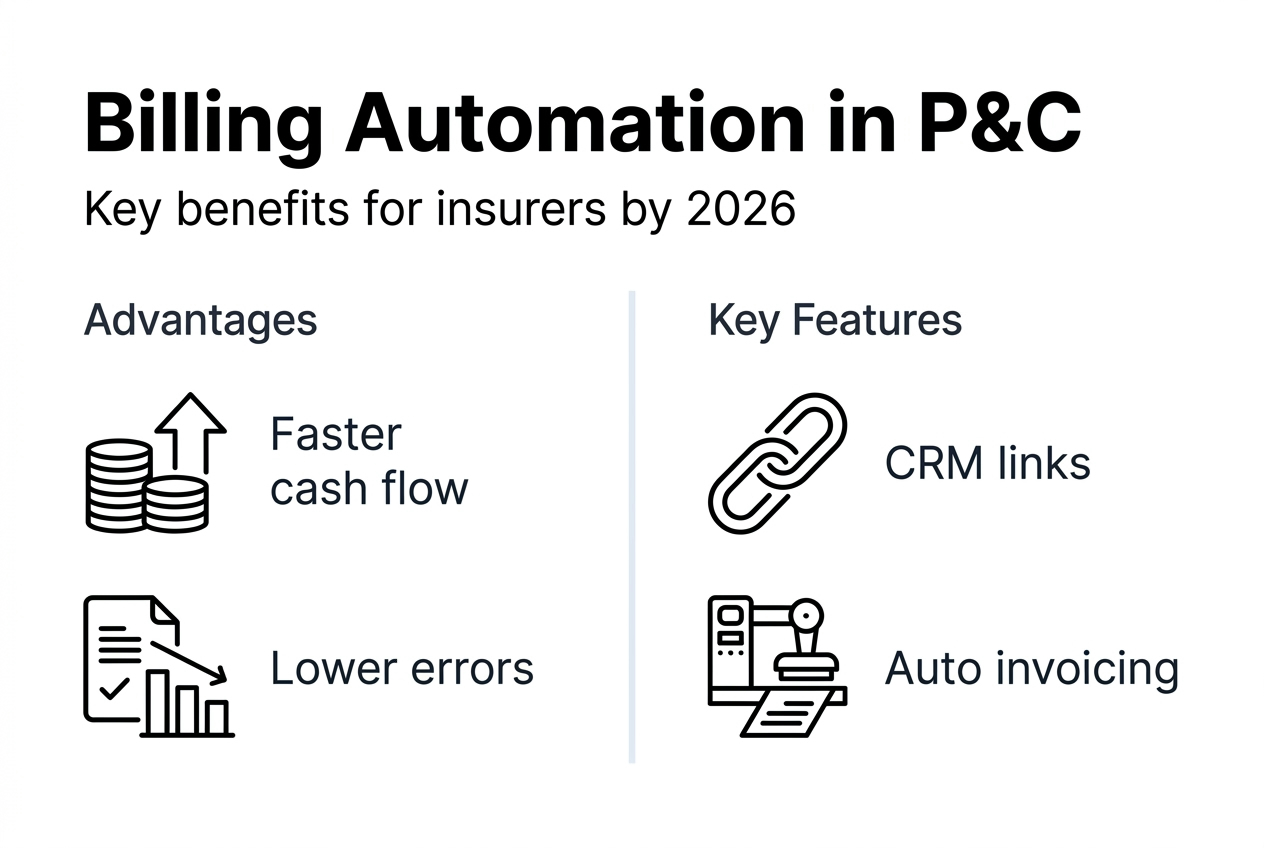
| Measurable benefits | Automation delivers up to 70% reduction in errors whilst reducing operating costs and accelerating payment cycles. |
| Process focus | Success demands process redesign and change management, not just technology implementation. |
| System integration | Effective automation requires integration with CRM, accounting systems, and policy administration platforms. |
| Flexibility requirements | Complex policies with endorsements and riders need configurable rules to handle varied billing scenarios accurately. |
Understanding insurance billing automation
Insurance billing automation refers to the systematic use of software platforms to execute billing functions with minimal manual intervention. These functions include generating invoices, processing premium payments, sending payment reminders, applying policy adjustments, and managing refunds or cancellations.
For property and casualty insurers, automation addresses unique challenges inherent in commercial lines and speciality coverages. Unlike personal lines with straightforward monthly premiums, P&C policies often involve complex rating structures, mid-term endorsements, and diverse payment plans. BillingCenter provides a single platform for managing all aspects of the billing process, from policy initiation to payment processing.
Automation encompasses several core operational areas:
- Invoice generation based on policy terms, coverage changes, and rating schedules
- Payment processing across multiple channels including direct debit, credit cards, and agent remittance
- Automated dunning procedures with escalating reminder sequences for overdue accounts
- Premium allocation across complex policy structures with multiple covereds and locations
- Commission calculation and distribution to agents and brokers
- Integration with general ledger systems for accurate financial reporting
The operational scope extends from the moment a policy binds through its entire lifecycle. When endorsements modify coverage, the system automatically recalculates premiums, generates supplemental invoices, and adjusts payment schedules. This end-to-end capability distinguishes true automation from simple invoice generation tools. Understanding insurance billing processes explained provides essential context for evaluating automation solutions.
Key benefits of automation in insurance billing
Property and casualty insurers implementing comprehensive billing automation realise substantial operational and financial improvements. The reduction in operating costs stems from eliminating manual data entry, reducing staffing requirements for routine tasks, and accelerating cash flow through faster payment processing.
Error reduction represents one of the most significant quantifiable benefits. Manual billing processes introduce mistakes through data entry errors, calculation inconsistencies, and missed endorsements. Automated systems reduce error rates by up to 70% compared to manual processes, directly improving accuracy in premium calculations and reducing disputes with policyholders.

Customer experience improvements manifest through faster response times and increased transparency. Policyholders receive immediate confirmation of payments, instant access to billing history, and proactive communication about upcoming charges. This responsiveness builds trust and reduces enquiries to customer service teams.
Operational efficiency gains include:
- Accelerated invoice generation from hours to minutes following policy changes
- Real-time payment allocation eliminating reconciliation delays
- Automated dunning reducing manual follow-up on overdue accounts
- Streamlined audit trails with complete transaction histories
- Enhanced reporting capabilities for financial analysis and forecasting
Integration with customer relationship management systems creates a unified view of policyholder interactions. When billing data flows seamlessly into CRM platforms, service representatives access complete payment histories during calls, enabling more informed conversations. This integration proves especially valuable for commercial accounts with multiple policies and complex billing arrangements. Exploring automation and artificial intelligence in P&C insurance reveals broader digital transformation opportunities.
Pro tip: Track specific metrics before and after automation implementation, including average days outstanding, billing error rates, and customer service call volume related to billing enquiries, to quantify return on investment and identify areas for further optimisation.
The financial impact extends beyond direct cost savings. Faster payment processing improves cash flow, reducing borrowing costs and enabling more accurate financial forecasting. Reduced errors minimise write-offs and collection costs whilst improving relationships with agents who benefit from accurate commission payments. For insurers pursuing comprehensive digital transformation, billing automation often serves as a gateway to broader improvements in streamline claims processing and policy administration.
Navigating challenges and complexities in billing automation
Implementing billing automation in property and casualty insurance presents distinct challenges that require thoughtful planning and execution. Complex policies with multiple endorsements require careful configuration of automated billing rules to avoid errors, particularly when endorsements add or remove coverages mid-term.
Policy complexity creates several specific challenges. Commercial lines policies often include multiple locations, varying coverage limits, and exposure-based rating factors that change throughout the policy period. Fleet policies may add or remove vehicles monthly, requiring pro-rata premium adjustments. Workers’ compensation policies involve audit processes that reconcile estimated versus actual payroll, potentially resulting in substantial return or additional premiums.
Successful automation implementation requires addressing these key considerations:
- Map existing billing workflows in detail before automation to identify inefficiencies and opportunities for improvement
- Configure flexible rating and billing rules that accommodate policy variations without requiring custom coding
- Establish robust testing protocols using real policy scenarios including complex endorsement combinations
- Plan phased rollouts starting with simpler policy types before tackling complex commercial lines
- Create comprehensive training programmes covering both system operation and revised business processes
Change management represents a critical success factor often underestimated by insurers. Billing automation is equally about process redesign and change management to realise full benefits. Staff members accustomed to manual processes may resist new systems, particularly when automation eliminates familiar workarounds they developed over years.
Common implementation pitfalls include insufficient stakeholder engagement during requirements gathering, inadequate data cleansing before migration, and unrealistic timelines that force corners to be cut. Insurers sometimes focus exclusively on technology selection whilst neglecting process redesign, resulting in automated versions of inefficient manual workflows.
Pro tip: Establish a cross-functional implementation team including billing operations, IT, underwriting, and claims to ensure automation serves the needs of all departments and integrates properly with existing systems across the organisation.
Integration challenges arise when connecting billing automation with legacy policy administration systems, especially those built on older technology platforms. Data quality issues in source systems can propagate through automated processes, magnifying rather than solving problems. Understanding the insurance billing process P&C insurers use helps identify integration points requiring special attention during implementation.
Best practices and strategies for optimising billing automation
Maximising the value of billing automation requires strategic planning and ongoing optimisation beyond initial implementation. Flexibility is foundational for speciality insurance automation systems, enabling insurers to adapt quickly to new products, rating structures, and regulatory requirements without extensive custom development.
Successful insurers adopt these proven strategies:
- Select platforms designed specifically for insurance rather than generic billing systems lacking industry-specific functionality
- Prioritise API-first architectures enabling seamless integration with policy administration, claims, and accounting systems
- Implement configurable business rules engines allowing business users to modify billing logic without developer involvement
- Establish regular review cycles for billing rules and workflows to identify improvement opportunities
- Create comprehensive audit trails supporting regulatory compliance and internal controls
Integration architecture deserves particular attention. Billing automation delivers maximum value when connected to broader insurance operations. Real-time synchronisation with policy administration systems ensures billing reflects current coverage. Integration with CRM platforms provides service representatives complete visibility into payment histories. Connections to accounting systems automate general ledger posting and reconciliation.
Staff training must address both technical system operation and revised business processes. Effective programmes combine hands-on practice with real scenarios, ongoing support during initial months post-implementation, and clear documentation of new workflows. Champions within billing operations who embrace automation can accelerate adoption by demonstrating benefits to colleagues.
The following table compares workflow characteristics across different automation levels:
| Workflow aspect | Manual billing | Semi-automated | Fully automated |
|---|---|---|---|
| Invoice generation | Individual creation | Template-based with manual review | Automatic upon policy events |
| Payment processing | Manual entry and allocation | Assisted entry with validation | Real-time processing across channels |
| Endorsement handling | Recalculate and bill manually | System calculates, manual approval | Automatic calculation and invoicing |
| Reporting | Manual compilation from multiple sources | Scheduled reports with manual analysis | Real-time dashboards with alerts |
| Audit compliance | Document gathering for reviews | Partial trail automation | Complete automated audit trails |
Regular system optimisation ensures automation continues delivering value as business needs evolve. Monitor key performance indicators including invoice accuracy rates, days sales outstanding, payment processing times, and customer satisfaction scores. When metrics deteriorate, investigate whether configuration changes, additional training, or process refinements are needed.
Leveraging insights from claims automation step by step can inform billing automation strategies, as both domains share similar integration requirements and change management challenges. Insurers pursuing comprehensive digital transformation benefit from coordinated automation initiatives across policy administration, billing, and claims.
Explore IBSuite policy administration for seamless automation
IBSuite delivers a cloud-native platform purpose-built for property and casualty insurers seeking to modernise billing operations whilst maintaining flexibility for complex commercial lines. The platform’s API-first architecture enables seamless integration across the insurance value chain, connecting billing with policy administration, claims, rating, and CRM functionality.
Insurers using IBSuite policy administration benefit from configurable billing rules that accommodate diverse policy structures without custom coding. The platform handles complex scenarios including multi-location risks, exposure-based rating, and mid-term endorsements whilst maintaining accurate premium calculations and audit trails.
Discover how IBSuite can transform your billing operations by exploring our comprehensive capabilities. Book a demo to see firsthand how the platform addresses your specific billing challenges and supports your digital transformation objectives.
Frequently asked questions
What exactly is insurance billing automation?
Insurance billing automation uses specialised software to execute billing functions including invoice generation, payment processing, premium adjustments, and collections with minimal manual intervention. The technology automatically calculates premiums based on policy terms, processes payments across multiple channels, and handles endorsement billing throughout the policy lifecycle.
How does billing automation improve customer experience?
Automation enhances customer experience through faster invoice delivery, immediate payment confirmation, transparent access to billing history, and proactive communication about upcoming charges. Policyholders benefit from reduced errors, multiple self-service payment options, and quicker resolution of billing enquiries as service representatives access complete transaction histories instantly.
What is the difference between billing and claims automation?
Billing automation focuses on premium collection, invoice generation, payment processing, and financial reconciliation related to policy charges. Claims automation addresses loss reporting, adjudication, payment processing, and reserve management. Whilst both improve operational efficiency, they serve distinct functions within the insurance value chain and typically integrate through shared policy administration platforms.
What organisational changes are needed for successful automation?
Successful implementation requires process redesign to eliminate inefficient manual workflows, comprehensive staff training on new systems and procedures, and change management to address resistance from employees accustomed to legacy processes. Insurers must also establish cross-functional governance involving billing operations, IT, underwriting, and finance to ensure automation serves enterprise-wide objectives rather than departmental silos.
How does automation handle complex commercial policies?
Modern billing automation platforms use configurable business rules engines that accommodate complex scenarios including multiple endorsements, exposure-based rating, multi-location risks, and varying payment plans. These systems calculate pro-rata adjustments when coverages change mid-term, handle audit premiums for workers’ compensation policies, and support flexible billing arrangements required for large commercial accounts whilst maintaining calculation accuracy and audit trails.
Recommended
- Insurance Billing Processes – Impact on P&C Insurers
- Automation and Artificial Intelligence in P&C Insurance – Digital Insurance Platform | IBSuite Insurance Software | Modern Insurance System
- Insurance Claims Automation: Complete Overview for P&C Insurers – Digital Insurance Platform | IBSuite Insurance Software | Modern Insurance System
- How European Insurers Use Data & Automation in 2025 – Digital Insurance Platform | IBSuite Insurance Software | Modern Insurance System
- PCI HIPAA Compliance – Avoiding Costly Mistakes in 2026
- Business Automation & AI Integration | LOOM Brand Designs