19.01.26
Insurance Market Trends 2026: Accelerating P&C Innovation

Rising claims costs and talent gaps are testing every property and casualty insurer in Central Europe. The mounting pressure to adapt is forcing leaders to re-evaluate their approach at every level. Cloud computing and artificial intelligence have become strategic imperatives, enabling firms to develop intelligent, data-driven insurance models and thrive amid volatility. This article brings you fresh insights on key trends, technologies, and strategies forecast to redefine the insurance sector by 2026.
Table of Contents
- Defining Insurance Market Trends For 2026
- Emerging Digital Technologies And Processes
- Shifting Distribution Models And Partnerships
- Regulatory Changes Impacting P&C Insurers
- Accelerating Product Innovation And Speed To Market
- Risks, Liabilities, And Compliance Challenges
Key Takeaways
| Point | Details |
|---|---|
| Technological Transformation | Insurers must invest in digital transformation, leveraging technologies like Artificial Intelligence and Cloud Computing to enhance operational efficiency and customer experience. |
| Evolving Distribution Models | Embrace digital ecosystem partnerships and omnichannel strategies to improve customer engagement and adapt to changing market demands. |
| Regulatory Compliance | Stay ahead of regulatory changes by developing adaptive technological infrastructures that ensure robust risk management and compliance. |
| Product Innovation | Focus on agile product development by utilising advanced analytics and modular architectures to quickly meet evolving customer needs. |
Defining Insurance Market Trends for 2026
The property and casualty (P&C) insurance landscape is undergoing profound transformation, driven by technological disruption and evolving market dynamics. As insurers prepare for 2026, they must navigate a complex ecosystem characterised by unprecedented change. Strategic digital transformation will be crucial in addressing emerging challenges and opportunities.
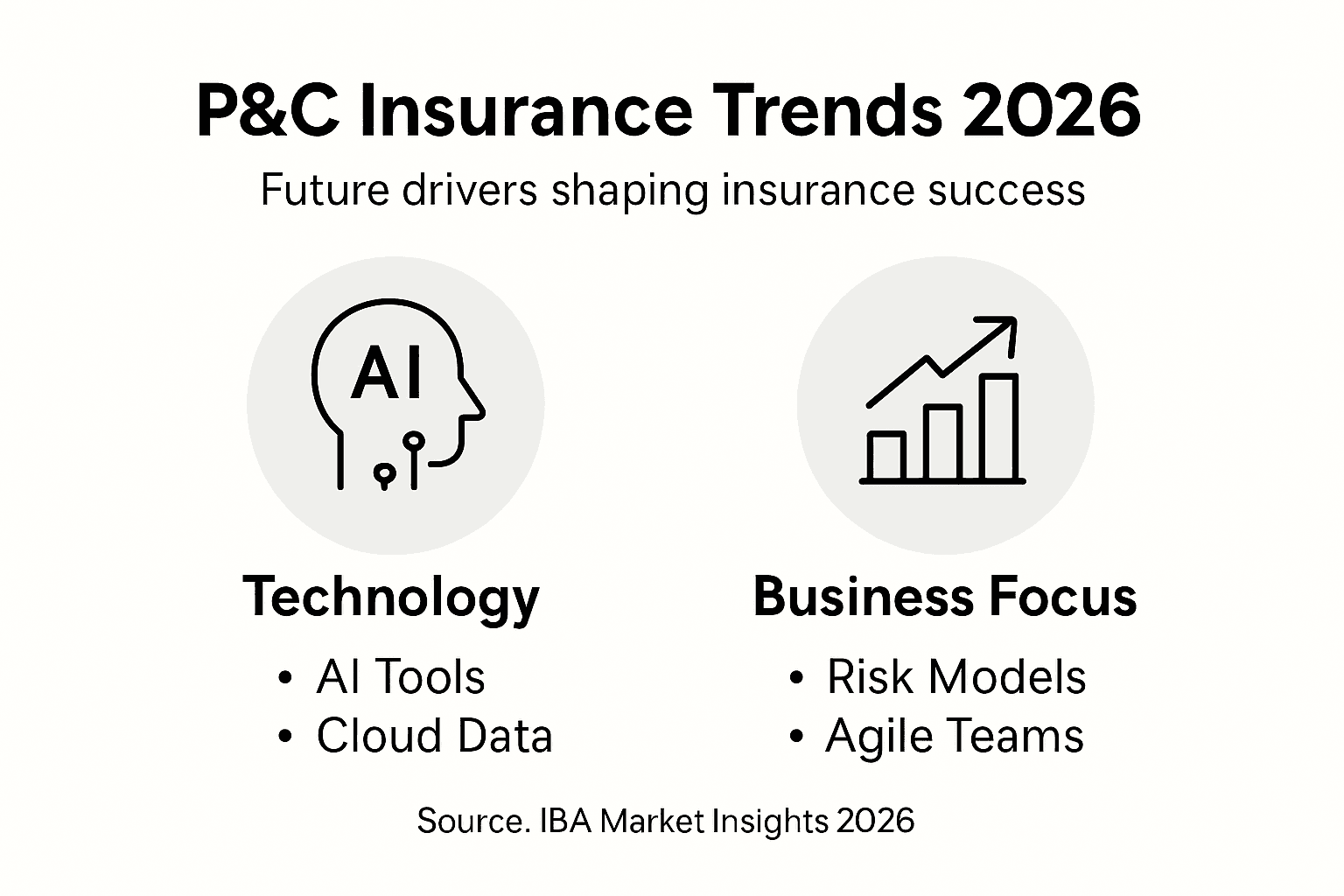
Key market trends indicate a significant shift towards more intelligent, data-driven insurance models. Cloud computing and artificial intelligence are emerging as foundational technologies enabling insurers to enhance operational efficiency, improve risk assessment, and deliver more personalised customer experiences. These technological capabilities will help insurers develop more responsive and adaptive business strategies.
The competitive landscape for P&C insurers in 2026 will be defined by several critical trends:
- Increased automation of core insurance processes
- Advanced predictive analytics for risk management
- Enhanced digital customer engagement platforms
- Strategic technology partnerships and ecosystem integration
- Continuous innovation in product design and delivery
Moreover, insurers must prioritise operational resilience, regulatory compliance, and agile technological infrastructure to remain competitive. The ability to rapidly adapt to changing market conditions while maintaining robust risk management will separate industry leaders from followers.
Pro tip: Invest in modular technology platforms that enable quick product iteration and seamless integration of emerging technologies to stay ahead of market trends.
Emerging Digital Technologies and Processes
The property and casualty (P&C) insurance sector is experiencing a profound technological revolution, with emerging digital technologies fundamentally reshaping operational strategies and customer interactions. Advanced data intelligence platforms are enabling insurers to transition from reactive risk management to proactive, predictive approaches that anticipate potential challenges before they emerge.
Artificial intelligence and machine learning technologies are driving significant transformations across insurance processes. Cloud-based ecosystem platforms are facilitating seamless integration of complex technological capabilities, allowing insurers to develop more sophisticated, responsive, and personalised service models. These technological innovations support several critical capabilities:
- Real-time risk assessment and dynamic pricing
- Automated underwriting processes
- Intelligent fraud detection mechanisms
- Predictive claims management
- Personalised customer engagement strategies
Digital transformation is not merely about implementing new technologies, but fundamentally reimagining how insurance services are designed, delivered, and experienced. Insurers must invest in modular, scalable technological infrastructures that enable continuous innovation and rapid adaptation to changing market demands. The most successful organisations will be those that can effectively balance technological sophistication with human-centric service approaches.

Below is a summary comparing core digital technologies driving transformation in P&C insurance for 2026:
| Technology | Core Functionality | Business Impact |
|---|---|---|
| Artificial Intelligence | Automates decision processes | Accelerates claims and underwriting |
| Cloud Computing | Enables scalable infrastructure | Reduces IT costs, supports agility |
| Data Intelligence | Analyses complex data in real time | Improves risk prediction accuracy |
| Ecosystem Platforms | Integrates partners and systems | Facilitates new service offerings |
Pro tip: Develop a comprehensive digital transformation roadmap that prioritises interoperability, data integration, and continuous learning capabilities across technological platforms.
Shifting Distribution Models and Partnerships
The European insurance landscape is experiencing a radical transformation in distribution strategies, moving beyond traditional sales channels towards more integrated, technology-enabled ecosystems. Digital ecosystem partnerships are reshaping how insurers connect with customers, creating more personalised and responsive engagement models that transcend conventional broker relationships.
Technology is fundamentally redefining distribution approaches, enabling insurers to collaborate across multiple sectors and platforms. Omnichannel engagement strategies are becoming crucial, allowing insurers to deliver seamless experiences that combine digital interactions with personalised human touchpoints. These emerging distribution models offer several strategic advantages:
- Enhanced customer journey mapping
- Flexible, adaptive service delivery
- Integrated cross-sector partnerships
- Real-time personalisation capabilities
- Expanded market reach through digital platforms
Successful insurers will prioritise building adaptive, technology-driven distribution networks that can rapidly respond to changing customer expectations. This requires developing sophisticated technological infrastructures that support seamless integration, data sharing, and collaborative service delivery across diverse partner ecosystems. The future of insurance distribution lies in creating interconnected, intelligent platforms that can dynamically adjust to market needs.
Pro tip: Invest in flexible technological architectures that enable rapid onboarding and integration of new distribution partners while maintaining robust data governance and security standards.
Regulatory Changes Impacting P&C Insurers
The European insurance landscape is undergoing significant regulatory transformation, with comprehensive legislative frameworks reshaping operational requirements for property and casualty insurers. Multiple regulatory initiatives are compelling insurers to fundamentally reconsider their technological infrastructures, risk management strategies, and compliance approaches.
Key regulatory developments are driving substantial operational changes across the insurance ecosystem. Emerging compliance standards mandate enhanced operational resilience, with specific focus on digital maturity, data governance, and customer protection. These regulatory shifts introduce critical requirements for insurers:
- Enhanced cybersecurity protocols
- Robust data protection mechanisms
- Transparent sustainability reporting
- Advanced operational risk management
- Comprehensive digital governance frameworks
Navigating these complex regulatory landscapes requires a proactive, strategic approach. Insurers must develop adaptive technological capabilities that can seamlessly integrate evolving compliance requirements while maintaining commercial effectiveness. This necessitates continuous investment in regulatory technology solutions, comprehensive staff training, and agile technological architectures that can rapidly respond to emerging legislative mandates.
The following table highlights regulatory challenges and strategic responses for P&C insurers in Europe:
| Regulatory Challenge | Insurer Response | Resulting Benefit |
|---|---|---|
| Evolving cybersecurity | Adopt advanced security protocols | Strengthens customer trust |
| Data protection mandates | Invest in robust governance | Enhances compliance |
| Sustainability reporting | Implement transparent disclosures | Improves reputation |
| Digital governance | Build adaptive tech architectures | Ensures operational resilience |
Pro tip: Establish a dedicated regulatory compliance team with cross-functional expertise to monitor legislative changes and implement dynamic adaptation strategies.
Accelerating Product Innovation and Speed to Market
The European insurance market is experiencing a radical transformation in product development, driven by the imperative to deliver more agile and responsive solutions. Microinsurance and personalised product strategies are reshaping how insurers conceptualise, design, and launch innovative insurance offerings that meet rapidly evolving customer expectations.
Technological advancements are enabling insurers to dramatically compress product development cycles. Digital platforms, artificial intelligence, and advanced analytics are facilitating rapid innovation and market responsiveness that were previously impossible. These technological capabilities support several critical innovation strategies:
- Modular product architectures
- Real-time risk assessment
- Usage-based insurance mechanisms
- Sustainability-focused coverage options
- Personalised underwriting approaches
Successful insurers will prioritise developing flexible technological infrastructures that enable continuous product iteration and rapid market deployment. This requires investment in advanced analytics, artificial intelligence, and collaborative ecosystem partnerships that can provide real-time insights into emerging customer needs and market dynamics. The future of insurance product development lies in creating intelligent, adaptive platforms that can quickly transform insights into marketable solutions.
Pro tip: Implement cross-functional innovation teams with representatives from technology, product development, and customer experience to accelerate product ideation and reduce time-to-market.
Risks, Liabilities, and Compliance Challenges
The European property and casualty insurance sector is confronting an increasingly complex risk landscape characterised by multifaceted challenges that demand sophisticated strategic responses. Emerging liability exposures are fundamentally reshaping risk management approaches, compelling insurers to develop more dynamic and resilient operational frameworks.
Critical risk dimensions are compelling insurers to reimagine their compliance and risk mitigation strategies. Advanced operational risk management frameworks are becoming essential for navigating increasingly intricate regulatory environments. These transformative challenges encompass several key strategic imperatives:
- Climate change-induced catastrophe risk
- Escalating cyber security threats
- Inflation-driven claims complexity
- Enhanced data protection requirements
- Sustainable finance regulatory alignment
Successful insurers will prioritise developing comprehensive risk intelligence capabilities that integrate advanced analytics, predictive modeling, and agile compliance mechanisms. This requires significant investment in technological infrastructure, continuous staff training, and adaptive governance models that can rapidly respond to emerging regulatory and market dynamics. The future of risk management lies in creating intelligent, proactive systems that anticipate challenges before they materialise.
Pro tip: Develop a holistic risk management approach that combines technological capabilities, regulatory expertise, and cross-functional collaboration to create a resilient, adaptive compliance strategy.
Accelerate Your P&C Insurance Innovation with IBA
The insurance market trends for 2026 highlight urgent challenges for Property and Casualty insurers, such as the need for rapid product innovation, agile technological infrastructures, and seamless digital transformation. If you find yourself challenged by complex legacy systems, slow time-to-market, or difficulty integrating emerging technologies into your core operations, you are not alone. Today’s market demands modular, cloud-native solutions that support rapid product iteration, scalable digital platforms, and regulatory compliance—all crucial to staying ahead in a competitive landscape.
Insurance Business Applications (IBA) offers IBSuite, a secure, API-first platform designed specifically to help P&C insurers overcome these barriers. With IBSuite, you can streamline the full insurance value chain from underwriting to claims while embracing new distribution models and accelerating your innovation cycles. Don’t wait until market shifts force your hand. Discover how to transform your business and maintain agility in a digital-first world by booking a personalised demo today.
Explore how IBSuite can power your digital transformation and deliver faster market-ready products with IBA’s cloud-native core insurance platforms. Ready to lead P&C innovation and enhance your customer experience? Take the next step now and book your demo to see how IBSuite can future-proof your business.
Frequently Asked Questions
What are the key trends shaping the insurance market in 2026?
The insurance market in 2026 is being shaped by increased automation of core processes, advanced predictive analytics for risk management, enhanced digital customer engagement platforms, strategic technology partnerships, and continuous product innovation.
How are digital technologies influencing P&C insurance?
Digital technologies such as artificial intelligence, machine learning, and cloud computing are transforming P&C insurance by enabling real-time risk assessment, automated underwriting, intelligent fraud detection, and personalised customer engagement strategies.
What should insurers prioritise to remain competitive in 2026?
Insurers should focus on operational resilience, regulatory compliance, and agile technological infrastructure. Developing sophisticated risk management strategies and continuously adapting to market changes is essential for maintaining competitiveness.
How is product innovation being accelerated in the insurance sector?
Product innovation is being accelerated through modular product architectures, real-time risk assessment, usage-based insurance mechanisms, and technology-enabled rapid market responsiveness, making it easier for insurers to meet evolving customer expectations.
Recommended
- Opportunities and Challenges for P&C Insurers: Embracing Insurtech – Digital Insurance Platform | IBSuite Insurance Software | Modern Insurance System
- Rapid Product Innovation Insurance: Driving Agility for P&C Insurers – Digital Insurance Platform | IBSuite Insurance Software | Modern Insurance System
- 7 Key Insurtech Trends 2025 for P&C Insurance Leaders – Digital Insurance Platform | IBSuite Insurance Software | Modern Insurance System
- Rapid Insurance Product Innovation Guide for P&C Insurers – Digital Insurance Platform | IBSuite Insurance Software | Modern Insurance System
- Case Study: Strengthening Controls for a UAE Payment Institution