05.02.26
Insurance Fraud Analytics: Transforming P&C Detection

Fraudulent claims threaten both financial stability and reputation across European Property & Casualty insurance firms. Facing increasingly complex schemes, professionals must rely on digital innovation and advanced data insights to protect their organisations. By adopting robust insurance fraud analytics, analysts gain the power to uncover hidden patterns, spot suspicious behaviour and reinforce proactive fraud defence. The pursuit of data-driven fraud detection is now central to sustainable risk management in European insurance contexts.
Table of Contents
- Defining Insurance Fraud Analytics in P&C
- Types of Fraud Detected by Analytics Platforms
- How Advanced Analytics Identifies Fraud Patterns
- Legal, Regulatory and Data Challenges in Central Europe
- Key Pitfalls, Costs and Implementation Risks
Key Takeaways
| Point | Details |
|---|---|
| Insurance Fraud Analytics | Utilises advanced data analysis techniques, including machine learning, to detect and prevent fraud in Property & Casualty insurance. |
| Types of Fraud Detected | Platforms can identify various fraud types, such as application fraud, identity theft, and staged accidents, minimising financial damage. |
| Regulatory Challenges | Insurers must navigate strict compliance requirements, such as GDPR, ensuring transparency while managing data privacy effectively. |
| Implementation Risks | Successful implementation requires balancing technology and operational readiness, addressing potential false positives and investment costs. |
Defining Insurance Fraud Analytics in P&C
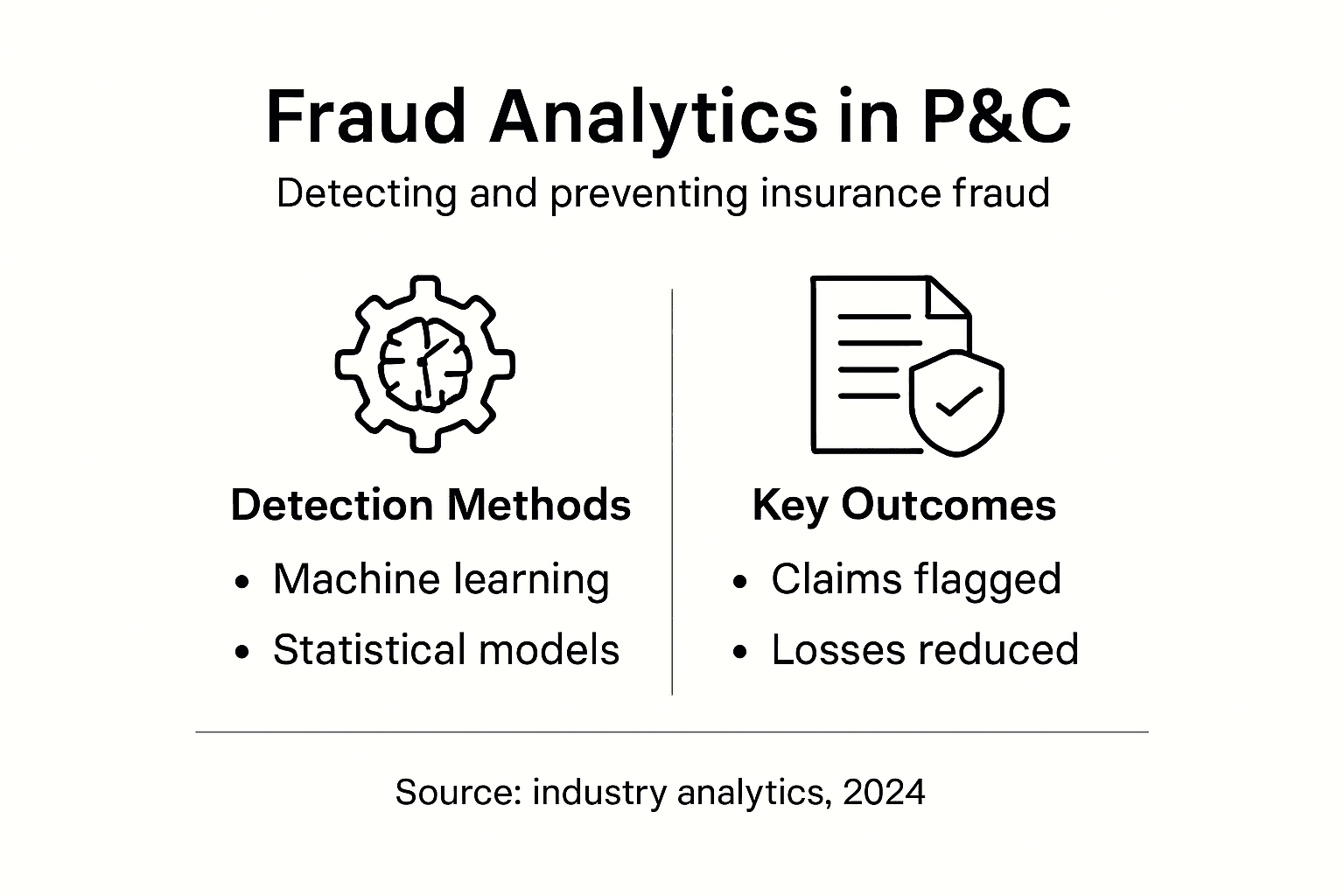
Insurance fraud analytics represents a sophisticated approach to detecting and preventing fraudulent activities within Property & Casualty (P&C) insurance domains. By leveraging advanced data analysis techniques, insurers can systematically identify suspicious patterns and potential misrepresentations that might otherwise go unnoticed.
At its core, insurance fraud analytics involves using predictive modeling and machine learning algorithms to scrutinise insurance transactions and claims. Predictive modeling techniques enable insurers to develop robust detection mechanisms that can rapidly assess risk and flag potentially fraudulent cases before significant financial damage occurs.
Key components of effective insurance fraud analytics include:
- Advanced data mining techniques
- Machine learning algorithms like Random Forest models
- Statistical pattern recognition
- Comprehensive transaction history analysis
- Cross-referencing multiple data sources
The primary objective of these analytics is not just detection, but prevention. By understanding fraudulent behaviour patterns, insurers can design more sophisticated risk management strategies. Fraud detection frameworks help organisations develop proactive policies that reduce financial losses and protect their operational integrity.
Pro tip: Implement continuous model training and update your fraud detection algorithms regularly to stay ahead of evolving fraudulent techniques.
Types of Fraud Detected by Analytics Platforms
Insurance fraud analytics platforms have become sophisticated tools for identifying a wide range of fraudulent activities across Property & Casualty (P&C) insurance domains. These advanced systems leverage complex algorithms and data analysis techniques to detect and prevent multiple types of fraudulent behaviour that could potentially cause significant financial damage to insurers.
The National Insurance Crime Bureau identifies several critical fraud types that advanced analytics platforms detect, including:
- Application fraud
- Rate evasion fraud
- Identity theft
- Money laundering
- Premium fraud
- Bodily injury fraud
- Staged accidents
- Vehicle-related fraud (such as arson or rental fraud)
Modern fraud detection technologies rely on intricate pattern recognition and anomaly detection mechanisms. Data analytics techniques enable insurers to cross-reference multiple data sources, identifying suspicious transactions, repeated claims, and unusual behavioural patterns that might indicate fraudulent intent.

These platforms go beyond simple rule-based systems, employing machine learning algorithms that can adapt and improve their detection capabilities over time. By continuously analysing vast amounts of transactional data, insurance fraud analytics platforms can quickly flag potential risks and help organisations take proactive measures to mitigate financial losses.
Pro tip: Implement a multi-layered fraud detection approach that combines statistical analysis, machine learning models, and domain expertise for comprehensive risk management.
How Advanced Analytics Identifies Fraud Patterns
Advanced analytics has revolutionised fraud detection by employing sophisticated techniques that go far beyond traditional rule-based systems. Anomaly detection methodologies enable insurers to systematically identify unusual patterns and behaviours that might indicate potential fraudulent activities across complex financial networks.
The core mechanisms of advanced fraud pattern identification involve multiple sophisticated approaches:
- Supervised machine learning models
- Unsupervised pattern recognition algorithms
- Statistical deviation analysis
- Behavioural network mapping
- Complex interaction tracking
- Real-time transaction monitoring
Modern fraud detection technologies leverage artificial intelligence to create intricate models that can detect subtle irregularities. AI-driven fraud detection techniques analyse vast datasets, identifying complex interactions and behavioural anomalies that human analysts might easily overlook. These systems continuously learn and adapt, becoming increasingly precise in distinguishing between legitimate variations and genuine fraudulent activities.
By combining multiple analytical approaches, insurers can develop robust fraud detection frameworks that provide comprehensive protection. The integration of machine learning, statistical analysis, and domain expertise creates a multi-layered defence mechanism capable of identifying increasingly sophisticated fraudulent schemes.
This table summarises how different machine learning techniques enhance fraud detection in P&C insurance analytics:
| Technique | Main Benefit | Example Application |
|---|---|---|
| Random Forest Models | High accuracy in classification | Detecting complex fraud scenarios |
| Anomaly Detection | Identifies rare data patterns | Spotting unusual claim behaviour |
| Behavioural Network Mapping | Uncovers hidden relationships | Revealing fraud rings and collusion |
| Real-time Monitoring | Immediate risk flagging | Preventing rapid fraudulent payouts |
Pro tip: Continuously update your fraud detection models by incorporating new data and emerging fraud patterns to maintain predictive accuracy.
Legal, Regulatory and Data Challenges in Central Europe
The landscape of insurance fraud analytics in Central Europe is significantly shaped by complex legal and regulatory frameworks that demand sophisticated compliance strategies. AI and algorithmic decision challenges require insurers to navigate intricate data protection requirements while maintaining effective fraud detection capabilities.
Key regulatory challenges for insurers include:
- General Data Protection Regulation (GDPR) compliance
- Cross-border data exchange restrictions
- Transparency and explainability of AI models
- Protection of sensitive personal information
- Interoperability between different regulatory systems
- Ethical use of advanced analytics technologies
Central European regulatory environments impose stringent constraints on data handling and privacy. Regulatory data protection requirements create significant complexity for insurance fraud analytics platforms, requiring meticulous approach to data management, consent mechanisms, and algorithmic transparency.
Insurers must develop robust governance frameworks that balance advanced technological capabilities with strict legal compliance. This involves creating sophisticated data anonymisation techniques, implementing comprehensive consent management systems, and ensuring that fraud detection algorithms remain interpretable and accountable to regulatory authorities.
Here is a quick comparison of regulatory challenges faced by insurers in Central Europe versus other regions:
| Challenge | Central Europe | Other Regions |
|---|---|---|
| Data Protection Laws | Strict GDPR enforcement | Moderate to varied |
| AI Model Transparency | Mandatory explainability | Less stringent |
| Cross-border Data Exchange | Highly restricted | More flexibility |
| Consent Management | Rigorous requirements | Lighter procedures |
Pro tip: Develop a comprehensive data governance strategy that prioritises regulatory compliance, transparency, and ethical use of advanced analytics technologies.
Key Pitfalls, Costs and Implementation Risks
Implementing insurance fraud analytics platforms involves navigating a complex landscape of technological, operational, and regulatory challenges. Fraud detection implementation risks encompass multiple dimensions that insurers must carefully manage to ensure effective and sustainable fraud prevention strategies.
Critical challenges and potential pitfalls include:
- High technology investment costs
- Complex data integration requirements
- Risk of generating false positive alerts
- Potential regulatory compliance complications
- Technological infrastructure limitations
- Staff resistance to new analytical systems
- Evolving fraud detection methodologies
- Sophisticated cybersecurity vulnerabilities
The financial implications of fraud analytics implementation are substantial. Fraud risk management strategies require comprehensive investment across multiple organisational domains, including technological infrastructure, specialised personnel training, and continuous system adaptation to emerging fraud tactics.
Successful implementation demands a holistic approach that balances technological capabilities with organisational readiness. This involves developing robust governance frameworks, ensuring data quality, maintaining algorithmic transparency, and creating adaptive fraud detection mechanisms that can evolve alongside increasingly sophisticated fraudulent techniques.
Pro tip: Conduct thorough pre-implementation risk assessments and develop a phased rollout strategy that allows for continuous learning and system refinement.
Transform Your P&C Fraud Detection with Cutting-Edge Technology
Insurance fraud analytics reveals complex challenges such as identifying evolving fraudulent patterns, maintaining GDPR compliance, and avoiding costly false positives. Insurers face the critical need to deploy advanced machine learning algorithms and robust data governance frameworks to stay ahead. At Insurance Business Applications, we understand these pain points and empower Property & Casualty insurers to overcome them with our cloud-native platform, IBSuite. Designed for seamless integration and continuous adaptation, IBSuite supports efficient fraud detection alongside comprehensive policy administration and claims management.
Embrace a future of fraud prevention that combines regulatory compliance, real-time analytics, and rapid product innovation — all on a secure, API-first system trusted by global insurers. Don’t let the complexities of insurance fraud analytics slow your business down. Take control now and discover how IBSuite can transform your fraud detection capabilities. Contact us to Book a Demo and start your journey towards smarter, faster, and more reliable insurance operations.
Frequently Asked Questions
What is insurance fraud analytics in P&C insurance?
Insurance fraud analytics in Property & Casualty (P&C) insurance refers to the use of advanced data analysis techniques, such as predictive modelling and machine learning, to detect and prevent fraudulent activities by identifying suspicious patterns in insurance transactions and claims.
What types of fraud can be detected using analytics platforms?
Analytics platforms can detect various types of fraud, including application fraud, identity theft, premium fraud, staged accidents, bodily injury fraud, and vehicle-related fraud such as arson or rental fraud.
How do advanced analytics identify fraud patterns?
Advanced analytics identify fraud patterns through methods like supervised and unsupervised machine learning, anomaly detection, behavioural network mapping, and real-time transaction monitoring to spot unusual behaviours and relationships that may indicate fraudulent activities.
What are the main challenges of implementing insurance fraud analytics?
Challenges include high technology investment costs, complex data integration, risk of false positives, regulatory compliance issues, infrastructure limitations, and the need for staff training and adaptation to new systems.
Recommended
- 2025 Guide to Insurance Analytics: Transform Your Decisions – Digital Insurance Platform | IBSuite Insurance Software | Modern Insurance System
- 7 Essential Insurance Rating Models List for P&C Leaders
- Automation and Artificial Intelligence in P&C Insurance – Digital Insurance Platform | IBSuite Insurance Software | Modern Insurance System
- Insurance Data Security Best Practices for P&C Insurers