portalId 145238543 hublet eu1 environment prod defaultChatFlow ----

Modern insurance infrastructure: a guide for P&C transformation

Modern insurance infrastructure: a guide for P&C transformation

Insurance executive reviewing reports in bright office


TL;DR:

  • Nearly 74% of insurance infrastructure transformations fail due to poor approach rather than technology. Modernisation offers significant benefits like faster product launches, cost reductions, and improved customer experience. Successful programmes focus on business transformation involving people, processes, and technology, not just IT upgrades.

Nearly 74% of insurance infrastructure transformations fail, not because the technology is wrong, but because the approach is. For P&C insurers, the pressure to modernise has never been sharper. Climate volatility, AI-driven competition, and rising customer expectations are reshaping the market faster than legacy systems can respond. This guide cuts through the noise to give insurance executives and IT leaders a practical, evidence-based framework for modernising core infrastructure. You will find methodologies, real-world benchmarks, and honest guidance on what separates successful transformations from costly failures.

Table of Contents

Key Takeaways

Point Details
Modernisation is critical Updating infrastructure is essential for competitiveness and cost-efficiency in P&C insurance.
Mindset trumps technology Successful projects prioritise people, processes, and measurable business outcomes over pure tech solutions.
Benchmarks drive credibility Evidence from leading insurers shows double-digit efficiency gains and rapid payback.
No one-size-fits-all Pick the methodology—rip-and-replace, incremental, or hybrid—best suited to your organisation’s context.

Why modern insurance infrastructure matters now

Legacy core systems are no longer just a technical inconvenience. They are a strategic liability. Insurers running on outdated policy administration, billing, and claims platforms routinely face product launch cycles measured in months, not days. IT teams spend the majority of their budget maintaining systems that were never designed for APIs, cloud, or real-time data exchange. The result is a compounding disadvantage as competitors move faster and customers expect more.

The strategic case for change is clear. Modernisation is existential for competitiveness amid AI advances, climate risk, and talent gaps, with potential savings of up to 1% of gross written premium. For a mid-sized P&C insurer writing £500 million in GWP, that is a £5 million annual saving. Not a rounding error.
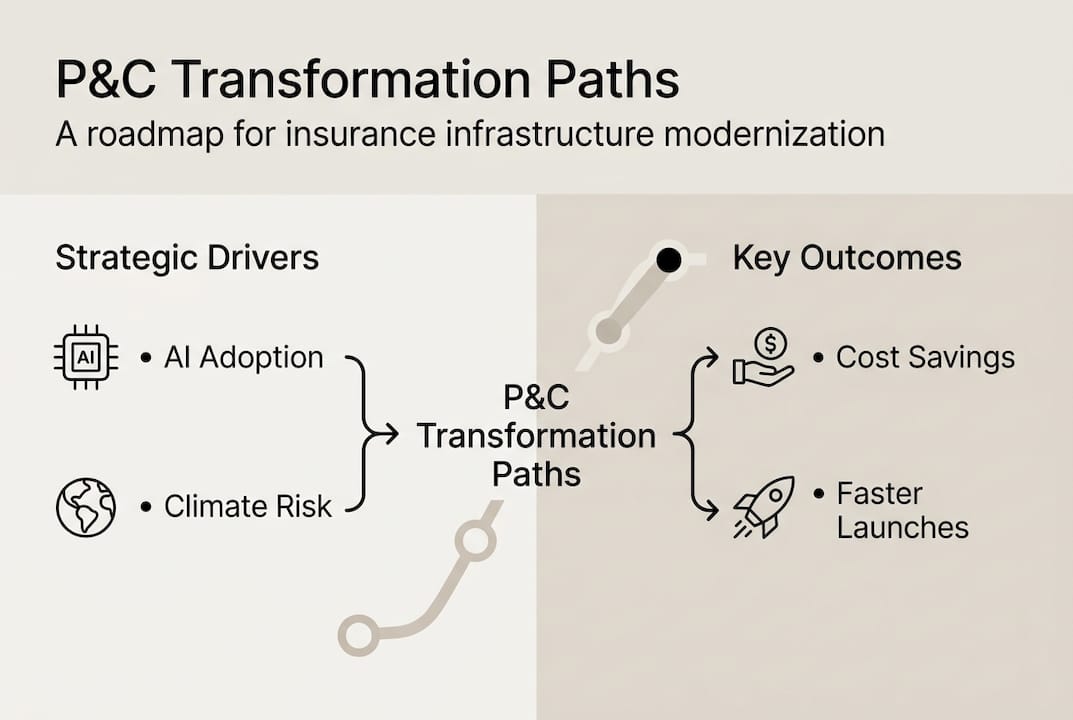
Infographic showing key drivers and outcomes of PC transformation

Capital expenditure for modernisation typically runs at 2 to 4% of GWP, with operational savings of 0.5 to 1% once the new platform is fully embedded. The payback period is real, but so is the risk of doing nothing. Insurers that delay are watching their insurance transformation drivers compound: talent who understand legacy COBOL systems are retiring, and the cost of technical debt grows every year.

Modern infrastructure also enables capabilities that legacy systems simply cannot support. Insurers are already experimenting with stablecoin premiums as a new payment model, a move that requires real-time API connectivity and flexible billing architecture. That kind of experimentation is impossible on a monolithic core.

Here are the key benefits that a modern insurance platform delivers:

  • Speed to market: New products and endorsements can be configured in days rather than months
  • Regulatory agility: Built-in compliance tools adapt to changing rules without custom development
  • Customer experience: Real-time data and omnichannel support enable personalised, responsive service
  • IT cost reduction: Cloud-native architecture eliminates expensive on-premise infrastructure
  • AI readiness: Clean, structured data and open APIs make AI integration straightforward
  • Scalability: Elastic cloud capacity handles volume spikes without manual intervention

The opportunity is significant. The risk of inaction is greater.

Core approaches to modernising insurance infrastructure

There is no single path to modernisation. The right approach depends on your organisation’s risk appetite, existing architecture, and strategic priorities. Understanding the main methodologies is the first step to choosing wisely.

Core modernisation involves transitioning to cloud-native SaaS platforms using microservices and agentic AI across all policy, claims, and billing operations. Each methodology has distinct strengths.

Methodology Pros Cons Best use case
Agentic AI integration Accelerates discovery and migration Requires clean data Complex legacy environments
Microservices architecture Modular, independently deployable Higher initial complexity Large, multi-product insurers
SaaS platform adoption Fast deployment, Evergreen updates Less customisation Growth-stage or regional carriers
Zero-based design Clean slate, no legacy constraints High disruption risk Greenfield or spin-off entities
API-first decoupling Preserves legacy while enabling change Slower full transformation Insurers with stable core but digital ambitions

For most established P&C insurers, a phased migration strategy offers the best balance of speed and risk management. Here is a practical sequence:

  1. Assess and map: Catalogue all systems, data flows, and integration points. Agentic AI tools can automate this discovery phase significantly.
  2. Define the target architecture: Agree on the future-state platform, whether SaaS, hybrid, or cloud-native build.
  3. Decouple via APIs: Introduce an API layer between legacy and new systems to enable parallel operations.
  4. Migrate incrementally: Move one domain at a time, starting with billing or rating where risk is lower.
  5. Validate and stabilise: Run parallel operations, validate data integrity, and confirm business continuity.
  6. Decommission legacy: Only retire old systems once the new platform is fully proven in production.

Pro Tip: Start with APIs before touching the core. An API layer lets you connect modern front-end tools and third-party services to your legacy system immediately, delivering business value while the deeper platform transformation proceeds in the background. This approach also gives your team time to build confidence in the new architecture before the high-stakes cutover.

A well-documented example of this in practice is the pet insurance automation case, where phased automation delivered measurable results without disrupting live operations.

Benchmarks, outcomes and real-world impact

Methodologies are only credible when backed by evidence. The good news is that the data from leading modernisation programmes is compelling.

Swiss Life’s cloud transformation delivered a 25% reduction in IT costs and 98% less time spent on SQL server management. DICEUS-led programmes achieved 65 to 75% less manual processing, with time-to-change dropping from 8 to 16 weeks down to just 3 to 5 days. These are not marginal gains. They represent a fundamental shift in operating capability.

IT manager analyzing cloud migration outcomes

Metric Before modernisation After modernisation
IT cost as % of GWP 4.5%+ 3.0 to 3.5%
Product launch cycle 3 to 6 months 1 to 4 weeks
Manual processing rate High (65 to 75% of tasks) Near-automated
Time-to-change (core config) 8 to 16 weeks 3 to 5 days
SQL server management burden Significant Reduced by 98%

The insurance cloud migration outcomes above are achievable, but they require disciplined execution. Insurers that treat modernisation as a pure IT project, rather than a business transformation, consistently underperform.

Why 74% of transformations fail: The most common failure modes are not technical. They include insufficient executive sponsorship, underestimating change management complexity, attempting to migrate everything at once, and failing to align IT deliverables with business outcomes. Programmes that succeed treat people and process change as equal priorities alongside technology.

The modern platform benefits extend beyond cost. Insurers report faster regulatory filings, improved NPS scores, and the ability to launch in new markets without building bespoke systems. These strategic gains are harder to quantify but often more valuable than the IT savings alone.

Addressing challenges and choosing the best-fit path

The benefits are clear, but how do you navigate real-world challenges? Even well-resourced programmes encounter significant friction. Understanding the most common obstacles before you start is the difference between a managed programme and a crisis.

Key edge cases include multi-country regulatory requirements, massive system dependencies, high migration risks, vendor lock-in, and siloed data that blocks effective AI deployment. The debate between full replacement versus incremental enhancement is live in every boardroom, with no universal answer.

The most common practical challenges are:

  • Regulatory complexity: Multi-jurisdiction compliance requirements can make a single configuration change a months-long legal review process
  • Data quality and migration risk: Legacy systems often contain decades of inconsistent, poorly structured data that must be cleansed before migration
  • Vendor lock-in: Proprietary platforms can create new dependencies that are as constraining as the legacy systems they replaced
  • Siloed data architecture: Disconnected systems prevent the unified data model that AI and analytics require
  • Organisational resistance: Business units that have built workarounds on legacy systems often resist change, even when the new platform is objectively better

Choosing between full rip-and-replace, incremental enhancement, or a hybrid buy-and-configure model requires honest assessment of your organisation’s risk tolerance and timeline. Use risk assessment tools to quantify migration complexity before committing to a path.

An API-first approach reduces migration risk significantly by allowing legacy and modern systems to coexist during transition. For insurers with complex regulatory environments, this is often the only viable path. The critical modernisation challenges facing P&C insurers are well documented, and integration challenge solutions exist for most scenarios.

Pro Tip: Establish federated governance from day one. Assign clear ownership of data, processes, and outcomes across both IT and business units. Set KPIs tied to business results, such as time-to-market and claims cycle time, not just technical milestones like server migrations. This keeps the programme accountable to value, not activity.

A practical perspective: What actually works in insurance modernisation

After working with P&C insurers across multiple markets, one pattern stands out clearly. Programmes that treat modernisation as a technology procurement exercise almost always underdeliver. The ones that succeed treat it as a business transformation that happens to involve technology.

70% of transformation success depends on people and processes, not just the technology itself. Yet most budgets and timelines are allocated almost entirely to software and infrastructure. That imbalance is where programmes quietly fail.

The 10-20-70 rule is instructive here. Roughly 10% of transformation value comes from the data and tools, 20% from the algorithms and platform capabilities, and 70% from the people, processes, and organisational behaviours that determine whether the platform is actually used well. Choosing the right software stack matters, but it is not the differentiator.

What actually moves the needle is aligning business and IT leadership from the very first day, setting outcome-based KPIs rather than milestone-based ones, and maintaining executive sponsorship through the inevitable friction of a live migration. The transformation drivers are real and urgent, but urgency without discipline produces expensive failures. Slow down to go fast.

How to accelerate your insurance infrastructure transformation

Applying this perspective can be accelerated with the right platform and partner. IBSuite, built by Insurance Business Applications (IBA), is a cloud-native, API-first core insurance platform designed specifically for P&C insurers. It covers the full value chain, from policy administration and underwriting to claims, billing, rating, and CRM, all within a single, Evergreen-updated platform built on AWS. IBA’s approach is grounded in the same evidence-based principles covered in this guide: phased migration, API-first decoupling, and outcome-focused delivery. If you are ready to move from planning to action, book a demo to see how IBSuite can fit your modernisation roadmap.

Frequently asked questions

What is modern insurance infrastructure?

Modern insurance infrastructure combines cloud-native, API-driven systems, agentic AI, and modular SaaS platforms to support efficient, digital-first operations. It replaces monolithic legacy cores with flexible, interconnected components that can evolve without full system replacements.

How can agentic AI help insurers modernise core systems?

Agentic AI is used across eight modernisation phases, from discovery to migration, accelerating process mapping, reducing manual handling, and cutting integration errors. It makes complex migrations faster and less risky than traditional approaches.

What are common pitfalls in insurance modernisation?

The biggest pitfalls include underestimating change management, siloed data, regulatory complexity, and misaligned business-IT priorities. As the 74% failure rate shows, people and process issues cause more programme failures than technology choices.

How much can insurers save by modernising their infrastructure?

Savings typically reach 0.5 to 1% of GWP, alongside a 25% reduction in IT costs and 65 to 75% less manual processing. For large P&C carriers, these figures represent tens of millions in annual operational improvement.

Core insurance platform functions: top 6 for efficiency

Core insurance platform functions: top 6 for efficiency

Insurance team reviewing platform documents


TL;DR:

  • Core functionalities like policy management, claims, billing, and self-service are vital for modern insurers.
  • Integration and flexibility are crucial to ensure agility, scalability, and regulatory compliance.
  • Successful platform selection requires balancing feature depth with adaptability to future operational and regulatory changes.

Modern P&C insurance is under pressure from every direction. Shifting customer expectations, tightening regulations, and relentless competition from digital-first challengers mean that operational efficiency is no longer a nice-to-have. It is a survival requirement. The functionalities embedded in your core insurance platform directly shape how fast you can launch products, how well you serve customers, and how confidently you meet compliance obligations. This article breaks down the essential core insurance functionalities, compares their real-world impact, and gives you a practical framework for making the right platform decisions for your organisation.

Table of Contents

Key Takeaways

Point Details
Set clear selection criteria Start with your business goals to define which core functionalities deliver the greatest value.
Prioritise integration and flexibility Ensure chosen platforms provide seamless connectivity and adaptability for future changes.
Tailor platforms to your needs Match core functionalities with your organisation’s size, market, and digital ambition for the best results.
Customer experience is vital Robust self-service and claims features now differentiate leading insurers in the market.

How to evaluate core insurance functionalities

Before you assess any platform, you need clarity on what your organisation actually needs. That sounds obvious, but many insurers begin platform evaluations by reviewing vendor feature lists rather than starting with their own strategic priorities. The result is a selection process driven by demos rather than outcomes.

Start by defining your top three strategic goals. Are you optimising for speed to market, operational scale, or improved customer experience? Each goal points to different functional priorities. An insurer focused on speed to market will weight product configuration and rating engine flexibility heavily. One focused on customer experience will prioritise self-service portals and omni-channel communication.

Once your goals are clear, assess each core functionality against these criteria:

  • Integration capability: Can the platform connect with your existing systems and third-party partners via open APIs?
  • Data quality and governance: Does the platform support clean, centralised data that feeds reliable reporting and analytics?
  • Automation potential: Which manual workflows can be eliminated or accelerated?
  • Compliance support: Does the platform provide built-in regulatory reporting tools that adapt to local and international requirements?
  • Flexibility and configurability: Can business users adjust products and rules without heavy IT involvement?

As insurance core systems form the engine of modern insurers, platform choice is not a technology decision alone. It is a business strategy decision. The essential platform features you prioritise should map directly to the competitive advantages you are trying to build.

Pro Tip: Involve your underwriting, claims, and finance teams in the evaluation process from day one. They will surface practical requirements that IT teams alone may overlook.

The essential list of core insurance functionalities

With an evaluation framework in place, let’s detail the specific core functionalities you should expect in your insurance platform. Insurance platform modules that enable seamless policy, claim, and customer lifecycle management define what a modern platform delivers.

Here are the six core functionalities every P&C platform must include:

  • Policy administration: Covers quoting, binding, endorsements, renewals, and cancellations. This is the operational backbone of your business.
  • Claims management: Includes first notice of loss (FNOL), adjudication, payment processing, and fraud detection. Speed and accuracy here directly affect customer retention.
  • Billing and payments: Manages invoicing, receivables, payment plans, and automated reconciliation. Poor billing processes are a leading cause of customer churn.
  • Customer self-service: Portals, omni-channel communication, and real-time status updates that reduce call centre volume and improve satisfaction.
  • Regulatory compliance and reporting: Automated tools to generate filings, track regulatory changes, and maintain audit trails.
  • Integration capabilities: Open APIs and partner connectivity that allow your platform to exchange data with brokers, reinsurers, and third-party services.
Functionality Primary benefit Risk if absent
Policy administration Faster product launch Slow quoting, manual errors
Claims management Improved customer retention High leakage, slow settlement
Billing and payments Reduced revenue leakage Reconciliation errors, churn
Customer self-service Lower operational costs High call centre volume
Compliance and reporting Regulatory confidence Fines, audit failures
Integration capabilities Ecosystem agility Data silos, IT bottlenecks

Pro Tip: When reviewing vendor demos, ask specifically how each module handles exception scenarios, not just standard workflows. Edge cases reveal true platform maturity.

Comparing core functionalities: impact and integration

Having outlined each function, it is valuable to see how they compare for real-world outcomes. Not all functionalities carry equal weight, and your investment priorities should reflect that.

Policy administration and claims management consistently deliver the highest direct impact on both customer satisfaction and cost control. A slow or error-prone claims process is one of the fastest ways to lose a customer permanently. Policy administration inefficiencies, such as manual endorsement processing, inflate operational costs and slow your response to market opportunities.

Claims specialist reviewing customer records at desk

Billing and self-service functions have a quieter but significant impact. Billing errors erode trust and create reconciliation backlogs that consume finance team capacity. Self-service portals, when well designed, can deflect a substantial share of routine customer enquiries, reducing operational costs without sacrificing service quality.

The biggest risk in platform selection is treating these modules as independent units. Siloed systems that do not share data in real time create friction at every handoff. A claims event that does not automatically trigger a billing adjustment, or a policy change that does not update the customer portal instantly, creates operational drag and customer frustration.

Integration challenges for insurers are a key differentiator for P&C insurers updating their core systems. Platforms with open, API-first architectures allow you to connect new capabilities without rebuilding from scratch, which is critical as market conditions evolve.

Functionality Customer satisfaction impact Cost reduction potential Integration complexity
Policy administration High High Medium
Claims management Very high High High
Billing and payments Medium High Medium
Customer self-service High Medium Low
Compliance and reporting Low (indirect) Medium Low
Integration capabilities Medium Very high High

When planning upgrades or new acquisitions, prioritise core system transformation that replaces siloed legacy modules with a unified, integrated architecture. The short-term cost of integration work pays back quickly in reduced manual effort and faster data flows.

Situational recommendations for insurance platforms

Beyond generic comparisons, it is critical to match your feature selection to your organisation’s unique context. A large multi-country insurer has very different priorities from a fast-growing managing general agent (MGA) or a digital-first challenger entering a new market.

Here is a practical framework for aligning functionality priorities to your situation:

  1. Legacy insurer modernising core systems: Focus first on policy administration and integration capabilities. Replacing manual policy workflows and connecting legacy data sources will deliver the fastest efficiency gains.
  2. Fast-growing MGA or digital challenger: Prioritise customer self-service, billing automation, and rapid product configuration. Speed and agility matter more than deep compliance tooling at early stages.
  3. Multi-country enterprise insurer: Compliance and reporting functionality becomes critical. You need a platform that handles multiple regulatory frameworks without requiring separate system instances.
  4. Insurer with high claims volume: Claims management and integration with third-party services such as repair networks and fraud detection tools should top the investment list.
  5. Insurer focused on distribution growth: Integration capabilities and customer self-service features that support broker portals and direct channels will drive the most value.

“The insurers that win in the next decade will not be those with the most features. They will be those whose platforms adapt fastest to customer and regulatory change.”

Customer self-service engagement is a top differentiator for modern P&C insurers, and compliance features are increasingly non-negotiable as regulatory complexity grows globally. Build your investment roadmap around the functionalities that address your most pressing gaps first, then layer in advanced capabilities as your digital maturity increases.

Pro Tip: Avoid the temptation to select a platform based on its longest feature list. A platform with fewer, deeply integrated capabilities will outperform a sprawling system with shallow modules every time.

What most insurers miss when selecting platform functionalities

Here is a candid observation from years of working with P&C insurers across markets: the most common failure in platform selection is not choosing the wrong features. It is underestimating what it takes to make those features work in practice.

Decision-makers frequently focus on functional coverage during evaluation, ticking boxes for policy administration, claims, billing, and compliance. What they underestimate is change management, data migration complexity, and the long-term cost of a platform that cannot adapt without expensive customisation.

The insurers who achieve the most from their platform investments share a common trait. They treat the platform not as a technology purchase but as a long-term operating model decision. They ask not just “does this platform do what we need today?” but “will it scale for the regulatory, customer, and technology changes coming in the next five to ten years?”

The most successful transformations we have observed combine strong core functionalities with modular, open architectures that allow incremental change. Reviewing the platform benefits summary of mature solutions makes clear that adaptability is as important as any individual feature. A platform that locks you into a fixed architecture is a liability, regardless of how impressive its current feature set appears.

See modern insurance core functionalities in action

If this framework has helped clarify what your platform should deliver, the logical next step is seeing these capabilities demonstrated in a real-world context. IBSuite by IBA is built to support the full P&C insurance value chain, from policy administration solution through claims, billing, self-service, compliance, and integration, all within a single cloud-native, API-first platform. Since 2010, IBA has helped insurers across global markets modernise their core operations and launch products faster without accumulating technical debt. If you are ready to evaluate how a unified platform can replace fragmented legacy systems, request a platform demo and see IBSuite’s core functionalities in action.

Frequently asked questions

What are the most important functionalities in a core insurance platform?

The most critical are policy administration, claims management, billing, customer self-service, regulatory compliance, and integration capability. Critical modules across these areas define whether a platform can support the full insurance lifecycle effectively.

How does customer self-service impact insurance operations?

Customer self-service features improve engagement, reduce operational costs, and create a smoother claims experience. Self-service portals drive measurable cost savings by deflecting routine enquiries from call centres.

How can insurers ensure smooth integration of new core systems?

Insurers should prioritise open APIs, robust data mapping, and involve IT teams early in the platform evaluation and rollout process. Integration challenges can be addressed through careful planning and selecting platforms with proven API-first architectures.

How does core insurance software support regulatory compliance?

Modern platforms include compliance tools and automated reporting features to help insurers keep pace with changing regulations. Compliance modules automate filing generation and maintain audit trails, reducing the manual burden on compliance teams.

Billing automation guide: streamline insurance operations

Billing automation guide: streamline insurance operations

Insurance manager reviewing billing workflow at desk


TL;DR:

  • Billing automation reduces errors by up to 70% and lowers operational costs.
  • Successful implementation requires deep process redesign and strong cross-team collaboration.
  • Key KPIs include Days Premium Outstanding, straight-through processing rates, and e-payment adoption.

Manual billing in property and casualty insurance is a quiet drain on performance. Errors compound, payments stall, and policyholders grow frustrated with processes that feel decades old. Billing automation can reduce errors by up to 70% and is strongly preferred by customers who expect digital-first experiences. This guide walks P&C insurance executives and technology leaders through the business case, core components, implementation roadmap, common pitfalls, and the metrics that prove success. Whether you are planning your first automation project or refining an existing one, what follows is a practical framework built for the realities of modern insurance operations.

Table of Contents

Key Takeaways

Point Details
Error reduction possible Billing automation can reduce manual errors by up to 70% in P&C insurance.
Customer preferences 83% of insurance customers favour digital payment options, making automation vital.
Integration essentials Seamless billing automation requires integration with policy admin, claims, and finance systems.
Stepwise rollout works best Phased implementations and thorough testing avoid pitfalls and maximise results.
Continuous optimisation needed Regularly monitor KPIs and adapt to ongoing regulatory and business changes.

Why billing automation matters for P&C insurers

Manual billing workflows carry a cost that rarely appears on a single line in your accounts. It shows up in staff overtime, rework after errors, delayed cash collection, and policyholders who lapse because a payment reminder never arrived. These are not edge cases. They are systemic problems that compound as your book of business grows.

The numbers make the case plainly. Automation reduces billing errors by up to 70%, lowers operating costs, and 83% of insurers’ customers prefer digital payment options. That last figure matters enormously for retention. When customers cannot pay the way they want, they find a carrier who lets them.

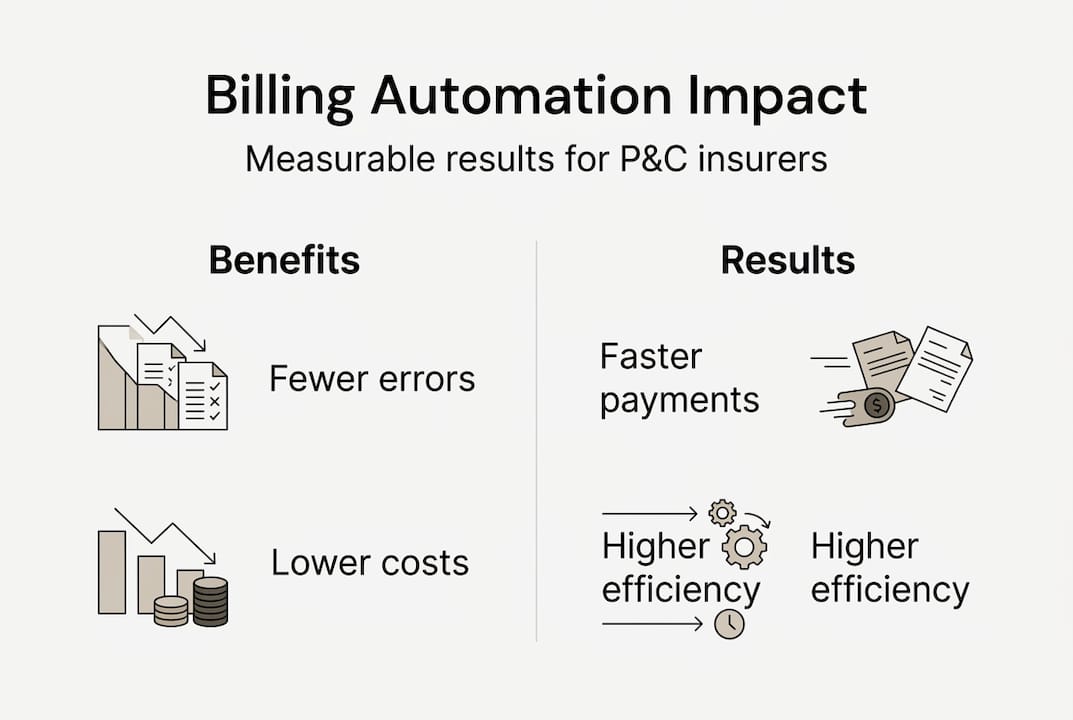
Infographic of benefits and results of billing automation

Beyond the customer experience, consider the billing process impact on your operations team. Manual reconciliation, paper invoicing, and phone-based payment collection consume hours that could be redirected to exception handling and strategic work. Automation does not simply speed up what already exists. It changes the nature of the work entirely.

Here are the key business benefits that make automation a board-level conversation:

  • Reduced error rates: Automated rules engines eliminate manual keying mistakes and misapplied payments
  • Lower operating costs: Straight-through processing (STP) cuts the labour required per transaction significantly
  • Improved compliance: Automated audit trails and configurable rules support multi-jurisdictional regulatory requirements
  • Faster cash collection: Automated reminders and retry logic reduce days premium outstanding (DPO)
  • Higher customer retention: Self-service portals and flexible payment options reduce friction-driven lapses
  • Scalability: Automated workflows handle volume spikes without proportional headcount increases

“The real cost of manual billing is not just the errors you catch. It is the customers you lose before you realise anything went wrong.”

For insurance executives, the business case is not theoretical. It is measurable, and the benchmarks are now well established across the industry.

Core components and tools for billing automation

Knowing why automation matters is one thing. Knowing what you actually need to build it is another. Billing automation requires integration with policy administration, general ledger, and claims systems to create a seamless workflow. Without these connections, you are automating fragments rather than the full billing cycle.

The table below outlines the core components, their function, and the key integration considerations for each.

Component Function Integration consideration
Policy administration Source of truth for premium, coverage, and endorsements Real-time sync required for mid-term changes
General ledger Financial sub-ledger reconciliation and reporting Automated journal entries on payment events
Claims system Offset billing against claims payments where applicable Bidirectional data flow for accurate balances
Payment gateway Processes card, ACH, and direct debit transactions PCI-DSS compliance and retry logic essential
CRM Customer communication and self-service portal Triggers for reminders, confirmations, and escalations

Beyond the integrations, the architecture itself matters. A flexible rules engine lets you configure billing plans, instalment schedules, and dunning sequences (the automated process of chasing overdue payments) without custom development for every product line. API-first design ensures that as your ecosystem evolves, new tools can connect without rearchitecting the core.

Must-have technologies for a scalable billing automation rollout include:

  • API-first billing engine with configurable instalment and payment plan logic
  • Real-time event processing for policy changes that affect premium mid-term
  • Automated dunning and retry workflows for failed payments
  • Digital self-service portal for policyholders to manage payment methods and view statements
  • Audit logging for regulatory compliance and dispute resolution

For billing process efficiency, your policy administration tools and claims management integration must operate as a unified system, not separate silos passing files overnight.

Insurance specialists discuss billing tools integration

Pro Tip: Insurance billing has unique requirements that generic accounts receivable platforms were not designed to handle. Start with an insurance-specific platform that already understands endorsements, pro-rata calculations, and regulatory variance. Retrofitting a generic tool costs far more in time and customisation than choosing the right platform from the outset.

Step-by-step: Implementing automated billing workflows

A clear sequence prevents the most common implementation failures. Best practice favours phased rollouts, starting with simpler policy types and engaging cross-functional teams throughout. Here is a practical roadmap.

  1. Assess and prepare: Audit your current billing data quality, map existing workflows, and identify integration points. Assign a cross-functional project team including finance, IT, operations, and compliance.
  2. Define requirements: Document billing rules, instalment options, payment methods, dunning logic, and regulatory constraints for each product line and jurisdiction.
  3. Select your platform: Evaluate insurance-specific platforms against your requirements. Prioritise API flexibility, configurability, and vendor track record with P&C carriers.
  4. Run a pilot: Choose a single, lower-complexity product line. Configure, test, and validate against real billing scenarios before expanding.
  5. Phased rollout: Expand to additional product lines incrementally, incorporating lessons from the pilot. Maintain parallel processing briefly to catch discrepancies.
  6. Governance and optimisation: Establish ongoing monitoring, KPI tracking, and a regular review cadence to refine rules and address emerging edge cases.

The choice between a phased rollout and a big-bang approach is worth examining carefully.

Approach Advantages Risks
Phased rollout Lower risk, faster learning, easier rollback Longer overall timeline, temporary complexity
Big-bang Single cutover, uniform experience from day one High risk, difficult to isolate issues, staff strain

For most P&C carriers, phased rollout is the safer path. The automation benefits compound over time, and a controlled expansion protects both data integrity and customer experience during transition. Refer to billing process guidance for additional sequencing detail.

Pro Tip: Before go-live on any phase, run your automated workflows against a full set of real historical billing scenarios, including edge cases like mid-term cancellations, partial payments, and reinstatements. Surprises in production are far more costly than surprises in testing.

Troubleshooting and compliance: Navigating pitfalls

Even well-planned automation projects encounter problems. Knowing what to expect reduces the time you spend firefighting and increases the time you spend improving.

Common pitfalls in P&C billing automation include:

  • Poor data quality: Legacy systems often contain duplicate records, inconsistent formats, and missing fields. Data cleansing before migration is not optional.
  • Change management gaps: Staff who relied on manual processes need retraining and clear communication about new workflows. Resistance is predictable; plan for it.
  • Failed payment handling: Automated dunning must be configured carefully. Overly aggressive retry logic can trigger bank flags; too passive and you lose premium.
  • Regulatory variance: Different jurisdictions have different rules on instalment fees, notice periods, and cancellation procedures. These must be embedded in your rules engine, not managed manually.
  • Legacy system integration failures: Older policy admin systems may not support real-time APIs. Middleware or event-driven architecture may be required.

Complex commercial policies and legacy systems present unique challenges that require configurable rules and deep integration. Compliance must be embedded throughout, not bolted on afterwards.

“Generic automation platforms treat insurance billing like any other accounts receivable process. The moment you encounter a mid-term endorsement on a commercial package policy, that assumption falls apart entirely.”

Consider a practical example. A commercial property insurer adds a new location to an existing policy mid-term. The billing system must calculate pro-rata additional premium, generate a revised invoice, update the instalment schedule, and notify the policyholder, all automatically and in compliance with the applicable jurisdiction’s notice requirements. Embed regulatory compliance in your automation rules logic from the start, particularly for multi-jurisdictional operations.

Ongoing optimisation matters as much as the initial build. Schedule quarterly reviews of exception reports, failed payment rates, and customer complaints to identify rules that need adjustment as your product mix and regulatory environment evolve. Review compliance in billing requirements regularly to stay current.

Measuring success: KPIs and business impact

Automation without measurement is just activity. The goal is demonstrable, quantifiable improvement. With proper implementation, up to 70% error reduction and 83% digital payment adoption are achievable benchmarks for P&C carriers.

The KPIs that matter most for billing automation include:

  • Days premium outstanding (DPO): Measures how quickly premium is collected after billing. Lower is better.
  • Straight-through processing (STP) rate: The percentage of transactions completed without manual intervention. Target above 85% for mature programmes.
  • E-payment adoption rate: Tracks the shift from cheque and manual payments to digital channels.
  • Lapse rate due to payment failure: Isolates involuntary lapses caused by billing friction rather than customer intent to cancel.
  • Billing error rate: Tracks incorrect invoices, misapplied payments, and reconciliation discrepancies.
  • Customer satisfaction score (CSAT) for billing interactions: Measures the policyholder experience directly.

Track DPO, e-payment adoption, lapse rates, and STP as your primary indicators of automation health. High STP rates and growing digital payment adoption are the clearest signals that your project is delivering.

Building a regular audit cadence into your governance model ensures you catch drift early. Billing rules that worked well at launch may need adjustment as new products launch, regulations change, or customer behaviour shifts. Review your billing optimisation tips regularly and treat automation as a living system rather than a one-time deployment.

What most insurers get wrong about billing automation

The most common mistake we see is treating billing automation as a technology project rather than a business transformation. Executives approve a platform, IT deploys it, and six months later the error rates have barely moved. The technology worked. The transformation did not.

True automation success requires redesigning the underlying processes before you automate them. Automating a broken workflow produces broken results faster. Executives often mistake automation for simple tech deployment, ignoring the deep process changes required to realise the full benefit.

Cross-silo collaboration is equally underestimated. Finance, operations, IT, and compliance each own a piece of the billing workflow. When they are not aligned on requirements and governance, the automation serves one team well and creates problems for the others. The technology is rarely the bottleneck. Stakeholder alignment almost always is.

Post-go-live governance is where most programmes quietly lose momentum. The teams move on to the next project, and the billing automation runs without oversight until a significant failure surfaces. Sustained improvement requires sustained attention. Explore how AI in insurance automation is extending what is possible for carriers who have already built strong automation foundations.

Accelerate your insurance billing transformation

If you are ready to move beyond manual billing and build a genuinely automated, compliant, and customer-friendly billing operation, IBSuite is designed for exactly this challenge. IBA’s policy administration solution and claims management solution are built to work together as part of a unified, API-first platform that supports the full P&C insurance value chain. From configurable billing rules to real-time payment processing and regulatory compliance, IBSuite gives your team the tools to automate with confidence. Book a demo to see how IBSuite handles real-world billing complexity and delivers measurable results from day one.

Frequently asked questions

What are the key KPIs for billing automation in P&C insurance?

Track DPO, e-payment adoption, lapse rates, and STP as your primary performance indicators, with high STP rates and growing digital adoption signalling a successful programme.

How does automation improve customer experience for P&C insurers?

Automation enables self-service portals, flexible payment options, and automated retry logic that reduces churn from payment friction, making billing a retention tool rather than a liability.

What is a common pitfall when implementing billing automation?

Insufficient data cleansing and rushed timelines are the most frequent causes of integration failure; a phased, insurance-specific approach significantly reduces this risk.

What systems must billing automation integrate with?

Billing automation must connect with policy administration, general ledger, claims, and payment systems to support a seamless, end-to-end workflow.

What error reduction can you expect from billing automation?

Insurers that implement automation properly can achieve up to 70% error reduction compared to manual billing workflows, alongside significantly lower operating costs.

Streamline policy management for insurance success

Streamline policy management for insurance success

Manager reviewing insurance policies in office


TL;DR:

  • Policy management is a strategic backbone impacting compliance, customer experience, and profitability.
  • Modern systems combine automation with human judgment to handle complex insurance scenarios effectively.
  • Treating policy management as a core strategic function enhances insurer resilience and competitive advantage.

Policy management is not a back-office afterthought. For property and casualty insurers, it is the operational backbone that determines whether your firm can price accurately, comply reliably, and serve customers without friction. Yet too many executives treat it as a clerical function, delegating it downward without strategic oversight. That misalignment is costly. From regulatory exposure to E&O claims and customer attrition, the consequences of poor policy management compound quietly until they become impossible to ignore. This article breaks down what modern policy management actually involves, where the real risks hide, and what it takes to build a future-ready approach.

Table of Contents

Key Takeaways

Point Details
Policy management defined It involves controlling the complete lifecycle of insurance policies to maximise efficiency, compliance, and customer value.
Key challenges revealed Legacy systems, policy complexity, and manual review processes create risk and hinder transformation.
Human and digital synergy Successful policy management blends automation for routine tasks with expert intervention for complex cases.
Modernisation best practices Integrating automation, data, and flexible processes builds agile, scalable insurance operations.

Defining policy management in insurance

Policy management, at its core, is the discipline governing the full lifecycle of an insurance policy. From the moment a quote is generated to the final cancellation or non-renewal, every transaction, adjustment, and communication falls within its scope. For P&C insurers, this lifecycle is rarely linear. It involves quoting, binding, issuing, endorsements, mid-term adjustments, renewals, and cancellations, each carrying its own compliance requirements and operational dependencies.

The technology layer underpinning this discipline is the Policy Administration System (PAS). A PAS is fundamentally a transaction engine. It records, processes, and tracks policy events. What it is not, and what many firms mistakenly expect it to be, is an analytics or reporting platform. As policy administration experts note, treating your PAS as a ledger for business intelligence rather than a transaction processor creates misaligned expectations and underinvestment in the right tools.

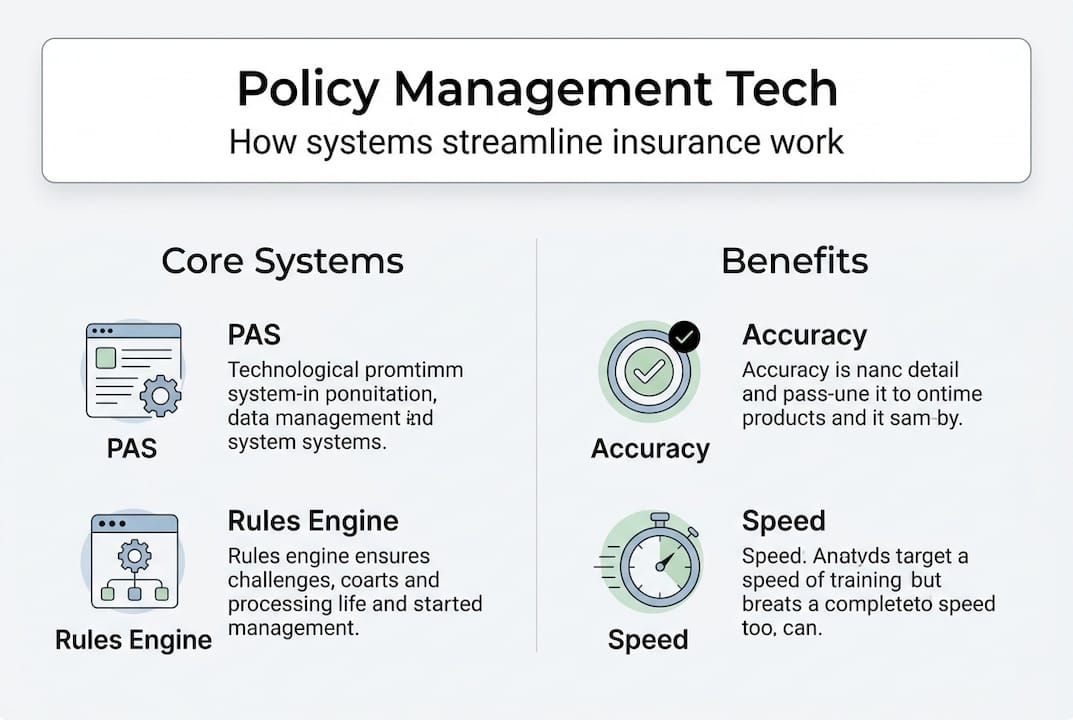
Infographic showing core systems and benefits

Understanding insurance product management value is essential here. Product design and policy administration are deeply intertwined. A product built without considering how it will be administered creates downstream chaos in endorsements, rating, and compliance.

The core processes within policy management include:

  • Quoting and binding: Generating accurate risk-based prices and confirming coverage
  • Policy issuance: Producing compliant documents and delivering them to policyholders
  • Endorsements: Processing mid-term changes to coverage, limits, or insured details
  • Renewals: Reassessing risk and repricing at policy expiry
  • Cancellations and reinstatements: Managing terminations within regulatory timelines

“A policy administration system is a transaction engine first. Expecting it to serve as your analytics backbone leads to underperformance on both fronts.”

When policy management works well, it directly improves profitability through accurate rating, reduces compliance risk, and creates the seamless experience that retains customers. Effective change management in insurance is what ensures these processes evolve without disrupting the business.

The key challenges in policy management

Having outlined the scope, it is essential to confront the challenges that make effective policy management elusive for most P&C carriers.

The first challenge is sheer complexity. Commercial lines policies in particular can involve dozens of coverage parts, multiple endorsements, and bespoke conditions. Each variation creates a decision point that must be handled accurately. Personal lines may be higher in volume but carry their own edge cases, particularly around personal insurance scenarios that fall outside standard rating rules.

Analyst sorting complex insurance paperwork

Mid-term adjustments (MTAs) are a persistent source of friction. When a policyholder changes their vehicle, adds a driver, or adjusts their coverage limits, the system must recalculate premium, generate revised documents, and trigger billing changes, all without error. High-volume MTAs are one of the leading causes of administrative breakdown.

Legacy systems compound every problem. Siloed data, inflexible rating engines, and manual workarounds create the conditions for error. The integration challenges in insurance that arise from disconnected systems are not just technical inconveniences. They translate directly into inaccurate policies and delayed responses.

Challenge Business impact Risk level
High-volume MTAs Process delays, billing errors High
Legacy system silos Data inaccuracy, poor customer experience High
Manual review processes 2-3% error rate, E&O exposure Critical
Multi-jurisdictional compliance Regulatory penalties, inconsistency High
Complex commercial policies Underwriting gaps, coverage disputes Medium-High

The manual error rate in policy administration sits at 2 to 3%, driven by complex commercial policies, legacy data silos, and high-volume MTAs. That figure sounds small until you apply it to a book of 200,000 policies. Suddenly, thousands of policies carry errors that could trigger E&O claims or regulatory scrutiny.

Multi-jurisdictional compliance adds another layer. Insurers operating across regions must apply different rules, forms, and filing requirements consistently. Failure to do so creates regulatory exposure that is difficult and expensive to remediate. Applying insurance risk management best practices at the process level is what separates firms that manage this well from those that do not.

Human in the loop: Technology’s role and its limits

These difficulties point toward digital solutions, but technology is not the full answer.

A modern PAS automates the routine. Standard endorsements, renewal notices, premium calculations, and document generation can all be handled without human intervention when the inputs are clean and the rules are well-defined. This is where automation delivers genuine value: speed, consistency, and reduced administrative cost.

But not every policy transaction fits neatly into a ruleset. Complex commercial risks, unusual coverage combinations, and regulatory ambiguities require human judgement. This is the principle behind human-in-the-loop (HITL) design, where automated systems handle standard cases and flag exceptions for skilled underwriters or administrators to review.

“The most effective policy operations are not the most automated. They are the ones that know precisely where automation ends and human judgement must begin.”

Rules engines are a critical component of this architecture. Rather than hardcoding logic into your PAS, externalising business rules into a dedicated rules engine allows you to update rating logic, compliance requirements, and underwriting guidelines without a full system rebuild. This modularity is what makes digital transformation sustainable rather than disruptive.

Approach Best suited for Key limitation
Full automation Standard, high-volume transactions Fails on edge cases
Rules engine Configurable logic, regulatory updates Requires ongoing maintenance
Human-in-the-loop Complex, ambiguous, high-risk scenarios Slower, higher cost
Hybrid model Most P&C operations Requires clear escalation design

Pro Tip: When designing your HITL workflow, map every exception type to a specific escalation path before implementation. Undefined exceptions become bottlenecks that negate the efficiency gains from automation.

Exploring AI in insurance policy management reveals how machine learning can assist in flagging anomalies and prioritising review queues, but the final decision on complex risks still benefits from experienced human oversight. An API-first approach in insurance enables the integrations that make HITL workflows function across systems without manual data transfer.

Modernising policy management: Best practices for transformation

With an understanding of technology’s role and limits, it is time to examine actionable strategies that create real impact.

  1. Assess your current state honestly. Before investing in new technology, audit your existing systems, processes, and data flows. Identify where manual workarounds exist, where data is duplicated, and where compliance gaps are most acute. This baseline shapes every subsequent decision.

  2. Prioritise integration over replacement. Most insurers cannot replace their core systems overnight. A more practical approach is to integrate modern tools around your existing PAS, connecting rating, billing, and CRM through APIs. This reduces data integration friction in insurance without the risk of a full cutover.

  3. Automate routine steps, design for exceptions. Identify the highest-volume, lowest-complexity transactions in your book and automate those first. Then design explicit exception-handling workflows for the cases that require human review. Do not automate ambiguity.

  4. Adopt cloud-native and modular architecture. Cloud-native insurance transformation enables insurers to scale processing capacity, receive continuous updates, and integrate new capabilities without large capital expenditure. Modular design means you can upgrade components independently rather than replacing everything at once.

  5. Invest in change management. Technology without adoption is waste. Staff who understand why processes are changing, and who are trained on new workflows, deliver far better outcomes than those who resist or work around new systems. Compliance through next-generation platforms depends as much on people as on software.

Pro Tip: Run a parallel processing pilot on a defined subset of your book before full rollout. This surfaces integration issues and workflow gaps in a controlled environment, protecting your broader operation.

The firms that modernise most successfully treat policy management transformation as a programme, not a project. It requires sustained leadership attention, clear milestones, and a willingness to iterate based on what the data reveals.

Why policy management is insurance’s core hidden lever

Here is the view that too many in the insurance sector miss: policy management is consistently undervalued as a strategic asset. Boards and executive teams invest heavily in product innovation, distribution strategy, and brand positioning. Policy management gets categorised as operations and handed to middle management with a mandate to keep costs down.

This is a strategic error. The firms that treat policy administration as a board-level priority consistently outperform on customer retention, regulatory resilience, and speed to market. When your policy foundation is adaptable, you can launch new products faster, respond to regulatory changes without crisis, and deliver the kind of consistent customer experience that drives loyalty.

Conversely, digital transformation programmes that neglect policy management fail at the implementation stage. A brilliant distribution strategy collapses if the underlying policy issuance process cannot handle volume or variation. Investing in change management strategies that elevate policy management to a strategic function is not an operational nicety. It is a competitive necessity. The insurers who will lead the next decade are those who have already made this shift.

Improve your policy management with advanced insurance platforms

Putting these strategies into practice requires the right technology foundation. IBA’s policy administration solution is built specifically for P&C insurers who need to manage complex policy lifecycles with precision, speed, and regulatory confidence. From endorsements and renewals to multi-jurisdictional compliance, it handles the full spectrum of policy transactions without the constraints of legacy architecture. The IBSuite insurance platform extends this further, connecting policy administration with underwriting, billing, claims, and CRM in a single cloud-native environment. If your firm is ready to move from reactive administration to proactive policy management, explore IBSuite or speak with our team about a tailored demonstration.

Frequently asked questions

What is the main goal of policy management in insurance?

The main goal is to efficiently control the entire lifecycle of policies to maximise compliance, minimise risk, and improve operational outcomes. A well-functioning PAS acts as a transaction engine, ensuring every policy event is recorded and processed accurately.

How does digital transformation help policy management?

Digital transformation standardises processes, integrates data, and automates routine tasks, driving greater speed and accuracy. PAS automation handles standard transactions whilst human-in-the-loop workflows manage complex scenarios that require judgement.

Why can’t all policy management be automated?

Complex policies, regulatory differences, and judgement calls still require human expertise alongside automation. HITL design exists precisely because edge cases and ambiguous risks cannot be reliably resolved by rules alone.

What are common causes of errors in policy administration?

Manual reviews, legacy system silos, and frequent policy changes (MTAs) often drive error rates of 2 to 3% across policy books, creating significant E&O exposure and compliance risk for P&C insurers.

Insurance customer self-service: boost engagement in 2026

Insurance customer self-service: boost engagement in 2026

Woman using insurance portal at kitchen table

85% of policyholders now value instant digital access to payments, ID cards, and policy details, yet many insurers still rely on phone queues and manual processes that frustrate rather than retain. The gap between what customers expect and what most carriers deliver is widening fast. For property and casualty (P&C) insurance leaders, closing that gap is no longer a future ambition. It is a present-day competitive necessity. This guide breaks down what insurance customer self-service actually means, why the business case is stronger than ever, what commonly goes wrong, and how to build something that genuinely works.

Table of Contents

Key Takeaways

Point Details
Digital self-service is essential Modern insurance customers expect quick, flexible online access to their policy needs.
Empirical benefits are clear Leading insurers achieve lower costs and higher satisfaction by digitising routine workflows.
Not a replacement for agents Human guidance is still vital for complex situations and escalations.
Trust outpaces technology Data quality, transparency, and balanced automation determine long-term success.
Actionable rollout steps Prioritise high-ROI modules, benchmark against leaders, and ensure strong UX and compliance.

What is insurance customer self-service?

Insurance customer self-service is the digital enablement of routine insurance tasks that policyholders complete on their own, without needing to call an agent or visit a branch. Think of it as giving your customers a well-organised control panel for their insurance relationship. They log in, do what they need, and move on with their day.

The range of interactions covered is broader than many executives initially assume. Core self-service capabilities typically include:

  • Viewing and downloading policy documents and certificates
  • Reporting First Notice of Loss (FNOL), the initial claim notification after an incident
  • Tracking claim status in real time
  • Accessing digital ID cards
  • Updating contact and billing details
  • Making payments and viewing payment history
  • Requesting policy endorsements or coverage changes

72% of customers prefer digital self-service for policy changes, which signals a clear shift in how policyholders want to interact with their insurers. This is not a niche preference. It is mainstream behaviour.

Critically, self-service is not about replacing agents. It is a choice model. Complex queries, sensitive claims, and relationship-driven conversations still benefit enormously from skilled human involvement. What self-service does is free your agents to focus on those high-value interactions, while routine tasks are handled efficiently by the customer themselves. When built on modern insurance platforms, self-service becomes the foundation for improved customer experience (CX), meaningful cost efficiency, and genuine competitive differentiation.

Pro Tip: Map your current inbound call types before investing in self-service features. If 40% of calls are payment queries, that is your first digitisation priority, not the most technically exciting feature on your roadmap.

Key benefits: Why insurers are prioritising self-service

The drivers of digital transformation in insurance are well documented, but the financial and operational case for self-service specifically is compelling enough to stand on its own.

The headline figure: digitisation and automation can reduce operating expenses by up to 40%, alongside a 30 to 50% reduction in inbound call volumes. For a mid-sized P&C insurer handling tens of thousands of routine interactions monthly, that is a transformational cost reduction.

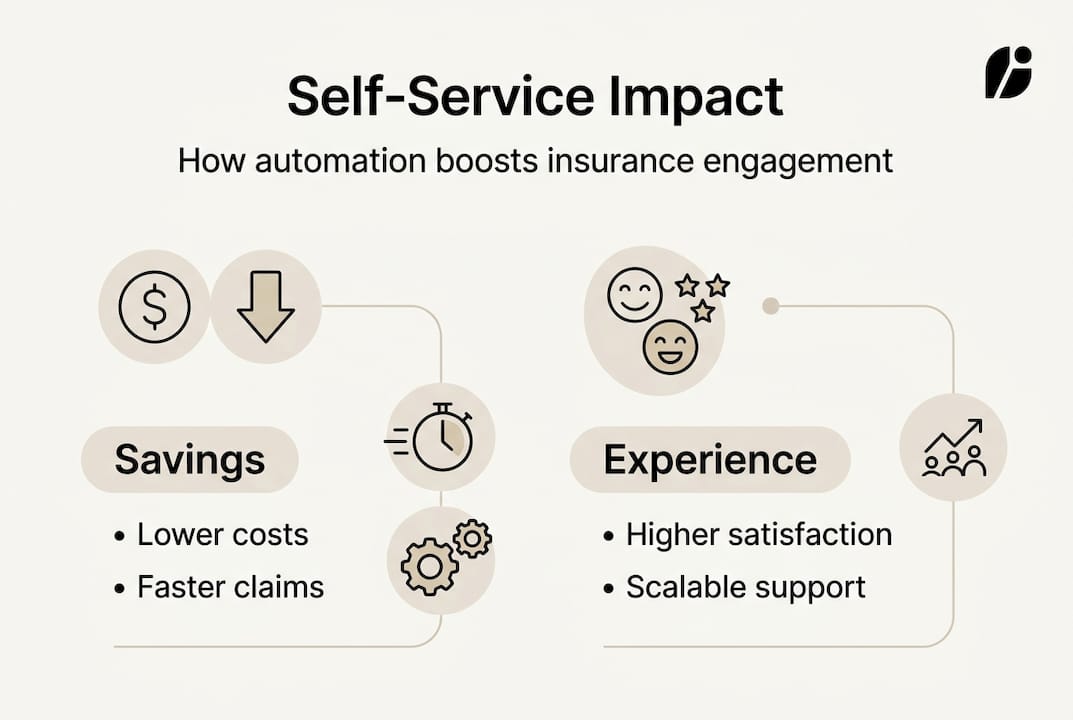
Infographic showing insurance self-service benefits

Benefit Impact
Reduced cost per interaction Digital self-service costs a fraction of agent-handled calls
Higher customer satisfaction Fast resolution drives loyalty and reduces churn
Scalability during peak events Portals absorb catastrophe claim surges without staffing spikes
Competitive differentiation Leaders set benchmarks that peers scramble to match
Agent productivity Frees staff for complex, high-value conversations

Beyond cost, customer satisfaction scores rise sharply when policyholders can resolve issues quickly and independently. Loyalty is built not in the moment of purchase but in the moments of need. A customer who files a FNOL at 11pm from their phone and receives instant confirmation is far less likely to shop around at renewal.

Insurance agent assisting customer at desk

Scalability deserves special attention. Catastrophe events create sudden, massive claim surges that overwhelm traditional service models. A well-built self-service portal absorbs that volume without a corresponding spike in staffing costs. Knowing how to digitise insurance processes effectively is what separates insurers who thrive during those events from those who simply survive them.

Forward-thinking insurers are also recognising self-service as a competitive signal. When your portal is faster, cleaner, and more capable than a competitor’s, that becomes part of your value proposition at the point of sale.

Risks, trade-offs, and what most self-service rollouts get wrong

The case for self-service is strong. But the path to getting it right is littered with expensive mistakes. Clunky UX, data quality issues, lack of human fallback, and underinsurance risk remain the most cited concerns from insurers who have invested heavily and seen disappointing results.

Here is what typically goes wrong, in order of frequency:

  1. Poor user experience leads to abandonment. If your self-service portal requires more than three steps to find a policy document, customers will call instead. Every unnecessary click is a failure point.
  2. Data quality errors undermine trust. If a customer sees incorrect coverage details or an outdated payment record, they lose confidence in the entire platform, and in your brand.
  3. No clear escalation path. Self-service must always offer a visible, frictionless route to human support. Customers who feel trapped in a digital loop become your most vocal detractors.
  4. Underinsurance risk. Without guided prompts or advisory nudges, customers making self-service coverage changes may inadvertently reduce protection. This creates liability exposure and poor outcomes at claim time.

“The insurers who struggle most with self-service are not the ones who built too little. They are the ones who automated too fast without designing for the moments when customers genuinely need a human.”

Data privacy is another non-negotiable. Robust insurance data privacy controls are mandatory, not optional. GDPR compliance, secure authentication, and transparent data handling are table stakes for any self-service deployment in 2026.

Pro Tip: Before launch, run your self-service flows through usability testing with real policyholders across different age groups and digital literacy levels. What feels intuitive to your development team may be completely opaque to a 65-year-old filing their first FNOL. The role of AI in P&C insurance is growing, but human-centred design remains the foundation.

Best practices: Designing self-service that delivers results

Given these risks, what actually works? The most successful self-service rollouts in P&C insurance share a consistent set of priorities.

  1. Start with high-ROI workflows. Policy documents, FNOL, and payments deliver the highest return when digitised first. These are the interactions customers need most frequently and where digital resolution creates the greatest satisfaction uplift.
  2. Integrate AI thoughtfully. Personalisation through AI-powered customer engagement can surface relevant coverage recommendations, flag anomalies in claims data, and guide customers through complex flows. But every AI touchpoint must have a clear human fallback. Explainability matters too: customers should understand why they are seeing a particular prompt or recommendation.
  3. Benchmark against leaders, not just peers. The best P&C self-service portals are now being compared to retail and banking apps by customers. Your benchmark should be the best digital experience your customer uses daily, not the industry average.
  4. Build on cloud-native, API-first core systems. Scalability, integration flexibility, and the ability to iterate quickly all depend on your underlying technology. Approaches to API-first personalisation demonstrate how modern architecture enables insurers to tailor experiences at scale without rebuilding from scratch.
  5. Measure continuously. Track abandonment rates, task completion rates, and post-interaction satisfaction scores. Use that data to prioritise your next iteration.

Pro Tip: Do not treat self-service as a one-time project. The insurers who win are those who treat their digital portal as a living product, releasing improvements regularly and responding to customer behaviour data. Modernising insurance operations is an ongoing discipline, not a destination.

Why the real competitive edge is trust, not just automation

Here is the uncomfortable truth that most self-service guides skip over: automation is a commodity. Every insurer will eventually have a portal, a mobile app, and some form of digital FNOL. The technology itself will not separate winners from losers for long.

What will separate them is trust. Customers who encounter a data error, a confusing flow, or a dead end when they need help do not just abandon the task. They abandon the insurer. Trust, once broken in a digital interaction, is extraordinarily difficult to rebuild.

The insurers who will genuinely outpace their competitors are those who design self-service with human fallback built in from day one, not bolted on as an afterthought. They are transparent about how data is used. They offer flexibility for customers who want digital and for those who still want a phone call. They build modern insurance platforms that empower both policyholders and intermediaries, creating lifetime relationships rather than transactional touchpoints.

Automation delivers scale. Trust delivers loyalty. The smartest investment you can make in self-service is designing for both simultaneously.

Take customer engagement to the next level with IBApplications

The self-service principles covered in this guide, from high-ROI workflow prioritisation to AI integration and human fallback design, require a core platform that can actually deliver them. IBApplications’ IBSuite is built precisely for this. As a cloud-native, API-first platform, IBSuite Insurance Platform supports the full P&C insurance value chain, giving you the technical foundation to launch and iterate self-service capabilities at speed. Explore sales and underwriting solutions and policy administration features to see how IBApplications helps insurers build the digital experiences that today’s policyholders expect and tomorrow’s market will demand.

Frequently asked questions

What are the most common self-service features in P&C insurance?

Policy document access, payments, FNOL, and policy changes are the most used self-service features. 85% of users value quick access to payments, ID cards, and policy details above all other digital capabilities.

Does self-service mean customers never need a human agent?

No. Complex claims and disputes still require skilled human intervention for the best outcomes. Complex claims require human escalation, with AI flagging issues for agents rather than replacing their judgement.

How does self-service impact customer loyalty?

Fast, easy access to policy information and quick resolutions increase loyalty, while friction or errors drive customers away. 60% consider switching after a poor claims experience, making seamless self-service a direct retention tool.

Can digital self-service help handle claim surges during catastrophes?

Yes. Robust self-service portals help insurers scale up and manage high claim volumes efficiently. Digital self-service handles surges during catastrophe events without requiring proportional increases in staffing.

What are critical best practices for launching self-service in insurance?

Prioritise high-ROI workflows, ensure strong UX and data quality, and always provide clear escalation to human support. Prioritising high-ROI features alongside robust human fallback is what consistently separates successful rollouts from costly failures.

Top underwriting process improvement ideas for efficiency

Top underwriting process improvement ideas for efficiency

Underwriter mapping process on office table

Underwriting sits at the heart of every P&C insurer’s profitability, yet it remains one of the most bottleneck-prone functions in the business. Manual data entry, inconsistent decision frameworks, and slow exception handling eat into cycle times and erode competitive advantage. The pressure to move faster without sacrificing accuracy or compliance has never been greater. This article sets out evidence-backed improvement ideas, practical comparisons, and a clear framework for phased implementation, giving you the tools to drive measurable gains in underwriting efficiency without exposing your firm to unnecessary risk.

Table of Contents

Key Takeaways

Point Details
Start with workflow mapping Identify bottlenecks and pain points as the first step toward digital transformation.
Automate routine tasks AI and digital tools can halve review times and cut costs significantly while freeing underwriters for complex cases.
Match effort to risk Use intelligent triage to ensure easy cases are streamlined and expertise focuses on high-impact decisions.
Use quality data and analytics Standardised data collection and predictive analytics produce more accurate, faster decisions across teams.
Embrace continuous improvement Feedback from KPIs and digital tools should continually refine underwriting processes for lasting results.

Diagnosing process pain points: Mapping workflows and addressing bottlenecks

Before you can fix what is broken, you need to see it clearly. Most underwriting inefficiencies are invisible until someone maps the full process end to end. Common pain points include manual data entry, inconsistent exception handling, unclear decision authority, and handoff delays between teams. These issues compound over time, inflating cycle times and frustrating both underwriters and brokers.

Mapping and documenting current workflows is the essential first step to identifying bottlenecks like manual data entry and exception handling. A well-structured workflow map reveals exactly where decisions stall, where data is re-keyed unnecessarily, and where accountability gaps exist.

When building your diagnostic, focus on these core areas:

  • Handoff points between teams or systems where delays accumulate
  • Data input stages where manual entry introduces errors or duplication
  • Exception queues that pull senior underwriters away from complex risks
  • Decision authority gaps that cause escalations for routine cases
  • KPI blind spots where cycle time, hit ratio, or loss ratio are not tracked consistently

Pro Tip: Run a one-week time-in-motion study across your underwriting team before committing to any technology investment. The findings often reveal that 30 to 40 per cent of delays sit in process design rather than system capability.

“You cannot improve what you cannot measure. Workflow mapping is not a one-time exercise; it is the foundation of a continuous improvement culture in underwriting.”

Once you have a clear picture of your current state, prioritise fixes by impact and ease of implementation. Quick wins build momentum and demonstrate value to stakeholders before larger transformation programmes begin. Tracking KPIs such as cycle time, submission-to-bind ratio, and referral rate gives you the baseline data needed to prove ROI at every stage of optimising underwriting workflows.

Automation and AI: Transforming repetitive tasks for faster, smarter underwriting

Once pain points are identified, automation delivers the most immediate improvements in efficiency. The goal is not to replace underwriters but to remove the low-value, repetitive work that slows them down and introduces errors.

Businesswoman using underwriting automation tools

Automating repetitive tasks such as data extraction, pre-screening, and compliance checks using AI and digital tools frees experienced underwriters to focus on risk judgement and relationship management. The productivity gains are significant and well-documented.

Consider this comparison of manual versus automated underwriting tasks:

Task Manual approach Automated approach
Data extraction Hours per submission Minutes via OCR and AI
Compliance checks Analyst review Real-time rule engine
Pre-screening Senior underwriter time Automated scoring model
Document validation Manual cross-referencing AI-powered verification

The results speak for themselves. Aviva achieved a 50% reduction in medical underwriting review time and £100M in claims savings through machine learning and AI integration. That is not a marginal gain; it is a structural shift in operating economics.

A phased approach works best for most insurers:

  1. Pilot on a single product line to validate the technology and build internal confidence
  2. Measure cycle time and error rate improvements before expanding scope
  3. Scale automation to adjacent lines once the model is proven and refined
  4. Integrate with existing systems to avoid creating new data silos
  5. Train underwriters to work alongside automated tools rather than around them

Explore digital underwriting workflow automation and the broader case for using automation and AI in P&C underwriting to understand where the technology is heading and how to position your firm ahead of the curve.

Intelligent triage and segmentation: Matching effort to case complexity

Beyond automation, risk segmentation and triage amplify process gains. Not every submission deserves the same level of scrutiny, and treating them as if they do wastes your most valuable resource: experienced underwriter time.

Intelligent triage matches effort to risk complexity, routing low-touch cases for automated processing while directing high-value or unusual risks to senior review. The result is faster throughput across the board without compromising quality where it matters most.

Here is how a segmented model typically looks in practice:

Risk tier Characteristics Recommended handling
Simple Standard profile, low value, clean data Straight-through processing
Moderate Some exceptions, mid-value, minor gaps Automated with light review
Complex Non-standard, high value, emerging risk Senior underwriter judgement

The hybrid model is optimal: AI handles data processing and triage efficiently, while humans apply strategic judgement where it genuinely adds value. This is not a compromise; it is the most commercially rational design.

Key benefits of intelligent triage include:

  • Faster average processing times across all submission types
  • Consistent outcomes for standard risks with less variability
  • Senior underwriters spending more time on genuinely complex cases
  • Reduced referral volumes clogging exception queues

Pro Tip: Set clear, rules-based criteria for each risk tier before deploying triage tools. Ambiguous boundaries create more exceptions, not fewer, and undermine the efficiency gains you are trying to achieve.

Understand why automated underwriting matters for P&C insurers looking to scale without proportionally increasing headcount.

Enhancing decision quality: Data standardisation and predictive analytics

Smarter segmentation is maximised when paired with high-quality data and analytics. Inconsistent data inputs are one of the most underestimated sources of underwriting inefficiency. When different teams collect different information in different formats, comparison becomes difficult and decision quality suffers.

Standardising data collection and applying consistent underwriting guidelines across teams removes this variability. It also makes your data far more useful for analytics and model training.

Predictive analytics take standardised data and turn it into a competitive asset. Real-time analytics and predictive models enable dynamic risk assessment and pricing that responds to market conditions rather than lagging behind them. With real-time insurance data trends shifting rapidly, particularly in cyber and climate-exposed lines, static pricing models are a liability.

The practical benefits of this approach include:

  • Faster decisions because underwriters are not hunting for missing or inconsistent data
  • More accurate pricing driven by richer, cleaner risk signals
  • Scalable best practices that new team members can adopt quickly
  • Regulatory compliance supported by consistent, auditable data trails
  • Climate risk integration through modelling tools that quantify exposure more precisely

Understanding the drivers of digital transformation helps frame why data standardisation is not just an operational nicety but a strategic necessity. Firms that invest in digitising P&C insurance processes now will have a significant analytical advantage within two to three years.

Digital inspections and continuous improvement: Scaling speed without sacrificing control

As data sophistication rises, even physical risk validation can be upgraded and monitored for ongoing gains. Traditional field inspections are time-consuming, costly, and difficult to scale. Digital inspection tools change that equation significantly.

Optimising inspection workflows with digital tools and AI delivers both speed and precision in risk validation. Remote inspections using photo analysis, satellite imagery, and AI-driven assessment tools can reduce review cycles from days to hours while improving consistency.

Key advantages of digital inspection programmes include:

  • Remote validation that eliminates travel time and scheduling delays
  • AI-powered photo analysis that flags structural or hazard issues automatically
  • Standardised reporting that feeds directly into underwriting systems
  • Reduced loss ratios through more accurate pre-bind risk assessment
  • Scalability across high-volume personal and commercial lines portfolios

“Digital inspections are not just about speed. They create a consistent, auditable evidence trail that strengthens both underwriting decisions and claims outcomes.”

Continuous improvement is the other half of this equation. Efficiency gains erode quickly without a feedback loop. Tracking underwriting KPIs such as referral rate, bind ratio, and loss ratio by segment allows you to identify where new bottlenecks are forming before they become entrenched. Review your workflow maps quarterly, not annually. Explore how digital insurance broker efficiency translates into faster underwriting cycles and stronger broker relationships.

A balanced blueprint: Why hybrid workflows empower both tech and underwriting judgement

Here is the uncomfortable truth that many transformation programmes miss: technology alone does not win. The insurers achieving the best results are not the ones who have automated the most; they are the ones who have been most deliberate about where they automate and where they preserve human judgement.

AI cannot replace human judgement for nuanced risks, broker relationships, or regulatory complexity. These are precisely the areas where underwriting expertise creates competitive differentiation. Automating them away does not improve efficiency; it introduces new categories of risk.

Regulatory shifts, climate change, and evolving client expectations all require a blend of analytical capability and experienced judgement. A phased, hybrid approach, where routine tasks are automated and people are empowered to handle exceptions, produces the most resilient and profitable underwriting operations. Explore how compliance in insurance platforms supports this balance by keeping regulatory obligations embedded in the workflow rather than bolted on afterwards.

The firms that will lead in underwriting over the next decade are those building cultures where technology and expertise reinforce each other rather than compete.

Ready to accelerate your underwriting transformation?

The strategies outlined here, from workflow mapping and intelligent triage to predictive analytics and digital inspections, are most powerful when supported by a platform built for the full insurance value chain. IBSuite by IBA is designed precisely for this. It brings together policy administration, claims management, rating, billing, and underwriting automation in a single cloud-native environment. Whether you are modernising a legacy system or scaling a new product line, IBSuite gives your teams the tools to move faster, decide smarter, and adapt to market changes without IT complexity holding you back. Book a custom demo to see how IBSuite can be configured to your specific underwriting challenges.

Frequently asked questions

What is the best way to start improving underwriting processes?

Mapping current workflows to identify bottlenecks such as manual data entry and exception handling is the most effective starting point. This diagnostic step ensures that technology investments target the highest-impact areas first.

How much efficiency can AI automation add to underwriting?

Aviva’s 50% reduction in medical underwriting review time and £100M in claims savings illustrates the scale of gains achievable through AI. Results vary by line of business and implementation approach, but the efficiency case is well-established.

Does automation replace human underwriters?

No. Automation handles routine tasks but expert judgement remains essential for complex, nuanced, or emerging risks where relationships and regulatory context matter.

How do predictive analytics improve underwriting?

Predictive models enable dynamic pricing and risk selection, allowing underwriters to make faster, more consistent decisions based on real-time data signals rather than static historical averages.