22.12.25
Data Integration in Insurance: Driving Insight and Efficiency

Insurance companies in the British market face mounting pressure to keep pace with a data-driven world. More than 60 percent of insurers report that integrating complex data is their top challenge in digital transformation. The right approach to data integration unlocks faster claims processing, richer customer profiles, and sharper risk prediction. Understanding how data integration works in the British insurance sector can help organisations compete, adapt, and deliver better service.
Table of Contents
- What Data Integration Means In Insurance
- Types Of Integration Approaches In Insurance
- How Integration Improves Workflows
- Governance, Security And Compliance Demands
- Addressing Legacy Systems And Technical Debt
Key Takeaways
| Point | Details |
|---|---|
| Significance of Data Integration | Data integration allows insurers to create comprehensive data ecosystems that enhance risk profiling and operational efficiency. |
| Advanced Integration Approaches | Employ hybrid cloud strategies and ontology-based integration to effectively manage diverse data sources and improve technological capabilities. |
| Impact on Workflows | Integrated systems streamline operations, enabling faster decision-making and reducing manual errors across various functions. |
| Governance and Compliance | Developing robust governance frameworks is essential for ensuring data security, compliance, and accountability in integration processes. |
What data integration means in insurance
Data integration in insurance represents a sophisticated process of consolidating and transforming disparate data sources into a unified, actionable insights platform. At its core, this approach enables insurers to aggregate information from multiple channels—including claims records, customer interactions, risk assessments, and external market data—into a cohesive analytical framework.
The significance of data integration extends beyond mere technical consolidation. Technological advancements are fundamentally reshaping insurance products, particularly in domains like individual retirement and life insurance, where rapid, precise customer response has become a critical competitive differentiator. By creating comprehensive data ecosystems, insurers can develop more nuanced risk profiles, personalise product offerings, and streamline operational efficiency.
Practical implementation of data integration involves sophisticated technological infrastructure that can handle complex data transformation. This typically includes data warehousing, real-time processing systems, and advanced analytics platforms capable of ingesting structured and unstructured data from diverse sources. The goal is not just collection, but meaningful interpretation that drives strategic decision-making. Big data convergence enables refined risk assessment methodologies and enhanced fraud prevention mechanisms, transforming how insurers understand and mitigate potential challenges.
Pro Tip: Strategic Data Integration: Begin by conducting a comprehensive audit of your existing data sources, identifying potential integration points, and investing in flexible, scalable technology platforms that can adapt to evolving data landscapes and regulatory requirements.
Types of integration approaches in insurance
Insurance organisations employ multiple data integration approaches to transform their technological capabilities and operational efficiency. These approaches range from traditional methods to advanced technological solutions that enable comprehensive data management and strategic insights.
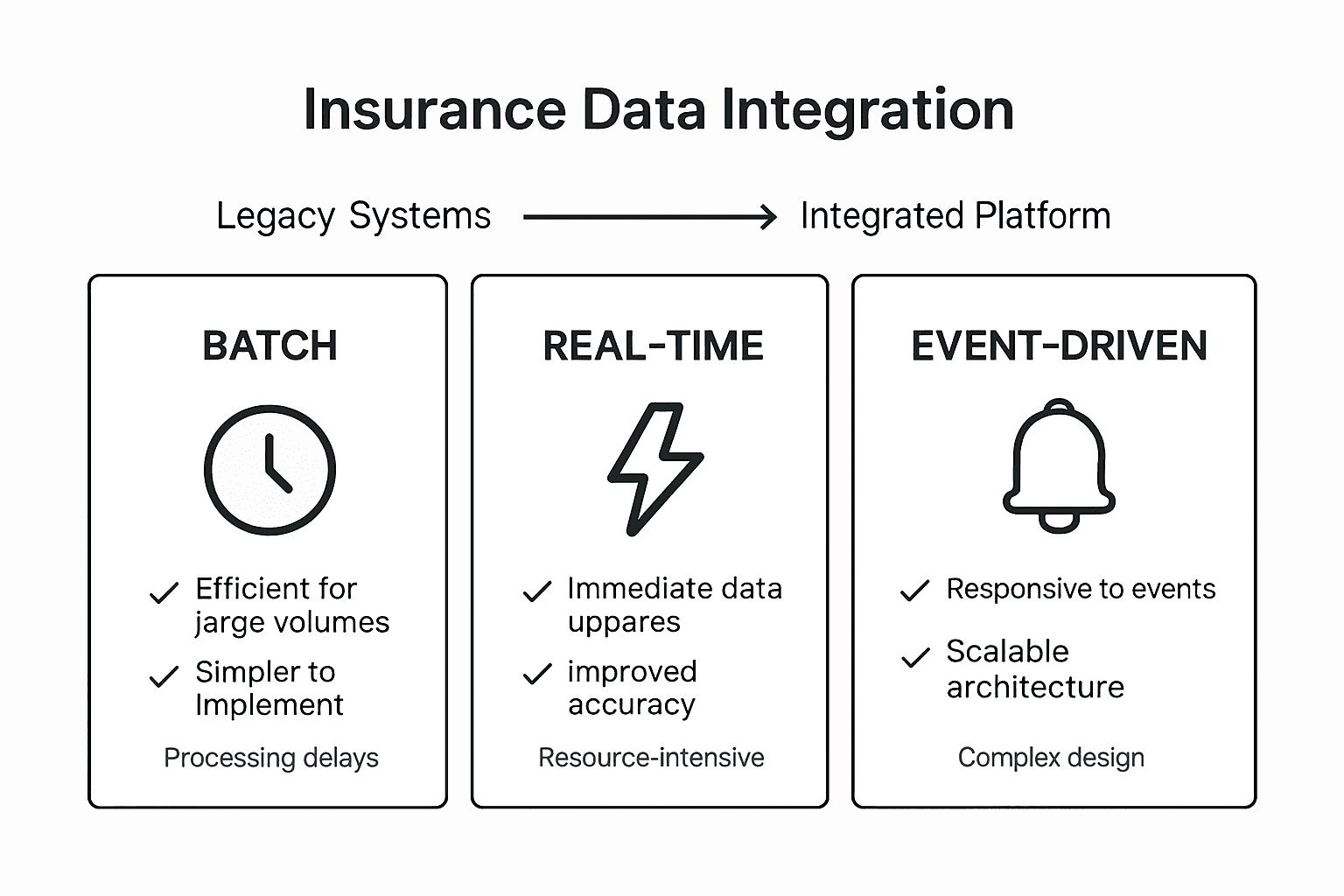
Hybrid cloud data integration strategies have emerged as a sophisticated approach for insurers seeking flexible and scalable data management solutions. This method combines on-premises infrastructure with cloud-based platforms, allowing organisations to leverage the strengths of both environments. Key integration approaches include batch integration, real-time integration, and event-driven integration, each serving distinct operational requirements and technological contexts.
Ontology-based data integration represents another advanced methodology, providing a sophisticated framework for combining heterogeneous data sources. This approach utilises semantic mapping techniques to reconcile differences between diverse data structures, enabling insurers to create unified views across complex information landscapes. Typical integration techniques encompass:
- API-driven integration
- Enterprise service bus (ESB) architectures
- Message-oriented middleware systems
- Microservices-based integration platforms
Pro Tip: Integration Strategy Selection: Conduct a comprehensive assessment of your existing technological infrastructure, data complexity, and strategic objectives before selecting an integration approach, ensuring alignment between technical capabilities and business requirements.
Here is a summary comparing common data integration approaches in insurance:
| Integration Approach | Typical Use Case | Advantages | Challenges |
|---|---|---|---|
| Batch Integration | Nightly data consolidation | Cost-effective for bulk | Delayed insights, lower agility |
| Real-Time Integration | Live policy updates | Immediate data access | Higher complexity, costlier |
| Event-Driven Integration | Automated claim notifications | Responsive, scalable | Requires complex setup |
| API-Driven Integration | Connecting with partners/vendors | Flexible, re-usable | Versioning, security risks |
How integration improves workflows
Data integration fundamentally transforms insurance workflows by creating seamless, intelligent systems that streamline complex operational processes. By connecting disparate data sources and platforms, insurers can dramatically reduce manual intervention, minimise errors, and accelerate decision-making across multiple business functions.

Advanced text mining techniques enhance risk monitoring and underwriting processes, enabling insurers to develop more nuanced and precise operational workflows. These integrated systems allow for real-time data analysis, which means underwriters can quickly assess risk profiles, claims processors can expedite settlement procedures, and customer service teams can access comprehensive client information instantaneously.
Predictive analytics and automated workflow systems represent critical components of modern integration strategies. Combining proprietary insurance claims information with InsurTech data enables organisations to develop sophisticated loss models that improve risk management capabilities. The integration workflow typically encompasses several key improvements:
- Automated data validation and cross-referencing
- Reduced manual data entry and processing times
- Enhanced accuracy in risk assessment
- Streamlined communication between different departments
- Real-time performance monitoring and reporting
Pro Tip: Workflow Integration Strategy: Prioritise incremental implementation of integrated systems, starting with high-impact, low-complexity processes to build organisational confidence and demonstrate immediate operational benefits.
The following table outlines business impacts of effective data integration for insurers:
| Key Function | Impact on Operations | Strategic Value |
|---|---|---|
| Automated Data Validation | Fewer manual errors | Improved compliance, accuracy |
| Real-Time Analysis | Faster decision-making | Competitive advantage |
| Workflow Optimisation | Shorter claim settlement times | Enhanced customer experience |
| Cross-Department Data | Better collaboration | More holistic client view |
Governance, security and compliance demands
Data integration in insurance demands rigorous governance frameworks that balance technological innovation with stringent security protocols. Organisations must navigate complex regulatory landscapes while protecting sensitive client information and maintaining operational integrity across multiple technological platforms.
Model interpretation and transparency tools are crucial for enforcing control over actuarial models, particularly when leveraging advanced machine learning technologies. These tools enable insurers to maintain accountability, demonstrating how sophisticated governance mechanisms can support both technological advancement and regulatory compliance.
Semantic interoperability emerges as a critical component in this complex ecosystem. Ensuring unambiguous data exchange with shared meaning becomes paramount for maintaining robust security standards. Key governance and compliance considerations include:
- Implementing comprehensive data protection protocols
- Establishing clear audit trails for all data transformations
- Developing transparent algorithmic decision-making processes
- Creating robust encryption and access control mechanisms
- Maintaining continuous regulatory alignment
Pro Tip: Compliance Integration Strategy: Develop a cross-functional governance committee that includes representatives from legal, technology, and business departments to ensure comprehensive oversight of data integration and security initiatives.
Addressing legacy systems and technical debt
Legacy systems represent significant technological challenges for insurance organisations, creating complex barriers to digital transformation and operational efficiency. These outdated technological infrastructures often impede innovation, consume disproportionate maintenance resources, and create substantial risks in data management and integration strategies.
Model-driven interoperability provides a methodological framework for transforming enterprise systems, enabling organisations to systematically modernise their technological foundations. This approach allows insurers to progressively replace or upgrade legacy systems without causing catastrophic disruptions to ongoing business operations, utilising semantic annotations and ontological mapping techniques.
Technical debt mitigation requires a strategic, multi-dimensional approach. The Architecture of Interoperable Information Systems offers a systematic method for adjusting and extending internal information systems, helping organisations navigate complex modernisation challenges. Key strategies for addressing legacy system constraints include:
- Conducting comprehensive technological infrastructure audits
- Implementing incremental system replacement strategies
- Developing robust middleware integration layers
- Creating flexible, modular architectural frameworks
- Establishing clear migration roadmaps with measurable milestones
Pro Tip: Legacy System Transformation: Prioritise gradual, controlled system migrations that maintain operational continuity, focusing on high-impact areas that deliver immediate business value while minimising potential disruption.
Unlock Seamless Data Integration with IBSuite
The article reveals common challenges insurers face with legacy systems, fragmented data sources and complex workflows that hinder insight and efficiency. The need for API-driven integration, real-time processing and robust governance underscores the urgency of modernising core insurance platforms to keep pace with market demands and regulatory requirements. If you aim to reduce technical debt, accelerate digital transformation and fully leverage your data for smarter underwriting and claims management, the right solution matters.
Insurance Business Applications offers IBSuite, a cloud-native, end-to-end insurance platform designed specifically to address these pain points. With secure, scalable integrations and built-in compliance, IBSuite simplifies data consolidation across the insurance value chain — from underwriting and policy administration to claims and customer engagement. Discover how to streamline your operations, enhance product innovation and gain real-time insights by booking a personalised demo today at Book a Demo. Take control of your data integration strategy with IBSuite and transform your insurance workflows now.
Frequently Asked Questions
What is data integration in insurance?
Data integration in insurance refers to the process of consolidating and transforming various data sources into a unified platform that provides actionable insights. This includes aggregating data from claims records, customer interactions, and external market data to create a comprehensive analytical framework.
How does data integration improve workflows in the insurance industry?
Data integration streamlines workflows by connecting disparate data sources, thereby reducing manual interventions and errors. It accelerates decision-making through real-time data analysis and enhances operational efficiency across departments such as underwriting, claims processing, and customer service.
What are the different types of data integration approaches used in insurance?
Common approaches to data integration in insurance include batch integration, real-time integration, event-driven integration, and API-driven integration. Each method serves different operational needs, balancing cost, complexity, and immediacy of data access.
Why is governance important in data integration for insurance?
Governance is crucial in data integration as it ensures compliance with regulatory requirements and protects sensitive client information. Effective governance frameworks support accountability and establish robust security protocols to maintain data integrity across integrated systems.
Recommended
- 2025 Guide to Insurance Analytics: Transform Your Decisions – Digital Insurance Platform | IBSuite Insurance Software | Modern Insurance System
- Overcoming Integration Challenges – Digital Insurance Platform | IBSuite Insurance Software | Modern Insurance System
- Understanding the Impact of AI in Insurance 2025 – Digital Insurance Platform | IBSuite Insurance Software | Modern Insurance System
- Automation and Artificial Intelligence in P&C Insurance – Digital Insurance Platform | IBSuite Insurance Software | Modern Insurance System
- Understanding the Importance of Customer Communication – My WordPress