26.02.26
How to Optimise Underwriting Workflows for Efficiency

Manual bottlenecks and fragmented data flows are still common frustrations for property and casualty insurers across Central Europe. As regulatory demands grow and competition increases, knowing exactly where your underwriting workflow stalls has never been more important. This step-by-step guide offers practical strategies to map your current process, identify pain points, and use digital tools to drive measurable improvements in efficiency and compliance—all tailored to the complex needs of the Central European insurance market.
Table of Contents
- Step 1: Assess Current Underwriting Processes
- Step 2: Implement Advanced Digital Tools For Automation
- Step 3: Customise Workflows For Local Compliance Needs
- Step 4: Verify Improvements With Performance Metrics
Quick Summary
| Key Point | Explanation |
|---|---|
| 1. Document Current Workflows | Understand your current underwriting processes by mapping every step and identifying delays and inefficiencies. |
| 2. Automate Repetitive Tasks | Implement digital tools for automating manual tasks such as data entry and compliance checks to improve accuracy and speed. |
| 3. Tailor for Local Compliance | Customise workflows for each jurisdiction, ensuring adherence to local regulatory requirements and documentation standards. |
| 4. Measure Performance Metrics | Establish baseline metrics before changes and track improvements to verify efficiency gains and quality of decisions. |
| 5. Involve Your Team in Reviews | Regularly review metrics with your underwriting team to identify patterns and further areas for improvement. |
Step 1: Assess current underwriting processes
Before optimising anything, you need a clear picture of what you’re actually doing today. Start by documenting your underwriting workflow exactly as it operates now, not how you think it should work.
Your first task is to map the entire journey from application submission to final decision. This means tracking every step, every person involved, and every system they use. Don’t skip the tedious parts—those manual handoffs and paper-based approvals are often where most delays hide.
Gather your underwriting team and ask them what consumes their time:
- Manual data entry from application forms into multiple systems
- Back-and-forth emails requesting additional information from applicants
- Document reviews across different software platforms
- Approval queues waiting for specific underwriter sign-off
- Regulatory compliance checks that happen at various points
- Exception handling when cases fall outside standard guidelines
Document how long each stage takes. You need real numbers here, not estimates. Track a sample of actual cases over two weeks and measure cycle times for each workflow step.
Sound underwriting practices form the foundation of financial stability, and understanding your current processes is the first step to improving them.
Look at your current data flows carefully. Many Central European insurers still rely on credit and insurance underwriting approaches that mix manual assessment with automated systems, creating inconsistencies. Identify where data enters your system and where it gets stuck.
Consider identifying whether you’re experiencing process variations across different underwriter groups or office locations. Your team in Prague might handle applications differently from your Budapest office, which creates inefficiency at scale.
Once you’ve mapped everything, note the pain points explicitly. Where do applications spend the most time waiting? Where do errors occur most frequently? Which approval steps generate the most back-and-forth questions?

Review relevant industry practices by examining underwriting process best practices for P&C firms to benchmark against what leading firms are achieving.
Pro tip: Record a few underwriters walking through a case from start to finish. Watch what they actually do—not what the process documentation says they should do. You’ll discover workarounds, shortcuts, and bottlenecks that no flowchart captures.
Here is a summary of common underwriting process bottlenecks and their underlying causes:
| Bottleneck Location | Main Cause | Typical Impact |
|---|---|---|
| Manual data entry | Legacy systems, lack of integration | Increased errors, slow processing |
| Approval queue delays | Sequential sign-offs | Longer cycle times |
| Document review | Multiple platforms | Higher error risk, lost documents |
| Compliance checks | Disparate regulations | Inconsistency between teams |
| Exception handling | Non-standard cases | Frequent back-and-forth queries |
Step 2: Implement advanced digital tools for automation
Now that you understand your current workflows, it’s time to introduce technology that removes manual work and accelerates decisions. The right digital tools can cut underwriting cycle times significantly while improving accuracy.
Start by identifying which workflow steps are most suitable for automation. Look for processes that are repetitive, rule-based, and don’t require subjective judgment. These are your quick wins.
Focus on these automation candidates first:
- Automated data extraction from application documents and emails
- Pre-screening applications against basic eligibility criteria
- Automatic flagging of missing information before underwriter review
- Real-time cross-referencing with external data sources
- Routine compliance and regulatory checks
- Automated workflow routing to the correct underwriter or approval queue
Consider that artificial intelligence and machine learning applications are now enhancing underwriting workflows by improving accuracy and reducing processing times across European insurers.
Intelligent automation doesn’t replace underwriters—it frees them from tedious tasks so they can focus on complex risk assessment where their expertise matters most.
When selecting your technology platform, prioritise solutions that integrate with your existing systems rather than requiring complete replacements. Your underwriters shouldn’t have to switch between five different applications to complete one case.
Look for platforms offering digital underwriting workflow capabilities that streamline the entire process from application to decision.
Build a phased implementation plan. Don’t try to automate everything at once. Start with one workflow—perhaps initial document processing or basic eligibility checks—and prove the concept before expanding.
Measure the impact of each automation carefully. Track how many hours underwriters save per week, how many errors decrease, and what your new cycle time becomes. These metrics justify expansion to other areas.
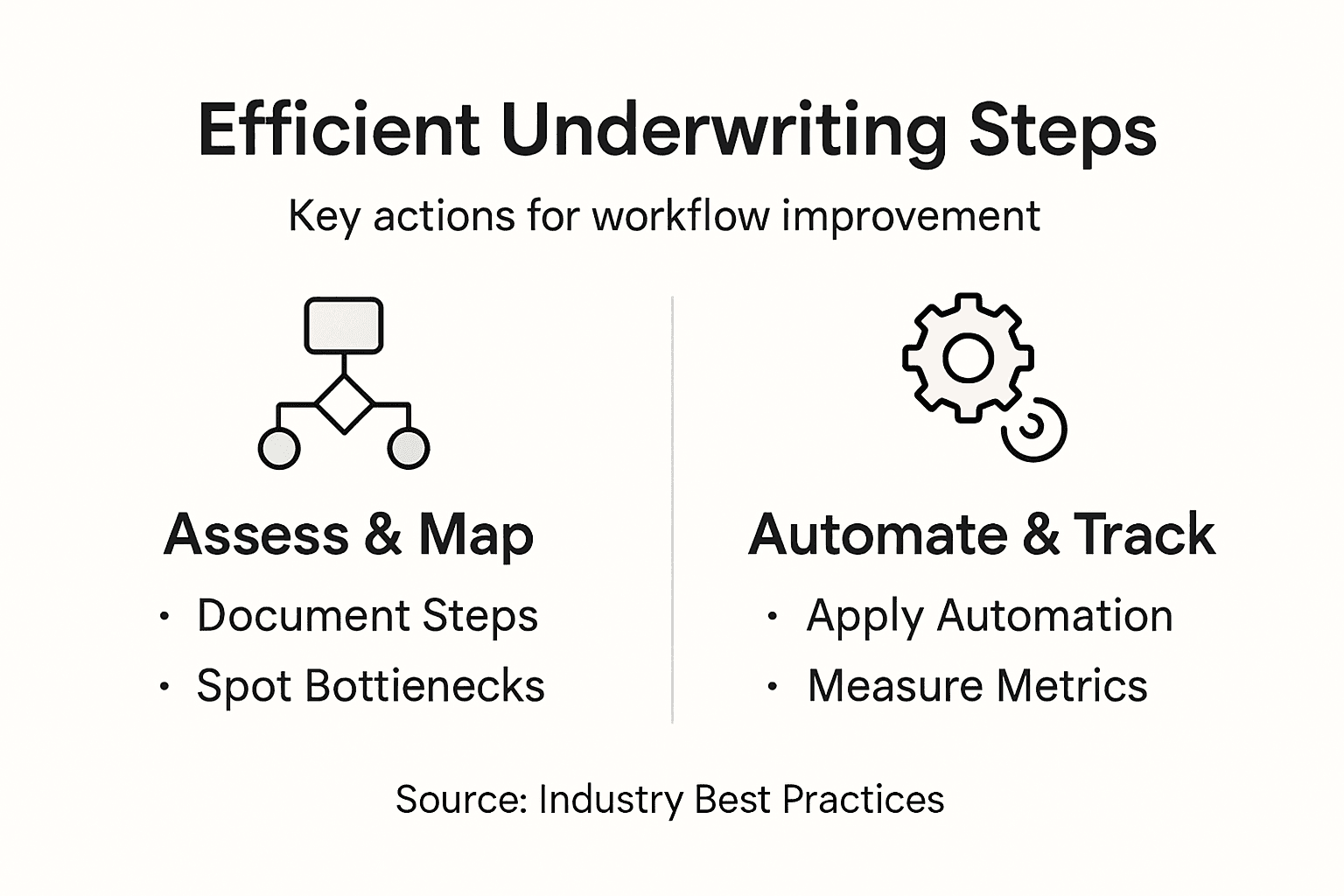
Remember that automation works best when combined with proper change management. Your team needs training on new tools and clear explanation of why changes matter for their daily work.
Pro tip: Begin with the most time-consuming manual task in your workflow. Automating something your underwriters spend four hours weekly on will deliver visible results quickly and build momentum for broader digital transformation.
Below is a comparison of pre- and post-automation underwriting workflows:
| Workflow Feature | Manual Process (Before) | Automated Process (After) |
|---|---|---|
| Data extraction | Typed by underwriters | Software parses instantly |
| Application screening | Individual review needed | Rules pre-filter automatically |
| Compliance checks | Performed manually in steps | Real-time and continuous |
| Workflow routing | By manager assignment | System assigns dynamically |
| Error rate | Higher due to manual entry | Lower with validation rules |
Step 3: Customise workflows for local compliance needs
Your underwriting process must adapt to the legal requirements of each market where you operate. What works in Poland won’t automatically work in Austria or Hungary without adjustment. Compliance isn’t optional, and neither is flexibility.
Begin by mapping regulatory requirements for each jurisdiction you serve. Document the specific rules, documentation standards, and approval procedures mandated by local authorities.
Key compliance areas to review include:
- Data protection and privacy regulations specific to each country
- Local insurance licensing and approval requirements
- Documentation standards for policy evidence and risk assessment
- Consumer protection rules governing underwriting decisions
- Anti-fraud and money laundering compliance procedures
- Specific information disclosure requirements for applicants
- Approval timelines set by local regulators
Understanding how local regulatory frameworks influence underwriting workflows is critical for maintaining compliance across multiple jurisdictions whilst avoiding operational delays.
Each market has unique compliance demands. Your workflow must bend to fit local rules, not the other way around.
Now configure your digital platform to enforce these requirements automatically. Your automation tools should apply different rule sets based on where the application originates. An application from your Prague office triggers different compliance checks than one from your Vienna office.
Build conditional workflows that route cases appropriately. Some applications may need additional review steps in certain jurisdictions. Others might require specific documentation that’s mandatory in one country but unnecessary in another. Your system should handle this complexity without human intervention.
Training matters here. Your underwriting teams need to understand not just the rules themselves, but why they exist. Someone reviewing applications in Budapest needs to know what makes their compliance requirements different from their colleagues in Bucharest.
Review comparative underwriting practices across European countries to identify variations driven by local regulations and market expectations.
Test your customised workflows thoroughly before going live in each new market. Run sample applications through your system and verify they follow the correct approval paths and documentation standards for that jurisdiction.
Pro tip: Create a compliance checklist for each country you serve and attach it directly to your workflow system. This ensures no underwriter accidentally bypasses a local requirement, even under time pressure.
Step 4: Verify improvements with performance metrics
Optimisation without measurement is guesswork. You need concrete data showing whether your workflow changes actually deliver the efficiency gains you expected. This step separates real improvement from wishful thinking.
Start by establishing your baseline metrics before implementing any changes. Go back to the data you collected in Step 1 and document your current performance across these dimensions.
Track these core metrics consistently:
- Average underwriting cycle time from application submission to final decision
- Percentage of applications requiring additional information requests
- Number of underwriting errors or policy cancellations due to incorrect risk assessment
- Underwriter productivity measured in applications reviewed per week
- Compliance violations or regulatory findings related to underwriting
- Cost per underwritten application including all resource expenditure
- Time spent on manual data entry versus value-added review activities
Measure these same metrics again four to six weeks after implementing your changes. Compare the results directly to your baseline. Did cycle time drop by 15%? Did error rates fall? Did underwriters process more applications?
Understanding key performance indicators for assessing underwriting quality helps you verify efficiency gains and identify where further improvements are needed.
Numbers don’t lie. If your metrics haven’t improved, your optimisation hasn’t worked, and you need to adjust your approach.
Beyond the basic metrics, look at quality indicators. Are your underwriters making better decisions? Check your non-performing loan ratio or policy lapse rates if applicable. Optimisation that speeds up decisions but increases risk is counterproductive.
Involve your underwriting team in reviewing these metrics. They often spot patterns you’ll miss. One underwriter might notice that applications from certain regions process faster, suggesting regional workflow differences worth investigating.
Don’t chase perfection. Look for meaningful improvement—typically 20 to 30 percent gains in cycle time represent substantial achievement. Small gains in accuracy or error reduction compound significantly over thousands of applications annually.
Schedule regular reviews of these metrics. Monthly reporting keeps momentum alive and allows you to spot problems early if improvements plateau or regress.
Pro tip: Create a simple dashboard your entire team can see. When underwriters visualise how their cycle times are improving or how error rates are dropping, it reinforces the value of your optimisation work and builds buy-in for further changes.
Transform Your Underwriting Workflow with Intelligent Automation
The challenge of optimising underwriting workflows centres on reducing manual bottlenecks, enhancing accuracy, and navigating complex compliance across multiple jurisdictions. Your team faces persistent pain points such as time-consuming data entry, disjointed approval queues, and the need for local regulatory adaptability. These obstacles can slow cycle times and increase errors, placing pressure on underwriters and risking customer satisfaction.
Insurance Business Applications (IBA) understands these critical struggles and offers a solution designed to empower your underwriting teams with cloud-native automation and seamless system integration. Our IBSuite platform delivers advanced digital underwriting workflow capabilities that eliminate repetitive manual tasks, enforce compliance rules automatically, and provide real-time visibility into process metrics. Supported by secure API-first architecture and ongoing updates, IBSuite enables you to accelerate decisions, reduce errors, and adapt workflows to varied European legal frameworks effortlessly.
Ready to move beyond guesswork and start seeing measurable efficiency gains? Discover how IBSuite can revolutionise your underwriting process by booking a personalised demo today at IBA Book a Demo. Learn more about our digital underwriting workflow guide to see technology in action and explore our commitment to empowering insurers across diverse markets.
Frequently Asked Questions
How can I assess my current underwriting workflows effectively?
Begin by mapping your entire underwriting process from application submission to final decision. Document each step, including time spent and systems used, to identify bottlenecks and inefficiencies within 14 days.
What steps can I take to automate my underwriting processes?
Focus on repetitive, rule-based tasks suitable for automation, such as data extraction and compliance checks. Start by implementing automated data entry, which can reduce manual processing time by approximately 30%.
How do I ensure my underwriting workflows comply with local regulations?
Map out the specific regulatory requirements for each jurisdiction you operate in. Customise your workflows to incorporate compliance checks that are triggered automatically based on application location.
What performance metrics should I track after optimising underwriting workflows?
Track core metrics such as average underwriting cycle time, error rates, and compliance violations. Measure these metrics regularly, ideally within four to six weeks after changes, to assess improvements and identify further optimisation opportunities.
How can I involve my underwriting team in the optimisation process?
Engage your underwriting team by involving them in the mapping and documentation of current workflows. Regularly review performance metrics together to spot patterns and gather feedback, fostering a collaborative environment for effective changes.
Recommended
- Digital Underwriting Workflow Guide for Seamless Automation – Digital Insurance Platform | IBSuite Insurance Software | Modern Insurance System
- 7 Best Underwriting Process Best Practices for P&C Firms
- How to Streamline Claims Processing for Greater Efficiency
- Underwriting Defined: Boosting Agility in P&C Insurance
- Finance Recruitment Trends in Birmingham (2026) | IBACO Recruitment