portalId 145238543 hublet eu1 environment prod defaultChatFlow ----

What is insurance billing automation? P&C benefits 2026

What is insurance billing automation? P&C benefits 2026

Manager reviewing automated billing in office

Many insurance executives mistakenly view billing automation as purely a technology deployment. In reality, successful automation requires careful process redesign, change management, and integration across multiple systems to deliver meaningful improvements in efficiency and customer engagement. This guide clarifies what billing automation truly entails for property and casualty insurers, exploring its core benefits, implementation challenges, and practical strategies to maximise return on investment in 2026.

Table of Contents

Key takeaways

Point Details
Definition and scope Billing automation encompasses invoicing, payment processing, reminders, and adjustments across the policy lifecycle for P&C insurers.
Measurable benefits Automation delivers up to 70% reduction in errors whilst reducing operating costs and accelerating payment cycles.
Process focus Success demands process redesign and change management, not just technology implementation.
System integration Effective automation requires integration with CRM, accounting systems, and policy administration platforms.
Flexibility requirements Complex policies with endorsements and riders need configurable rules to handle varied billing scenarios accurately.

Understanding insurance billing automation

Insurance billing automation refers to the systematic use of software platforms to execute billing functions with minimal manual intervention. These functions include generating invoices, processing premium payments, sending payment reminders, applying policy adjustments, and managing refunds or cancellations.

For property and casualty insurers, automation addresses unique challenges inherent in commercial lines and speciality coverages. Unlike personal lines with straightforward monthly premiums, P&C policies often involve complex rating structures, mid-term endorsements, and diverse payment plans. BillingCenter provides a single platform for managing all aspects of the billing process, from policy initiation to payment processing.

Automation encompasses several core operational areas:

  • Invoice generation based on policy terms, coverage changes, and rating schedules
  • Payment processing across multiple channels including direct debit, credit cards, and agent remittance
  • Automated dunning procedures with escalating reminder sequences for overdue accounts
  • Premium allocation across complex policy structures with multiple covereds and locations
  • Commission calculation and distribution to agents and brokers
  • Integration with general ledger systems for accurate financial reporting

The operational scope extends from the moment a policy binds through its entire lifecycle. When endorsements modify coverage, the system automatically recalculates premiums, generates supplemental invoices, and adjusts payment schedules. This end-to-end capability distinguishes true automation from simple invoice generation tools. Understanding insurance billing processes explained provides essential context for evaluating automation solutions.

Key benefits of automation in insurance billing

Property and casualty insurers implementing comprehensive billing automation realise substantial operational and financial improvements. The reduction in operating costs stems from eliminating manual data entry, reducing staffing requirements for routine tasks, and accelerating cash flow through faster payment processing.

Error reduction represents one of the most significant quantifiable benefits. Manual billing processes introduce mistakes through data entry errors, calculation inconsistencies, and missed endorsements. Automated systems reduce error rates by up to 70% compared to manual processes, directly improving accuracy in premium calculations and reducing disputes with policyholders.

Woman cross-checking invoices for error reduction

Customer experience improvements manifest through faster response times and increased transparency. Policyholders receive immediate confirmation of payments, instant access to billing history, and proactive communication about upcoming charges. This responsiveness builds trust and reduces enquiries to customer service teams.

Operational efficiency gains include:

  • Accelerated invoice generation from hours to minutes following policy changes
  • Real-time payment allocation eliminating reconciliation delays
  • Automated dunning reducing manual follow-up on overdue accounts
  • Streamlined audit trails with complete transaction histories
  • Enhanced reporting capabilities for financial analysis and forecasting

Integration with customer relationship management systems creates a unified view of policyholder interactions. When billing data flows seamlessly into CRM platforms, service representatives access complete payment histories during calls, enabling more informed conversations. This integration proves especially valuable for commercial accounts with multiple policies and complex billing arrangements. Exploring automation and artificial intelligence in P&C insurance reveals broader digital transformation opportunities.

Pro tip: Track specific metrics before and after automation implementation, including average days outstanding, billing error rates, and customer service call volume related to billing enquiries, to quantify return on investment and identify areas for further optimisation.

The financial impact extends beyond direct cost savings. Faster payment processing improves cash flow, reducing borrowing costs and enabling more accurate financial forecasting. Reduced errors minimise write-offs and collection costs whilst improving relationships with agents who benefit from accurate commission payments. For insurers pursuing comprehensive digital transformation, billing automation often serves as a gateway to broader improvements in streamline claims processing and policy administration.

Implementing billing automation in property and casualty insurance presents distinct challenges that require thoughtful planning and execution. Complex policies with multiple endorsements require careful configuration of automated billing rules to avoid errors, particularly when endorsements add or remove coverages mid-term.

Policy complexity creates several specific challenges. Commercial lines policies often include multiple locations, varying coverage limits, and exposure-based rating factors that change throughout the policy period. Fleet policies may add or remove vehicles monthly, requiring pro-rata premium adjustments. Workers’ compensation policies involve audit processes that reconcile estimated versus actual payroll, potentially resulting in substantial return or additional premiums.

Successful automation implementation requires addressing these key considerations:

  1. Map existing billing workflows in detail before automation to identify inefficiencies and opportunities for improvement
  2. Configure flexible rating and billing rules that accommodate policy variations without requiring custom coding
  3. Establish robust testing protocols using real policy scenarios including complex endorsement combinations
  4. Plan phased rollouts starting with simpler policy types before tackling complex commercial lines
  5. Create comprehensive training programmes covering both system operation and revised business processes

Change management represents a critical success factor often underestimated by insurers. Billing automation is equally about process redesign and change management to realise full benefits. Staff members accustomed to manual processes may resist new systems, particularly when automation eliminates familiar workarounds they developed over years.

Common implementation pitfalls include insufficient stakeholder engagement during requirements gathering, inadequate data cleansing before migration, and unrealistic timelines that force corners to be cut. Insurers sometimes focus exclusively on technology selection whilst neglecting process redesign, resulting in automated versions of inefficient manual workflows.

Pro tip: Establish a cross-functional implementation team including billing operations, IT, underwriting, and claims to ensure automation serves the needs of all departments and integrates properly with existing systems across the organisation.

Integration challenges arise when connecting billing automation with legacy policy administration systems, especially those built on older technology platforms. Data quality issues in source systems can propagate through automated processes, magnifying rather than solving problems. Understanding the insurance billing process P&C insurers use helps identify integration points requiring special attention during implementation.

Best practices and strategies for optimising billing automation

Maximising the value of billing automation requires strategic planning and ongoing optimisation beyond initial implementation. Flexibility is foundational for speciality insurance automation systems, enabling insurers to adapt quickly to new products, rating structures, and regulatory requirements without extensive custom development.

Successful insurers adopt these proven strategies:

  • Select platforms designed specifically for insurance rather than generic billing systems lacking industry-specific functionality
  • Prioritise API-first architectures enabling seamless integration with policy administration, claims, and accounting systems
  • Implement configurable business rules engines allowing business users to modify billing logic without developer involvement
  • Establish regular review cycles for billing rules and workflows to identify improvement opportunities
  • Create comprehensive audit trails supporting regulatory compliance and internal controls

Integration architecture deserves particular attention. Billing automation delivers maximum value when connected to broader insurance operations. Real-time synchronisation with policy administration systems ensures billing reflects current coverage. Integration with CRM platforms provides service representatives complete visibility into payment histories. Connections to accounting systems automate general ledger posting and reconciliation.
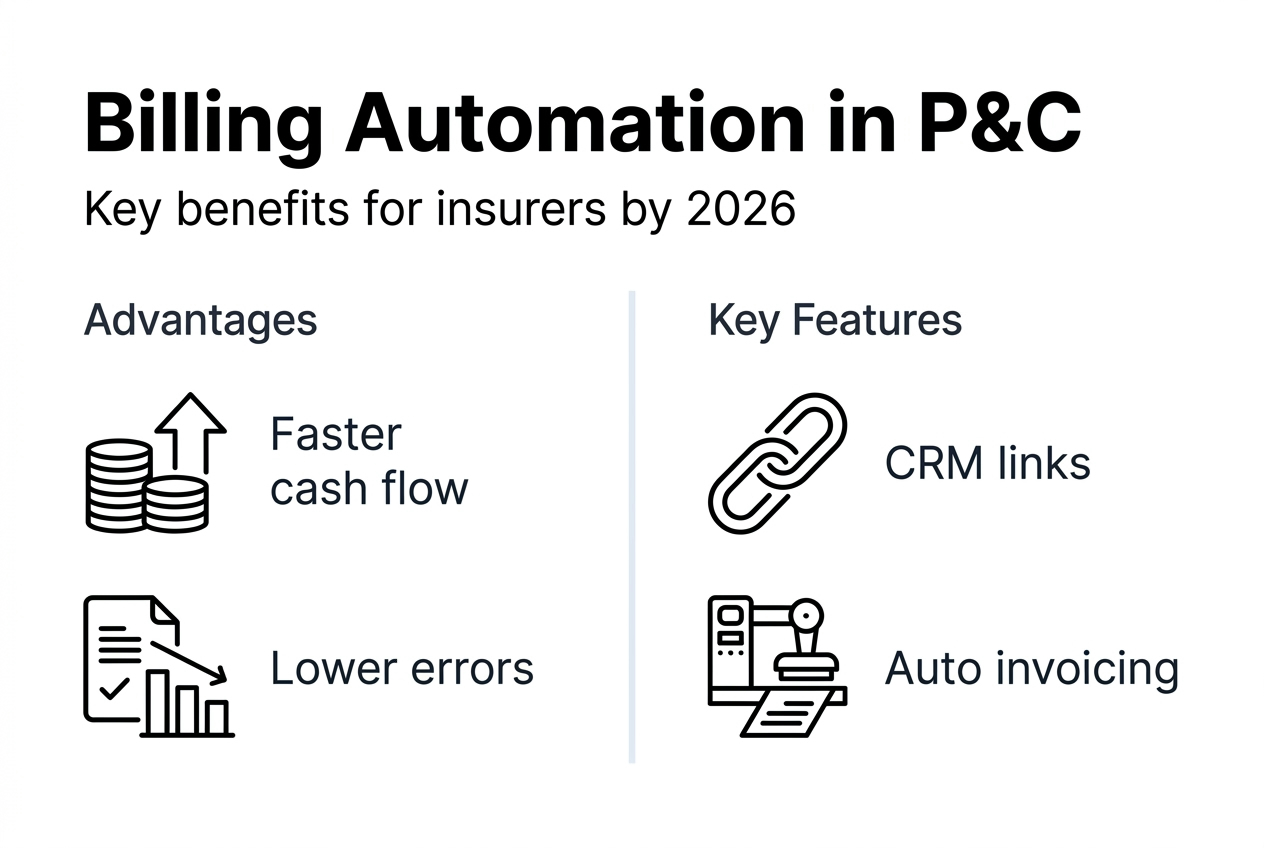
Infographic showing billing automation benefits and features

Staff training must address both technical system operation and revised business processes. Effective programmes combine hands-on practice with real scenarios, ongoing support during initial months post-implementation, and clear documentation of new workflows. Champions within billing operations who embrace automation can accelerate adoption by demonstrating benefits to colleagues.

The following table compares workflow characteristics across different automation levels:

Workflow aspect Manual billing Semi-automated Fully automated
Invoice generation Individual creation Template-based with manual review Automatic upon policy events
Payment processing Manual entry and allocation Assisted entry with validation Real-time processing across channels
Endorsement handling Recalculate and bill manually System calculates, manual approval Automatic calculation and invoicing
Reporting Manual compilation from multiple sources Scheduled reports with manual analysis Real-time dashboards with alerts
Audit compliance Document gathering for reviews Partial trail automation Complete automated audit trails

Regular system optimisation ensures automation continues delivering value as business needs evolve. Monitor key performance indicators including invoice accuracy rates, days sales outstanding, payment processing times, and customer satisfaction scores. When metrics deteriorate, investigate whether configuration changes, additional training, or process refinements are needed.

Leveraging insights from claims automation step by step can inform billing automation strategies, as both domains share similar integration requirements and change management challenges. Insurers pursuing comprehensive digital transformation benefit from coordinated automation initiatives across policy administration, billing, and claims.

Explore IBSuite policy administration for seamless automation

IBSuite delivers a cloud-native platform purpose-built for property and casualty insurers seeking to modernise billing operations whilst maintaining flexibility for complex commercial lines. The platform’s API-first architecture enables seamless integration across the insurance value chain, connecting billing with policy administration, claims, rating, and CRM functionality.

Insurers using IBSuite policy administration benefit from configurable billing rules that accommodate diverse policy structures without custom coding. The platform handles complex scenarios including multi-location risks, exposure-based rating, and mid-term endorsements whilst maintaining accurate premium calculations and audit trails.

Discover how IBSuite can transform your billing operations by exploring our comprehensive capabilities. Book a demo to see firsthand how the platform addresses your specific billing challenges and supports your digital transformation objectives.

Frequently asked questions

What exactly is insurance billing automation?

Insurance billing automation uses specialised software to execute billing functions including invoice generation, payment processing, premium adjustments, and collections with minimal manual intervention. The technology automatically calculates premiums based on policy terms, processes payments across multiple channels, and handles endorsement billing throughout the policy lifecycle.

How does billing automation improve customer experience?

Automation enhances customer experience through faster invoice delivery, immediate payment confirmation, transparent access to billing history, and proactive communication about upcoming charges. Policyholders benefit from reduced errors, multiple self-service payment options, and quicker resolution of billing enquiries as service representatives access complete transaction histories instantly.

What is the difference between billing and claims automation?

Billing automation focuses on premium collection, invoice generation, payment processing, and financial reconciliation related to policy charges. Claims automation addresses loss reporting, adjudication, payment processing, and reserve management. Whilst both improve operational efficiency, they serve distinct functions within the insurance value chain and typically integrate through shared policy administration platforms.

What organisational changes are needed for successful automation?

Successful implementation requires process redesign to eliminate inefficient manual workflows, comprehensive staff training on new systems and procedures, and change management to address resistance from employees accustomed to legacy processes. Insurers must also establish cross-functional governance involving billing operations, IT, underwriting, and finance to ensure automation serves enterprise-wide objectives rather than departmental silos.

How does automation handle complex commercial policies?

Modern billing automation platforms use configurable business rules engines that accommodate complex scenarios including multiple endorsements, exposure-based rating, multi-location risks, and varying payment plans. These systems calculate pro-rata adjustments when coverages change mid-term, handle audit premiums for workers’ compensation policies, and support flexible billing arrangements required for large commercial accounts whilst maintaining calculation accuracy and audit trails.

What is reinsurance in P&C: key benefits for 2026

What is reinsurance in P&C: key benefits for 2026

Insurance executives meeting about reinsurance

Natural catastrophes caused more than $100 billion in insured losses for the sixth consecutive year in 2025, straining P&C insurers’ capital reserves and forcing executives to rethink risk strategies. Yet many decision makers still misunderstand how reinsurance works and why it matters beyond simple risk transfer. This guide clarifies reinsurance fundamentals, examines 2026 market dynamics, and shows how sophisticated reinsurance strategies protect financial stability whilst enabling sustainable growth.

Table of Contents

Key takeaways

Point Details
Risk transfer essentials Reinsurance shifts catastrophic exposure to reinsurers, protecting insurer capital and enabling larger underwriting portfolios.
Market pricing trends Global property catastrophe rates dropped 12% at January 2026 renewals despite sustained high losses, creating strategic opportunities.
Financial stability impact Effective reinsurance reduces leverage deviations and volatility, accelerating capital structure adjustments and strengthening combined ratios.
Strategic contract choices Proportional versus non-proportional structures significantly affect risk appetite, capital planning, and long-term profitability outcomes.
Future preparedness Executives must monitor casualty market dynamics and avoid complacency, as current pricing calm may mask emerging risks.

Understanding reinsurance in property and casualty insurance

Reinsurance helps P&C insurers manage risk by transferring a portion of their financial exposure to another party, the reinsurer. This fundamental mechanism allows primary insurers to underwrite policies they might otherwise decline due to concentration limits or capital constraints. When catastrophic events strike, reinsurers absorb agreed portions of claims, preventing potentially crippling losses that could threaten an insurer’s solvency.

The practice serves multiple strategic purposes beyond simple risk transfer. Reinsurance enables insurers to write more business without proportionally increasing capital reserves, effectively leveraging their balance sheets. It smooths earnings volatility across underwriting cycles, making financial performance more predictable for stakeholders. Insurers also gain access to reinsurers’ technical expertise and loss data, improving their own risk management capabilities.

Common risks covered include:

  • Natural catastrophes such as hurricanes, earthquakes, and floods
  • Large individual losses exceeding retention thresholds
  • Accumulated small claims creating adverse development
  • Liability exposures with long tail characteristics
  • Cyber events and emerging technology risks

Reinsurance contracts typically specify coverage limits, retention levels, premium rates, and exclusions. The ceding insurer pays premiums to the reinsurer and recovers claims payments according to contract terms. This contractual relationship creates a critical financial partnership that directly influences both parties’ risk profiles and strategic flexibility.

“Understanding what reinsurance is means recognising it as both a financial tool and a strategic partnership that fundamentally shapes how P&C insurers approach underwriting decisions and capital allocation.”

The reinsurance market entered 2026 showing significant pricing adjustments after years of elevated catastrophe activity. Global Property Catastrophe Rate on Line fell 12% at January 2026 renewals, signalling increased reinsurer capacity and competition. Regional variations emerged, with US wind rates dropping 15% whilst Japanese earthquake coverage declined just 5%, reflecting localised risk appetites.

Analyst reviewing reinsurance market pricing chart

These pricing movements occurred despite catastrophe losses exceeding the $100 billion threshold for six consecutive years. Reinsurers absorbed substantial claims yet maintained profitability through disciplined underwriting and diversified portfolios. The apparent contradiction between persistent losses and softening prices reflects improved capitalisation, sophisticated risk modelling, and strategic competition for quality business.

Region Rate Change Jan 2026 Key Drivers
Global average Down 12% Increased capacity, competition
US wind exposure Down 15% New capital, improved terms
European flood Down 10% Model refinements, diversification
Japanese earthquake Down 5% Concentrated risk, cautious appetites
Casualty lines Stable to slight increases Social inflation concerns

Market participants demonstrated nuanced behaviours reflecting lessons from recent volatile years:

  • Reinsurers selectively increased limits for well-performing cedants
  • Primary insurers negotiated improved contract terms beyond just pricing
  • Both parties invested heavily in exposure management technology
  • Alternative capital sources expanded into traditionally reinsured risks

Industry observers caution against interpreting price decreases as risk reduction. Market dynamics simply reflect current supply and demand equilibrium, not fundamental changes to underlying catastrophe exposure. Executives must recognise these insurance market trends for 2026 whilst maintaining robust risk assessment practices.

“Despite price easing, the risk environment remains elevated with climate change increasing frequency and severity of weather events, demanding continued strategic vigilance from P&C insurers.”

How reinsurance supports risk management and financial stability in P&C firms

Reinsurance delivers measurable financial benefits beyond theoretical risk transfer. Research shows reinsurance reduces absolute values of actual and target leverage deviations for property–casualty insurers, accelerating capital structure adjustments. This means insurers can respond faster to market opportunities or adverse developments without lengthy capital raising processes.

The mechanism works through volatility reduction in loss experience. When catastrophes strike, reinsurance recoveries offset claim payments, preventing sharp swings in reported profits. This stability allows management to maintain consistent dividend policies, capital deployment strategies, and growth initiatives regardless of loss year severity. Rating agencies recognise this benefit, often granting better credit assessments to well-reinsured firms.

Recent performance data validates these theoretical benefits. The P&C combined ratio strengthened in 2025 with manageable natural catastrophe ratios, demonstrating how effective reinsurance programmes protected profitability despite elevated loss activity. Insurers with sophisticated reinsurance strategies maintained target leverage ratios whilst competitors faced capital pressure.

Reinsurance also reduces the probability of extreme loss scenarios threatening solvency. Regulators and rating agencies model capital adequacy using stress tests that assume major catastrophes. Appropriate reinsurance coverage significantly lowers required capital under these models, freeing resources for business growth. This regulatory capital relief represents tangible financial value beyond pure risk transfer.

Pro Tip: Most insurers focus solely on loss recovery when evaluating reinsurance value, overlooking the strategic benefit of maintaining consistent capital structure and leverage ratios across market cycles, which often exceeds direct claim recoveries.

Executives integrating reinsurance into risk management strategies should follow these steps:

  1. Quantify volatility tolerance and target capital ratios
  2. Model potential catastrophe scenarios and retention impacts
  3. Evaluate reinsurance costs against capital raising alternatives
  4. Structure programmes balancing protection and profitability
  5. Monitor performance metrics quarterly and adjust accordingly
  6. Review relationship quality and reinsurer financial strength annually

This disciplined approach ensures reinsurance serves strategic objectives rather than becoming a reactive expense following loss events. Forward-looking insurers recognise reinsurance as a core component of financial planning, not merely a claims mitigation tool.

Choosing the right reinsurance strategy: structures and contract considerations

Reinsurance structures divide into two fundamental categories with distinct risk-sharing models. Proportional reinsurance means the reinsurer assumes a fixed percentage of premiums and losses from covered policies, creating aligned interests. Non-proportional coverage activates only when losses exceed specified thresholds, protecting against severity rather than frequency.

Infographic of reinsurance strategy structure comparison

Feature Proportional Non-proportional
Premium sharing Fixed percentage Based on exposure and limits
Loss sharing Same percentage as premium Only excess of retention
Primary use case Capacity relief, new ventures Catastrophe protection
Capital impact Immediate balance sheet relief Protects against tail risk
Cost efficiency Predictable, relationship-based Variable, event-driven

The choice of reinsurance structure and contract terms critically impacts insurer risk profile and financial outcomes. Proportional treaties suit insurers entering new markets or product lines, providing capital relief whilst sharing underwriting expertise. Non-proportional coverage works better for managing catastrophe aggregations in established portfolios with proven profitability.

Contract terms deserve careful scrutiny beyond basic structure decisions. Retention levels determine how much loss the insurer bears before reinsurance activates, directly affecting both premium cost and protection value. Higher retentions reduce reinsurance expense but increase earnings volatility. Limits cap reinsurer liability, creating potential exposure if catastrophes exceed covered amounts.

Exclusions and definitions significantly impact actual coverage. Standard contracts exclude war and nuclear events, but subtle language around flood definitions, named storm criteria, or hours clauses can dramatically alter protection. Executives must involve legal and technical experts in contract review, as seemingly minor wording differences create major financial consequences during claims.

Pro Tip: The most overlooked contract feature is reinstatement provisions, which determine whether coverage renews after a loss and at what cost, yet these terms can double effective programme costs following major catastrophes.

Critical assessment criteria when selecting reinsurance include:

  • Reinsurer financial strength and claims paying ability
  • Geographic diversification of reinsurer exposures
  • Historical relationship quality and claims settlement speed
  • Contract flexibility for mid-term adjustments
  • Pricing competitiveness relative to market benchmarks
  • Technical expertise and value-added services offered

Insurers facing P&C industry challenges must balance cost efficiency against comprehensive protection. The optimal strategy aligns reinsurance structure with specific risk appetites, capital targets, and business growth plans rather than simply minimising premium expense.

Preparing for changes: future outlook and strategic advice for executives

The reinsurance landscape faces structural pressures despite current market stability. US P&C executives relying on casualty reinsurance pricing risk future repricing events beyond their control, as social inflation, legal system changes, and loss development trends create latent exposures. Property markets show similar vulnerabilities, with climate change progressively shifting risk distributions in ways models struggle to capture.

Several drivers warrant executive attention:

  • Casualty reserve adequacy questions emerging from pandemic-era claims
  • Regulatory capital requirements evolving with climate risk recognition
  • Cyber accumulation scenarios challenging traditional reinsurance approaches
  • Alternative capital sources creating new competitive dynamics
  • Technology enabling more granular risk selection by reinsurers

Proactive insurers should implement robust preparation measures. Conduct quarterly stress tests examining how major loss events would impact capital ratios under current reinsurance programmes. Evaluate alternative risk transfer mechanisms including catastrophe bonds and sidecars as programme complements. Invest in exposure management platforms that provide real-time aggregation visibility.

Pro Tip: Establish continuous monitoring of legal precedent changes, weather pattern shifts, and construction cost inflation, as these loss trend drivers often trigger reinsurance market corrections before official industry data confirms deterioration.

Practical steps for executive action:

  • Schedule annual reinsurance strategy reviews with board risk committees
  • Develop relationships with multiple reinsurers to avoid dependence
  • Implement scenario planning for hard market return conditions
  • Integrate change management processes for rapid programme adjustments
  • Challenge actuarial assumptions about loss trends quarterly

The current pricing environment creates opportunities to secure favourable terms whilst capacity remains available. However, executives must resist complacency, recognising that reinsurance markets can shift rapidly when loss trends surprise or capital depletes. Strategic positioning now, during relatively calm conditions, provides flexibility when inevitable market disruptions emerge.

Successful navigation requires balancing short-term cost optimisation against long-term protection needs. Insurers that maintain disciplined reinsurance strategies through market cycles, neither over-buying during hard markets nor under-buying during soft markets, achieve superior risk-adjusted returns and stakeholder confidence.

Discover solutions to optimise your reinsurance strategy

Navigating complex reinsurance decisions requires sophisticated data analysis and scenario modelling capabilities. IBSuite’s cloud-native platform provides P&C insurers with integrated tools for exposure management, capital planning, and risk management that inform smarter reinsurance purchasing decisions. Our API-first architecture enables real-time aggregation monitoring and what-if analysis, helping executives visualise how different reinsurance structures impact financial outcomes.

As insurance market dynamics evolve in 2026, technology advantages become competitive necessities. IBSuite’s financial sub-ledger and rating engine integrate seamlessly with reinsurance accounting, automating recoveries and improving cash flow visibility. Ready to transform how your organisation approaches reinsurance strategy? Book a demo to explore how IBSuite supports data-driven decision making for today’s P&C challenges.

Frequently asked questions

What is the role of reinsurance in managing catastrophe losses?

Reinsurance transfers part of catastrophe risk to reinsurers, reducing direct losses and protecting insurer capital from depletion. It enables underwriting of larger portfolios by limiting exposure to extreme events that would otherwise threaten solvency.

How do reinsurance contracts affect an insurer’s financial performance?

Contract terms determine risk retention and premium costs, directly impacting profitability and loss ratios. Effective reinsurance stabilises earnings across underwriting cycles and improves capital efficiency through reduced leverage volatility.

What should executives consider when selecting reinsurance structures?

Balance proportional and non-proportional coverage based on your risk tolerance and capital objectives. Evaluate contract details including limits, reinstatement provisions, and exclusions alongside costs versus capital relief trade-offs. Prioritise reinsurer financial strength and partnership quality for long-term stability.

Why did reinsurance pricing decrease despite continued high catastrophe losses?

Increased reinsurer capitalisation, improved risk modelling, and competitive dynamics drove pricing down whilst loss experience remained elevated. Market supply expanded through new capacity and alternative capital sources, creating downward pressure on rates despite sustained claims activity.

Boost cybersecurity in cloud-native insurance platforms

Boost cybersecurity in cloud-native insurance platforms

IT manager checking cloud security dashboard

Cyberattacks targeting insurance platforms surged by 64% in Central Europe during 2025, with ransomware incidents affecting one in four P&C insurers. Cloud-native systems offer transformative agility but introduce complex security challenges that demand rigorous controls. This guide explores how insurance executives can strengthen cybersecurity posture whilst navigating stringent regulatory requirements and evolving threat landscapes in 2026.

Table of Contents

Key takeaways

Point Details
Regulatory compliance GDPR and NIS2 mandate data protection by design and incident reporting with penalties reaching €10 million.
Cyber threat evolution Ransomware, API vulnerabilities, and third-party risks now dominate the cloud insurance threat landscape.
Security frameworks Zero Trust architecture and continuous monitoring provide essential defence layers beyond perimeter security.
Operational security Automated patching, incident response drills, and API governance reduce vulnerability windows significantly.
Misconception risks Cloud adoption alone does not guarantee security without proper configuration and ongoing risk management.

Introduction to cybersecurity in cloud-native insurance platforms

Cloud-native adoption in insurance has transformed how P&C platforms operate since 2010, enabling unprecedented agility through API-first architectures. Whilst these systems accelerate product launches and integration capabilities, they simultaneously expand attack surfaces that malicious actors actively exploit.

P&C insurance platforms process vast quantities of sensitive personal and financial data across policy administration, claims processing, and billing workflows. A single data breach exposes millions of policyholder records, triggering regulatory penalties, reputational damage, and operational disruption. The stakes have never been higher.

Cyber threat actors increasingly target insurance entities because these organisations hold rich datasets valuable for identity theft, fraud, and corporate espionage. Attack frequency against insurers rose sharply in 2025, with threat intelligence showing sophisticated campaigns leveraging automation and social engineering to penetrate cloud environments.

Regulatory frameworks directly shape cybersecurity strategies for European insurers:

  • GDPR enforces strict data protection obligations requiring privacy by design across all platform components
  • NIS2 Directive imposes mandatory incident reporting and robust security governance with severe penalties
  • Industry-specific standards demand continuous auditability and risk documentation
  • Cross-border data transfer regulations add complexity for multinational operations

Understanding cybersecurity tools and best practices forms the foundation for building resilient cloud-native insurance platforms. Security excellence requires integrating compliance requirements into platform architecture from the earliest design stages rather than retrofitting controls later.

Regulatory compliance impact on insurance cybersecurity in Central Europe

GDPR remains the cornerstone of data protection regulation across Europe, mandating that insurers implement data protection by design and maintain continuous privacy integration throughout system lifecycles. Controllers must demonstrate accountability through comprehensive documentation, regular impact assessments, and transparent data processing practices.

The NIS2 Directive introduces stringent penalties reaching €10 million or 2% of global turnover for organisations failing to meet cybersecurity standards. This regulation specifically targets essential service providers, including insurers managing critical infrastructure, demanding robust incident detection, immediate reporting protocols, and comprehensive audit trails.

“Regulatory compliance failures in 2025 cost European insurers over €240 million in combined penalties, operational remediation expenses, and litigation settlements, demonstrating that prevention costs far less than non-compliance.”

Heavy financial penalties represent only part of the compliance risk equation. Reputational damage following regulatory enforcement actions erodes customer trust, complicates vendor relationships, and triggers insurance coverage exclusions. Executives face personal liability under certain circumstances, particularly when governance failures demonstrate wilful neglect.

Integrating compliance requirements fundamentally shapes platform security architecture through these mechanisms:

  • Privacy-enhancing technologies must be embedded within core system design, not added as afterthoughts
  • Automated compliance monitoring tools provide continuous validation against regulatory baselines
  • Incident response workflows incorporate mandatory reporting timelines and stakeholder notification protocols
  • Regular third-party audits verify control effectiveness and identify gaps before regulators discover them

Successful compliance integration transforms regulatory obligations from burdensome constraints into competitive advantages. Platforms demonstrating strong governance attract customers increasingly concerned about data protection whilst reducing total cost of ownership through efficient, automated compliance processes.

Understanding the cyber threat landscape for cloud insurance systems

Ransomware attacks now represent the primary threat vector targeting cloud-native insurance platforms, with attackers encrypting critical policy data and demanding substantial payments for decryption keys. Average ransom demands increased to €2.3 million in 2025, though paying ransoms provides no guarantee of data recovery or prevents subsequent extortion attempts.

Analyst reviewing ransomware alerts workspace

Data exfiltration attacks often precede or accompany ransomware deployments, with threat actors stealing sensitive policyholder information for sale on dark web marketplaces. Stolen insurance data commands premium prices because it combines financial details, health records, and personal identifiers valuable for identity fraud schemes.

Threat Type Attack Vector Primary Impact Detection Difficulty
Ransomware Phishing, vulnerable endpoints Operational shutdown, data loss Medium
API exploitation Authentication bypass, injection attacks Unauthorised data access High
Insider threats Privileged access abuse Data theft, sabotage Very High
Supply chain compromise Third-party vulnerabilities Widespread exposure High
DDoS attacks Infrastructure flooding Service disruption Low

API-first architectures essential for cloud-native platform flexibility create expanded attack surfaces requiring specialised security attention. Each API endpoint represents a potential entry point for unauthorised access if authentication mechanisms, rate limiting, or input validation prove inadequate. Attackers systematically probe APIs seeking misconfigurations or logic flaws enabling data manipulation.

Insider threats introduce particularly challenging risks because authorised users possess legitimate access credentials and understand system architectures. Malicious insiders exploit privileged positions to exfiltrate data, modify records, or create backdoors for external collaborators. Detection requires behavioural analytics identifying anomalous activity patterns amongst normal operational noise.

Third-party vendors and integration partners compound risk exposure through:

  • Software vulnerabilities in external components incorporated into platform stacks
  • Inadequate security practices by vendors handling sensitive insurance data
  • Supply chain attacks targeting software update mechanisms
  • Credential sharing across interconnected systems

Continuous monitoring paired with threat intelligence feeds enables timely detection of emerging attack patterns before they cause substantial damage. Security operations centres analyse network traffic, system logs, and user behaviour to identify indicators of compromise requiring immediate investigation and response.

Common misconceptions about cybersecurity in insurance platforms

Cloud infrastructure provides robust security foundations, yet organisations frequently assume inherent protection without implementing proper configuration management. Default cloud settings prioritise flexibility over security, leaving platforms vulnerable unless teams actively harden configurations, restrict access, and enable comprehensive logging.

Compliance checklists create dangerous false confidence when treated as comprehensive security strategies rather than minimum baselines. Ticking regulatory boxes satisfies auditors but fails to address organisation-specific risks, emerging threats, or sophisticated attack techniques that regulations cannot anticipate. Security requires continuous risk assessment beyond static compliance frameworks.

Third-party integrations often receive insufficient security scrutiny because organisations assume reputable vendors maintain adequate controls. Reality proves more complex:

  • Vendors may subcontract components introducing hidden vulnerabilities
  • Security postures degrade over time without ongoing assessment
  • Integration points create trust boundaries requiring explicit validation
  • Vendor breaches frequently expose customer data through shared infrastructure

Security strategies focused exclusively on regulatory compliance miss critical threats whilst allocating resources inefficiently. Modern insurance platforms demand risk-based approaches prioritising controls protecting highest-value assets and addressing most probable attack scenarios.

Pro Tip: Conduct quarterly threat modelling exercises mapping specific attack paths against your platform architecture. This practical activity identifies gaps invisible to compliance checklists whilst building security awareness across technical teams.

Penetration testing represents another area where misconceptions flourish. Annual compliance-driven tests provide snapshots quickly becoming obsolete as platforms evolve and new vulnerabilities emerge. Effective security programmes incorporate continuous testing methodologies identifying weaknesses before attackers exploit them.

Assuming cloud providers handle all security responsibilities ignores the shared responsibility model fundamental to cloud computing. Providers secure underlying infrastructure whilst customers remain accountable for application security, data protection, identity management, and configuration choices. This division requires clear understanding and appropriate resource allocation.

Frameworks and technical strategies for cyber risk management

Risk assessment frameworks provide structured methodologies for identifying, prioritising, and mitigating cybersecurity threats aligned with business objectives. Leading approaches combine quantitative metrics measuring potential financial impact with qualitative assessments evaluating likelihood based on threat intelligence and vulnerability data.

Continuous monitoring infrastructure captures real-time security telemetry across cloud environments, enabling rapid threat detection and response. Security Information and Event Management (SIEM) platforms aggregate logs from diverse sources, apply correlation rules identifying suspicious patterns, and trigger automated responses or analyst investigations.

Security Approach Traditional Perimeter Zero Trust Architecture
Trust model Implicit inside network Verify every access
Access control Network location-based Identity and context-based
Lateral movement Easily achievable Severely restricted
Breach containment Difficult Automatic micro-segmentation
Implementation complexity Lower initially Higher but more resilient

Zero Trust architecture eliminates implicit trust based on network location, instead requiring continuous authentication and authorisation for every access request. This model assumes breach scenarios where attackers have penetrated perimeters, implementing granular controls limiting lateral movement and containing damage.

Implementing Zero Trust involves these sequential steps:

  1. Map all data flows and identify critical assets requiring protection
  2. Implement strong identity and access management with multi-factor authentication
  3. Deploy micro-segmentation restricting network communication to necessary paths
  4. Enforce least-privilege access granting minimum permissions required for tasks
  5. Monitor and log all access attempts for anomaly detection
  6. Regularly review and update access policies as roles and systems evolve

Automated Evergreen updates delivered continuously reduce vulnerability windows compared to traditional patch cycles requiring manual intervention. Insurance platform security fundamentals include automatic security patching ensuring systems remain protected against known exploits without operational disruption.

Pro Tip: Establish security metrics dashboards providing executives with clear visibility into risk posture, incident trends, and control effectiveness. Quantifiable metrics enable informed investment decisions and demonstrate security programme value to stakeholders.

SIEM platforms enable real-time correlation of security events across distributed cloud environments, identifying attack patterns invisible when examining individual system logs. Advanced implementations incorporate machine learning models detecting anomalous behaviours indicating potential breaches requiring immediate investigation.

Operationalising cybersecurity in cloud-native platforms

Automating security patching through Evergreen update mechanisms eliminates human delays that create vulnerability exposure windows. Modern platforms deliver security fixes continuously without requiring downtime or manual intervention, ensuring protection against newly discovered exploits within hours rather than weeks.

Incident response planning transforms chaotic breach scenarios into coordinated containment efforts minimising damage and recovery time. Effective plans document:

  • Clear roles and responsibilities for incident response team members
  • Communication protocols for internal stakeholders and external parties
  • Technical procedures for isolating affected systems and preserving evidence
  • Recovery workflows restoring operations whilst maintaining security
  • Post-incident review processes capturing lessons and improving defences

Regular incident response drills test plan effectiveness and build team proficiency before real crises demand flawless execution. Tabletop exercises simulate breach scenarios whilst technical drills validate backup restoration, failover mechanisms, and communication systems under pressure.

API security requires rigorous controls beyond basic authentication, including:

  • Rate limiting preventing abuse and denial-of-service attacks
  • Input validation blocking injection attacks and malformed requests
  • Output encoding preventing data leakage through error messages
  • Comprehensive logging capturing all API access for audit and forensics
  • Regular security testing identifying logic flaws and authentication bypasses

Granular access controls implement least-privilege principles ensuring users and systems access only resources necessary for legitimate functions. Role-based access control (RBAC) simplifies permission management whilst attribute-based access control (ABAC) enables context-aware policies considering factors like location, device posture, and time.

Pro Tip: Implement automated security scanning within continuous integration pipelines, blocking deployments containing known vulnerabilities before reaching production environments. This shift-left approach catches issues early when remediation costs remain minimal.

Third-party vendor risk management demands ongoing assessment rather than one-time due diligence during procurement. Insurers should establish vendor security programmes including:

  • Initial security assessments evaluating vendor controls and certifications
  • Contractual requirements mandating security standards and breach notification
  • Continuous monitoring tracking vendor security posture through external ratings
  • Regular audits validating vendor compliance with contractual obligations
  • Contingency planning for vendor failures or security incidents

Digital transformation drivers accelerate cloud adoption whilst simultaneously elevating cybersecurity importance. Successfully digitising insurance processes requires embedding security controls throughout transformation initiatives rather than treating security as afterthought.

Security awareness training transforms employees from vulnerability sources into defensive assets capable of identifying and reporting threats. Effective programmes deliver engaging, role-specific content through multiple formats whilst measuring comprehension through simulated phishing campaigns and knowledge assessments. Training frequency matters; quarterly refreshers maintain awareness better than annual sessions.

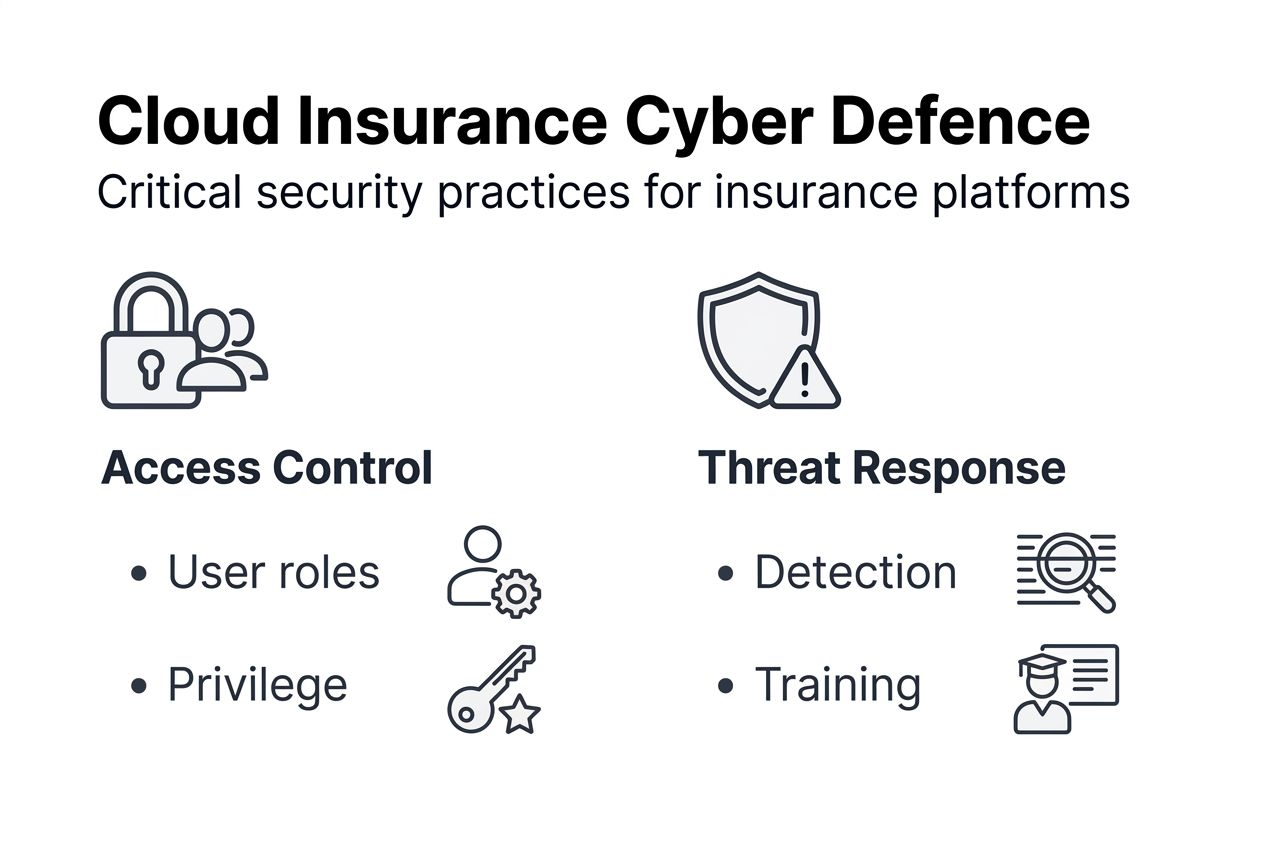
Infographic showing cloud insurance cyber defense

Case studies and lessons learned from European P&C insurers

A major Central European insurer reduced breach incidents by 37% following comprehensive cloud security programme implementation combining Zero Trust architecture, automated patching, and enhanced monitoring. The transformation required 18 months but delivered measurable risk reduction and improved regulatory compliance audit outcomes.

Incident response preparedness proved critical when a mid-sized P&C platform detected ransomware deployment attempts during routine monitoring. Immediate activation of rehearsed response procedures isolated affected systems within 12 minutes, preventing encryption of critical policy data. Post-incident analysis revealed the attack vector involved compromised vendor credentials, prompting enhanced third-party access governance.

Key lessons from successful security implementations include:

  • Executive sponsorship accelerates security initiatives by allocating adequate resources and removing organisational barriers
  • Cross-functional collaboration between security, operations, and development teams prevents silos undermining defence effectiveness
  • Continuous risk monitoring identifies emerging threats faster than periodic assessments
  • Third-party risk management requires ongoing vigilance beyond initial vendor due diligence
  • Security metrics aligned with business objectives demonstrate programme value and justify continued investment

Best practices emerging from peer experiences emphasise automation wherever possible to reduce human error and response latency. Manual security processes cannot scale with cloud platform growth or match attack speeds requiring sub-second detection and response.

Proactive security integration during platform design costs substantially less than retrofitting controls into existing systems whilst delivering superior protection. Early security involvement identifies architectural decisions creating long-term vulnerabilities, enabling course corrections before technical debt accumulates.

Operational resilience improvements following security enhancements extend beyond breach prevention to include faster recovery from incidents, reduced regulatory scrutiny, and improved customer confidence. Insurers demonstrating strong security postures differentiate themselves in competitive markets where data protection increasingly influences purchasing decisions.

Conclusion: enhancing resilience and compliance for future-ready insurance platforms

Cybersecurity demands continuous commitment rather than one-time projects, with threat landscapes evolving faster than annual security reviews can address. Insurance executives must champion ongoing investment in detection capabilities, response readiness, and architectural improvements maintaining protection against emerging attack techniques.

Compliance and security integration from design through operation creates platforms simultaneously meeting regulatory obligations and defending against sophisticated threats. Cloud-native architectures enable this integration through automated controls, comprehensive logging, and API-driven security enforcement replacing manual processes.

Cloud platforms drive operational agility whilst enhancing security when organisations implement proper governance, continuous monitoring, and risk-based control frameworks. The combination of technological capability and disciplined security practices positions insurers to compete effectively whilst protecting sensitive policyholder data against evolving cyber threats throughout 2026 and beyond.

Explore secure digital insurance platform solutions

IBSuite delivers cloud-native insurance software purpose-built with security and compliance embedded throughout its modular architecture. Our policy administration platform and claims management system incorporate Evergreen updates, comprehensive audit trails, and API security controls supporting your cybersecurity objectives.

Built on AWS infrastructure with Zero Trust principles, IBSuite enables P&C insurers to accelerate digital transformation whilst maintaining robust data protection and regulatory compliance. Our platform supports GDPR requirements and NIS2 obligations through configurable privacy controls and automated compliance reporting.

Discover how IBSuite strengthens your security posture whilst delivering operational agility. Book a demo to explore how our secure, cloud-native platform addresses your specific cybersecurity and compliance requirements.

Frequently asked questions

What are the main cybersecurity challenges in cloud-native insurance platforms?

API-first architectures create broader attack surfaces requiring specialised security controls beyond traditional perimeter defences. Ransomware threats continue evolving with attackers developing sophisticated techniques targeting cloud storage and backup systems. Third-party integration risks multiply as platforms connect with external vendors, distribution partners, and data providers. Complex regulatory compliance demands add further challenges requiring continuous documentation and control validation.

How does the NIS2 Directive affect insurance platform security?

NIS2 mandates robust incident detection capabilities, immediate reporting protocols, and comprehensive security governance frameworks for essential service providers including insurers. Non-compliance risks include fines reaching €10 million or 2% of global annual turnover, whichever proves higher. The directive requires board-level oversight of cybersecurity risks and regular third-party audits validating control effectiveness.

What practical steps can insurers take to improve platform cybersecurity?

Implement Zero Trust architectures verifying every access request regardless of network location or user role. Automate security patch deployment through Evergreen update mechanisms eliminating manual delays creating vulnerability windows. Conduct regular incident response drills testing team readiness and plan effectiveness before actual breaches occur. Enforce comprehensive third-party risk governance including continuous vendor security monitoring and contractual security requirements. Deploy SIEM tools providing real-time threat detection across distributed cloud environments.

Are cloud platforms inherently secure for insurance data?

Cloud infrastructure alone provides baseline security capabilities but requires proper configuration, monitoring, and governance to protect insurance data effectively. Shared responsibility models mean providers secure underlying infrastructure whilst customers remain accountable for application security, access management, and data protection. Default cloud settings prioritise flexibility over security, demanding active hardening and continuous validation. Successful cloud security combines provider capabilities with customer-implemented controls addressing organisation-specific risks and regulatory requirements.

Key types of API integrations for insurance success

Key types of API integrations for insurance success

Insurance IT manager working on API integration

Choosing the right API integration type feels overwhelming when you’re managing legacy systems whilst driving rapid digital transformation. Many property and casualty insurance executives face competing demands for security, performance, and innovation. This article cuts through the noise by clarifying the essential API types, defining practical evaluation criteria, and mapping real-world insurance scenarios to optimal integration strategies. You’ll gain confidence to select API approaches that enhance operational efficiency and accelerate your firm’s digital journey.

Table of Contents

Key takeaways

Point Details
Balance critical factors API integration selection must weigh security, legacy compatibility, performance, and total cost of ownership to align with insurance operational goals.
Diverse integration types REST and SOAP cover most insurance needs, but GraphQL and event-driven APIs offer strategic advantages for modern customer engagement and automation.
Clear evaluation criteria Scenario-based recommendations tied to specific insurance workflows help executives optimise API strategies and avoid costly integration failures.
Accelerate transformation Understanding trade-offs between integration types enables P&C insurers to make informed decisions that drive digital innovation and efficiency.

Selection criteria for API integrations in insurance

Before diving into specific API types, you need a clear framework to evaluate which integration approach fits your insurance operations. The wrong choice can delay digital initiatives, inflate costs, and compromise regulatory compliance.

Security and compliance rank as top priorities. Security and compliance are paramount for P&C insurers when choosing API integrations because you handle sensitive customer data subject to strict regulatory oversight. Any integration must support encryption, authentication, and audit trails.

Implementation speed affects your competitive edge. Faster integration cycles mean quicker product launches and enhanced customer experiences. Ease of implementation reduces dependency on scarce technical resources and minimises disruption to ongoing operations.

Performance and scalability determine whether your systems handle peak transaction volumes during renewal periods or claims surges. An API that slows under load damages customer satisfaction and operational efficiency.

Legacy system compatibility cannot be ignored. Most P&C insurers operate hybrid IT environments mixing modern cloud platforms with decades-old core systems. Your chosen API must bridge this gap without requiring costly system rewrites.

Total cost of ownership extends beyond initial development. Consider ongoing maintenance, licensing fees, infrastructure requirements, and the skill level needed to support each API strategy factor over time.

Key criteria for evaluating API integrations:

  • Security and compliance capabilities for regulatory requirements
  • Speed and ease of implementation to accelerate time to market
  • Performance under high transaction volumes during peak periods
  • Compatibility with both legacy core systems and modern platforms
  • Total cost including development, maintenance, and infrastructure

Types of API integrations: REST

REST APIs have become the default choice for modern insurance digital platforms. They use stateless, resource-based design that aligns naturally with web and mobile application architectures.

Insurance team discussing REST API diagrams

The stateless nature of REST means each request contains all necessary information. Your servers don’t maintain session state between calls, enabling horizontal scaling to handle traffic spikes during open enrolment periods or catastrophic event claims.

Over 80% of property and casualty insurers use REST APIs for digital platforms due to their scalability and widespread developer support. This popularity creates a large talent pool and extensive libraries that reduce development time and costs.

REST excels in customer-facing scenarios. Policy portals, quote engines, and mobile apps benefit from REST’s lightweight JSON payloads and simple HTTP methods. Integration with third-party services like payment gateways or data enrichment providers becomes straightforward.

Development and maintenance costs stay lower compared to older protocols. Standard HTTP tools, abundant documentation, and familiar patterns mean your development teams can build and troubleshoot REST integrations efficiently.

Common REST use cases in insurance:

  • Customer self-service portals for policy management and claims submission
  • Mobile applications for quotes, policy updates, and document access
  • Integration with payment processors and third-party data providers
  • Microservices architectures within modern insurance platforms

Pro Tip: REST’s simplicity means you must implement security layers separately. Use OAuth 2.0 for authentication, enforce HTTPS for all communications, and implement rate limiting to prevent abuse. Don’t assume REST handles security automatically.

Types of API integrations: SOAP

SOAP might seem outdated, but it remains essential for many insurance IT landscapes. This protocol-based standard defines strict messaging rules that ensure security, reliability, and transaction integrity.

The structured nature of SOAP makes it ideal for complex, mission-critical workflows. Built-in WS-Security standards provide enterprise-grade authentication, encryption, and message signing without additional implementation effort.

Approximately 45% of large P&C insurers still use SOAP APIs for critical legacy integrations requiring strict security and transaction integrity. These integrations connect core policy administration systems, billing platforms, and financial sub-ledgers where data consistency is non-negotiable.

SOAP’s reliability features guarantee message delivery through built-in retry logic and acknowledgement protocols. When processing premium payments or policy endorsements, you cannot afford lost transactions.

The trade-off comes in complexity and cost. SOAP requires more development effort, generates verbose XML payloads, and demands specialised expertise. Maintenance costs run higher because fewer developers possess deep SOAP experience compared to REST.

Typical SOAP integration scenarios:

  • Connecting modern front-end systems to legacy core platforms
  • Inter-system communication requiring guaranteed transaction delivery
  • Regulated workflows demanding comprehensive audit trails
  • Backend processes where SOAP’s legacy use ensures compatibility with existing infrastructure

Types of API integrations: GraphQL, event-driven and batch

Beyond traditional REST and SOAP, emerging API types address specific insurance challenges with innovative approaches.

GraphQL revolutionises data fetching by letting clients request exactly the data they need. Instead of multiple REST calls to assemble policy details, claims history, and customer information, a single GraphQL query retrieves precisely the required fields. GraphQL reduces over-fetching and API call volume by up to 30% compared to REST, enhancing performance in customer-facing insurance applications.

Event-driven APIs enable real-time responsiveness. When a claim gets filed, an event triggers immediate workflows for fraud detection, adjuster assignment, and customer notification. This asynchronous pattern supports automation and reduces manual processing delays.

Batch APIs handle bulk operations efficiently. End-of-day policy updates, monthly financial reconciliations, and data warehouse synchronisation benefit from batch processing that optimises resource usage and maintains system performance.

Trade-offs require careful consideration:

  • GraphQL demands more sophisticated client development but rewards with flexible, efficient queries
  • Event-driven architectures introduce complexity in monitoring and debugging distributed systems
  • Batch processing sacrifices real-time updates for operational efficiency

Real-world applications:

  1. Customer portals use GraphQL to deliver dynamic interfaces with minimal latency
  2. Claims automation leverages event-driven APIs to orchestrate instant responses
  3. Policy renewals employ batch APIs for overnight processing of thousands of records
  4. Mobile apps benefit from GraphQL and event-driven APIs to provide responsive user experiences

Pro Tip: Start with REST for standard integrations, then introduce GraphQL for specific high-traffic customer interfaces where query flexibility justifies the additional client complexity.

Comparison of API integration approaches

Understanding how different API types perform across key dimensions helps you match integration approaches to specific insurance requirements.

Latency and throughput vary significantly. REST and SOAP operate synchronously, meaning each request waits for a response. Event-driven APIs work asynchronously, allowing systems to continue processing whilst awaiting responses. For high-volume quote engines, asynchronous patterns prevent bottlenecks.

REST APIs offer lower development costs and good scalability, whereas SOAP APIs have higher complexity but ensure transaction integrity. This cost differential can reach 40% over a project lifecycle when factoring development time and ongoing maintenance.

Scalability impacts differ across API types. REST scales horizontally with ease because of its stateless design. SOAP can scale but requires more infrastructure planning. Event-driven architectures scale exceptionally well for asynchronous workloads but need robust message queuing infrastructure.

Implementation complexity affects time to value. REST implementations launch quickly with standard tooling. GraphQL requires client library integration and schema design. Event-driven systems demand event bus infrastructure and careful error handling patterns.

API Type Latency Development Cost Scalability Complexity Best For
REST Low-Medium Low Excellent Low Customer portals, mobile apps
SOAP Medium High Good High Legacy integration, transactions
GraphQL Low Medium Excellent Medium Dynamic customer interfaces
Event-driven Very Low Medium-High Excellent High Real-time automation, claims
Batch High Low Good Low Bulk data synchronisation

Resilience and ecosystem maturity matter for long-term sustainability. REST benefits from massive ecosystem support. SOAP offers proven reliability for critical systems. Newer approaches like GraphQL have growing but smaller communities.

Consider your API integration comparison needs holistically. No single API type fits every scenario. Most successful insurance platforms employ multiple integration patterns optimised for specific use cases.

Summary and situational recommendations

Selecting the right API integration type requires matching technical capabilities to your specific insurance operational context. This summary table distils key attributes to guide your decision.

API Type Security Cost Complexity Performance Typical Use Cases
REST Good (requires additional layers) Low Low High Customer portals, mobile apps, third-party integrations
SOAP Excellent (built-in) High High Medium Legacy core systems, financial transactions, regulatory workflows
GraphQL Good (requires additional layers) Medium Medium Excellent Dynamic customer interfaces, complex data queries
Event-driven Good (requires design) Medium-High High Excellent Claims automation, fraud detection, real-time notifications
Batch Good Low Low Variable Policy updates, reporting, data warehouse synchronisation

Scenario-based recommendations:

For customer engagement and digital portals, choose REST or GraphQL. REST provides quick implementation and broad support. GraphQL suits applications where users need flexible data access patterns and responsive interfaces.

For legacy core system integration requiring high security, SOAP remains the pragmatic choice. Its built-in transaction integrity and security standards align with compliance requirements and legacy system expectations.

For automated claims processing and fraud detection, event-driven APIs deliver real-time responsiveness. They enable intelligent automation that improves operational efficiency whilst enhancing customer experience.

For bulk data synchronisation like policy management and end-of-period reporting, batch APIs optimise resource usage. They handle high volumes efficiently without impacting real-time system performance.

Trade-offs to consider:

  • Higher initial investment in event-driven infrastructure pays dividends through automation and speed
  • SOAP’s complexity cost is justified when transaction integrity is non-negotiable
  • GraphQL’s client-side complexity makes sense for frequently changing data requirements
  • REST’s simplicity accelerates projects where standard CRUD operations suffice

Align your API integration recommendations with your firm’s priorities, IT landscape maturity, and available technical expertise. Most successful strategies employ multiple API types optimised for specific workflows rather than forcing a single approach across all integrations.

Discover modern API-driven insurance platforms

The integration strategies outlined in this article come to life when implemented on platforms built for modern insurance operations. IBSuite’s modern insurance platforms provide robust API-first architecture designed specifically for property and casualty insurers navigating digital transformation.

Our API-first insurance platforms support the full insurance value chain with seamless integration capabilities across REST, SOAP, and emerging API types. You gain the flexibility to connect legacy core systems whilst building modern customer experiences.

See how IBSuite enables rapid innovation, reduces IT complexity, and supports your unique integration requirements. Book a demo to explore how our cloud-native platform accelerates your digital transformation journey.

Frequently asked questions

What are the main differences between REST and SOAP APIs?

REST is stateless and lightweight, making it ideal for web and mobile applications where simplicity and scalability matter most. SOAP is a protocol with strict standards for security and reliable messaging, favoured in legacy, transactional systems requiring guaranteed delivery. REST offers easier development and maintenance with lower costs, whilst SOAP provides stricter compliance and comprehensive error handling built into the standard.

How do event-driven APIs improve claims processing?

Event-driven APIs enable real-time detection and handling of claims events the moment they occur. They support automation by triggering immediate workflows for fraud detection, adjuster assignment, and customer notifications without manual intervention. This reduces processing times significantly and improves accuracy in identifying suspicious patterns.

When should an insurer choose GraphQL over REST?

GraphQL is preferred when clients need flexible, efficient data queries that reduce over-fetching and API call volume. It’s ideal for customer portals requiring dynamic interfaces where users access varying combinations of policy, claims, and billing data. Choose GraphQL when query flexibility and performance optimisation justify the additional client-side development complexity.

Can multiple API types coexist in one insurance platform?

Absolutely. Most successful insurance platforms employ multiple API types optimised for specific use cases rather than forcing a single approach. You might use REST for customer portals, SOAP for legacy core system connections, event-driven APIs for claims automation, and batch APIs for overnight data synchronisation. This hybrid approach maximises the strengths of each integration type.

What security considerations apply across different API types?

All API types require robust authentication, encryption, and access control regardless of their underlying architecture. REST and GraphQL need additional security layers like OAuth 2.0 and API gateways. SOAP includes built-in WS-Security standards. Event-driven APIs require secure message queuing and event validation. Implement rate limiting, logging, and monitoring across all integration types to prevent abuse and ensure compliance with insurance data protection regulations.

How to modernise insurance systems: cut costs 35-50% in 2026

How to modernise insurance systems: cut costs 35-50% in 2026

Insurance team reviews migration plans in meeting

Legacy policy and claims systems cause 35-50% higher IT maintenance costs for 45% of insurers, risking competitiveness in a digital-first market. Modernisation is no longer optional. It’s vital to meet customer expectations, regulatory demands, and operational efficiency goals. This guide walks you through preparing, executing, and measuring successful modernisation projects that transform your P&C insurance operations.

Table of Contents

Key takeaways

Point Details
Legacy systems drain budgets Outdated P&C platforms increase IT costs by 35-50%, limiting innovation and agility.
Preparation drives success Executive buy-in, IT readiness, and stakeholder alignment are essential before modernisation begins.
Cloud-native and AI accelerate outcomes Modern platforms with API-first architecture and AI integration cut processing times by 25% and improve customer satisfaction.
Incremental upgrades balance risk Phased modernisation spreads costs, reduces upfront risk, and allows continuous validation of results.
Projects deliver measurable ROI Typical implementations complete in 12-24 months with significant cost reductions and operational improvements.

Prerequisites and preparations for modernisation

Secure executive leadership buy-in and strategic clarity before any modernisation initiative. Without C-suite sponsorship, projects stall due to budget constraints and competing priorities. Define clear strategic goals that align with business outcomes, whether reducing costs, improving customer experience, or accelerating product launches.

Ensure your IT infrastructure supports cloud-native and API-first architectures. Legacy environments often lack the flexibility needed for modern platforms, so assess current capabilities early. Robust data governance frameworks are non-negotiable. Inconsistent data standards create migration headaches and compromise system integrity.

Engage stakeholders across underwriting, claims, IT, and compliance from day one. Early involvement builds consensus and surfaces technical or regulatory concerns before they derail timelines. Transparent communication keeps all parties aligned on objectives, milestones, and expected outcomes.

Develop detailed migration plans that map data flows, integration points, and rollback procedures. Underestimating this complexity causes cost overruns in 40% of projects. Consider how modern insurance platform benefits support your strategic goals and explore cloud insurance platforms for P&C success to understand infrastructure requirements.

Pro Tip: Establish a dedicated modernisation steering committee with representatives from all key departments. This cross-functional team ensures decisions reflect operational realities and accelerates issue resolution.

With solid preparations in place, we move on to the core steps for executing the modernisation successfully.

Core steps for modernising insurance systems

Start by assessing your legacy systems comprehensively. Document technical debt, integration dependencies, and business-critical workflows. This audit reveals which components need immediate replacement versus gradual retirement.

Secure leadership support with a business case that quantifies expected savings and efficiency gains. Allocate budget for software licences, implementation services, training, and contingency reserves. Realistic funding prevents mid-project compromises that undermine outcomes.

Establish data governance policies and detailed migration strategies before touching production systems. Clean, standardised data ensures smooth transitions and accurate reporting post-migration. Validate data quality through pilot runs that catch issues early.

Select cloud-native, API-first core platforms designed for scalability and agility. These architectures support rapid product innovation and seamless integrations with third-party services. Evaluate vendors based on their ability to support your specific lines of business and regulatory requirements.

IT specialist prepares cloud setup in server room

Implement AI to automate underwriting, claims processing, and risk analysis. AI integration reduces processing times by 25% and improves accuracy in risk assessment. AI-powered claims transformation achieves resolution times under 10 days with customer satisfaction scores exceeding 760 out of 1000.

Follow this implementation sequence:

  1. Launch pilot projects with non-critical business lines to validate platform capabilities.
  2. Monitor key performance indicators like processing speed, error rates, and user satisfaction.
  3. Iterate based on feedback before scaling to core operations.
  4. Roll out full deployment in phases, maintaining parallel operations initially.
  5. Decommission legacy systems only after confirming stable production performance.

Continuous testing and validation reduce the risk of disruptions. Consider how AI integration in underwriting and claims transforms operations and explore API-first core insurance platforms to understand architecture benefits.

Pro Tip: Assign dedicated product owners to oversee each modernisation workstream. Their accountability ensures issues get resolved quickly and project momentum stays strong.

Having established the step-by-step process, we next weigh the different modernisation strategies and vendor selection tradeoffs.

Modernisation strategies and vendor selection tradeoffs

Incremental modernisation by hollowing out legacy systems mitigates risk and spreads investment over manageable phases. This approach replaces modules gradually, maintaining business continuity throughout. You validate each upgrade before proceeding, reducing the chance of catastrophic failures.

Full system replacements deliver faster end-state outcomes but carry higher initial risk. Big-bang implementations can disrupt operations if not executed flawlessly. They require extensive testing and robust contingency planning to handle unforeseen issues.

Vendor cloud-native platforms accelerate timelines by 20-30% compared to in-house development. Established vendors bring domain expertise, pre-built integrations, and continuous platform improvements. In-house builds offer customisation but demand significant internal resources and longer development cycles.

Key evaluation criteria for vendor platforms include:

  • API-first design enabling flexible integrations with existing and future systems
  • Scalability to handle volume growth without performance degradation
  • Ecosystem partnerships providing pre-built connectors to essential third-party services
  • Regulatory compliance support for jurisdictions where you operate
  • Implementation track record with similar P&C insurers

Compare approaches based on your organisation’s capabilities and risk tolerance:

Strategy Cost Timeline Risk Best For
Incremental modernisation Spread over phases 18-24 months Low to medium Risk-averse organisations with complex legacy systems
Full replacement Higher upfront 12-18 months Medium to high Insurers with clear end-state vision and strong change management
Vendor platform Licence fees plus implementation 12-18 months Low to medium Most P&C insurers seeking proven solutions and faster deployment
In-house build Development resources plus ongoing maintenance 24-36 months High Large insurers with specialised requirements and deep technical teams

Tradeoffs involve balancing speed against risk, cost against control, and standardisation against customisation. Explore core platform vendor evaluation to understand selection criteria in depth.

Understanding strategies helps avoid pitfalls, so let’s explore common mistakes and how to troubleshoot them.

Common mistakes and troubleshooting modernisation projects

Data migration complexity gets underestimated in 40% of projects, causing cost overruns and timeline delays. Legacy data often contains inconsistencies, duplicates, and outdated formats that require extensive cleansing. Plan meticulously with expert help to map every data element and validate transformations through multiple test cycles.

Failing to align stakeholders creates resistance that stalls progress. Technical teams may prioritise different features than business users, leading to friction and rework. Regular workshops and transparent roadmaps keep everyone focused on shared objectives.

Incomplete vendor evaluation causes poor platform fit and costly rework. Rushing procurement decisions without thoroughly testing capabilities against your requirements leads to gaps discovered mid-implementation. Conduct proof-of-concept trials with real data and workflows before signing contracts.

Neglecting change management reduces adoption and undermines transformational benefits. Users revert to workarounds if training is inadequate or new systems feel cumbersome. Invest in comprehensive training programmes and communicate benefits clearly to build enthusiasm.

Successful modernisation requires treating people and processes with the same rigour as technology. Continuous communication and hands-on support during transitions make or break adoption rates.

Mitigation strategies include:

  • Appointing data migration specialists early to assess complexity and build realistic plans
  • Holding bi-weekly stakeholder reviews to surface concerns and adjust course
  • Running extended vendor evaluations with pilots on representative workloads
  • Developing role-based training tailored to each user group’s daily tasks
  • Establishing support channels for post-launch questions and feedback

Learn more about managing change during modernisation to reduce resistance and accelerate adoption.

Pro Tip: Create a lessons-learned repository after each project phase. Documenting what worked and what didn’t helps refine your approach for subsequent rollouts and builds institutional knowledge.

With risks managed, it’s important to set realistic expectations on results and timelines, which we cover next.

Expected results and timelines for modernisation

Projects generally complete within 12 to 24 months with proper planning and phased execution. Complexity, organisational readiness, and vendor capabilities influence actual duration. Incremental approaches trend towards the longer end whilst full replacements can compress timelines if executed well.

IT maintenance costs drop by 35-50% post-modernisation as cloud-native platforms eliminate legacy infrastructure overhead. Automated updates and scalable architectures reduce the need for manual patching and capacity planning.

Infographic showing insurance modernisation results overview

Processing times for underwriting and claims cut by 25% or more through AI automation and streamlined workflows. Faster cycle times improve customer satisfaction and free staff for higher-value activities. Claims resolved under 10 days drive satisfaction scores above 760 out of 1000, significantly boosting retention and referrals.

Key performance indicators to track:

Metric Baseline Target Post-Modernisation
IT maintenance cost as % of revenue 15-20% 8-12%
Average underwriting cycle time 7-10 days 3-5 days
Claims resolution time 15-20 days Under 10 days
Customer satisfaction score 650-700/1000 Over 760/1000
Product launch timeline 6-12 months 2-4 months

Success depends on clear KPIs established before implementation and ongoing optimisation after go-live. Monitor system performance, user adoption rates, and business outcomes monthly. Adjust configurations and training based on real-world usage patterns.

Expect initial productivity dips during transitions as users adapt to new interfaces and workflows. Provide extra support during this learning curve to maintain morale and prevent reversion to old habits.

Now that expectations are clear, let’s bridge to practical solutions offered to help you modernise confidently.

Explore modern insurance platforms to accelerate your transformation

IBSuite offers cloud-native, API-first platforms tailored for P&C insurers seeking to modernise core systems efficiently. Our solutions integrate AI and modular architectures that deliver scalability, agility, and faster time-to-market for new products. We support the full insurance value chain from sales and underwriting to policy administration, claims, billing, and financial sub-ledger.

Explore modern insurance platform benefits to understand how end-to-end solutions transform operations. Learn how API-first insurance platforms enable seamless integrations and rapid innovation. Book a demo to see how IBSuite can support your modernisation goals and accelerate your digital transformation journey.

Frequently asked questions

How long does it take to modernise P&C insurance systems?

Modernisation projects generally take 12 to 24 months depending on scale, complexity, and chosen approach. Phased implementations allow for risk management, continuous validation, and ongoing improvements throughout the journey. Proper planning and stakeholder alignment significantly influence actual timelines.

What benefits does AI integration bring to insurance modernisation?

AI reduces underwriting and claims processing times by around 25%, improving operational efficiency substantially. It enhances risk assessment accuracy through advanced analytics and accelerates claims resolution to under 10 days. Faster processing drives customer satisfaction scores above 760 out of 1000, boosting retention and competitive positioning.

Should we build insurance systems in-house or select a vendor platform?

Vendor platforms accelerate timelines by 20-30% compared to in-house development and bring proven domain expertise. They offer pre-built integrations, continuous platform improvements, and lower ongoing maintenance costs. In-house builds provide customisation but require significant resources, longer development cycles, and higher risk of execution challenges.

What common mistakes should be avoided in modernisation projects?

Underestimating data migration complexity and poor stakeholder alignment cause delays and cost overruns in 40% of projects. Incomplete vendor evaluation leads to poor platform fit requiring costly rework. Early engagement, detailed planning, and comprehensive change management mitigate these risks effectively and improve success rates.

How can insurance companies reduce costs during modernisation?

Adopt incremental modernisation to spread investments over manageable phases and reduce upfront financial strain. Select cloud-native, modular platforms that offer scalability, automated updates, and lower maintenance expenses. Phased approaches allow continuous validation whilst controlling costs and minimising disruption to ongoing operations.

Insurance marketplace models 2026: 50% faster launches

Insurance marketplace models 2026: 50% faster launches

Insurance executive reviewing marketplace launch timeline

By 2026, over 70% of insurers are modernising core systems to escape legacy constraints. Insurance marketplace models now define competitive advantage for P&C insurers across Central Europe. Cloud-native platforms, API-first architecture, and AI automation deliver measurable gains in speed, cost, and customer satisfaction. This article explores how modern marketplace models accelerate digital transformation, streamline operations, and enhance regulatory compliance for insurers seeking operational excellence.

Table of Contents

Key takeaways

Point Details
Cloud-native platforms Reduce product launch time by up to 50% through microservices and rapid deployment capabilities.
API-first architecture Cuts integration project time by 30% enabling faster ecosystem connections.
AI automation Enhances underwriting speed and claims accuracy whilst reducing operational costs significantly.
Regulatory compliance DORA and Solvency II frameworks drive secure innovation rather than stifling it.
Customer expectations Over 65% of European policyholders demand seamless omnichannel service from insurers.

Introduction to insurance marketplace models

Insurance marketplace models are integrated digital platforms enabling product distribution, underwriting, claims processing, and partner ecosystem management. These platforms serve as the operational backbone for P&C insurers navigating digital transformation.

For insurance executives, marketplace models represent strategic infrastructure. They determine how quickly you launch products, how efficiently you process claims, and how effectively you meet customer expectations. In 2026, competitive agility depends on platform architecture.

Several market forces drive marketplace evolution. Digital customer expectations demand instant quotes and transparent pricing. Regulatory complexity requires real-time compliance monitoring. Cost pressures force operational efficiency improvements. Omnichannel distribution models necessitate seamless partner integrations.

Key trends shaping insurance marketplace models include:

  • Shift from monolithic legacy systems to modular cloud-native platforms
  • API-first design enabling rapid third-party integrations
  • AI-driven automation reducing manual processing workloads
  • Embedded insurance expanding distribution beyond traditional channels
  • Real-time data analytics informing underwriting and pricing decisions

These trends converge to create marketplace models that balance innovation speed with regulatory compliance. Insurers adopting modern platforms gain measurable advantages in time-to-market, operational cost, and customer satisfaction metrics.

Technological evolution: from legacy systems to cloud-native platforms

Legacy insurance systems create substantial barriers to innovation. Monolithic architectures resist change. Integration projects stretch across months. Maintenance consumes IT budgets. Legacy core systems are frequently cited as barriers to operational efficiency, with inflexible designs and high maintenance costs driving modernisation investments.

Cloud-native platforms solve these limitations through fundamentally different architecture. Microservices modularity allows independent component updates. Elastic scaling adjusts resources to demand. Lower infrastructure complexity reduces IT overhead. Cloud-native insurance platforms accelerate product launch times by up to 50% by enabling rapid configuration through microservices and API-first design.

API-first design amplifies these benefits. Standardised interfaces simplify integrations with distribution partners, data providers, and regulatory systems. Pre-built connectors reduce custom development. Version management maintains stability during platform evolution.

Attribute Legacy Systems Cloud-Native Platforms
Architecture Monolithic, tightly coupled Microservices, modular
Deployment speed Months for major changes Days or weeks for new products
Integration approach Custom point-to-point Standardised API connections
Scaling capability Fixed capacity, manual upgrades Elastic, automatic scaling
Maintenance cost High, dedicated resources Lower, shared services

Modern cloud-native insurance platforms deliver measurable improvements. Product launches accelerate. Integration complexity decreases. Operational costs decline. These platforms support innovation velocity required in competitive markets.

IT manager working on launch acceleration

Pro Tip: Prioritise modular, API-first platforms to shortcut integration complexity and accelerate time-to-market for new products.

For further reading on modernisation trends, see the OECD insurance modernisation report.

Role of API-first architecture in integration and product innovation

API-first architecture transforms how insurers connect with partners and deploy products. Rather than custom integrations for each relationship, standardised APIs create reusable connections. This approach delivers speed and consistency across ecosystem interactions.

API-first design in insurance platforms enables seamless integration with digital distribution channels, third-party data providers, and partner ecosystems. Integration project time drops 30% compared to traditional custom development approaches.

Rapid product iteration becomes feasible with API-based architectures. Insurers configure new offerings using existing platform services. Testing cycles shorten. Deployment risks decrease. Market feedback loops accelerate product refinement.

Key integration benefits include:

  • Ecosystem connectivity enabling multi-channel distribution without custom builds
  • Real-time data access from credit bureaus, weather services, and IoT devices
  • Product scalability supporting rapid market expansion
  • Partner onboarding measured in weeks rather than months
  • Consistent security and compliance across all integrations

Practical API use cases in P&C marketplaces demonstrate versatility. Distribution partners access quoting and policy issuance through standardised interfaces. Claims systems integrate with repair networks and medical providers. Underwriting engines pull risk data from multiple external sources simultaneously.

API-first core insurance platforms support innovation velocity required in competitive markets. They reduce technical debt whilst expanding capability. Insurers gain flexibility without sacrificing stability.

For regulatory context, review the EIOPA 2025 report on digital infrastructure requirements.

Impact of AI and automation in underwriting and claims processing

AI and automation technologies deliver measurable improvements in underwriting speed, claims accuracy, and operational cost for insurance marketplaces. These tools augment human expertise rather than replacing it.

Operational improvements manifest across key processes. Underwriting decisions that required days now complete in minutes. Claims triage identifies complex cases requiring human review whilst automating straightforward approvals. Error rates decline through consistent rule application.

Cost savings accumulate from reduced manual handling. Fewer staff hours per transaction. Lower error correction costs. Faster cycle times improving customer satisfaction. AI-driven automation reduces operational expenses whilst improving decision accuracy across P&C processes.

Practical AI applications include:

  • Risk scoring engines analysing hundreds of variables in seconds
  • Fraud detection identifying suspicious patterns across claims data
  • Claims automation routing straightforward cases to instant approval
  • Natural language processing extracting structured data from unstructured documents
  • Predictive analytics forecasting loss trends to inform pricing

These applications deliver tangible business value. Risk scoring improves underwriting profitability by 15-25%. Fraud detection prevents losses totalling millions annually. Automation in claims processing reduces cycle time by 40-60% for routine cases.

The combination of AI and automation in P&C insurance creates competitive differentiation. Insurers process higher volumes with consistent quality. Customer satisfaction improves through faster service. Operating ratios benefit from lower expense bases.

Pro Tip: Combine AI with human expertise for optimal decision quality. Use automation for routine cases whilst directing complex scenarios to experienced underwriters and adjusters.

For industry analysis on AI adoption, see the Morgan Philips report on AI in insurance.

Regulatory compliance challenges and solutions in Central Europe

Regulatory compliance shapes insurance marketplace design across Central Europe. Requirements extend beyond traditional solvency rules to encompass operational resilience and data protection.

Compliance with the Digital Operational Resilience Act (DORA) and evolving Solvency II requirements necessitates marketplace models built for secure data exchange and real-time risk monitoring. These frameworks set minimum standards for system reliability, incident response, and third-party risk management.

Modern marketplace platforms address compliance through embedded capabilities. Secure data exchange protocols protect customer information. Real-time monitoring identifies operational anomalies before they escalate. Audit trails document decision processes for regulatory review.

Key compliance challenges and marketplace responses include:

  • Data residency requirements addressed through regional cloud deployment options
  • Incident reporting obligations met via automated monitoring and alerting systems
  • Third-party risk management supported by API security controls and vendor assessments
  • Business continuity planning enabled through redundant infrastructure and failover capabilities
  • Regulatory reporting automated via pre-configured templates and data extraction tools

Compliance becomes an innovation enabler when embedded early in platform architecture. Insurers meeting regulatory standards gain customer trust. They access new markets confidently. They avoid costly remediation projects.

Embracing compliance through next-generation insurance platforms positions insurers for sustainable growth. Regulatory alignment supports rather than constrains innovation.

For detailed compliance requirements, review DORA and Solvency II compliance guidance.

Operational benefits and efficiency gains from modern marketplaces

Modern insurance marketplace models deliver quantifiable operational improvements. These gains manifest in streamlined workflows, reduced manual processing, and lower IT complexity.

Operational improvements include faster policy issuance cycles, automated premium calculations, and integrated document management. Claims workflows route cases efficiently. Commission calculations complete automatically. Renewal processes require minimal manual intervention.

IT maintenance and complexity costs decline substantially. Cloud infrastructure eliminates hardware refresh cycles. Automated updates reduce manual patching. Consolidated platforms replace fragmented systems.

Metric Legacy Systems Cloud-Native API-First Platforms
Product launch time 6-12 months 2-8 weeks
Integration duration per partner 3-6 months 2-4 weeks
Annual IT maintenance cost 20-30% of platform value 10-15% of platform value
System availability 95-97% 99.5-99.9%
Manual processing rate 40-60% of transactions 10-20% of transactions

Efficiency gains accumulate across multiple dimensions:

  • IT cost savings from consolidated infrastructure and reduced maintenance
  • Increased productivity through automation of routine tasks
  • Improved scalability supporting business growth without proportional cost increases
  • Enhanced data quality from integrated systems eliminating duplicate entry
  • Faster decision cycles enabling market responsiveness

Operational efficiency with API-first platforms transforms cost structures. Fixed expenses decline. Variable costs scale with volume. Margins improve through operational leverage.

Infographic with speed and cost savings of insurance marketplaces

The benefits of modern insurance platforms extend beyond immediate cost savings. Improved agility enables faster market adaptation. Better data visibility supports strategic decision-making. Enhanced customer experience drives retention.

Pro Tip: Invest in holistic platform redesign rather than piecemeal upgrades to realise full efficiency gains and avoid integration complexity.

Customer experience improvements and market adaptation

Customer expectations drive insurance marketplace evolution. Digital natives demand instant quotes, transparent pricing, and omnichannel service. Traditional distribution models no longer satisfy these requirements.

Over 65% of European policyholders demand seamless omnichannel service from insurers. They expect consistent experiences across web, mobile, agent, and phone channels. Marketplace models enabling this consistency gain competitive advantage.

Embedded insurance and integrated digital ecosystems improve cross-sell rates by 15-20% by offering tailored products at point of need. Purchase journeys shorten. Conversion rates increase. Customer lifetime value grows.

Modern marketplace models enable personalised, transparent, and interactive customer experiences. Real-time pricing reflects individual risk profiles. Self-service portals allow policy modifications without agent intervention. Mobile apps provide instant proof of coverage.

Customer experience benefits include:

  • Quick quotes delivered in seconds rather than hours
  • Multi-channel support maintaining context across touchpoints
  • Product relevance through personalised recommendations
  • Transparent pricing explaining premium calculations
  • Instant policy changes without paperwork delays

These improvements translate to business outcomes. Customer acquisition costs decline. Retention rates improve. Net promoter scores increase. Digital-first insurers capture market share from traditional competitors.

Market adaptation requires continuous platform evolution. Customer preferences shift. New channels emerge. Competitive offerings raise expectations. Marketplace models built on flexible architecture adapt quickly.

For customer expectation trends, see the EIOPA customer expectations report and BCG report on embedded insurance.

Common misconceptions about insurance marketplace models

Several misconceptions limit insurer adoption of modern marketplace models. Addressing these misunderstandings accelerates transformation initiatives.

Misconception 1: Digital transformation is just a technology upgrade. Digital transformation requires holistic business model redesign incorporating customer-centric strategies. Technology enables change but doesn’t define it. Successful transformations align operating models, distribution strategies, and product portfolios with platform capabilities.

Misconception 2: AI replaces human underwriters and adjusters. AI augments human expertise rather than replacing it. Automation handles routine decisions freeing experienced staff for complex cases requiring judgement. The combination delivers superior outcomes compared to either approach alone.

Misconception 3: Regulatory compliance stifles innovation. Compliance frameworks drive secure, sustainable innovation. Marketplace models meeting regulatory standards gain customer trust and market access. Compliance becomes competitive advantage rather than constraint.

Key corrections include:

  • Digital transformation requires cultural change and process redesign beyond technology implementation
  • AI and automation complement human expertise by handling routine work efficiently
  • Regulatory compliance enables innovation through standardised security and governance frameworks
  • Cloud-native platforms reduce rather than increase operational complexity
  • Modern marketplace models support traditional distribution whilst enabling new channels

Regulatory frameworks like DORA and Solvency II establish foundations for innovation by ensuring operational resilience and customer protection. Insurers viewing compliance as enabler rather than burden gain strategic advantage.

Clearing these misconceptions removes barriers to modernisation. Insurance executives gain realistic expectations. Transformation initiatives focus on strategic business outcomes rather than technology specifications alone.

Conclusion and practical recommendations for insurers

Insurance marketplace models determine competitive position for P&C insurers in 2026. Cloud-native platforms, API-first architecture, and AI automation deliver measurable improvements in speed, cost, and customer satisfaction.

Key learnings emphasise technology as enabler of business transformation. Legacy constraints limit innovation velocity. Modern architectures remove these barriers whilst embedding compliance and security. Customer expectations require digital-first experiences across channels.

Practical recommendations for insurance executives:

  1. Prioritise cloud-native API-first platforms providing scalability and regulatory compliance foundations.
  2. Invest strategically in AI and automation for underwriting and claims processes to improve efficiency.
  3. Align compliance strategy with innovation goals viewing regulations as enablers rather than constraints.
  4. Maintain customer-centric marketplace design ensuring seamless omnichannel experiences.
  5. Plan holistic transformation rather than piecemeal upgrades to maximise efficiency gains.
  6. Engage experienced platform providers with proven P&C expertise to accelerate implementation.

Successful marketplace transformation balances innovation speed with operational stability. Insurers adopting modern platforms gain flexibility without sacrificing reliability. They respond to market changes quickly whilst maintaining regulatory compliance and customer trust.

Discover modern insurance platforms designed for your success

IBSuite delivers cloud-native, API-first platform capabilities supporting P&C insurers across digital transformation journeys. Our solutions embed AI and automation whilst ensuring compliance with Central European regulatory requirements including DORA and Solvency II.

Explore how modern insurance platform benefits apply to your organisation. See how API-first core insurance platforms accelerate product innovation and ecosystem integration.

Ready to modernise your insurance marketplace model? Book a demo to discuss tailored solutions for your digital transformation requirements.

Frequently asked questions

What are insurance marketplace models?

Insurance marketplace models are integrated digital platforms enabling product distribution, underwriting, claims processing, and partner ecosystem management. They serve P&C insurers by supporting multi-channel access and rapid product innovation whilst maintaining operational efficiency.

How do cloud-native platforms improve insurance marketplaces?

Cloud-native platforms enable modular microservices architecture, faster product deployment, and easier third-party integrations. They support rapid product launches reducing time-to-market by up to 50% whilst lowering operational costs through elastic scaling and reduced IT complexity.

What role does AI play in modern insurance marketplaces?

AI accelerates underwriting and claims decisions, reduces processing errors, and cuts operational costs significantly. It complements human expertise by handling routine cases efficiently whilst directing complex scenarios requiring judgement to experienced professionals for optimal decision quality.

How does regulatory compliance impact insurance marketplace design?

Compliance ensures secure data handling, operational resilience, and real-time risk management across marketplace operations. It supports innovation by fostering customer trust and operational stability rather than constraining capability. Modern platforms embed compliance requirements enabling insurers to meet regulatory standards efficiently.

What are common pitfalls in modernising insurance marketplace models?

Underestimating integration complexity and neglecting customer experience design are frequent errors. Piecemeal upgrades create technical debt rather than solving underlying architectural limitations. Early compliance engagement and modular platform selection mitigate these risks whilst accelerating transformation timelines.

Digital Insurance Broker: 70% Faster Underwriting

Digital Insurance Broker: 70% Faster Underwriting

Insurance broker working in sunny corner office

Digital insurance brokers can reduce underwriting times by up to 70%, transforming how P&C insurers operate in 2026. This guide unpacks what digital brokers are, how their technology differs from traditional models, and concrete ways you can leverage them to drive operational efficiency and elevate customer engagement across your organization.

Table of Contents

Key Takeaways

Point Details
Speed and Automation Digital insurance brokers cut underwriting times by up to 70% through automated workflows.
Technology Foundation Cloud-native platforms and API integrations enable scalable, flexible broker solutions.
Hybrid Models Combining human advisors with digital tools preserves trust while boosting efficiency.
Operational Impact Insurers gain cost savings, faster product launches, and improved data accuracy.
Customer Benefits Instant quotes, personalized policies, and digital interactions enhance satisfaction and loyalty.

Introduction to Digital Insurance Brokers

Digital insurance brokers leverage cloud-native platforms and APIs to automate sales, underwriting, and policy management. Unlike traditional brokers who rely on manual processes and in-person meetings, digital brokers handle workflows through software. They provide automated underwriting, instant quoting, policy issuance, and digital claims initiation, all integrated with insurer core systems.

Traditional brokers spend significant time on paperwork, phone calls, and face-to-face consultations. Digital brokers replace many of these steps with automated decisioning and self-service portals. This shift accelerates product launches and enables scalability that manual processes cannot match. Understanding digital-first insurance strategies helps you see how digital brokers fit into broader transformation efforts.

Core functions of digital brokers include:

  • Automated underwriting using predefined rules and AI models
  • Real-time quoting and policy comparison engines
  • Digital policy issuance and document management
  • Integrated claims initiation and tracking
  • API-driven data exchange with insurer platforms

These capabilities fundamentally change how insurers interact with customers and manage risk. Digital brokers support faster time-to-market for new products and enable insurers to compete more effectively in a digital economy.

Technological Enablers of Digital Insurance Brokers

Cloud-native platforms provide the foundation for digital brokers by delivering flexibility, scalability, and reduced IT maintenance costs by up to 30%. These platforms eliminate the need for on-premise infrastructure and enable continuous updates without disrupting operations. When selecting modern insurance platforms, prioritize those with robust API ecosystems.

API-first architecture allows digital brokers to integrate seamlessly with insurer core systems, third-party data providers, and distribution channels. API-first insurance platforms enable real-time data exchange, reducing manual data entry and errors. This architecture supports rapid innovation by allowing new services to connect without rebuilding existing systems.

Automation and AI streamline workflows across the insurance value chain:

  • Automated underwriting evaluates risk based on real-time data
  • AI-powered recommendations personalize policy options for customers
  • Robotic process automation handles routine administrative tasks
  • Machine learning improves fraud detection and claims accuracy

Pro Tip: Select platforms with proven API integration capabilities to avoid technical debt and ensure future-proofing as your technology stack evolves.

These technologies work together to create a digital broker ecosystem that operates faster and more accurately than traditional models. Optimizing cloud insurance platforms ensures you maximize the value of these investments.

Operational Efficiency Gains From Digital Brokers

Automated underwriting can reduce processing time by 50-70%, directly impacting your bottom line. This acceleration comes from eliminating manual review steps, automating data collection, and applying consistent decisioning logic. Insurers also see cost reductions from less labor-intensive workflows and improved accuracy that reduces errors and rework.

Insurance team collaborating on automated underwriting

Integration with core systems enables smooth data flow between brokers, underwriting, policy administration, and claims. This connectivity eliminates data silos and ensures all departments work from the same information. Understanding digital insurance platform benefits helps you quantify potential gains.

To realize operational efficiency from digital brokers, follow these steps:

  1. Assess current workflows to identify manual bottlenecks and inefficiencies
  2. Select a cloud-native platform with strong API support and automation capabilities
  3. Integrate the platform with existing core systems using APIs
  4. Automate workflows for underwriting, quoting, and policy issuance
  5. Measure outcomes through key performance indicators like processing time and cost per policy

Pro Tip: Prioritize platforms with proven integration track records in your insurance segment to reduce transition risks and accelerate time to value.

The benefits of modern insurance platforms extend beyond speed to include better data quality, compliance support, and the ability to launch new products in weeks rather than months. These improvements compound over time, creating sustained competitive advantage.

Enhancing Customer Engagement through Digital Insurance Brokers

Digital brokers provide instant quotes and AI-driven policy recommendations, delivering measurable gains in customer satisfaction. Customers no longer wait days for quotes or policy decisions. Instead, they receive immediate responses and can complete transactions digitally at their convenience. This speed and transparency build trust and increase conversion rates.

Personalized policy suggestions powered by AI analyze customer data to recommend coverage that fits individual needs. This customization goes beyond generic product offerings to create tailored solutions. Digital document management simplifies policy issuance and claims filing, reducing friction throughout the customer journey.

Key customer engagement improvements include:

  • Instant digital quotes that shorten the buying cycle
  • AI-enabled personalized recommendations that improve policy fit
  • Self-service portals for policy management and claims filing
  • Omni-channel interactions blending digital and advisor support
  • Real-time status updates and notifications

Customer engagement scores improve measurably after digital broker adoption. Insurers report higher Net Promoter Scores, increased policy retention, and greater customer lifetime value. Digital brokers support omni-channel strategies that let customers choose how they interact, whether through self-service or with human advisors.

The combination of speed, personalization, and convenience creates experiences that meet modern customer expectations. Exploring insurance customer experience improvements shows how digital brokers fit into broader engagement strategies.

Common Misconceptions about Digital Insurance Brokers

Many executives believe digital brokers will fully replace human agents. In reality, over 60% of successful implementations use hybrid human-digital models. These models combine automated workflows with human expertise for complex risks or high-value customers. The technology handles routine tasks while agents focus on advisory services that require judgment and relationship building.

Another misconception is that digital brokers are simply traditional brokers with websites. True digital brokers use cloud-native, API-driven automation that fundamentally transforms operations. They integrate with insurer core systems, apply real-time data analytics, and automate decisioning in ways basic websites cannot.

Some leaders assume digital broker adoption guarantees instant, flawless operations. Integration with legacy systems and regulatory compliance requires careful planning and phased implementation. Success depends on selecting the right platform, managing change effectively, and addressing technical debt in existing systems.

Understanding these realities helps you:

  • Set realistic transformation timelines and expectations
  • Design hybrid models that leverage both technology and human expertise
  • Allocate sufficient resources for integration and change management
  • Avoid underestimating the strategic planning required for success

Addressing these misconceptions upfront prevents common pitfalls and improves your chances of achieving the full benefits digital brokers offer.

Comparison Framework: Digital vs. Traditional Brokers

Traditional brokers rely on manual workflows, face-to-face meetings, and paper-based documentation. Product launches can take months due to the need to train agents, print materials, and establish manual processes. Customer interactions happen primarily in person or via phone, limiting scalability and creating bottlenecks during peak periods.

Digital brokers use cloud-native platforms and automation to accelerate every step. They enable instant quotes, automated underwriting, and digital policy issuance. Customer interaction shifts to omni-channel digital experiences that support self-service while preserving access to human advisors when needed. Understanding P&C insurance distribution types provides context for how digital brokers fit into your distribution strategy.

Infographic comparing digital and traditional insurance brokers

Dimension Traditional Brokers Digital Brokers
Workflow Manual processes, paper documentation Automated workflows, digital documentation
Underwriting Speed Days to weeks Minutes to hours
Customer Interaction In-person, phone Omni-channel digital, self-service with advisor support
Technology Platform Legacy systems, limited integration Cloud-native, API-first architecture
Product Launch Time Months Weeks
Scalability Limited by agent capacity Highly scalable through automation

Key differences in operational approach:

  • Digital brokers automate risk assessment using real-time data feeds
  • Traditional brokers require manual data collection and analysis
  • Digital platforms enable continuous innovation through API integration
  • Traditional systems often require custom development for changes

The speed advantage of digital brokers compounds across the insurance value chain, enabling faster product innovation, quicker response to market changes, and better customer experiences.

Real-World Examples and Case Studies

A Central European P&C insurer reduced underwriting time by 65% after integrating digital broker capabilities through a modern core platform. The insurer automated risk assessment, policy issuance, and initial claims processing. Sales increased by 25% within the first year as the faster underwriting process improved conversion rates and enabled expansion into new market segments.

Cost savings came from multiple sources:

  • Reduced manual effort in underwriting and policy administration
  • Lower error rates and rework from automated data validation
  • Decreased IT maintenance costs through cloud-native infrastructure
  • Faster product launches that reduced time-to-market expenses

Lessons learned from this transformation include the importance of phased integration, starting with less complex product lines before expanding to the full portfolio. The insurer maintained hybrid agent models, allowing experienced underwriters to focus on complex risks while automation handled routine cases. A comprehensive digital transformation roadmap proved essential for managing change and maintaining business continuity.

The competitive advantage became clear within months. The insurer launched three new products in the time it previously took to launch one. Customer satisfaction scores improved by 35% due to faster quotes and policy issuance. Agent productivity increased as they spent less time on administrative tasks and more on customer relationships.

These measurable improvements demonstrate the tangible business impact digital brokers deliver when implemented strategically with the right technology foundation.

Implementation Challenges and Strategic Considerations

Integration complexity with legacy insurer systems represents the most common barrier to digital broker adoption. Many core systems lack modern APIs, requiring custom integration work or middleware solutions. This technical debt can slow implementation and increase costs if not addressed strategically.

Regulatory compliance must be factored into platform selection and workflow design. Digital brokers must maintain audit trails, data privacy protections, and compliance with insurance regulations across jurisdictions. Platforms with built-in compliance features reduce this burden.

Critical success factors include:

  • Robust API architecture that enables seamless integration with existing systems
  • Continuous platform updates that keep pace with regulatory changes
  • Strong vendor support and implementation expertise
  • Clear change management processes to support organizational adoption

Adopting hybrid human-digital brokerage models helps maintain customer trust during transitions. Customers accustomed to personal relationships appreciate having access to advisors while benefiting from digital convenience. This approach also eases internal resistance by showing agents how technology enhances rather than replaces their roles.

Strategic planning reduces implementation risks. Start with a pilot program on a single product line or market segment. Measure results, refine processes, then expand gradually. Partner with experienced providers who understand insurance operations and can guide you through technical and organizational challenges. Exploring API-first core insurance platforms helps you evaluate platform capabilities before committing.

Phased rollout allows you to build internal expertise, prove value to stakeholders, and adjust your approach based on real-world feedback. This method delivers faster time to value while managing risk effectively.

Explore Modern Insurance Platforms to Accelerate Your Digital Brokerage

Discover how modern insurance platforms powered by IBSuite enable seamless digital brokerage through cloud-native architecture and API-first design. IBSuite supports the full insurance value chain from sales and underwriting to policy administration, claims, and billing, helping you achieve the operational efficiency and customer engagement gains outlined in this guide.

Leverage automation and integrated workflows to boost productivity while maintaining the flexibility to adapt quickly to market changes. IBSuite’s proven integration capabilities reduce implementation risks and accelerate your path to digital transformation. Understanding the complete range of insurance platform benefits helps you evaluate how these capabilities apply to your specific needs.

Ready to see how a modern core platform can transform your brokerage operations? Book a demo to explore IBSuite’s capabilities and discuss a customized roadmap for your digital broker strategy.

FAQ

What is the difference between a digital insurance broker and a traditional insurance broker?

Digital brokers automate workflows through cloud-native platforms and APIs, while traditional brokers rely on manual processes and in-person interactions. Digital brokers deliver faster underwriting, instant quotes, and digital engagement, whereas traditional brokers provide more face-to-face service. Many successful insurers use hybrid models that combine digital efficiency with human advisory for complex situations, preserving relationship value while gaining automation benefits.

How do digital insurance brokers improve customer engagement?

They offer instant digital quotes, AI-driven policy recommendations, and digital document handling that create faster, more transparent interactions. This convenience and personalization lead to higher customer satisfaction scores and increased loyalty. Customers appreciate the ability to self-serve for routine tasks while still accessing human advisors when needed.

What are the main challenges when implementing digital insurance brokers?

Integration with legacy insurer systems and ensuring regulatory compliance represent the biggest complexities. Strategic planning, selecting platforms with strong API architectures, and phased implementation help mitigate these challenges. Working with experienced partners who understand insurance operations reduces risk and accelerates successful adoption.