portalId 145238543 hublet eu1 environment prod defaultChatFlow ----

What does an underwriter do? A Central Europe career guide

What does an underwriter do? A Central Europe career guide

Hands analyzing underwriting risk data on desk

An underwriter assesses risk, sets the price and terms for accepting it, and decides whether a firm should take it on at all. That three-part function — evaluate, price, decide — sits at the commercial heart of every insurer, reinsurer, and lending institution. The role sits between distribution (brokers and agents who bring business in) and the technical teams behind it: actuaries who model long-run loss trends, and claims handlers who deal with outcomes. Regulators such as EIOPA sets the solvency and conduct framework within which underwriters operate, while major European reinsurers like Hannover Re and platforms like Ibapplications shape how the work is done day to day.

Key takeaways

Underwriters assess, price, and accept or decline risks — a function that sits at the commercial centre of every insurer and lender in Central Europe.

Point Details
Core function Underwriters evaluate risk, set premiums and terms, and decide whether to accept or decline business.
Entry routes Graduate schemes, underwriting assistant roles, and lateral moves from broking or claims are the main paths in Central Europe.
Salary range London benchmarks run from roughly £35,578 to £63,721; Central European markets vary by country and employer.
Digital skills matter Modern underwriters configure and interpret automated rules; platform literacy is now a hiring criterion.
Ibapplications IBSuite Supports P&C underwriting teams across Europe with policy administration and claims management on a single cloud-native platform.

Table of Contents

How does the underwriting process actually work?

The underwriting process follows a clear sequence, even if the pace and complexity vary by line of business.

  • Lead or submission received: a broker, agent, or applicant submits a proposal with supporting information.
  • Data gathering: the underwriter collects applications, survey reports, claims histories, financial statements, and third-party data.
  • Risk assessment: the file is scored against appetite guidelines, actuarial models, and market benchmarks.
  • Pricing and terms: a premium is calculated, coverage conditions are set, and any exclusions or warranties are drafted.
  • Acceptance or decline: the underwriter issues a quote, refers the file upward if it exceeds their authority, or declines.
  • Documentation: policy wording, endorsements, and referral notes are finalised and recorded in the system.
  • Renewal: at expiry, claims experience and updated risk data feed back into the next cycle.

According to Indeed’s underwriter job description, a standard role involves analysing applications, meeting brokers, using actuarial data and software, liaising with surveyors, and making acceptance decisions — all of which map directly onto this lifecycle. The outputs are tangible: a quoted premium, a set of policy terms, an endorsement, or a documented referral to a specialist.

How do underwriter roles vary by specialism?

The title “underwriter” covers several distinct roles. The underlying skills overlap, but the stakeholders, data sources, and daily rhythms differ considerably.

Insurance underwriting (P&C, life, health)

Property and casualty underwriters assess physical and liability risks: buildings, fleets, professional indemnity, employers’ liability. Life and health underwriters focus on mortality and morbidity data, medical histories, and actuarial life tables. Both types negotiate terms with brokers, set premiums, and manage a book of business against a loss ratio target. Hannover Re describes the core task as analysing risks, developing customised solutions, and combining statistical models with market judgement to decide which risks to accept.

Reinsurance underwriting

Reinsurance underwriters work one step removed from the policyholder, pricing and accepting portfolios of risk ceded by primary insurers. The data inputs are aggregated loss runs, catastrophe models, and treaty structures rather than individual applications. Negotiations happen with cedants and brokers at a portfolio level, and the commercial stakes per transaction are considerably higher.

Mortgage and loan underwriting

In banking and lending, underwriters assess creditworthiness: income verification, debt-to-income ratios, property valuations, and credit scores. The decision framework is more formulaic than in insurance, with automated scoring playing a larger role, but human judgement still governs complex or borderline cases.

Securities and IPO underwriting

Investment banks underwrite securities issuances, guaranteeing to purchase any unsold shares in a new offering. The risk here is market risk rather than insurance risk, and the underwriter’s role involves due diligence on the issuer, pricing the offering, and managing syndicate relationships. Risk modelling skills transfer across all four types; the vocabulary and regulatory environment change.

What does an underwriter do day to day?

A working week for an insurance underwriter typically looks like this:

  • Review new submissions and triage by complexity and priority.
  • Run pricing calculations using rating tools, actuarial tables, and internal models.
  • Call or meet brokers to discuss terms, negotiate conditions, or request additional information.
  • Handle referrals: files that exceed personal authority limits go to a senior underwriter or technical specialist.
  • Update the policy administration system with decisions, terms, and premium records.
  • Produce or contribute to management reports on portfolio performance, loss ratios, and pipeline.

A single new-business file illustrates the sequence well. A broker submits a commercial property risk on Monday morning. The underwriter checks it against appetite, orders a survey if the sum insured warrants it, prices it using the rating model, and issues indicative terms by Wednesday. After broker negotiation, final terms are agreed, the policy is documented, and the file is closed by Friday. HDI’s senior underwriter job description lists exactly these duties: examining proposals, calculating premiums, setting forecasts, and producing management reports.

Regular interaction with actuaries, claims handlers, and distribution teams is built into the role. Actuaries supply the loss models; claims handlers flag emerging trends that affect pricing; distribution teams relay broker feedback on competitiveness.

What skills and qualifications do underwriters need in Central Europe?

Technical and analytical skills

Strong numeracy is non-negotiable. Underwriters work with pricing models, loss ratios, exposure data, and actuarial outputs daily. Proficiency in Excel is a baseline; familiarity with statistical tools and underwriting platforms is increasingly expected. Commercial judgement — knowing when a technically marginal risk is worth accepting for relationship or portfolio reasons — separates competent underwriters from good ones.

Professional qualifications

In Central Europe, the most widely recognised pathway runs through the Chartered Insurance Institute (CII) or its national equivalents. The CII’s Certificate and Diploma in Insurance are accepted benchmarks across the region. Eficert’s Sectoral Quality Framework (SQF) provides a structured competency ladder: SQF Level 6 for senior underwriters specifies that practitioners at that level translate legislation into internal processes, manage specialist class knowledge, and contribute to product development. Continuous professional development (CPD) is expected at every level, particularly as regulation evolves under Solvency II and EIOPA guidance.

Soft skills and digital competence

Negotiation, written communication, and attention to detail are the soft skills employers cite most. Digital competence now sits alongside them: underwriters are expected to configure and interpret automated underwriting rules, not simply feed data into a system and accept its output. Modern underwriting increasingly relies on automation and data models, and candidates who can interpret platform outputs and troubleshoot rules have a clear advantage.

Pro Tip: Build a working knowledge of at least one underwriting or policy administration platform before your first interview. Even a demo environment or a vendor’s training module signals digital readiness to hiring managers.

How do you become an underwriter in Central Europe?

  1. Complete a relevant degree. Insurance, finance, economics, mathematics, or law are the most common backgrounds. A degree is not always mandatory, but it accelerates entry into graduate schemes.
  2. Apply for a graduate scheme or underwriting assistant role. Most large insurers and reinsurers in Central Europe run structured graduate programmes. These typically rotate candidates through underwriting, claims, and broking before specialisation.
  3. Earn your first professional qualification. Sit the CII Certificate in Insurance (or national equivalent) within the first two years. Many employers fund this and treat it as a condition of progression.
  4. Progress to underwriter (typically two to four years in). After an assistant period, candidates with a clean track record and a completed Certificate move to a named underwriter role with their own authority limit.
  5. Consider lateral entry from broking or claims. Brokers who understand client risk profiles and claims handlers who know loss patterns are attractive hires. Lateral moves at the two-to-three-year mark are common.
  6. Build towards senior underwriter (five to eight years). Senior roles require a Diploma-level qualification, a demonstrable book of business, and the ability to mentor juniors.

Practical job-search tips: tailor your CV to show commercial outcomes, not just tasks. Mention specific lines of business, any authority limits held, and loss ratio results where you can. Contact underwriting managers directly at target employers — many roles are filled before they are advertised.

What salary and career prospects can underwriters expect?

Salary varies significantly by market, line of business, and seniority. Glassdoor’s London data shows underwriter salaries spanning roughly £35,578 to £63,721 per year, useful as a Western European benchmark. Central European markets — Germany, Austria, Switzerland, Poland, Czech Republic — tend to sit below London on base salary but often offer stronger benefits packages and lower living costs. Figures vary by employer size, line of business, and individual performance, so treat any range as a guide rather than a guarantee.

Most underwriters work standard office hours, though deadline pressure around renewals and catastrophe events can extend the working week. The role carries genuine decision pressure: a mispriced book of business affects profitability for years. That said, the stress is largely cognitive rather than physical, and most practitioners describe it as manageable once experience builds.

Onward career paths include:

  • Technical underwriting lead or class of business specialist
  • Underwriting manager or head of underwriting
  • Portfolio or product management roles
  • Reinsurance or treaty roles at a larger carrier
  • Risk management or compliance functions

How are technology and automation changing the underwriter’s role?

The underwriter’s job is shifting from manual file processing towards analytical oversight. Automated underwriting increases throughput and consistency for P&C lines, handling high-volume, low-complexity risks without human intervention. The underwriter’s attention moves to the exceptions: complex risks, referrals, and portfolio-level decisions.

Hannover Re’s practitioner perspective frames the modern underwriter as an analytical business partner who must combine digital affinity with commercial judgement. That framing is increasingly accurate across Central European carriers. Underwriters now configure automation rules, interpret model outputs, and troubleshoot platform behaviour — tasks that sit closer to data analysis than traditional file review.

Binding authorities and line slips are established market mechanisms that delegate underwriting authority or allow multiple underwriters to share portions of a risk. Managing these structures requires both technical precision and relationship management, particularly in specialty and reinsurance markets.

Pro Tip: Focus digital learning on underwriting workflow tools and data interpretation rather than coding. The ability to read a model’s output critically and adjust rules accordingly is more valuable than writing the model yourself.

The AI advantages in risk management now available to European insurers mean that candidates who understand how automated decisions are made — and where they break down — are better positioned than those who treat the platform as a black box. Similarly, automating compliance processes is reducing the administrative overhead that once consumed a significant portion of an underwriter’s week.

Where do underwriters work in Central Europe?

  • Primary insurers (P&C and life): the largest employer group; roles range from personal lines to complex commercial.
  • Reinsurers: Munich Re and Hannover Re both have significant Central European operations; roles tend to be more technical and portfolio-focused.
  • Banks and mortgage lenders: credit and mortgage underwriting teams within retail and commercial banking divisions.
  • Managing General Agents (MGAs) and specialist underwriters: smaller, often more agile operations where underwriters carry broader responsibility earlier in their careers.
  • Brokers with delegated authority: some large broking houses hold binding authorities and employ underwriters to manage them.

In a large reinsurer, an underwriter typically works within a defined class team with actuarial, legal, and claims support close at hand. In a small MGA, the same person may price, document, and report on their entire book with minimal specialist backup. Both environments develop strong skills, but the pace and breadth of responsibility differ considerably.

Role Primary responsibility Main skills Decision focus
Underwriter Assess and price individual risks; accept or decline Risk analysis, pricing, negotiation Risk selection and terms
Actuary Model long-run loss trends and reserving Advanced statistics, modelling Portfolio-level probability
Claims handler Investigate and settle claims Investigation, coverage interpretation Individual loss outcomes
Broker Represent client interests; place risk with insurers Relationship management, market knowledge Client advocacy and placement

Risk ownership sits most clearly with the underwriter: they commit the firm’s capital. Actuaries inform that decision with models but do not make individual risk calls. Claims handlers deal with the consequences of past underwriting decisions. Brokers advocate for the client rather than the insurer.

The hand-offs between these roles are frequent. An underwriter relies on actuarial pricing models, consults claims on loss trends, and negotiates terms with brokers daily. Understanding each adjacent role makes an underwriter more effective in all three conversations.

The analytical and commercial balance in modern underwriting

The underwriters who describe their work most vividly tend to say the same thing: the job is about selecting the right risks, not just pricing them. There is genuine satisfaction in building a profitable book over several years — in knowing that the terms you set held up when losses came through. The shift to data-led decisions has not removed that judgement; it has sharpened it. You now have better information, faster. The skill is in knowing when to trust the model and when the model is missing something the file is telling you. Translating a technical risk assessment into a commercial outcome — a price a broker will accept, a term a client will understand — remains a human task, and likely will be for some time.

How Ibapplications supports underwriting teams

Underwriting teams spend a disproportionate amount of time on administration: updating records, generating documents, chasing data. Policy administration platforms reduce that overhead by centralising product configuration, pricing rules, and documentation in one place, freeing underwriters to focus on the decisions that actually require their judgement. Claims management integration means loss data feeds back into renewal pricing without manual extraction, improving reserving accuracy and portfolio oversight.

Ibapplications’ IBSuite platform is built for P&C insurers operating in Europe, covering the full value chain from underwriting to claims on a cloud-native, API-first architecture. For teams evaluating whether a platform change would reduce their administrative burden, the policy administration and claims pages above are a practical starting point.

Sources

FAQ

What is the main role of an underwriter?

An underwriter assesses risk, calculates an appropriate premium, and decides whether to accept, decline, or refer a risk — balancing new business growth against portfolio profitability.

Is underwriting a stressful job?

The role carries real decision pressure, particularly around complex risks and renewal cycles, but most practitioners describe the stress as manageable. It is cognitive rather than physical, and experience reduces uncertainty considerably.

Is an underwriter a well-paid job?

Underwriting is generally well-compensated relative to other insurance roles. London salary data from Glassdoor shows underwriter salaries spanning roughly £35,578 to £63,721 per year; Central European markets vary by country, employer, and line of business.

How does an underwriter differ from an actuary?

An underwriter makes individual risk decisions — accept, decline, or price — while an actuary models long-run loss probabilities across portfolios. The two roles work closely together but carry different decision authority.

What qualifications do underwriters need in Central Europe?

The CII Certificate and Diploma in Insurance are widely recognised entry and progression qualifications. Eficert’s Sectoral Quality Framework provides a structured competency ladder, and ongoing CPD is expected under Solvency II and EIOPA guidance.

What a P&C insurer licence permits in Central Europe

What a P&C insurer licence permits in Central Europe

Hands assembling Central Europe puzzle map

A property and casualty insurer licence — the formal authorisation under Directive 2009/138/EC (Solvency II) — permits a company to underwrite, administer, settle claims, accept reinsurance, and operate across EU Member States for the specific non-life classes named in the authorisation. This is a corporate authorisation, not a personal sales licence.

Key boundaries to understand from the outset:

  • Scope is granular: the licence covers only the non-life classes (1–18 under Solvency II Annex I) explicitly requested and approved, not insurance broadly.
  • Passporting is included: a single authorisation from one EU home supervisor, such as Hungary’s MNB or Austria’s FMA, is valid across all Member States.
  • Home-state prudential responsibility applies: the home supervisor owns solvency oversight; host supervisors retain conduct supervision.
  • EIOPA sets the single rulebook and coordinates supervisory convergence across the EU.
  • The licence does not authorise life insurance, nor does it grant individual producer rights to employees.

Key takeaways

A P&C insurer licence under Solvency II authorises underwriting, policy administration, claims handling, and cross-border activity for specified non-life classes — but only within the capital, governance, and reporting framework the three pillars impose.

Point Details
Licence scope is granular Authorisation covers only the specific non-life classes requested and approved; expanding classes requires a revised scheme of operations.
EUR 5m threshold matters Very small undertakings with gross premium income below a regulatory threshold may opt out of full Solvency II but lose passporting rights across the EU.
IT pilot is a hard requirement Supervisors expect a working pilot of policy admin and Pillar 3 reporting systems before granting authorisation; a description of planned capability is insufficient.
Passporting has conduct limits Home-state prudential control and host-state conduct supervision run in parallel; local AML/CFT and IDD compliance applies in every market entered.
IBSuite supports licence readiness Ibapplications’ IBSuite provides audit trails, regulatory reporting, and policy admin in a single platform designed for P&C supervisory requirements.

Table of Contents

What activities does a P&C licence actually authorise your company to do?

The authorisation must specify which of the 18 non-life classes the undertaking may write. Supervisors expect applicants to request only the classes they can demonstrate they can underwrite and capitalise for — a broad request without class-level capital modelling is a common reason for rejection, as the FMA licensing guidance makes clear.

Within the approved classes, the licence covers:

  • Underwriting — accepting risk, setting terms, and issuing policies for approved classes.
  • Policy administration — maintaining policy records, endorsements, renewals, and cancellations.
  • Claims settlement — receiving, assessing, and paying claims, including cross-border claims coordination within the EU.
  • Reinsurance acceptance — carrying reinsurance business where the authorisation includes it.
  • Investment of technical provisions — managing assets backing policyholder liabilities within regulatory limits.
  • Branch establishment and freedom to provide services — operating in other Member States without a separate local licence, subject to notification.

Expanding into new classes after authorisation requires a revised scheme of operations and supervisor approval. Product innovation that materially changes the risk profile from the approved business plan typically triggers prior notification, even within existing classes.

Pro Tip: Draft your initial class list conservatively. Requesting fewer classes with strong capital evidence is faster to approve than a broad request with thin modelling. You can expand later once the operational track record supports it.


How do Solvency II’s three pillars constrain what the licence lets you do?

The European Commission’s Solvency II overview describes the framework as three interlocking pillars, each of which imposes practical limits on how freely you can use the licence.

Pillar 1 — Capital: Eligible own funds must cover both the Minimum Capital Requirement (MCR) and the Solvency Capital Requirement (SCR), modelled per the requested classes. Regulators can and do reject applications where capital evidence is weak or the modelling methodology is unconvincing.

Pillar 2 — Governance and ORSA: The Own Risk and Solvency Assessment must be embedded in operations, not produced as a one-off document. Governance requirements include fit-and-proper management, a risk management function, an actuarial function, and an internal audit function. These are prerequisites for licence validity, not post-approval niceties.

Pillar 3 — Reporting and disclosure: Quarterly and annual supervisory reporting (QRT templates), the Solvency and Financial Condition Report (SFCR), and the Regular Supervisory Report (RSR) are mandatory. The EIOPA single rulebook specifies the technical standards that govern all three.

Small undertakings threshold: Under Directive 2009/138/EC, very small undertakings that meet specific conditions including a low gross premium income may be excluded from the full Solvency II scope. They remain subject to national rules but lose passporting rights unless they opt into the full Directive.

Pillar Core requirement Practical licence constraint
Pillar 1 MCR and SCR coverage by eligible own funds Limits class breadth; weak capital blocks approval
Pillar 2 Governance, ORSA, four key functions Governance gaps trigger refusal or conditions
Pillar 3 QRT, SFCR, RSR reporting Inadequate IT/reporting systems delay or block launch

How do you obtain and maintain a P&C licence?

The MNB licensing overview and the MNB licensing guide together give the clearest picture of what Central European supervisors expect. The required submission includes:

  • Incorporation documents in the chosen Member State
  • A detailed business plan covering classes, premium projections, reserving methodology, and reinsurance arrangements
  • Proof of eligible own funds sufficient to cover MCR and SCR from day one
  • Governance documents: organisational structure, key function holders, fit-and-proper evidence
  • IT pilot results demonstrating that policy admin, claims, and reporting systems are operational
  • Proof of premises and operational readiness

The review focuses on business plan realism, governance substance, solvency evidence, and IT readiness. Supervisors are not looking for aspirational documents; they want evidence that the undertaking can operate safely from the first day of trading.

Common rejection reasons:

  1. Insufficient eligible own funds or unconvincing capital modelling
  2. Incomplete or immature governance and risk framework
  3. IT and reporting systems that cannot demonstrate a working pilot
  4. Business plan assumptions that are unrealistic against market benchmarks
  5. Fit-and-proper concerns about proposed senior managers

Capital buffer note: The MNB expects applicants to demonstrate not just MCR/SCR coverage at point of application but a credible plan for maintaining buffers under stress scenarios.


What does passporting actually enable, and where do limits remain?

A single authorisation under Article 15 of Directive 2009/138/EC permits the undertaking to establish branches or provide services across all EU Member States without a separate local licence. Slovakia’s Národná banka Slovenska confirms this principle explicitly in its authorisation framework.

What passporting does not eliminate:

  • Host-state conduct supervision remains with the local authority. Consumer protection rules, policy wording requirements, and claims handling standards vary by market.
  • Notification obligations apply before establishing a branch or commencing services in a host state. The FMA, for example, notifies EIOPA and the relevant host supervisor where planned activities are material for that market.
  • Local claims handling arrangements are practically necessary even when prudential reporting stays centralised.
  • Country-specific AML/CFT compliance applies in each host market under EU Anti-Money Laundering directives, regardless of where the home licence sits.

Pro Tip: Build your product configuration and reporting architecture to be country-parameterisable from day one. Retrofitting local conduct rules into a monolithic system after launch is significantly more expensive than designing for it upfront. See the customer onboarding playbook for Central Europe for practical conduct considerations.


What systems and controls must IT and compliance teams have in place?

Supervisors will inspect or depend on the following core systems during the application review and throughout the licence lifecycle:

  • Policy administration system — must support full audit trails, endorsement history, and product configuration per class.
  • Underwriting and rating engine — must reflect the approved risk appetite and class-level pricing assumptions from the business plan.
  • Claims management system — must handle first notification of loss through settlement, with documented workflows and reserve tracking.
  • Finance sub-ledger — must produce the figures that feed QRT templates accurately and on time.
  • Regulatory reporting pipeline — must generate Pillar 3 outputs (QRTs, SFCR, RSR) to EIOPA technical standards.

ORSA workflows need to be embedded in operations, not run as an annual exercise disconnected from live data. Supervisors increasingly expect near-real-time data transparency from core systems to satisfy Pillar 2 and 3 expectations. Audit trails, data lineage, and business continuity plans are explicit attachments in the MNB application.

IBSuite by Ibapplications is one example of a platform designed around this architecture: API-first, with built-in audit trails and configurable regulatory reporting. For teams assessing regulatory compliance readiness, the key question is whether your current stack can produce a clean, traceable data lineage from policy inception to QRT submission.

Pro Tip: Run a full pilot of your Pillar 3 reporting before submitting the licence application. Supervisors treat a working pilot as evidence of operational readiness; a description of planned capability is not equivalent.


What options do very small insurers have under Solvency II?

Undertakings with gross premium income below EUR 5 million may be excluded from the full Solvency II framework under the Directive’s small-undertaking provisions. The practical consequences split into two paths:

  • Remain under national rules: lighter prudential burden, lower capital and reporting overhead, but no single EU licence and no passporting. Cross-border activity requires separate national authorisations in each target market.
  • Opt into Solvency II voluntarily: full compliance cost, but access to the single authorisation and the ability to write business across the EU from one home licence.

The choice is strategic. A small insurer targeting a single domestic market may find national oversight proportionate and sufficient. One with cross-border ambitions, even at modest premium volumes, will typically find the passporting benefit worth the compliance investment. National rules vary across Central Europe, so the cost differential between the two paths depends heavily on the home Member State chosen.


What red flags will supervisors look for?

Supervisory intervention, licence conditions, or outright refusal typically follow from a recognisable set of weaknesses:

  • Capital shortfalls: eligible own funds that do not credibly cover MCR and SCR under stress, or modelling that cannot withstand actuarial scrutiny.
  • Governance gaps: absent or nominal key functions, fit-and-proper concerns, or a risk framework that exists on paper but not in practice.
  • IT and reporting immaturity: systems that cannot produce a working pilot of Pillar 3 outputs, or that lack documented audit trails and business continuity arrangements.
  • Unrealistic business plan: premium projections that diverge materially from market benchmarks, or reserving assumptions that are optimistic without actuarial support.
  • Outsourcing control weaknesses: material functions outsourced without documented oversight, escalation rights, and exit plans.
  • AML/CFT gaps: P&C insurers are subject to EU Anti-Money Laundering obligations. Supervisors expect documented customer due diligence procedures, transaction monitoring where relevant (particularly for high-value property lines), and a named money laundering reporting officer. Missing AML/CFT controls are increasingly a standalone ground for licence conditions.

Consequences range from a request for additional information (which delays the timeline) through to formal licence conditions restricting product launches or passporting, and in serious cases, refusal.


Executive checklist: what to decide before you file

Work through these decisions in sequence before submitting an application:

  1. Choose the home Member State — consider supervisor accessibility, national legal form requirements, and the tax and operational environment.
  2. Select legal form — stock company, mutual, or SE; national rules constrain the options.
  3. Confirm the class list — request only classes you can capitalise and operationalise from day one.
  4. Build the capital plan — model MCR and SCR per class, stress-test against conservative scenarios, and confirm the buffer above minimum requirements.
  5. Appoint fit-and-proper senior managers — start fit-and-proper assessments early; this is frequently on the critical path.
  6. Commit to IT and reporting build — select or configure policy admin, claims, and reporting systems and run a pilot before filing.
  7. Prepare governance documentation — risk management framework, ORSA methodology, internal audit charter, and actuarial function terms of reference.
  8. Plan distribution — confirm whether you will use tied agents, brokers, or direct channels, and ensure IDD compliance is built into the distribution model.

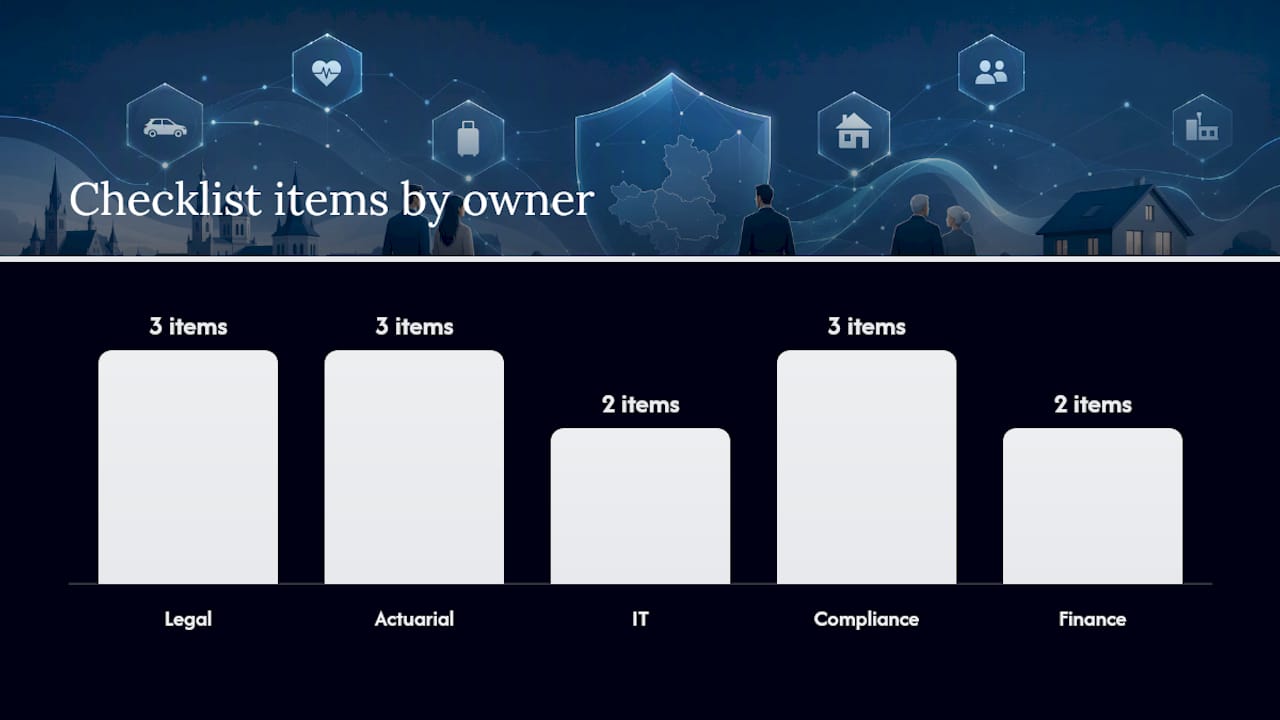
Workstream ownership: legal (incorporation, class selection, governance docs), actuarial (capital modelling, reserving, ORSA), IT (systems build and pilot), compliance (AML/CFT, IDD, fit-and-proper), finance (own funds evidence and reporting).

If the capital buffer disappears under that scenario, the supervisor will find it. Better to find it first and adjust the plan or the capital structure before filing.*


Executive checklist: what to decide before you file — overview diagram

A practitioner’s view on sequencing in Central Europe

The instinct of most executive teams is to spend the early months on product design. That is usually the wrong order of operations.

Regulators in Central Europe, whether the MNB in Budapest or the FMA in Vienna, prioritise policyholder protection and operational realism. A beautifully designed product range sitting on an immature reporting stack will not get a licence. Capital modelling and a minimum viable operational stack for pilot reporting should come first, before the product catalogue is finalised.

Early engagement with the home supervisor, before the formal application, is consistently undervalued. Most national supervisors in Central Europe will take a pre-application meeting. Use it. The feedback on capital methodology and governance structure is worth more than months of internal iteration.

Spend scarce budget on governance and reporting tooling. The insurance risk management framework and the Pillar 3 reporting pipeline are what supervisors inspect most closely. Cosmetic product features can wait.


IBSuite can reduce the operational friction supervisors check for

Ibapplications built IBSuite specifically for P&C insurers navigating exactly this kind of regulatory environment. The platform covers policy administration, underwriting, claims management, billing, and financial sub-ledger in a single cloud-native architecture on AWS, with full audit trails and configurable regulatory reporting built in from the ground up.

Data center corridor for cloud insurance platform

For teams preparing a licence application, that matters because supervisors want to see a working pilot, not a roadmap. IBSuite’s API-first design means it can connect to existing actuarial and reporting tools without a full rip-and-replace, which keeps the pilot timeline realistic. If your current stack cannot produce a clean data lineage from policy inception to QRT submission, that is the gap worth addressing before you file.

Book a demo to see how IBSuite maps to the supervisory checkpoints your application will face.


Useful primary sources

Bookmark these authoritative documents when preparing your application and board materials:


This article is general information, not a substitute for advice from a qualified financial advisor. Consult a qualified financial professional about your own circumstances before acting on anything here.

Sources

FAQ

What does a P&C insurer licence permit a company to do?

It authorises the undertaking to underwrite, administer policies, settle claims, and accept reinsurance for the specific non-life classes named in the authorisation, and to operate across EU Member States via passporting under Directive 2009/138/EC.

What is the EUR 5 million threshold in Solvency II?

Undertakings with gross premium income below EUR 5 million may be excluded from the full Solvency II framework and remain under lighter national rules, but they lose the right to passport across the EU unless they voluntarily opt into the full Directive.

What are the most common reasons a P&C licence application is refused?

The MNB licensing guide identifies insufficient eligible own funds, inadequate governance or risk framework, and immature IT and reporting systems as the leading grounds for refusal or a request for additional information.

Does a single EU authorisation remove the need for local compliance in host markets?

No. Passporting removes the need for a separate local licence, but host-state conduct supervision, AML/CFT obligations, and IDD requirements apply in every market where the insurer operates.

How does IBSuite support the supervisory requirements for a P&C licence?

IBSuite by Ibapplications provides policy administration, claims management, underwriting, and Pillar 3 reporting in a single cloud-native platform with full audit trails, supporting the IT pilot evidence and data lineage that supervisors inspect during and after the authorisation process.

Automation in insurance: a practical guide for Central Europe

Automation in insurance means using technologies such as robotic process automation (RPA), machine learning (ML), business process management (BPM), APIs, and document AI to replace manual steps across the insurance value chain, delivering faster decisions, lower operating costs, and higher straight-through processing (STP) rates. For Central Europe carriers, the payoff is concrete: shorter claims cycles, reduced expense ratios, and customer experiences that keep pace with digital-first expectations.

The core domains it reshapes:

  • Claims: FNOL intake, triage, damage estimation, reserving, and settlement
  • Underwriting: risk scoring, document extraction, pricing decisioning for standard lines
  • Policy administration: endorsements, renewals, cancellations, and billing
  • Distribution and customer service: quote automation, self-service portals, chatbot triage

Three regulatory signals set the context for every Central Europe deployment. EIOPA’s survey of 347 European insurers found roughly two-thirds already use generative AI, yet about half still lack formal AI governance frameworks. The EU AI Act’s high-risk provisions take effect on 2 August 2026, directly affecting automated underwriting and pricing models. GDPR continues to govern how personal data flows through training pipelines and automated decisioning. Getting the technology right matters; getting the governance right is what makes it stick.


Table of Contents

What technologies actually power insurance automation?

The highest-value technologies in insurance operations are not a single tool but a layered stack: workflow orchestration at the top, ML inference in the middle, and API connectivity at the base. Understanding where each layer sits prevents the common mistake of deploying point solutions that cannot talk to one another.

Overhead view of insurance automation tools on table

The orchestration layer (BPM and workflow engines) sequences tasks, routes exceptions, and enforces business rules. It is the conductor. The inference layer (ML models, large language models, document AI) makes decisions or extracts meaning from unstructured data. The connectivity layer (REST APIs, event streams, integration adapters) links the new stack to legacy policy and claims platforms without requiring a full system replacement.

RPA sits between orchestration and connectivity: it is best used for brittle, rules-based tasks on systems that have no API. Intelligent document processing (IDP) handles the extraction of structured data from medical reports, invoices, and loss-adjustment forms. End-to-end AI pipelines are appropriate where the volume and data quality justify training and maintaining a model. The API-first architecture is what allows these layers to compose without becoming a maintenance liability.

Statistic callout: EIOPA’s survey found that backend productivity tools, including data extraction and developer assistance, account for roughly 64% of generative AI use cases among European insurers, with customer-facing tools at 36% and often still at proof-of-concept stage.

Low-code platforms are increasingly used to configure decisioning rules and workflow logic without deep engineering effort, which shortens pilot timelines considerably. Agentic AI, where models take multi-step autonomous actions, is moving from experiment to production, but it raises the human-oversight questions the EU AI Act is designed to address.

Pro Tip: Deploy automation without replacing your core system by using the strangler-fig pattern: wrap legacy platforms with API adapters, route new traffic through the modern orchestration layer, and retire legacy functions incrementally. This avoids a big-bang migration and lets you prove value in months rather than years.


High-impact use cases across the insurance value chain

Embedding AI directly into core P&C claims and risk-assessment pipelines delivers larger financial impact than limiting it to peripheral support functions. The use cases below are ranked roughly by the combination of impact and delivery speed.

Claims automation (highest impact, fastest wins)

  • FNOL intake and triage via document AI and structured web/mobile forms: reduces manual data entry and accelerates first-response SLAs.
  • Image- and video-based motor and property damage estimation: production pilots in Central Europe show material reductions in assessment cycle time, though accuracy depends on image quality and model training data.
  • Automated reserving for standard, low-complexity claims: rules-based engines combined with ML can set initial reserves without adjuster intervention on the majority of straightforward cases.
  • Fraud-detection scoring at FNOL and during investigation: network-analysis models flag anomalous patterns across claimants, repair shops, and medical providers.

PZU Group, one of Central Europe’s largest P&C carriers, deployed over 30 generative AI solutions and processed approximately PLN 10 billion in claims through AI-enabled pipelines, with an internal target of faster delivery for business solutions. That is not a pilot; it is production at scale.

Underwriting and pricing (high value, moderate complexity)

  • Automated decisioning for personal lines and small commercial risks: ML models score applications against historical loss data, reducing underwriter time on standard risks.
  • Document extraction for medical and financial data in life and health lines: IDP cuts the time to process supporting documents from days to minutes.
  • Large commercial underwriting remains high-complexity and high-judgement; automation assists rather than replaces the underwriter here.

Policy administration and distribution (quick wins)

  • Endorsement and renewal processing: rules-based automation handles the majority of mid-term changes without human intervention.
  • Quote and bind for simple products via API-connected distribution channels.
  • Billing reconciliation and premium allocation: RPA handles the repetitive matching tasks that consume finance-team hours.

The role of automation in claims is well-documented, but the compounding effect across the full value chain is where the expense-ratio improvement becomes material.


What benefits and KPIs should you measure?

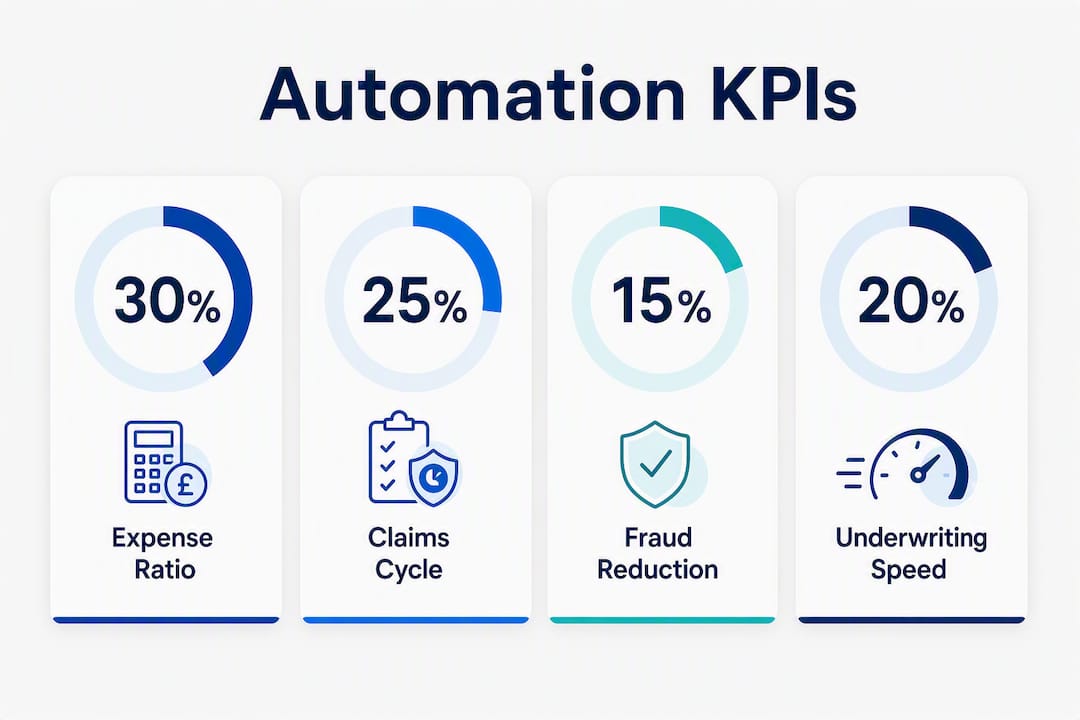
The primary measurable benefits of insurance process automation are expense ratio improvement, reduced claims cycle times, higher STP rates, and better customer satisfaction scores. McKinsey projects insurers can reduce operational expenses by up to 40% through productivity improvements including automation and AI by 2030, with many routine manual pricing and underwriting tasks automated for standard personal and small commercial lines. Early deployments already report 15–25% reductions in claims-handling expenses.

Infographic showing key insurance automation KPIs

Measuring whether automation is delivering requires a baseline before you start. Without one, you cannot attribute improvement to automation rather than to volume mix or seasonal effects.

KPI Unit Typical target range
Claims cycle time Days from FNOL to settlement Reduce by 20–40% vs baseline
Claims-handling cost per claim Currency per claim Reduce by 15–25% (sourced range)
STP rate % of claims closed without manual touch Target 60–80% for standard motor/property
Time to issue a policy Hours from application to bind Reduce time to issue policy significantly for personal lines
Automated underwriting decision rate % of applications decided without underwriter 70–85% for standard personal lines
Fraud-detection precision % of flagged claims that are genuine fraud Monitor to avoid false-positive costs
Net Promoter Score (NPS) Point score Track quarterly against automation rollout milestones

Continuous monitoring matters as much as the initial measurement. Model drift, data-quality degradation, and process changes can erode gains silently. Build monitoring dashboards into the automation architecture from day one, not as an afterthought.


A pragmatic roadmap for Central Europe insurers

The sequence is straightforward: assess your data and legacy estate, prioritise use cases by value and complexity, run a time-boxed pilot with clear KPI targets, then industrialise and scale. The challenge is discipline at each gate.

Legacy, fragmented data estates and batch-oriented policy and claims systems are the primary technical blockers to scaling AI and automation. Addressing data readiness is not optional; it is the first deliverable.

Technician connecting network cable in server room

Priority matrix for P&C carriers in Central Europe:

High value, lower complexity (pilot first): FNOL document AI, automated reserving for standard motor claims, fraud-scoring at intake, renewal automation.

High value, higher complexity (phase two): ML-based underwriting decisioning, image-based damage estimation, cross-line fraud-network analysis.

Lower value, lower complexity (automate opportunistically): Billing reconciliation, policy endorsement processing, report generation.

Typical timelines: two to four weeks for discovery and data assessment; three to six months for a focused pilot with one use case; twelve to twenty-four months to industrialise across multiple lines.

Practical next steps to take this week:

  1. Audit your claims data completeness: identify the fields required for ML-based triage and flag gaps.
  2. Map the manual steps in your FNOL process and estimate the volume of cases that could qualify for straight-through processing.
  3. Appoint an internal AI ambassador, a senior claims or underwriting professional who will own the pilot from the business side.
  4. Start a GDPR data-minimisation review for any personal data that would flow into model training.
  5. Draft a shortlist of three to five platform vendors using the criteria in the vendor-selection section below.

The digital transformation roadmap for P&C insurance covers sequencing in more depth for carriers at different maturity levels.


What are the key risks and how do you govern them?

The principal risks are data quality failures, model errors or hallucinations in automated decisions, regulatory non-compliance, vendor lock-in, and legacy integration breakdowns. Each is manageable with the right controls, but none is trivial.

EU AI Act: Automated underwriting and pricing models that materially affect access to insurance or its terms are likely to be classified as high-risk under the EU AI Act, with obligations including conformity assessments, human oversight, and detailed technical documentation. The high-risk provisions take effect on 2 August 2026. EIOPA’s data shows dedicated AI policies rose from 25% of European insurers in 2023 to 49% in the most recent survey. That means roughly half still have work to do before the deadline.

GDPR: Personal data used in model training must have a lawful basis, be minimised to what is necessary, and be subject to data-subject rights including the right to explanation for automated decisions. This is not new, but the scale of data flowing through AI pipelines makes it a live compliance risk.

Mitigation checklist:

  • Document every model: purpose, training data, performance metrics, known limitations.
  • Build human-in-the-loop controls for decisions above a defined value or complexity threshold.
  • Maintain full audit trails for automated decisions, including the inputs and model version used.
  • Apply data minimisation at the pipeline design stage, not retrospectively.
  • Test models for bias across protected characteristics before production deployment.
  • Monitor model performance continuously and set drift thresholds that trigger review.

On the cultural side, AI layered onto legacy architecture will not scale, and neither will automation imposed on teams without preparation. Resistance from claims handlers and underwriters who fear displacement is a genuine risk. Internal AI ambassadors, peer-level staff who drive adoption and provide training, have proven more effective than top-down mandates in group-wide transformations.

Pro Tip: Register your high-risk AI systems with your legal and compliance team now, before the August 2026 EU AI Act deadline. Map each automated decisioning model to the Act’s risk categories and assign an owner. A simple model register in a spreadsheet is a legitimate starting point; the goal is to have the documentation habit in place before regulators ask for it.


How should you evaluate automation platforms and partners?

The top selection criteria, in order of importance for Central Europe P&C carriers, are: API-first integration architecture, cloud-native deployment (preferably on a hyperscaler with EU data residency), data governance and auditability features, EU AI Act compliance support, MLOps and LLMOps capability, security certifications (ISO 27001, SOC 2), and a clear upgrade and maintenance model that does not require a full reimplementation for each release.

The table below maps these criteria to three generic platform categories.

Criterion Entry-level orchestration Enterprise platform Managed service
API-first integration Partial Full Varies by provider
Cloud-native, EU data residency Rarely Usually Usually
EU AI Act documentation support Minimal Built-in or roadmap Depends on contract
MLOps / model monitoring External tooling needed Native or integrated Managed externally
Evergreen updates (no big-bang upgrades) Rarely Increasingly standard Managed by provider
Security certifications Basic ISO 27001, SOC 2 Varies
Total cost of ownership over 3 years Lower upfront, higher integration cost Higher upfront, lower integration cost Predictable subscription

Sample RFP questions to ask vendors:

  • Where is data stored and processed? Can you guarantee EU data residency for all environments?
  • How does your platform produce audit trails for automated decisions, and in what format?
  • What documentation does your platform generate to support EU AI Act conformity assessments?
  • What is your upgrade model? How many full reimplementations have customers undergone in the last five years?
  • Can you provide two reference customers in Central Europe with comparable use cases?

When evaluating claimed ROI, ask for the baseline metric, the post-automation metric, the time period, and whether the improvement was audited by a third party. Vendor-supplied case studies without a stated baseline are marketing, not evidence. The digital transformation fundamentals context is worth reviewing if your leadership team needs a shared vocabulary before vendor conversations begin.


How IBSuite supports Central Europe insurers to industrialise automation

Insurance Business Applications (IBA) delivers IBSuite, a secure, API-first, cloud-native platform built on AWS that covers the full P&C value chain: policy administration, claims management, underwriting, billing, rating, CRM, and financial sub-ledger. For Central Europe carriers looking to industrialise automation, the architecture removes the integration work that typically consumes the first six months of a transformation programme.

Key capabilities relevant to the use cases covered above:

  • API connectors and integration adapters: pre-built connectors for common document-AI, fraud-detection, and damage-estimation services, reducing the time to wire up inference models to the claims workflow.
  • Claims orchestration: configurable workflow engine that supports FNOL routing, automated reserving rules, and exception handling without custom code.
  • Document-intelligence integration: native support for IDP tools that extract structured data from loss-adjustment documents, medical reports, and invoices.
  • Evergreen updates: continuous platform updates delivered without requiring a full reimplementation, which means compliance changes (including EU AI Act documentation requirements) are absorbed into the platform rather than becoming a project.
  • Regulatory compliance posture: built-in audit trails, role-based access controls, and data-governance features aligned to GDPR requirements.

IBSuite’s claims management capabilities are designed specifically for P&C carriers that want to move from manual adjudication to high-STP automated processing without replacing their entire technology estate. The platform’s policy administration module handles endorsements, renewals, and billing automation in the same environment, avoiding the data-silo problem that undermines cross-process automation.

For carriers earlier in their digital transformation in insurance, IBA’s consulting team supports use-case prioritisation, data-readiness assessment, and pilot design alongside the platform deployment.


Key takeaways

Automation in insurance delivers the largest financial returns when AI is embedded in core claims and underwriting workflows, not confined to peripheral tools, and when governance is built in from the start rather than retrofitted.

Point Details
Start with claims automation FNOL triage and automated reserving for standard motor claims offer the fastest path to measurable STP improvement.
Governance before the August 2026 deadline Build your EU AI Act model register now; many European insurers still lack formal AI governance frameworks.
Target 15–25% cost reduction in claims Early deployments report 15–25% reductions in claims-handling expense.
API-first architecture is non-negotiable Legacy platforms without API adapters block scaling; prioritise vendors with EU data residency and evergreen updates.
Ibapplications IBSuite IBSuite’s API-first, cloud-native architecture covers claims, policy admin, and underwriting automation in a single compliant platform for Central Europe P&C carriers.

The gap between automation ambition and automation discipline

The conversation about insurance automation tends to focus on the technology, which is the easy part. The harder part is what happens between a successful pilot and a production system that actually moves the expense ratio.

Most carriers I speak with have run at least one claims-automation pilot. A meaningful number have run three or four. The ones that have not scaled are almost always stuck on the same two problems: data that looked clean enough for a pilot but was not clean enough for production volume, and a governance process that nobody owned. The technology worked. The foundation did not.

The EIOPA finding that many European insurers still lack formal AI governance frameworks is not surprising to anyone who has sat in those conversations. Governance feels like overhead until a regulator asks for your model documentation or a biased automated decision ends up in a complaint. Then it feels like the thing you wish you had built first.

The carriers making real progress, PZU being the clearest Central Europe example, treated automation as an infrastructure investment, not a series of projects. They built the data pipelines, appointed internal champions, and accepted that the first year would look more like plumbing than transformation. That patience is what separates a 30-solution deployment from a pilot that never shipped.

If you are planning your first serious automation programme, pick one claims use case, measure it obsessively, and use the governance you build for that pilot as the template for everything that follows. The technology will not be your bottleneck.


Ready to move from pilot to production?

Central Europe P&C carriers that want to close the gap between automation ambition and production results have a concrete option in IBSuite. Rather than assembling a stack of point solutions that each require separate integration work, IBSuite provides the claims orchestration, policy administration, and API connectivity in a single EU-compliant platform, so your team spends its time on use-case design rather than plumbing.

If you are at the stage of scoping a claims-automation pilot, assessing vendor fit, or preparing for EU AI Act compliance, the Ibapplications specialist team can help you work through the specifics. Book a demo to see how IBSuite maps to your current architecture and use-case priorities.


Useful sources

  • EIOPA GenAI survey (actuary.info): The primary European regulatory intelligence source on AI adoption rates, governance gaps, and EU AI Act timelines across 347 insurers. Essential for compliance planning.
  • PZU Group AI transformation case study: The most detailed publicly available Central Europe production example, covering deployment scale, claims volumes, and internal adoption methods.
  • McKinsey: Insurance productivity 2030: Long-range productivity and automation projections for insurers; useful for building the business case with senior leadership.
  • McKinsey: Shiny objects — insurance productivity in an era of AI: Practical data on early deployment results, including the 15–25% claims-handling expense reduction range.
  • TechMahindra: The AI wave — future of insurance in the UK and Europe: Architecture and strategy perspective on why AI layered onto legacy systems does not scale; useful for vendor-selection and infrastructure conversations.
  • Ibapplications: API-first approach in insurance (whitepaper): Technical guidance on API-first design patterns and integration architecture for insurance automation programmes.

FAQ

What is automation in insurance?

Automation in insurance means using technologies such as RPA, ML, BPM, APIs, and document AI to replace manual steps in claims, underwriting, policy administration, and distribution, reducing costs and accelerating decisions.

What types of automation deliver the most value in P&C insurance?

Claims triage, automated reserving, fraud detection, and underwriting decisioning for standard personal lines deliver the highest combined impact; early deployments report 15–25% reductions in claims-handling expenses.

What does the EU AI Act mean for insurance automation in Central Europe?

Automated underwriting and pricing models that materially affect access to insurance are likely classified as high-risk under the EU AI Act, requiring conformity assessments, human oversight, and technical documentation; the high-risk provisions take effect on 2 August 2026.

What are the four main types of automation used in insurance?

The four main types are robotic process automation (RPA) for rules-based tasks, intelligent document processing (IDP) for unstructured data extraction, ML-based decisioning for risk scoring and fraud detection, and workflow orchestration (BPM) for sequencing and routing across the claims and underwriting process.

How long does an insurance automation pilot typically take?

Discovery and data assessment typically takes two to four weeks; a focused single-use-case pilot runs three to six months; scaling across multiple lines takes twelve to twenty-four months depending on data readiness and integration complexity.