31.07.26
Casualty in insurance: what it means and why it matters

In insurance, “casualty” means liability cover for loss or damage you cause to others. If a customer slips on a wet floor in your shop and sues you, or your car injures a pedestrian, casualty cover responds to that third-party claim. The sections below walk through policy types, how claims work, typical exclusions, and what the EU regulatory framework means for you as a policyholder in Central Europe.
Key takeaways
Casualty insurance means liability cover for harm you cause to others, and the wording of your policy matters as much as the limit you choose.
| Point | Details |
|---|---|
| Core definition | Casualty cover pays third-party claims for bodily injury or property damage you cause. |
| Casualty vs property | Property covers your own assets; casualty covers your legal liability to others. |
| Defence-costs wording | Check whether defence costs sit inside or outside the indemnity limit before buying. |
| Mandatory covers | Motor third-party and employers’ liability are compulsory in most Central European jurisdictions. |
| EU regulatory protection | Solvency II requires insurers to hold capital against casualty liabilities, protecting your claim. |
Table of Contents
- What does casualty insurance cover in practice?
- How casualty relates to liability and to property within P&C insurance
- Common casualty policy types: personal and commercial
- How a casualty claim typically proceeds
- Exclusions, limits, and deductibles: where cover can fall short
- How to choose the right liability limits in Central Europe
- Where casualty sits in the European insurance framework
- An editorial perspective on what actually trips people up
- Sources
- FAQ
What does casualty insurance cover in practice?
Casualty insurance protects you against legal liability arising from accidental injury or damage you cause to third parties. The cover typically extends to three categories of loss:
- Third-party bodily injury: medical costs, compensation, and lost earnings claimed by an injured person
- Third-party property damage: repair or replacement costs for someone else’s property you damage
- Legal defence costs: solicitor fees, court costs, and expert witnesses, whether or not the claim succeeds
Personal examples include motor third-party liability (compulsory across the EU) and personal liability attached to a home contents policy, which covers you if your dog bites a neighbour or your child breaks a friend’s window. Commercial examples reach further: public liability covers a visitor injured on your premises; products liability covers a customer harmed by something you manufactured or sold; employer’s liability covers an employee injured at work.
Casualty cover pays the other person’s losses, not your own. If you are looking for cover for your own injuries or property, that falls under accident, health, or property insurance — not casualty.
Pro Tip: When reviewing any policy, search for the words “liability” and “third party” in the definitions section. Those two phrases tell you immediately whether the policy has a casualty component.
A short scenario makes this concrete. A Warsaw-based café owner’s employee drops a tray of hot drinks on a customer. The customer suffers burns, incurs medical costs, and claims compensation. The café’s public liability policy (a casualty cover) pays the customer’s damages and the legal costs of defending the claim, up to the policy limit.

How casualty relates to liability and to property within P&C insurance
The terms “casualty”, “liability”, and “property and casualty (P&C)” overlap in ways that confuse even experienced buyers. Here is how they sit relative to each other:
| Term | What it covers | Typical policy examples |
|---|---|---|
| Property insurance | Direct loss to your own assets | Buildings, contents, business interruption |
| Casualty insurance | Legal liability for harm caused to others | Public liability, motor third-party, employers’ liability |
| Liability insurance | Largely synonymous with casualty in European usage | Professional indemnity, products liability |
| P&C insurance | Umbrella term combining both property and casualty lines | Combined commercial package, motor comprehensive |
In European market practice, “casualty” is used as shorthand for the liability side of a P&C product. Insurance Europe describes P&C as a broad umbrella covering motor, property, general liability, and accident lines. Property protects against direct asset loss; casualty protects the balance sheet from legal claims and third-party losses, which is why insurers commonly bundle them into a single P&C product.
When you see “P&C” on a policy schedule, check the schedule of covers: the property section lists your own assets, and the casualty or liability section lists what the insurer will pay on your behalf to others.
Common casualty policy types: personal and commercial
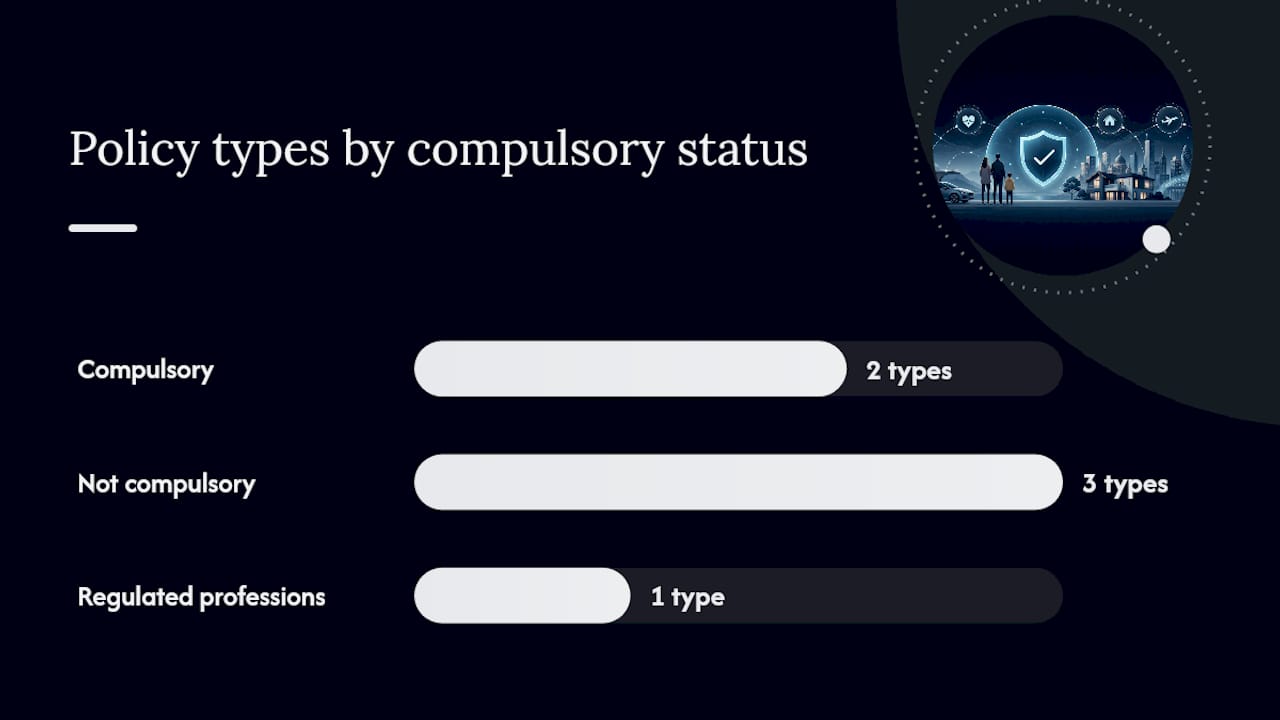
The table below lists the core liability policy types you are likely to encounter in Central Europe.
| Policy type | What it covers | Compulsory? |
|---|---|---|
| Motor third-party liability | Bodily injury and property damage to others caused by your vehicle | Yes, across the EU |
| Personal liability (home policy) | Accidental damage or injury you cause to others in private life | No, but often bundled |
| Public liability | Third-party injury or damage arising from your business premises or operations | No, but widely required by contracts |
| Employers’ liability | Injury or illness suffered by your employees in the course of work | Yes, in most Central European jurisdictions |
| Products liability | Harm caused by a defective product you manufactured, supplied, or sold | No, but often required by retailers |
| Professional indemnity | Financial loss suffered by a client due to your professional error or omission | Compulsory for regulated professions (lawyers, architects, financial advisers) |
Policies are commonly combined: a commercial package for a Czech manufacturer might include property, public liability, employers’ liability, and products liability in one document, with a single premium and shared aggregate limit. The CFC Europe IPID illustrates this structure, listing casualty elements as cover for bodily injury and property damage claims made against you in the course of business activities, alongside the property section.
How a casualty claim typically proceeds
Understanding the claim lifecycle helps you know what to expect after an incident.
- Incident occurs. A third party suffers injury or property damage and holds you responsible.
- Allegation or claim is made. The third party (or their insurer) notifies you of their intention to seek compensation.
- You notify your insurer promptly. Late notification can prejudice cover; most policies require notification as soon as you are aware of a potential claim.
- Insurer investigates. The insurer appoints a claims handler or solicitor to assess liability and quantum.
- Defence or settlement. The insurer exercises the duty to defend — it manages and funds the legal defence. If liability is established, the insurer pays the third party up to the indemnity limit.
- Subrogation. Where a third party caused or contributed to the loss, the insurer may pursue that party to recover what it paid.
Key concepts to know:
- Duty to defend: the insurer controls and pays for the legal defence, even if the claim is ultimately unsuccessful
- Indemnity limit: the maximum the insurer will pay per claim or in aggregate across the policy year
- Named insureds and additional insureds: employees acting in the course of their duties are typically covered; subcontractors may need to be specifically added
Exclusions, limits, and deductibles: where cover can fall short
Casualty policies carry restrictions that can leave significant gaps if you do not read the wording carefully.
Common exclusions include intentional or criminal acts, liability assumed under contract beyond what the law would impose, pollution (unless specifically endorsed), and fines or regulatory penalties. A manufacturer facing a product recall may find that the recall costs themselves are excluded unless a product recall extension has been purchased.
Limits work in two ways. A per-claim limit caps the insurer’s exposure on any single event. An aggregate limit caps total payments across the policy year. Once the aggregate is exhausted, no further claims are paid, regardless of how many incidents occur.
Pro Tip: Check whether defence costs are inside or outside the indemnity limit. If they are inside, a prolonged legal battle can eat into the money available to pay the third party’s damages, leaving you exposed to a shortfall.
Joint and several liability is a particular risk in commercial settings. If you are one of several defendants, a claimant can pursue you for the full amount even if others are partly responsible. One large claim can exhaust your aggregate limit entirely.
How to choose the right liability limits in Central Europe
A short checklist for buying or renewing casualty cover:
- Assess your exposure. Consider the maximum realistic claim against you: a single serious injury, a product defect affecting many consumers, or a professional error causing a large financial loss. Insurance risk management frameworks can help structure this assessment.
- Set a single-event limit that reflects that maximum. For most SMEs in Central Europe, public liability limits of €1 million to €5 million are common; larger manufacturers or professional firms often need €10 million or more.
- Check the aggregate limit. If you face high-frequency, low-severity claims (a retailer with many customer interactions), the aggregate matters as much as the per-claim limit.
- Confirm defence-costs treatment. Prefer policies where defence costs are outside the indemnity limit.
- Ask about run-off cover. Professional indemnity and products liability can generate claims years after the work was done or the product was sold. Run-off cover protects you after a policy lapses or a business closes.
- Clarify cross-border scope. If you trade across Central Europe, confirm whether cover applies EU-wide or is restricted to one jurisdiction. A P&C licence typically permits cross-border activity under EU passporting rules, but policy wording must confirm the territorial scope.
Where casualty sits in the European insurance framework
Insurance Europe identifies motor, property, general liability, and accident as the principal P&C business lines across European markets. General liability, the closest European equivalent to “casualty” in the broad sense, is a material line by premium volume across Central European markets including Poland, the Czech Republic, Austria, and Hungary.
The prudential framework governing these insurers is Solvency II, the EU-wide regime administered by EIOPA. Its three pillars cover:
- Pillar I: quantitative capital requirements, including technical provisions for outstanding casualty claims
- Pillar II: governance, risk management, and the Own Risk and Solvency Assessment (ORSA)
- Pillar III: supervisory reporting and public disclosure
For policyholders, the practical implication is straightforward. The Solvency II directive includes specific safeguards to protect insured persons in insolvency and winding-up proceedings, giving insurance claims a preferential status. Solvency II’s risk-based capital rules mean your insurer must hold capital proportionate to its casualty liabilities, which is the regulatory mechanism designed to keep claim-paying ability intact.
An editorial perspective on what actually trips people up
Most people buying liability cover focus almost entirely on the limit. That is understandable, but the limit is rarely where the real problem hides. The wording around defence costs, the definition of “insured”, and the territorial scope are where claims go wrong in practice.
A business that discovers its subcontractors are not covered as additional insureds, or that its policy excludes claims arising from work done outside its home jurisdiction, faces a gap that no amount of limit would have fixed. Checking those three things — defence costs, who is an insured, and territorial scope — takes twenty minutes and can prevent a very expensive surprise.
Sources
- Property & Casualty Insurance Product Information Document (IPID) — CFC Europe S.A.
- European Insurance in Figures – 2020 data
- Solvency II — EIOPA
- Directive 2009/138/EC (Solvency II) — EUR-Lex
This article is general information, not a substitute for advice from a qualified financial advisor. Consult a qualified financial professional about your own circumstances before acting on anything here.
FAQ
What does casualty insurance cover?
Casualty insurance covers your legal liability for accidental bodily injury or property damage caused to third parties, including the cost of defending claims. It does not cover damage to your own property or your own injuries.
Is casualty the same as liability insurance?
In European insurance practice, the two terms are largely interchangeable. “Casualty” is the broader category; “liability” describes the same protection and is the term more commonly used in European policy wording.
What does casualty mean in an accident context?
In an accident, the casualty element of your insurance responds when a third party holds you legally responsible for their injury or property damage. Your insurer investigates, defends the claim, and pays any agreed compensation up to the policy limit.
What are the most common exclusions in casualty policies?
Typical exclusions include intentional acts, contractual liabilities assumed beyond what the law imposes, pollution (unless endorsed), and regulatory fines or penalties. Always read the exclusions section before assuming a risk is covered.
Recommended
- Embedded Insurance and its Importance: Part 1 – Digital Insurance Platform | IBSuite Insurance Software | Modern Insurance System
- Parametric insurance, delighting customers and carriers – Digital Insurance Platform | IBSuite Insurance Software | Modern Insurance System
- The Cloud: Accessing Value for Insurers – Digital Insurance Platform | IBSuite Insurance Software | Modern Insurance System
- The Real Cost of Doing Nothing: Insurance Core Replacement – Digital Insurance Platform | IBSuite Insurance Software | Modern Insurance System