24.02.26
Underwriting Defined: Boosting Agility in P&C Insurance

Facing growing complexity in regulatory standards and risk profiles, Central European insurers must refine their approach to risk assessment if they want to stay competitive. The demand for efficient underwriting processes and robust compliance continues to escalate, especially as cloud-native platforms become the backbone of digital operations. This article explores how precise risk quantification, premium adequacy, and regulatory alignment shape profitable underwriting and support strategic innovation in property and casualty insurance.
Table of Contents
- Underwriting In Insurance: Core Principles
- Major Types Of Underwriting In P&C
- The Underwriting Process And Key Steps
- Technology’s Role In Modern Underwriting
- Efficiency, Compliance, And Risk Management Insights
Key Takeaways
| Point | Details |
|---|---|
| Fundamental Importance of Underwriting | Underwriting serves as the foundation of sustainable P&C insurance, ensuring accurate risk assessment, adequate pricing, and regulatory compliance. |
| Need for Climate Risk Integration | Underwriters must incorporate climate risk into their assessments and pricing strategies to reflect changing environmental conditions. |
| Technology and Automation Benefits | Modern technology enhances underwriting efficiency through automation, data integration, and advanced analytics, leading to faster and more accurate decision-making. |
| Regulatory Compliance as Competitive Advantage | Adhering to regulatory requirements not only ensures compliance but also contributes to operational efficiency and enhanced decision-making capabilities. |
Underwriting in Insurance: Core Principles
Underwriting is the foundation of profitable, sustainable P&C insurance. It determines which risks an insurer accepts, at what price, and under what conditions. Without solid underwriting principles, insurers face losses, regulatory challenges, and inability to compete effectively in today’s market.
At its core, underwriting balances three competing demands. First, it must assess risk accurately. Second, it must price premiums fairly. Third, it must ensure the insurer remains solvent and compliant. These three elements form the backbone of sound underwriting practice.
The Three Pillars of Core Underwriting
Each pillar addresses a different aspect of the underwriting decision:
- Risk assessment: Evaluating the likelihood and severity of claims using historical data, industry benchmarks, and applicant-specific information
- Premium adequacy: Ensuring the premium charged covers expected losses, expenses, and required profit margins
- Regulatory compliance: Meeting European solvency requirements and maintaining sound risk management practices aligned with supervisory expectations
Effective underwriting is not about rejecting risk—it’s about accepting the right risk at the right price.
Why Risk Quantification Matters
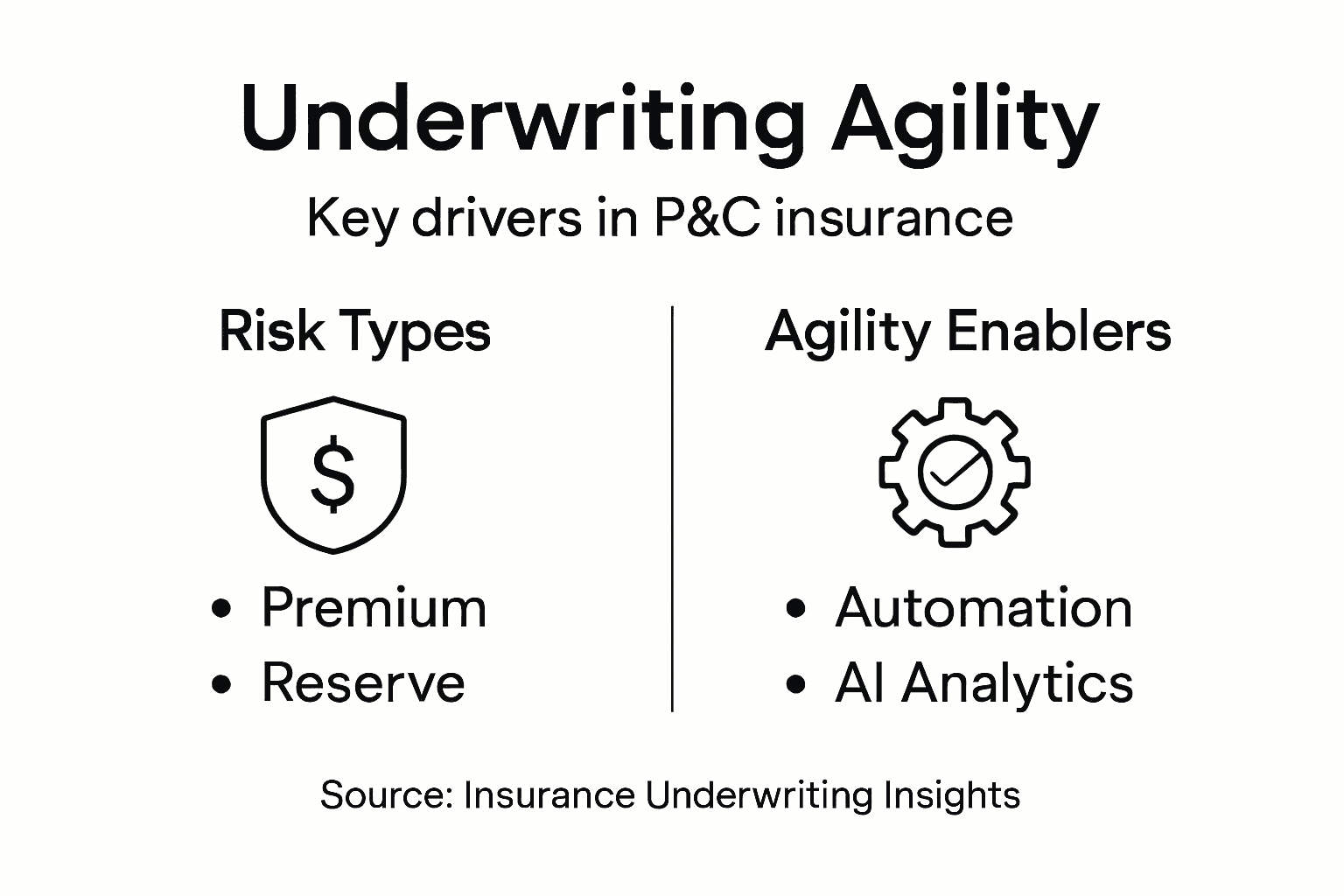
Premium, reserve, and catastrophe risks form the technical foundation of underwriting decisions. Each type of risk requires different analytical approaches and monitoring strategies.
Premium risk reflects uncertainty in claims experience relative to the premium charged. Reserve risk addresses the possibility that claims reserves prove insufficient. Catastrophe risk covers the tail events—floods, storms, industrial accidents—that can devastate profitability in a single event.
Central European insurers must evaluate all three when calculating solvency capital requirements. This ensures the business maintains adequate financial buffers to pay claims during adverse periods.
Climate Risk and Modern Underwriting
Traditional underwriting models assumed historical loss patterns would repeat. Climate change disrupts that assumption. Integrating climate risk into underwriting practices is no longer optional—it’s essential for accurate risk assessment.
Underwriters must now evaluate shifting environmental hazards when pricing and accepting risk. A property in a historically low-flood zone may face elevated risk in 2030. Agricultural insurance must account for changing precipitation patterns. Commercial underwriting demands forward-looking analysis rather than rear-view-mirror assessments.
Risk-based pricing reflects these evolving hazards. It ensures premiums remain adequate whilst keeping insurance affordable and available for insureds who manage their exposures responsibly.
Pro tip: Document your underwriting rationale for each major decision—especially climate risk adjustments—so you can defend your pricing and risk selection during regulatory reviews and claims disputes.
Major Types of Underwriting in P&C
P&C underwriting divides into distinct categories based on the customer type, risk complexity, and coverage scope. Understanding these categories helps underwriters apply appropriate risk assessment techniques and pricing strategies to each segment.
The main distinction separates personal lines from commercial lines, each requiring different expertise and analytical depth. Beyond that divide, specialty underwriting handles unique or high-risk exposures that demand specialist knowledge.
Personal Lines Underwriting
Personal lines cover individual homeowners, renters, and vehicle owners. These policies involve standardised risks with predictable loss patterns and relatively smaller exposure values per policy.
Personal underwriting relies heavily on automated decisioning systems and rating algorithms. Underwriters set guidelines, but most personal policies are underwritten through rules-based systems rather than individual manual review.
Common personal lines include:
- Homeowners insurance: Dwelling, personal property, and liability coverage for residential properties
- Motor insurance: Private vehicle coverage including third-party liability and comprehensive protection
- Renters insurance: Coverage for tenants’ personal belongings and liability exposure
Commercial Lines Underwriting
Commercial underwriting addresses business risks—small shops, mid-sized manufacturers, large corporations. These policies involve complex exposures, significant loss potential, and substantial premium volumes.

Commercial underwriters exercise greater judgment and discretion than personal underwriters. They negotiate terms, adjust coverage limits, and apply subjective assessments based on business operations, management quality, and loss history.
Common commercial lines include:
- General liability: Third-party bodily injury and property damage exposure from business operations
- Property insurance: Building and contents protection against fire, theft, and natural hazards
- Commercial auto: Vehicles used for business purposes with higher frequency and severity potential
Specialty Underwriting
Specialty underwriting handles unusual, high-value, or technically complex exposures. Professional indemnity, cyber liability, and environmental liability exemplify specialty lines requiring deep technical knowledge.
Premium risk, reserve risk, and catastrophe risk vary significantly across underwriting types. Specialty lines often carry elevated catastrophe exposure or reserve uncertainty compared to standardised personal products.
Each underwriting type demands different expertise—from statistical modelling in personal lines to relationship management and negotiation in commercial underwriting.
Climate Adaptation Across Underwriting Types
Climate change affects all underwriting types differently. Traditional underwriting approaches now require climate adaptation measures across personal, commercial, and specialty segments.
Personal underwriters must reassess flood and wind exposure in light of changing precipitation and storm patterns. Commercial underwriters need updated assumptions about business interruption from weather events. Specialty underwriters must evaluate emerging climate-related liabilities.
Risk mitigation through product design and pricing adjustments applies across all types. Underwriters increasingly offer premium reductions for climate-resilient properties, updated coverage terms for emerging exposures, and exclusions for uninsurable risks.
Here’s a summary of how climate risk impacts each underwriting type:
| Underwriting Type | Typical Climate Risk Impact | Key Adaptation Strategy | Business Challenge |
|---|---|---|---|
| Personal Lines | Increased flood/wind exposure | Update pricing and guidelines | Keeping cover affordable |
| Commercial Lines | Business interruption losses | Revise loss models | Complex risk assessment |
| Specialty Lines | Emerging liability risks | Technical risk evaluation | Lack of historical data |
Pro tip: Build underwriting guidelines specific to each line of business rather than applying one-size-fits-all criteria, as personal and commercial risks respond differently to the same pricing factors.
The Underwriting Process and Key Steps
The underwriting process transforms a customer’s application into a binding decision. It moves through distinct phases, each requiring specific inputs, analysis, and approvals before the insurer commits to the risk.
Understanding this workflow helps you spot inefficiencies, reduce cycle times, and improve decision quality. Most European P&C insurers follow a similar sequence, though specific steps vary by line of business and risk complexity.
Step 1: Submission Intake
Underwriting begins when a broker or customer submits an application. This stage involves collecting preliminary information about the risk, the applicant, and coverage requirements.
Efficient submission intake requires clear documentation standards. Missing or ambiguous information at this stage delays the entire process and creates rework downstream.
Key elements gathered include:
- Applicant details and history
- Risk location and exposure description
- Requested coverage limits and deductibles
- Loss history for past 5 years
- Any special requirements or exclusions
Step 2: Risk Assessment and Data Collection
Risk assessment involves gathering and evaluating detailed information to understand the exposure accurately. You’re looking beyond the initial application to validate claims and identify hidden exposures.
Underwriters request additional documents—site inspections, financial statements, safety certifications, or industry-specific reports. The depth of investigation depends on premium size and risk complexity.
This phase answers critical questions: Does the applicant’s description match reality? Are there undisclosed exposures? Does the business have adequate loss controls?
Step 3: Risk Classification and Pricing
Once you understand the risk, you assign it to a rating category and apply pricing factors. Classification determines which underwriting rules apply and which premium rates are appropriate.
You evaluate loss probability, potential severity, and controllability. A small retail shop presents different exposures than a manufacturing facility, even if both request general liability coverage.
Pricing reflects the risk profile whilst remaining competitive in the market.
Step 4: Compliance and Final Approval
Compliance checks ensure regulatory requirements and policy guidelines are met before approval. You verify the decision aligns with underwriting authority limits, solvency requirements, and any exclusions.
Final approval comes from the appropriate authority level—junior underwriters approve small, straightforward risks; senior underwriters or committees approve complex exposures.
Efficiency in underwriting comes from clear processes, not from rushing decisions.
Automation’s Role in Workflow Optimisation
Automation accelerates underwriting by integrating data sources and reducing manual processing. Modern underwriting platforms handle routine decisions instantly whilst flagging complex cases for human review.
Automated workflows improve accuracy, consistency, and cycle time. They free your team to focus on high-value judgment decisions rather than data entry and document retrieval.
Pro tip: Map your current underwriting workflow step-by-step, identifying where decisions happen slowly or require rework, then prioritise automating those bottlenecks first for maximum efficiency gains.
Technology’s Role in Modern Underwriting
Technology transforms how underwriters assess risk, price policies, and make decisions. Manual processes that once took days now happen in minutes. Accuracy improves. Consistency strengthens. Costs fall.
Central European insurers face intense pressure to compete on speed and precision. Legacy systems cannot match the agility required in today’s market. Digital-first platforms enable underwriters to process more applications, reduce errors, and respond faster to changing conditions.
Automation in Routine Underwriting Decisions
Automation handles high-volume, low-complexity decisions instantly. Personal lines underwriting benefits most from this capability—thousands of homeowners and motor policies follow predictable patterns.
Rules-based engines apply underwriting guidelines automatically. If an applicant meets all criteria, the system approves and issues the policy without manual intervention. If something deviates, the system flags the case for human review.
Automation delivers immediate benefits:
- Faster turnaround: Decisions in minutes instead of days
- Higher consistency: Same rules applied identically to every applicant
- Reduced costs: Fewer manual review hours required
- Better customer experience: Instant approval notifications
Artificial Intelligence and Predictive Analytics
AI adoption in insurance introduces advanced analytical capabilities that go beyond simple automation. Machine learning models identify patterns in historical claims data that human underwriters might miss.
These models predict loss probability with remarkable precision. They adjust pricing dynamically based on emerging risk factors. They flag applicants with hidden exposure characteristics that require deeper investigation.
AI improves accuracy, especially in commercial underwriting where risk assessment involves dozens of variables. The technology learns continuously as new claims data emerges.
Below is a comparison of automation and AI in underwriting:
| Technology | Main Function | Typical Use Case | Business Benefit |
|---|---|---|---|
| Automation | Rules-based decisioning | Personal lines approvals | Speed and cost reduction |
| AI & Analytics | Predictive modelling | Commercial risk analysis | Improved accuracy and insights |
Data Integration and Real-Time Risk Evaluation
Modern platforms consolidate data from multiple sources—applications, claims systems, external databases, inspection reports, financial records. Underwriters access complete risk profiles instantly rather than requesting documents piecemeal.
Integration reduces delays and improves decision quality. You see the full picture before committing to the risk. You identify inconsistencies or missing information immediately.
Technology alone doesn’t create agility; clear underwriting strategy combined with effective technology delivery does.
Regulatory Compliance and Transparency
Digital platforms maintain detailed audit trails of every underwriting decision. This transparency supports regulatory compliance and demonstrates sound risk management to supervisors.
Documentation happens automatically as underwriters work through cases. You meet solvency requirements and risk management standards without creating separate compliance processes.
AI systems require explainability—regulators expect you to justify algorithmic decisions. Modern platforms track which factors influenced each decision, enabling you to explain results to customers and regulators alike.
Pro tip: Start by automating your highest-volume, most straightforward underwriting decisions first, then expand to more complex cases once your team gains confidence in the technology and you’ve validated decision quality.
Efficiency, Compliance, and Risk Management Insights
Efficient underwriting and regulatory compliance are not competing objectives—they reinforce each other. When you build clear processes, apply consistent rules, and maintain quality data, you satisfy regulators whilst accelerating decisions.
Central European insurers operating under Solvency II must demonstrate sound risk management. This requirement aligns perfectly with the discipline that drives operational efficiency. You cannot cut corners on compliance and expect to improve speed sustainably.
Building Robust Risk Assessment Foundations
Robust risk management and regulatory compliance require accurate assessment of underwriting risks. You must identify exposure characteristics that drive loss probability and severity.
Data quality underpins everything. Poor input data produces poor risk assessments, leading to mispriced policies and unexpected claims. Clean, standardised data enables both accurate pricing and efficient processing.
Key elements of sound risk assessment include:
- Premium risk evaluation: Pricing adequacy relative to expected claims
- Reserve risk management: Ensuring claim reserves remain sufficient
- Catastrophe risk quantification: Modelling tail events and exposure concentration
- Data standardisation: Consistent information collection across all submissions
Regulatory Alignment Drives Operational Efficiency
Solvency II requirements force discipline into underwriting processes. You must document decision rationale, track risk exposures, and demonstrate compliance continuously.
This rigour, whilst demanding, creates efficiency. Clear audit trails reduce rework. Documented standards eliminate ambiguity. Consistent processes scale more effectively than ad-hoc approaches.
Underwriters spend less time debating “how should we handle this?” when underwriting guidelines are explicit and compliant.
Performance and Risk Appraisal Frameworks
Value and risk appraisal frameworks help underwriters balance performance opportunities against risk exposure. These frameworks assess counterparty risk, operational risk, and performance risk simultaneously.
Underwriters cannot optimise for profitability alone. They must consider whether accepting a profitable risk creates unacceptable concentration or operational challenges. Risk mitigation practices protect the insurer whilst enabling sustainable growth.
Compliance is not a cost centre—it’s a competitive advantage that enables faster, more confident decisions.
Operational Risk and Governance
Operational risk in underwriting includes process failures, data errors, and system failures. Robust governance structures, clear authority limits, and oversight mechanisms mitigate these risks.
Strong governance improves consistency and reduces errors. Underwriters know their decision authority. Cases requiring escalation are flagged automatically. Supervisory review happens at predetermined checkpoints rather than randomly.
This structure prevents both rogue decisions and unnecessary bottlenecks.
Data Quality as Foundation
Data quality determines underwriting accuracy and compliance capability. Standardised data collection eliminates ambiguity. Validated data prevents downstream errors.
Invest in data governance upfront. The payoff appears in faster underwriting cycles, fewer compliance issues, and more accurate risk pricing.
Pro tip: Audit your underwriting data quality monthly by comparing what you collect versus what you actually use in pricing decisions, then eliminate non-essential fields and strengthen validation for critical ones.
Unlock Agility and Precision in Underwriting with IBSuite
The article highlights the pressing challenges in P&C insurance underwriting today such as balancing accurate risk assessment, pricing adequacy, and regulatory compliance amid evolving climate risks and complex workflows. If you are seeking ways to overcome inefficiencies, manage data quality, and modernise your underwriting processes for faster decision making and better risk management, you are not alone.
IBA’s IBSuite platform is designed specifically to empower insurers like you to address these challenges confidently. With its cloud-native, API-first architecture, IBSuite streamlines underwriting operations, integrates real-time data for thorough risk evaluation, and ensures compliance with evolving regulatory demands. You can automate routine underwriting decisions while applying advanced analytics for complex commercial risks — all within one secure system. Experience how IBSuite helps you reduce IT complexity, accelerate product launches, and adapt rapidly to market changes.
Discover how to transform your underwriting agility now. Book a personalised demonstration with IBA and explore how IBSuite’s end-to-end insurance capability can give you a competitive edge. Take control of your underwriting workflow and safeguard profitability today by scheduling your demo here.
Frequently Asked Questions
What is underwriting in insurance?
Underwriting is the process by which insurers assess the risks associated with providing insurance coverage. It involves determining which risks to accept, at what price, and under what conditions.
Why is risk assessment important in underwriting?
Risk assessment is crucial in underwriting because it helps insurers evaluate the likelihood and potential severity of claims. Accurate risk evaluation ensures that premiums are set appropriately and that the insurer remains solvent.
How does climate change impact underwriting practices?
Climate change significantly affects underwriting by altering historical loss patterns. Underwriters must incorporate climate risk into their evaluations to ensure pricing reflects the evolving environmental hazards, thereby maintaining adequate coverage.
What role does technology play in the underwriting process?
Technology enhances the underwriting process by automating routine decisions, improving data integration, and enabling predictive analytics. This leads to faster processing times, greater accuracy, and better overall risk assessment.
Recommended
- 7 Best Underwriting Process Best Practices for P&C Firms
- Optimizing Cloud Insurance Platforms for P&C Success
- Automation and Artificial Intelligence in P&C Insurance – Digital Insurance Platform | IBSuite Insurance Software | Modern Insurance System
- Rapid Product Innovation Insurance: Driving Agility for P&C Insurers – Digital Insurance Platform | IBSuite Insurance Software | Modern Insurance System