portalId 145238543 hublet eu1 environment prod defaultChatFlow ----

The role of agile insurance platforms in P&C

The role of agile insurance platforms in P&C

Insurance analyst reviewing data on monitor

Agile insurance platforms are technology frameworks that enable property and casualty insurers to update products, processes, and integrations independently, without the disruption and cost of replacing entire core systems. The ACORD 2026 Insurance Digital Maturity Study confirms that only 7% of the world’s largest insurers reach the highest digital maturity tier, and those that do outperform peers through execution, not technology spend alone. For P&C executives, this distinction matters enormously. Definity built a full digital core in under 12 months using an API-first approach, while ICON Agility Services helped a national insurer cut claims modernisation time by 35% in six months. These results are not accidents. They are the product of deliberate platform design, and this article explains exactly how that design works.

What is the role of agile insurance platforms?

Agile insurance platforms, often discussed under the broader industry term adaptive core systems, are modular, API-connected technology environments built to support continuous change across the insurance value chain. Their role is not simply to replace legacy systems. Their role is to give insurers the structural capacity to respond to regulatory shifts, launch new products, and integrate AI capabilities without triggering expensive, organisation-wide disruption.

The drivers of digital transformation in insurance have accelerated significantly. Regulatory complexity, customer expectations, and the arrival of agentic AI have all raised the bar for what a core platform must deliver. A platform that cannot be updated in parts, connected to external data sources, or audited in real time is not simply outdated. It is a strategic liability.
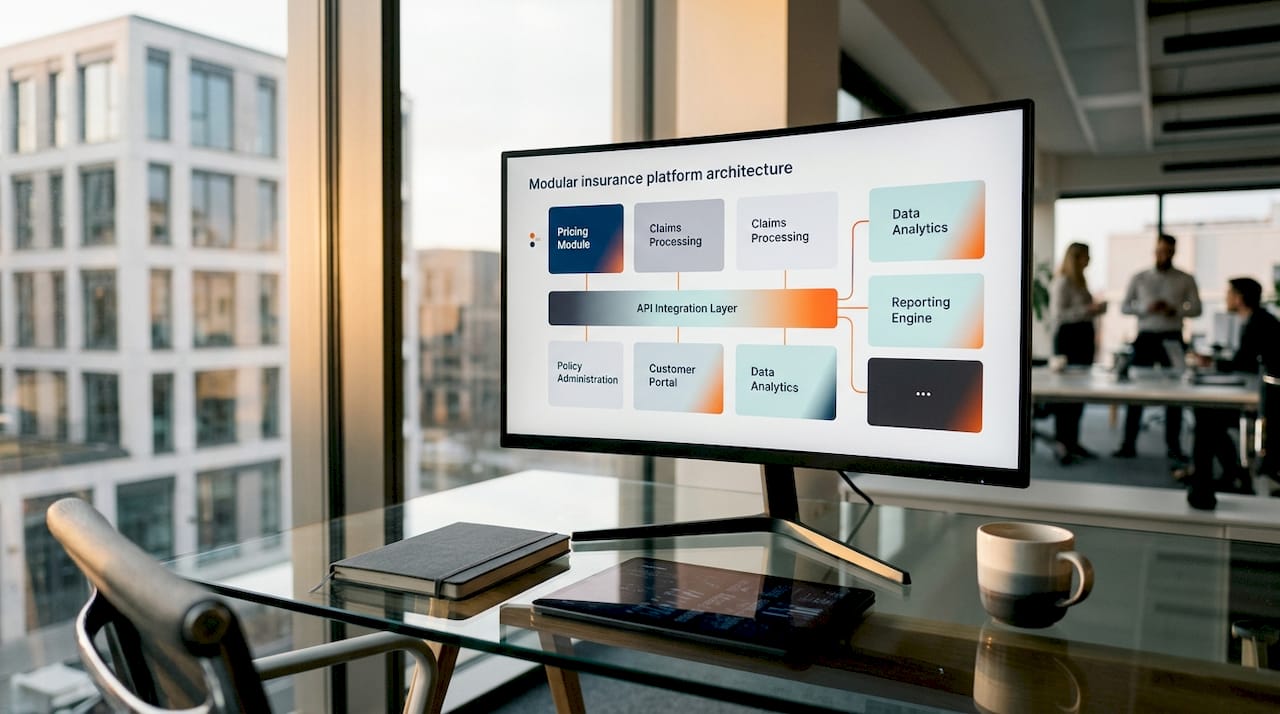
Modular insurance platform architecture diagram

The importance of agile insurance solutions becomes clearest when you compare what insurers can do with them versus without them. With a modular, API-first platform, a P&C insurer can update its pricing logic for a new product line without touching claims or billing. Without one, that same change requires months of testing across interdependent systems, significant IT resource, and considerable regulatory risk.

How does modular architecture enable platform agility?

Modular architecture is the structural foundation of any genuinely agile insurance platform. It divides the core system into discrete, independently deployable components, each responsible for a specific domain such as underwriting, rating, policy administration, or claims. Modular system design allows insurers to update pricing, reporting, and digital workflows independently, removing the costly monolithic upgrades that have historically slowed P&C carriers.

The contrast with monolithic architecture is significant. The table below illustrates the operational difference between the two approaches.

Dimension Monolithic architecture Modular architecture
Update scope Full system deployment required Component-level updates only
Regulatory change cost High, cross-system testing needed Isolated, lower risk and cost
AI integration Difficult, tightly coupled code API-connected, domain-specific
Time to launch new products Months to years Weeks to months
Audit and compliance Embedded in monolith, hard to isolate Event-driven, traceable by design

Practitioner guidance stresses the importance of separating platform coordination from module ownership in microservices environments. When each domain owns its logic and communicates through event-driven interfaces, integration gaps during critical periods such as renewals or claims audits are far less likely. This is not a theoretical benefit. It is the difference between a platform that holds together under pressure and one that requires emergency patches.

Pro Tip: When defining modular boundaries, align them with business domains rather than technical functions. A boundary drawn around “underwriting” is more durable than one drawn around “database layer”, because business domains change more predictably than technical implementations.
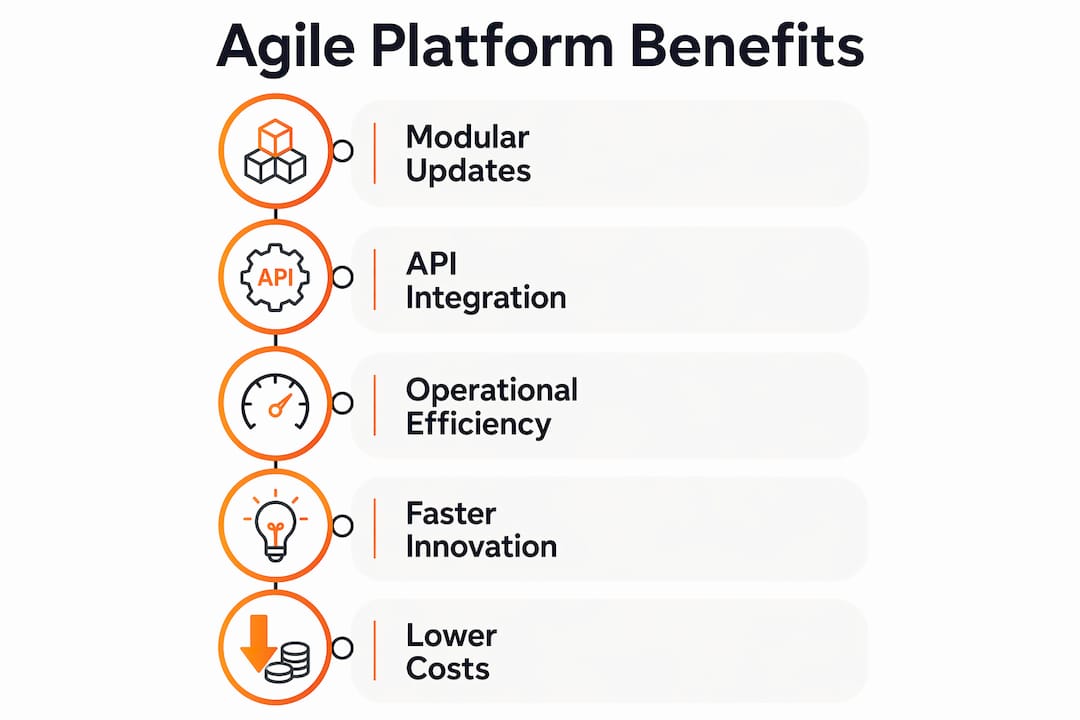
Infographic showing benefits of agile insurance platforms

The benefits of modular insurance platforms extend beyond speed. Insurers that adopt this architecture report lower operating costs during regulatory change cycles, because updates are scoped and tested within a single module rather than across the entire system.

Why are API integration layers critical for agile ecosystems?

An API integration layer is the connective tissue of an agile insurance platform. Without it, modular components remain isolated, and the platform cannot support the ecosystem partnerships, AI capabilities, or real-time data flows that modern P&C operations require. The API-first approach in insurance is now a prerequisite for any insurer serious about AI adoption, because AI systems require structured, accessible data to function at scale.

The practical impact of a well-designed API layer spans the entire insurance value chain:

  • Underwriting: External data sources such as geospatial risk feeds, telematics providers, and credit reference agencies connect directly, enriching risk assessment without manual data entry.
  • Claims: Third-party repair networks, fraud detection services, and document verification tools integrate in real time, reducing cycle times and improving accuracy.
  • Policy servicing: Broker portals, customer self-service applications, and distribution partners connect through standardised APIs, reducing IT overhead for each new channel.
  • AI and automation: Agentic AI systems require API access to trigger actions, retrieve policy data, and update records autonomously. Without a governed API layer, these capabilities cannot be deployed safely.

Definity’s API-first approach was central to their ability to build a digital core in under 12 months and subsequently deploy AI agentic systems at scale. The API layer was not an afterthought. It was the architectural decision that made everything else possible.

Pro Tip: Establish API governance standards before onboarding third-party integrations. Define versioning policies, authentication requirements, and rate limits centrally. Retrofitting governance onto an ungoverned API estate is significantly more costly than building it in from the start.

Real-world results: what agile platforms deliver in practice

The case for agile insurance platforms is strongest when examined through measurable outcomes. Three examples from recent industry experience illustrate the range of benefits available to P&C insurers.

Organisation Initiative Outcome Timeframe
ICON Agility Services client Claims modernisation with AI-Native ValueOps 35% faster claims delivery, compliance on time, improved customer satisfaction 6 months
Definity Digital core rebuild with API-first architecture Full digital core operational, AI agentic systems deployed, operational resilience improved Under 12 months
ACORD Solutions Group MCP-enabled architecture for AI readiness Agentic AI-ready platform, standardised data and workflows, compliant automation at scale Ongoing

The ICON Agility Services result deserves particular attention. A 35% improvement in claims modernisation speed within six months is not a marginal gain. It represents a structural shift in how quickly an insurer can respond to claims volume spikes, regulatory updates, and customer experience demands. The combination of AI-native diagnostics and agile restructuring produced an outcome that neither approach would have achieved independently.

The ACORD Solutions Group MCP architecture takes this further. By making digital insurance solutions fully AI agent-ready through standardised data and workflow structures, ACORD has created a model where autonomous AI interactions with insurance transactions are both possible and auditable. This matters for P&C insurers operating under European regulatory frameworks, where auditability is not optional.

The digital embedded microinsurance strategy literature reinforces a consistent finding: converting digital capabilities into measurable outcomes requires coordinated execution across technology, process, and governance. Technology alone does not produce these results.

Governance and culture: the factors that determine agile platform success

Technology is the enabler of agile insurance platforms, but governance and culture determine whether that technology delivers value. Agile modernisation fails when it is treated as a series of disconnected projects rather than a coordinated transformation. Shared standards, aligned operating models, and clear prioritisation frameworks are what separate digital leaders from the majority.

Four governance and cultural factors consistently distinguish successful agile platform implementations:

  1. Operating model alignment. Technology modernisation and operating model change must proceed together. An insurer that deploys a modular platform but retains a siloed organisational structure will not realise the speed benefits the platform makes possible. Business and IT teams must share ownership of outcomes, not just deliverables.

  2. Event-driven auditability. Event-driven, replayable workflow platforms embed auditability as a design feature rather than a compliance afterthought. Discrete events with full audit trails simplify regulatory validation and reduce the cost of responding to supervisory enquiries. For P&C insurers, this is a material operational advantage.

  3. Fusion teams bridging business and technology. The most effective agile implementations use cross-functional teams that include underwriters, claims managers, compliance officers, and engineers working on the same sprint cycles. This structure eliminates the translation delays that slow traditional IT delivery models.

  4. Continuous improvement as standard practice. Agile platforms are not one-time deployments. They require ongoing investment in capability, governance, and integration. Insurers that treat platform adoption as a project with an end date consistently underperform those that treat it as a permanent operating model.

The compliance through next-generation platforms framework demonstrates how agentic AI and standards-based integration can produce compliant, auditable workflows when governance is embedded from the design phase.

How should P&C insurers approach agile platform adoption?

Successful adoption of agile insurance software follows a recognisable pattern across European P&C carriers. The sequence matters as much as the individual steps.

  • Assess digital maturity before committing to architecture. A maturity assessment identifies where legacy constraints are most costly and where modular replacement will deliver the fastest return. Without this baseline, platform investments are frequently misaligned with operational priorities.
  • Prioritise API-first infrastructure from the outset. API layers must be designed before integrations are built, not retrofitted afterwards. Insurers that delay API governance consistently face higher integration costs and longer deployment timelines.
  • Embed compliance and auditability in the platform design. Regulatory requirements in European P&C insurance are not static. Platforms designed with event-driven audit trails adapt to new requirements far more efficiently than those where compliance is added as a layer on top of existing architecture.
  • Build cross-functional teams with shared accountability. Technology delivery teams that include business domain experts produce better outcomes than purely technical teams working from requirements documents. This is not a cultural preference. It is a delivery model with a measurable track record.
  • Select vendors with a continuous improvement commitment. Platform vendors that provide Evergreen updates and maintain regulatory compliance as part of their service model reduce the internal resource burden on insurers significantly. The digital transformation strategies literature consistently identifies vendor partnership quality as a key differentiator in long-term platform performance.

Key takeaways

Agile insurance platforms deliver measurable operational advantage when modular architecture, API governance, and aligned operating models are implemented together rather than in isolation.

Point Details
Modular architecture reduces change cost Independent component updates lower the risk and cost of regulatory and product changes significantly.
API layers unlock AI and ecosystem value A governed API-first design is the prerequisite for deploying agentic AI and third-party integrations at scale.
Real-world results are measurable ICON Agility Services achieved 35% faster claims delivery in six months through agile restructuring and AI diagnostics.
Governance determines outcome quality Shared standards and aligned operating models separate digital leaders from the majority, per the ACORD 2026 study.
Auditability must be designed in Event-driven, replayable workflows produce natural audit trails that simplify regulatory compliance in P&C insurance.

Where agile platforms are heading: a personal view

The conversation about agile methodologies in insurance has shifted considerably in the past two years. When I first began working closely with P&C insurers on platform strategy, the primary concern was speed to market. Today, the question I hear most often from senior executives is: “How do we make our platform AI-ready without creating new governance risks?”

That question reflects a genuine maturity in how the industry thinks about flexible insurance solutions. The early adopters who moved fast and broke things are now dealing with ungoverned API estates and AI deployments that cannot be audited. The insurers who are winning are those who treated governance as a design constraint from the beginning, not a compliance exercise at the end.

What concerns me about the current moment is the gap between ambition and execution. The ACORD data showing only 7% of large insurers at the highest digital maturity tier is not surprising to anyone who has worked inside these organisations. The technology is available. The barrier is almost always organisational: misaligned incentives, siloed ownership, and a tendency to treat platform modernisation as an IT project rather than a business transformation.

My advice to P&C executives is straightforward. Do not evaluate agile insurance platforms on their feature lists. Evaluate them on how well they support your operating model, your compliance obligations, and your ability to deploy AI safely. The platforms that will define the next decade of P&C insurance are not the ones with the most capabilities. They are the ones that make your organisation genuinely capable of using them.

— Tuna

Modern platform solutions for agile P&C insurers

Ibapplications builds IBSuite specifically for P&C insurers who need to move faster without accumulating technical debt. IBSuite’s policy administration system supports modular product configuration, enabling insurers to launch and adjust products independently across lines of business. For claims teams, the claims management platform accelerates processing cycles and embeds compliance controls directly into workflow design. Both are built on AWS with API-first architecture and Evergreen updates, meaning your platform evolves with regulatory requirements rather than falling behind them. If you are evaluating agile platform options for your P&C operation, IBSuite is worth a close look.

FAQ

What is an agile insurance platform?

An agile insurance platform is a modular, API-connected core system that allows insurers to update individual components, such as rating, underwriting, or claims, without disrupting the entire technology estate. The term is often used interchangeably with adaptive core systems in industry literature.

How does modular architecture improve operational efficiency?

Modular architecture allows insurers to update pricing, reporting, and digital workflows independently, reducing the cost and risk of regulatory changes. This removes the need for full-system deployments every time a product or compliance requirement changes.

Why is API governance important for agile insurance software?

API governance defines how integrations are built, versioned, and secured across the platform. Without it, insurers accumulate ungoverned connections that create security risks and make AI deployment unsafe. Definity’s experience shows that a governed API-first approach is what enables AI agentic systems to operate reliably at scale.

How long does agile platform adoption typically take?

Timelines vary by scope, but Definity built a full digital core in under 12 months using an API-first approach. ICON Agility Services delivered a 35% improvement in claims modernisation speed within six months. Both results required governance and operating model changes alongside the technology work.

What role does auditability play in agile insurance platforms?

Auditability is a design requirement, not a feature. Event-driven, replayable workflow platforms produce natural audit trails that simplify regulatory validation in P&C insurance. Insurers that embed auditability from the design phase face significantly lower compliance costs when regulatory requirements change.

Insurance rate quoting explained: a 2026 guide

Insurance rate quoting explained: a 2026 guide

Insurance agent entering quote data in office

Insurance rate quoting is the process by which an insurer calculates an estimated premium for a policyholder by applying carrier-specific rates to risk and coverage data. The industry term for this process is premium rating, and understanding it gives you a direct advantage when comparing policies and managing costs. Whether you are insuring a vehicle, a commercial property, or a workforce, the quote you receive is shaped by a rating engine processing dozens of variables before a single figure appears on your screen. This guide explains how that process works, what drives the numbers, and how to use quotes intelligently.

What is insurance rate quoting and why does it matter?

Insurance rate quoting is the structured method insurers use to translate risk data into a price estimate. It sits at the start of every insurance transaction and determines whether a policy is affordable, appropriate, and competitive.

The process begins when you submit information to an insurer or broker. A rating engine then applies the carrier’s filed rates to your specific exposure profile. The output is a quote: an estimated premium based on the data you have provided and the assumptions the insurer makes before full underwriting. State Farm describes quotes as detailed price estimates tailored to the coverage, limits, and deductibles you select, not as final bills.

Insurance rating engine displayed on monitor

For consumers, understanding this distinction prevents surprise. For businesses, it enables more precise budgeting and more productive conversations with brokers. The quote is the starting point, not the destination.

What factors affect insurance rate quotes?

Common factors in insurance rate quoting include accident history, vehicle or business details, coverage choices, and location-based risk characteristics. Each factor feeds directly into the insurer’s estimate of future claim costs.

Here is how the main inputs influence your quote:

  • Claims history. A record of previous claims signals higher future risk. Even a single at-fault accident can increase a motor insurance quote significantly for three to five years.
  • Location. Urban postcodes typically carry higher theft, accident, and weather-related risk than rural areas. Insurers apply area-specific factors to reflect this.
  • Coverage levels and deductibles. Higher limits increase the insurer’s potential payout and therefore raise the premium. A higher excess (deductible) shifts more risk to you and reduces the quoted price.
  • Vehicle or business profile. For motor insurance, the make, model, engine size, and age of the vehicle all affect repair and replacement costs. For commercial insurance, the nature of the business, number of employees, and turnover are equivalent inputs.
  • Credit score (where permitted). Some European insurers use credit-related data as a proxy for financial responsibility, though regulatory frameworks vary by country.

Each of these inputs influences the insurer’s estimated future claim costs and hence the premium calculation. Providing inaccurate or outdated information does not lower your final premium. It delays it, because underwriting verification will surface discrepancies and adjust the figure before the policy is issued.

Pro Tip: Before requesting any quote, gather your claims history for the past five years, confirm your registered address, and have your vehicle registration or business details to hand. Accurate inputs produce quotes that are far closer to the final premium, saving you time and avoiding unwelcome adjustments later.

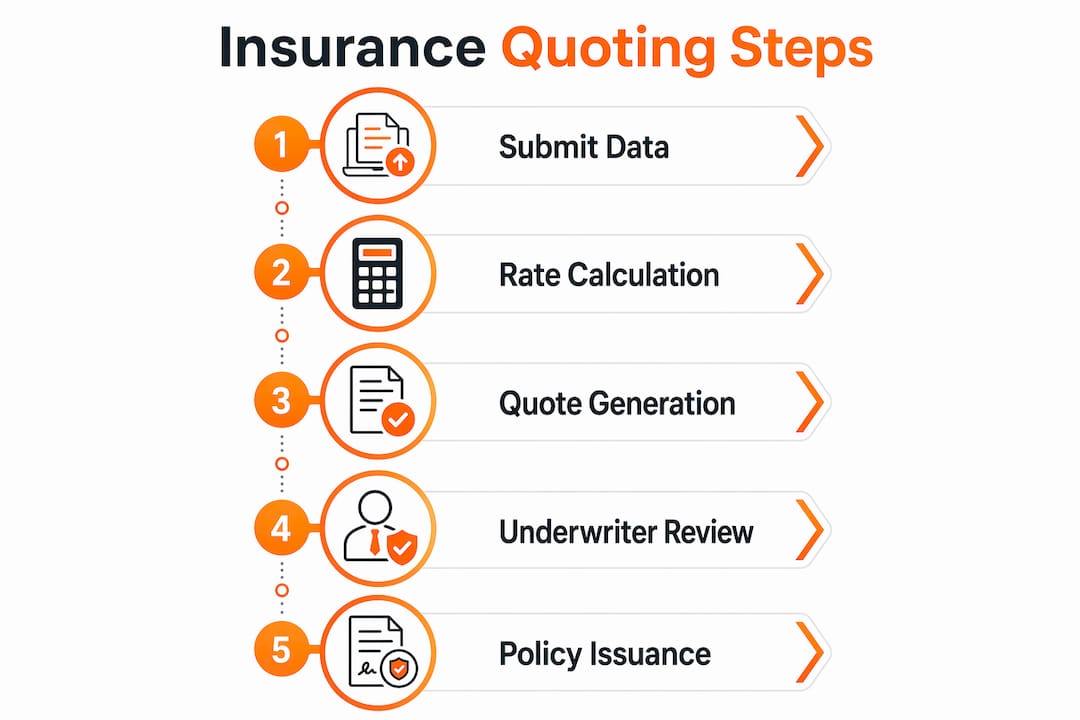
Infographic illustrating insurance quoting process steps

How do insurance rating engines and quoting tools work?

A rating engine is the software that applies an insurer’s filed rates to submitted data and produces a premium output. It is the computational core of every quoting system, whether that system is a simple online form or a sophisticated broker platform.

A rater is any tool that generates insurance premium quotes; carrier portals and comparative raters differ mainly in scope and complexity. Understanding the distinction helps you choose the right channel for your needs.

The data flow through a rating engine follows four stages:

  1. Input collection. You or your broker submits risk data: personal details, asset information, coverage preferences, and claims history.
  2. Risk assessment. The engine applies underwriting rules and risk factors to classify your exposure and identify applicable rate tables.
  3. Rate application. The carrier’s filed rates are multiplied against the relevant exposure units (for example, payroll for employers’ liability or vehicle value for motor insurance).
  4. Quote output. The engine produces a premium estimate, often with options showing how different coverage levels or excess amounts change the price.

Single-carrier portals run this process using one insurer’s rate tables. Comparative raters run the same data through multiple carriers simultaneously, producing side-by-side results. Different quoting channels from the same insurer may show varied quotes because of differing verification steps and assumptions, which is why the same policyholder can receive different figures from a carrier’s website versus a broker’s platform.

The most significant recent development in quoting technology is conversational AI. Liberty Mutual launched an AI quoting app inside ChatGPT in 2026, using their own rating engine to maintain pricing accuracy while meeting regulatory requirements around data privacy and disclosure. This illustrates both the opportunity and the constraint: AI can widen consumer access to quotes, but the underlying rating engine must still comply with filed rates and data governance rules.

Commercial lines quoting is more challenging than personal lines because commercial data is less standardised and fewer APIs exist to connect broker systems with carrier rating engines. This is why commercial quotes often take longer and require more manual input than a motor or home insurance quote.

Pro Tip: When using an online quoting tool, check whether it performs real-time data verification during entry. Tools that pull Motor Vehicle Records or claims data in real time produce near-final quotes. Tools that rely entirely on self-reported data will show a wider gap between the quote and the final premium.

What is the difference between a rate, a quote, and a premium?

These three terms are used interchangeably in everyday conversation, but they describe distinct stages of the pricing process. Confusing them leads to misplaced expectations.

Term Definition Example
Rate The price per unit of exposure, set by the insurer and filed with the regulator £0.50 per £100 of insured payroll
Quote An estimated premium calculated by applying rates to submitted data before full underwriting £1,200 per year based on information provided
Premium The final cost confirmed after underwriting verification and any adjustments £1,340 after claims history verified

In rate mathematics, the rate is the price per unit of exposure, while the premium is the final calculated cost after adjustments. A workers’ compensation example makes this concrete: a rate of £0.50 per £100 of payroll applied to a £500,000 payroll produces a base premium of £2,500 before discounts, surcharges, or fees are applied.

The quote sits between these two. It is the insurer’s best estimate given the data submitted, before the underwriter has verified claims records, credit data, or inspection reports. Auto insurance quotes are snapshots based on information given, not the final bill. The final premium depends on underwriting verification.

Insurance rate setting is constrained by claim cost coverage requirements and regulatory limits, which means insurers cannot simply adjust rates at will. Rate changes require regulatory approval, which is why quotes can remain stable even when claims costs are rising.

How to compare and use insurance quotes effectively

Getting a quote is straightforward. Using quotes well requires a more deliberate approach. The goal is not simply to find the lowest number but to identify the best value for the coverage you actually need.

  • Compare like for like. Request quotes with identical coverage limits, excess amounts, and policy conditions from each insurer or broker. A quote that appears 20% cheaper may simply carry a higher excess or exclude a key coverage section.
  • Use multiple channels. Request quotes from carrier portals, broker platforms, and comparative raters. Real-time data validation during entry improves accuracy over simplistic comparison tools, so prioritise platforms that verify data as you enter it.
  • Account for discounts and surcharges. Many insurers apply no-claims discounts, multi-policy discounts, or telematics-based reductions that do not appear in a standard quote. Ask specifically what adjustments are available.
  • Expect post-submission changes. Quote generation is often faster than binding a policy, as downstream document and approval coordination can add time. If your quote changes after submission, ask the insurer to explain which data point triggered the adjustment.
  • Know when to use a broker. For commercial insurance, a broker adds genuine value by accessing markets that do not quote directly to consumers and by structuring coverage to match your actual risk profile. For personal lines, a comparative rater is often sufficient.
  • Review coverage trade-offs critically. Reducing coverage to lower a quote is a legitimate choice, but it should be deliberate. Understand what you are giving up before accepting a lower figure. A useful reference for this is understanding why the cheapest option is not always the right one.

The API-driven integration between broker platforms and carrier rating engines is what makes multi-carrier comparison possible at speed. Where these integrations are absent, particularly in commercial lines, the comparison process becomes slower and more manual.

Key takeaways

Accurate insurance rate quoting requires consistent input data, an understanding of the rate-quote-premium distinction, and deliberate comparison across multiple channels and coverage configurations.

Point Details
Rate vs quote vs premium A rate is the price per exposure unit; a quote is an estimate; the premium is the final verified cost.
Data accuracy matters Inaccurate inputs produce quotes that diverge from the final premium after underwriting verification.
Channel choice affects output Single-carrier portals, comparative raters, and broker platforms can produce different figures for the same risk.
AI quoting is advancing Conversational AI tools like Liberty Mutual’s ChatGPT integration expand access but require accurate data and regulatory compliance.
Compare consistently Quotes are only comparable when coverage limits, excess amounts, and conditions are identical across all options.

The tension at the heart of modern quoting

I have spent considerable time working alongside insurers grappling with the gap between what quoting technology promises and what it actually delivers. The acceleration of digital quoting is real and genuinely useful. Real-time data verification, AI-powered automation, and comparative raters have made the process faster and more transparent for consumers. That is unambiguously good.

What concerns me is the growing assumption that speed equals accuracy. A quote generated in thirty seconds from a conversational AI interface is only as reliable as the data the consumer provides and the assumptions baked into the rating engine. Conversational AI quoting presents genuine opportunities but also raises challenges in data accuracy and regulatory compliance that are not yet fully resolved.

The consumers who get the most value from quoting tools are those who treat the quote as the beginning of a conversation, not the end of one. They verify what the quote includes, ask what could change it, and understand that the premium confirmed at binding may differ from the figure that first appeared on screen. That critical but confident approach is what separates informed buyers from those who are surprised when their renewal arrives.

Regulatory frameworks across Europe are also tightening around data use in automated pricing, particularly where credit data or behavioural signals feed into rating engines. This is a healthy development. It forces insurers to be more transparent about what drives a quote, which ultimately benefits everyone who buys insurance.

— Tuna

How IBSuite supports the full quoting and policy lifecycle

For insurers and brokers looking to improve the accuracy, speed, and consistency of their quoting processes, IBSuite from Ibapplications provides an end-to-end platform built for exactly this challenge. IBSuite’s policy administration capabilities connect rating engines, underwriting rules, and policy issuance within a single cloud-native system, reducing the manual steps that slow down the quote-to-bind process. The platform supports API-first integration with external data sources, enabling real-time verification that brings quotes closer to final premiums from the outset. If you are evaluating platforms for quoting, rating, or policy management, Ibapplications offers a demonstration tailored to your product lines and distribution model.

FAQ

What is insurance rate quoting?

Insurance rate quoting is the process by which an insurer applies carrier-specific rates to a policyholder’s risk and coverage data to produce an estimated premium. The resulting figure is a quote, not a confirmed price, until underwriting verification is complete.

What is the difference between a quote and a premium?

A quote is an estimated premium based on submitted information and preliminary calculations. The premium is the final cost confirmed after the insurer has verified claims history, credit data, and other underwriting factors.

What factors affect insurance rate quotes most?

Claims history, location, coverage levels, and vehicle or business profile are the primary factors. Each influences the insurer’s estimate of future claim costs and therefore the quoted price.

Why do quotes from the same insurer differ across channels?

Multi-channel quoting from a single insurer can yield different pricing outputs because different tools apply varying assumptions and data verification steps. A broker platform with real-time data checks will typically produce a more accurate quote than a basic comparison tool.

Can a quote change before the policy is issued?

Yes. Quote generation is faster than binding, and the final premium depends on underwriting confirmation. If the insurer discovers discrepancies during verification, the premium will be adjusted before the policy is issued.

Benefits of cloud-native insurance for executives

Benefits of cloud-native insurance for executives

Insurance executive reviewing cloud platform dashboard

Cloud-native insurance is defined as the practice of building core insurance platforms specifically for cloud environments, using microservices, API-first architecture, and elastic infrastructure rather than adapting legacy systems to run on cloud servers. The distinction matters enormously. Platforms like BriteCore and IBSuite, built from the ground up for the cloud, deliver agility, automation, and scalability that no retrofitted monolith can match. For P&C insurers facing tighter margins and faster-moving competitors, understanding the concrete benefits of cloud-native insurance is no longer an academic exercise. It is a strategic priority.

1. What are the benefits of cloud-native insurance architecture?

Cloud-native insurance platforms replace monolithic core systems with modular components that communicate through APIs, and this architectural shift is the foundation of every operational advantage that follows. Modular, API-driven designs speed time-to-market and support experimentation with new insurance products and pricing models. That means your underwriting team can iterate on a new commercial lines product without waiting for IT to untangle dependencies across a 20-year-old system.

The practical implications for insurers are significant:

  • Independent deployment: Each microservice, whether rating, billing, or claims, can be updated, tested, and released without touching the rest of the platform.
  • Third-party integration: An API-first approach allows insurers to connect with external data providers, brokers, and InsurTech partners without bespoke development work.
  • Phased migration: Modular design supports incremental replacement of legacy functions, so you do not face a high-risk, big-bang cutover.
  • Reduced technical debt: Retiring monolithic components one at a time lowers the long-term maintenance burden on your IT department.

Pro Tip: When evaluating cloud-native platforms, ask vendors specifically how many of their core modules can be deployed independently. A genuinely modular platform will give you a clear answer. A retrofitted legacy system dressed in cloud clothing will not.

2. How do embedded AI copilots transform insurance operations?

Colleagues discussing cloud-native insurance benefits

Automation through embedded AI is where cloud-native insurance advantages move from architectural theory to measurable business impact. BriteCore’s AI copilots reduce manual processing by up to 90% across underwriting, claims handling, and billing workflows. That figure represents not just cost savings but a fundamental reallocation of skilled staff time toward judgement-intensive work.

The key distinction with embedded AI, as opposed to bolted-on AI tools, is governance. BriteCore’s Model Context Protocol ensures AI interactions adhere to strict governance and auditability requirements, operating within insurer-controlled infrastructure rather than sending sensitive data to external services. For European insurers operating under GDPR and Solvency II, this is not a minor technical detail. It is a compliance prerequisite.

“Embedding AI copilots directly into insurance platforms redefines operational efficiency by blending human expertise with automated decision-making.” — BriteCore AI Strategy Report, 2026

The operational benefits compound across the value chain:

  • Underwriting: AI copilots pre-screen submissions, flag anomalies, and draft risk assessments, reducing the time underwriters spend on routine cases.
  • Claims: Automated first notice of loss processing, fraud scoring, and reserve recommendations accelerate settlement and reduce leakage.
  • Billing: Intelligent payment matching and exception handling cut manual reconciliation work significantly.
  • Compliance: Governed AI keeps audit trails intact and decision logic transparent, which is critical for regulatory reporting.

3. In what ways does cloud-native insurance improve scalability and resilience?

Scalability in cloud-native systems is not simply about handling more transactions. It is about handling the right transactions at the right cost, without over-provisioning infrastructure that sits idle for eleven months of the year. Microservices enable high-demand services to scale independently and isolate faults, enhancing resilience and system stability. A claims surge following a major weather event, for example, can be absorbed by scaling only the claims processing service rather than the entire platform.

The resilience argument is equally compelling. When one microservice fails in a cloud-native architecture, the failure is contained. In a monolithic system, a single defect can cascade across the entire platform, taking down policy administration, billing, and customer portals simultaneously.

Capability Legacy monolith Cloud-native platform
Scaling approach Full system scale-up required Independent service scaling
Fault containment System-wide risk Isolated to affected service
Infrastructure cost Fixed, over-provisioned Pay-as-you-go, elastic
Downtime during updates Planned outages required Rolling deployments, minimal disruption

Cloud adoption allows insurers to lower costs by scaling resources elastically and avoiding vendor lock-in associated with legacy systems. The pay-as-you-go model also converts large capital expenditure on data centre infrastructure into predictable operational expenditure, which simplifies budgeting for finance teams.

Pro Tip: Request a resilience architecture diagram from any platform vendor you are evaluating. If they cannot show you how service failures are isolated, the platform is not genuinely cloud-native.

4. What role does cloud-native architecture play in accelerating innovation?

Speed to market is the competitive currency of modern insurance, and cloud-native platforms built on modular, API-driven services give insurers the ability to launch, test, and refine products in weeks rather than quarters. This is not a marginal improvement. It is the difference between leading a market segment and following it.

The innovation advantages extend across several dimensions:

  • Advanced analytics: Cloud-native platforms integrate with data lakes, telematics feeds, and third-party enrichment services through open APIs, enabling data-driven pricing models that legacy systems cannot support.
  • Personalised customer engagement: Digital-first policy journeys, self-service portals, and real-time notifications become achievable without custom development projects.
  • New distribution models: API connectivity allows insurers to embed products into partner platforms, broker portals, and affinity channels without building bespoke integrations for each.
  • Agile experimentation: Modular architecture means a new product can be piloted in one region or distribution channel without committing the entire organisation to a platform change.

The ability to digitise insurance processes rapidly is particularly relevant for European insurers responding to shifting regulatory requirements and evolving customer expectations in markets like Germany, the Netherlands, and the Nordic countries, where digital-first purchasing behaviour is well established.

5. How does cloud-native technology reduce cost and improve operational efficiency?

The cost case for cloud-native insurance is built on three compounding factors: lower maintenance costs from retiring legacy systems, operational savings from automation, and infrastructure efficiency from elastic cloud resources. Cloud-native platforms enable insurers to increase efficiency and compete more effectively by modernising infrastructure, trading legacy technical debt for productivity gains.

The migration path itself need not be a source of financial risk. The Strangler Pattern enables insurers to incrementally replace legacy functions with cloud-native modules, reducing the risk of disruption and avoiding large investment spikes. Under this approach, a P&C insurer might migrate claims management first, realise the efficiency gains, and use those savings to fund the next phase of migration covering policy administration or billing.

Cost driver Legacy system impact Cloud-native impact
Infrastructure maintenance High, fixed annual cost Reduced, elastic spend
Manual processing labour Significant, routine tasks Reduced through AI automation
Product launch cost High, requires full system change Lower, modular deployment
Regulatory change cost Expensive, system-wide updates Targeted module updates

The operational efficiency gains from cloud technology in insurance are not theoretical. Insurers that have completed cloud-native migrations consistently report reduced IT operational costs and faster response times to both market opportunities and regulatory changes.

Key takeaways

Cloud-native insurance platforms deliver measurable advantages in agility, cost, resilience, and automation that legacy systems cannot replicate through incremental upgrades.

Point Details
Modular architecture drives flexibility Independent microservices allow product updates and integrations without full platform changes.
Embedded AI cuts manual work Governed AI copilots reduce routine processing by up to 90%, freeing staff for complex decisions.
Elastic scaling lowers cost Pay-as-you-go infrastructure eliminates over-provisioning and converts capital spend to operational spend.
Phased migration reduces risk The Strangler Pattern allows incremental legacy replacement without business disruption.
Innovation speed is a competitive advantage API-first design enables new product launches and distribution models in weeks, not quarters.

Cloud-native transformation is a business decision, not an IT project

I have spent considerable time working with insurance executives who frame cloud-native adoption as a technology upgrade. That framing is the single most common reason these programmes underdeliver. Successful cloud-native transformation requires executive sponsorship, clear KPIs, and a shift in organisational mindset that goes well beyond IT. When the business case is owned by the CIO alone, the programme tends to optimise for technical elegance rather than commercial outcomes.

The insurers I have seen succeed treat cloud-native migration as a product strategy decision. They start by asking which business capability, whether faster claims settlement, more competitive pricing, or new distribution channels, will generate the most value if unlocked first. Then they select the platform module that enables it. That sequencing discipline is what separates a successful phased migration from an expensive multi-year IT programme that never quite delivers.

There is also an uncomfortable truth about talent. Cloud-native platforms require a different kind of IT capability than legacy systems. The skills needed to configure and extend a microservices-based platform are not the same as those needed to maintain a monolith. Executives who invest in platform modernisation without investing in the people to run it will find themselves dependent on vendors in ways that limit their innovation sovereignty. Build the internal capability alongside the platform.

— Tuna

How IBSuite supports cloud-native insurance transformation

Ibapplications has built IBSuite as a fully cloud-native, API-first insurance platform for P&C insurers, covering the complete value chain from sales and underwriting through to claims management, billing, rating, and financial sub-ledger. Built on AWS and designed for Evergreen updates, IBSuite allows insurers to deploy modular capabilities at their own pace, integrating with existing systems through open APIs without requiring a full platform replacement on day one. If you are evaluating cloud-native options for your organisation, the IBSuite insurance platform provides a practical starting point for understanding what a purpose-built cloud-native core system can deliver.

FAQ

What is cloud-native insurance?

Cloud-native insurance refers to core insurance platforms built specifically for cloud environments using microservices, API-first architecture, and elastic infrastructure. These systems differ fundamentally from legacy platforms that have been migrated to cloud hosting without architectural redesign.

How does cloud-native architecture differ from legacy insurance systems?

Legacy systems are monolithic, meaning a change to one function requires testing and deploying the entire platform. Cloud-native platforms use independent microservices, so individual components such as claims or billing can be updated, scaled, or replaced without affecting the rest of the system.

Can insurers migrate to cloud-native platforms without disrupting operations?

Yes. The Strangler Pattern allows insurers to replace legacy functions incrementally with cloud-native modules, running both systems in parallel during transition. This approach reduces risk and avoids the large investment spikes associated with big-bang migrations.

How does embedded AI in cloud-native platforms support compliance?

Platforms like BriteCore embed AI agents within insurer-controlled infrastructure using governed protocols, ensuring all AI interactions maintain audit trails and adhere to data privacy requirements. This approach keeps AI decision-making transparent and auditable for regulatory purposes.

What are the primary cost benefits of cloud-native insurance platforms?

Cloud-native platforms reduce costs through elastic, pay-as-you-go infrastructure, lower legacy maintenance spend, and AI-driven automation that reduces manual processing across underwriting, claims, and billing operations.