31.07.26
Customer onboarding process in insurance: a Central Europe playbook

A digital-first, risk-rated onboarding workflow that verifies identity, automates KYC and issues a policy in under two minutes is the single fastest way to cut acquisition costs and reduce drop-out. Three actions your leadership team should sponsor this quarter:
- Assign a compliance champion who owns documented checkpoints across every digital onboarding path, so that regulatory interpretation changes do not invalidate automated flows.
- Run a six-week mobile KYC pilot on one low-risk retail product, instrumenting drop-off at every funnel step before scaling.
- Instrument funnel analytics from day one, targeting time-to-bind under two minutes for low-risk retail motor policies and tracking conversion at each step.
The primary success metric to anchor your programme: time-to-bind. Pair it with a drop-off rate per funnel step and a straight-through processing (STP) rate. When those three move together, everything else follows.
Table of Contents
- What does the customer onboarding process in insurance actually cover?
- Why a smooth onboarding experience directly affects your bottom line
- Seven-step operational checklist for your onboarding flow
- What technology architecture does fast, compliant onboarding require?
- How do you measure whether onboarding is actually working?
- What does a realistic implementation timeline and budget look like in Central Europe?
- How do eIDAS, IDD, AMLR and the EUDI Wallet affect your onboarding design?
- What operational pitfalls and fraud red flags should you watch for?
- Key takeaways
- What Central European insurers are actually getting right
- IBSuite supports the onboarding architecture this guide recommends
- Useful sources and further reading
- FAQ
What does the customer onboarding process in insurance actually cover?
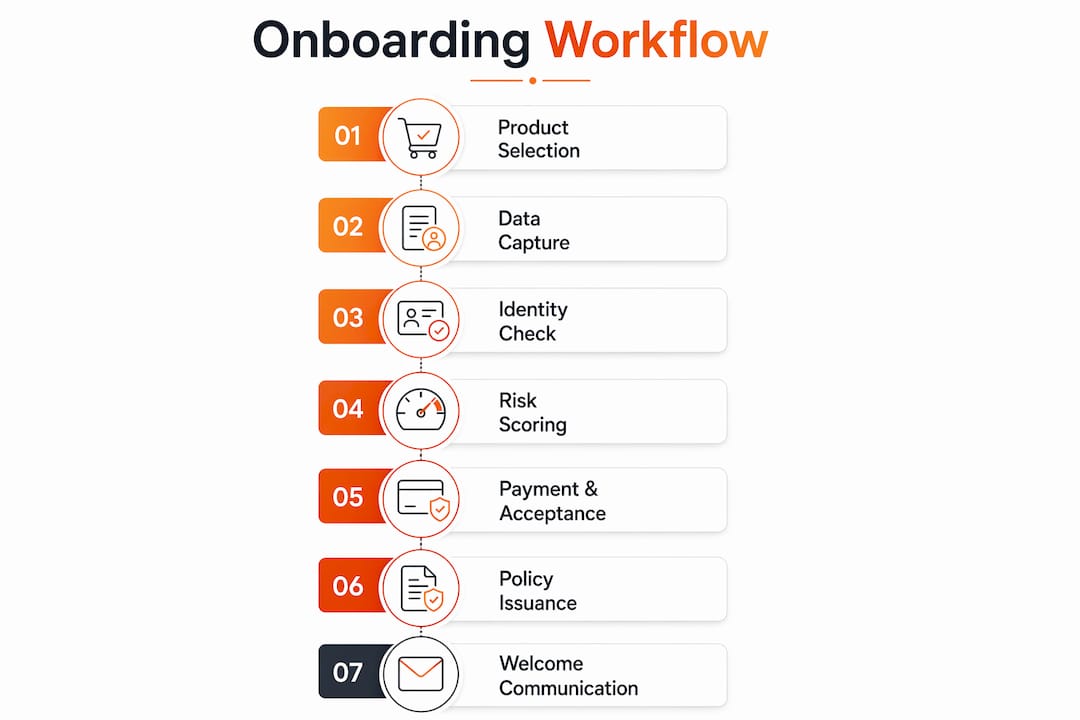
Onboarding in insurance is not just a welcome email. It spans every step from the moment a prospect selects a product to the moment a policy is live in their account and they know how to use it. That scope includes: needs assessment and product selection, data capture and pre-validation, identity verification and KYC, risk scoring and pricing, digital acceptance and payment, policy issuance, and welcome or activation communications.
Several internal teams touch this process. Sales and distribution own the front-end experience. Underwriting sets the risk-scoring rules. Compliance and legal define the KYC paths and evidence requirements. Policy administration systems receive the issued policy. Payment providers, identity/KYC vendors, and e-signature platforms sit in the middle as external parties. Getting all of them aligned on a single orchestration layer is where most insurers lose time.

What onboarding is not: it does not include full claims handling, mid-term policy changes, or renewal negotiations. Those are post-onboarding lifecycle events. Drawing that boundary clearly matters because scope creep is one of the most common reasons onboarding redesign projects stall.
A useful mental model: think of onboarding as a corridor with a clear entry point (product selection) and a clear exit point (first confirmed policy interaction or activation). Everything in between is yours to optimise.
Why a smooth onboarding experience directly affects your bottom line
The business case is straightforward. Every minute of unnecessary friction between a customer’s decision to buy and their receipt of a policy is a window for abandonment. Industry surveys across European markets indicate that roughly two-thirds of firms report losing customers because onboarding is too complex, and that automation reduces abandonment materially. That figure should concentrate minds in any budget meeting.
The cost side is equally compelling. Manual document review, back-and-forth email chasing, and agent re-keying all inflate cost-per-policy. Automating document extraction and liveness detection removes those steps entirely. A motor insurer that shaves four minutes off an eight-minute onboarding flow does not just improve NPS; it reduces the number of agents needed to handle incomplete applications, which compounds across tens of thousands of policies per year.
Fraud reduction is a less-discussed benefit. Automated AML/PEP screening and biometric liveness checks catch synthetic identities and document forgeries at the point of entry, before a fraudulent policy is ever issued. Catching fraud at onboarding is orders of magnitude cheaper than detecting it at claims.
The digital transformation drivers pushing Central European insurers toward digital-first distribution make this investment increasingly urgent, not optional.
Seven-step operational checklist for your onboarding flow
This is the core playbook. Each step has an owner, a minimum technical requirement, and a KPI to track.
1. Product selection and needs assessment
Owner: Distribution / product team. Minimum capability: A digital needs-assessment questionnaire that maps to IDD demands-and-needs requirements and delivers the Insurance Product Information Document (IPID) before contract conclusion. KPI: Completion rate of the needs assessment form.
Pro Tip: Pre-populate the needs assessment with any data you already hold (device type, referral channel, prior quote data). Every field you remove from the customer’s view increases completion rates.
2. Data capture and pre-validation
Owner: Operations / IT. Minimum capability: Real-time field validation (format checks, postcode lookups, VIN decoding for motor) that prevents bad data entering downstream systems. KPI: Data error rate at submission.
3. Identity verification and KYC pathing
Owner: Compliance / KYC vendor. Minimum capability: Document extraction, NFC/chip check where available, biometric liveness detection, and AML/PEP screening. Route low-risk customers through a lighter path; trigger enhanced due diligence (EDD) only where risk scoring demands it. KPI: KYC pass rate, time-to-verify, and EDD escalation rate.
Pro Tip: Do not apply the same KYC depth to every customer. A 30-year-old buying a €200 annual travel policy is not the same risk profile as a new commercial property client. Dynamic pathing by risk band is the single biggest lever for reducing abandonment without compromising compliance.
4. Risk scoring and pricing

Owner: Underwriting / actuarial. Minimum capability: Real-time rating engine connected to the policy administration system, with configurable rules for country variants. KPI: Time-to-quote, referral rate to manual underwriting.
5. Digital acceptance and payment
Owner: Product / payments. Minimum capability: In 26 of 27 EU member states, a wet signature is not required for online insurance purchases; payment confirmation or an acceptance checkbox suffices under eIDAS and the Consumer Rights Directive. Bulgaria is the exception. Integrate a payment gateway with 3DS2 authentication and log the acceptance event with a timestamp. KPI: Payment completion rate, payment failure rate.
6. Policy issuance and system integrations
Owner: IT / policy admin. Minimum capability: Automated policy document generation, real-time write to the policy administration system, and confirmation push to CRM. KPI: STP rate, policy issuance time.
7. Welcome and activation communications
Owner: Customer experience / marketing. Minimum capability: Triggered welcome message (email + SMS) with policy summary, claims contact, and a clear next action (download the app, set up direct debit, add a named driver). KPI: Activation rate within 48 hours, NPS at day seven.
What technology architecture does fast, compliant onboarding require?
The architecture question is not which vendor to pick first. It is which pattern to adopt so that swapping a vendor later does not require rebuilding the whole flow.
The API-first orchestration pattern
Place an orchestration layer between your customer-facing front end and every back-end service. This layer calls identity verification, AML screening, rating, policy admin, and payment in the correct sequence, handles retries and timeouts, and logs every event to an immutable audit trail. Without it, you end up with point-to-point integrations that break every time a vendor updates their API.
An event bus (Apache Kafka or a managed equivalent on AWS) gives you real-time status updates across systems without polling, which matters when you are targeting sub-two-minute onboarding.
Integration checklist
| Integration | Purpose | Compliance relevance |
|---|---|---|
| Document extraction + NFC/chip | Capture and validate ID documents | KYC / AMLR |
| Biometric liveness detection | Confirm document holder is present | KYC / AMLR |
| AML/PEP screening | Screen against sanctions and PEP lists | AMLR / AMLD |
| e-Signature / QES | Capture acceptance where required | eIDAS / country variant |
| Payment gateway (3DS2) | Collect premium, log acceptance event | Consumer Rights Directive |
| CRM API | Sync customer record post-issuance | GDPR data minimisation |
| Policy admin API | Issue policy, trigger document generation | IDD / policy issuance |
Vendor selection criteria
Prioritise vendors with EU data residency, transparent model decisions (especially for liveness and fraud scoring), documented SLAs for uptime and processing time, and clear certification status under eIDAS. For Central European deployments, check whether the vendor has live integrations with the national eID schemes in your target markets, not just EUDI Wallet readiness on paper.
Pro Tip: Build a sandbox environment that mirrors production data flows before signing any vendor contract. Run your full onboarding scenario end-to-end in sandbox, including failure paths (expired document, liveness failure, AML hit), and measure actual processing times. Vendor-quoted SLAs and real-world latency under load are often different numbers.
The automation and AI capabilities available in modern P&C platforms mean that document extraction and risk scoring can now be deeply embedded in the orchestration layer rather than bolted on as afterthoughts.
How do you measure whether onboarding is actually working?
Core KPI set
| KPI | What it measures | Recommended tracking cadence |
|---|---|---|
| Time-to-bind | End-to-end duration from product selection to policy issuance | Real-time dashboard |
| Drop-off rate per step | Where customers abandon the funnel | Real-time dashboard |
| KYC pass rate | % of customers completing identity verification without manual intervention | Daily |
| STP rate | % of policies issued without human touch | Daily |
| Conversion rate | % of started applications resulting in issued policies | Weekly |
| Cost per issued policy | Total onboarding cost divided by policies issued | Weekly |
| NPS / CSAT at day 7 | Customer satisfaction post-onboarding | Weekly |
| Fraud detection rate | % of applications flagged and confirmed fraudulent | Weekly |
Dashboard and alerting
Set real-time alerts for two signals: a drop-off spike at any single funnel step (which usually indicates a technical failure or a UX regression) and an AML hit rate that deviates from baseline (which may indicate a fraud campaign). Everything else can run on a weekly report.
- Track time-to-bind as a percentile distribution (P50, P90, P99), not just an average. Averages hide the long tail of customers stuck in manual review.
- Segment drop-off by device type, country, and product line. A drop-off spike on mobile in Poland may have a completely different root cause than the same spike on desktop in the Czech Republic.
- Review your KYC pass rate weekly against the previous four-week baseline. A sudden decline often signals a document type or camera quality issue before customers start complaining.
Experimentation cadence
Run A/B tests on copy and form layout in two-week sprints. Test KYC friction thresholds (for example, whether requiring NFC chip reading versus OCR-only changes pass rates and fraud rates) in four-week pilots with a clear rollback criterion: if fraud rate increases by more than a defined threshold, revert automatically. Risk-based pathing changes should go through a compliance sign-off before any live test.
What does a realistic implementation timeline and budget look like in Central Europe?
Phased delivery reduces risk and lets you validate the business case before committing full budget. The table below reflects typical durations and cost drivers for a Central European P&C insurer deploying a digital-first onboarding flow on an API-first core.
| Phase | Typical duration | Key activities | Primary cost drivers |
|---|---|---|---|
| Discovery and scoping | 4–6 weeks | Process mapping, regulatory gap analysis, vendor shortlisting | Internal time, legal/compliance advisory |
| Pilot (one product, one country) | 6–8 weeks | KYC vendor integration, front-end build, sandbox testing | Vendor integration fees, development resource |
| Integration and compliance sign-off | 8 weeks | Full API integrations, audit trail build, DPO review, GDPR documentation | IT resource, compliance advisory, vendor licences |
| Staged roll-out (additional products/countries) | 4–8 weeks per market | Country variant configuration, local eID testing, agent training | Change management, localisation, training |
Cost drivers vary significantly by starting point. An insurer on a legacy monolithic policy admin system will spend considerably more on integration than one already on an API-first core. Identity provider fees in Central Europe typically run on a per-verification basis; budget for volume tiers rather than flat fees. Compliance and legal advisory for AMLR readiness and GDPR documentation is often underestimated: allocate dedicated resource, not just a few hours of general counsel time.
A digital-first insurance strategy that stages roll-out by product and country also de-risks the programme commercially: you validate conversion and cost metrics on one product before committing the full integration budget.
How do eIDAS, IDD, AMLR and the EUDI Wallet affect your onboarding design?
IDD: needs assessment and IPID are non-negotiable
The Insurance Distribution Directive requires that every sale is preceded by a demands-and-needs assessment and, for non-life products, delivery of an IPID before contract conclusion. EIOPA’s third report on IDD application notes that these consumer-protection principles were written for human-led, linear sales and create friction when applied to real-time digital journeys. The practical implication: you must engineer the needs assessment and IPID delivery as explicit, logged steps in your digital flow, not as PDF attachments buried in a confirmation email.
AMLR and the new CDD triggers
The EU’s Anti-Money Laundering Regulation introduces a harmonised rulebook that expands customer due diligence triggers and lowers certain thresholds. The BIPAR/Steptoe AML/CFT handbook details the expanded CDD requirements and the new transactional threshold changes. For onboarding, this means you need to map every CDD trigger point into your orchestration layer and ensure evidence is retained in a tamper-evident audit trail.
eIDAS and the EUDI Wallet
The EUDI Wallet is mandated for EU Member States by December 2026, but adoption will vary significantly by country. The AMLR framework favours eIDAS methods (eIDs, EUDI Wallet, QES) for remote customer due diligence, but attribute gaps will remain in many national implementations. Design your KYC paths to support both eIDAS-native flows and robust fallbacks (OCR plus liveness, for example) for markets where wallet adoption is still low.
In practice, this means building country-variant configuration into your orchestration layer from the start, not as a retrofit. A flow that works in Austria may fail in Slovakia without local adjustments.
Pro Tip: Assign a named compliance champion who owns a living document of every digital checkpoint, the regulatory basis for each decision, and the evidence retained. When AMLR interpretation evolves or a national regulator issues guidance, that document is what keeps your automated flow defensible. Without it, you are one regulatory query away from a manual audit of thousands of records.
The compliance and governance capabilities of a next-generation platform make traceable checkpoints and audit evidence far easier to maintain than on a legacy system.
For data privacy and GDPR obligations specific to KYC data retention and minimisation, review your data protection officer’s guidance against the evidence retention requirements under AMLR before go-live.
What operational pitfalls and fraud red flags should you watch for?
Common pitfalls
- Over-engineering low-risk paths. Applying full EDD to a customer buying a €150 travel policy wastes time and drives abandonment. Calibrate KYC depth to risk band.
- Poor vendor orchestration. Calling KYC, AML, and rating services sequentially when they could run in parallel adds seconds that compound across thousands of applications.
- Missing country-variant test coverage. A flow tested only in one Central European market will surface unexpected failures when deployed in a second. Test every country variant in sandbox before live deployment.
- Incomplete evidence trails. If your audit log does not capture the exact version of the IPID delivered, the timestamp of the needs assessment completion, and the AML screening result, you cannot demonstrate compliance in a regulatory review.
Fraud and compliance red flags
- Frequent device changes during a single application session (a signal of session hijacking or synthetic identity use).
- Document images with inconsistent metadata (creation date, GPS data, or compression artefacts inconsistent with the claimed document type).
- High drop-off immediately after the KYC prompt, followed by a new application from a different device with similar personal data.
- AML hit rate deviating sharply from baseline within a short window (may indicate a coordinated fraud campaign).
Pro Tip: Set an automated escalation rule: any application that fails liveness twice, or triggers an AML hit, routes immediately to a named agent queue rather than sitting in a generic review pile. Response time on fraud escalations matters; a 24-hour queue is too slow.
Quick fixes deployable within weeks
- Implement dynamic pathing thresholds: configure your orchestration layer to route by risk score rather than product type alone.
- Add automated document re-request messaging: if document quality fails extraction, send an immediate in-app prompt with a specific instruction (for example, “Please retake your passport photo in natural light, avoiding flash”).
- Set a session timeout with a save-and-resume link rather than losing the application entirely. Many abandonment events are recoverable if the customer can return without restarting.
Key takeaways
A digital-first onboarding flow built on an API-first orchestration layer, with risk-based KYC pathing and documented compliance checkpoints, is the most direct route to lower acquisition costs and higher conversion for Central European P&C insurers.
| Point | Details |
|---|---|
| Target time-to-bind | Modern KYC platforms can complete full identity verification and policy issuance in under two minutes for low-risk retail products. |
| Risk-based KYC pathing | Calibrate verification depth to risk band; applying full EDD to every customer drives the abandonment that costs roughly two-thirds of firms customers. |
| Compliance documentation | Assign a compliance champion who maintains a living document of every digital checkpoint; this is your primary defence when regulatory interpretation changes. |
| Country-variant testing | EUDI Wallet adoption will vary significantly across Central Europe by December 2026; build fallback paths and test every country variant in sandbox before go-live. |
| Ibapplications IBSuite | IBSuite’s API-first orchestration and configurable KYC pathing support the seven-step checklist and audit trail requirements described in this guide. |
What Central European insurers are actually getting right
The gap between onboarding theory and onboarding practice in Central Europe is narrower than it was three years ago, but it is still wide enough to matter. The insurers making the most progress share one habit: they treat onboarding as a product, not a project. They have a named owner, a live dashboard, and a regular experimentation cadence. The ones still struggling treat it as an IT integration task with a go-live date and no ongoing measurement.
The regional variation point deserves more attention than most guides give it. eID adoption across Central Europe is genuinely uneven. A flow that achieves high straight-through processing in Austria or Estonia will not automatically replicate in markets where national eID infrastructure is less mature. The insurers getting this right are building country-variant configuration into their orchestration layer from the start, not as a retrofit after the first market fails. That is not a technical nicety; it is the difference between a scalable programme and one that stalls at market two.
Risk-based pathing is the other lever that separates the leaders. The instinct to apply maximum verification to every customer is understandable from a compliance perspective, but it is commercially costly. The insurers who have mapped their risk bands carefully and configured genuinely differentiated KYC paths are seeing the conversion improvements that justify the investment. The ones applying uniform friction are not.
*— Tuna
IBSuite supports the onboarding architecture this guide recommends
The checklist and architecture patterns in this guide require a platform that can orchestrate KYC, AML, rating, and policy admin through a single API layer, maintain a tamper-evident audit trail, and support country-variant configuration without custom development for each market. IBSuite, Ibapplications’s cloud-native P&C core, is built on exactly that pattern: API-first, AWS-hosted, with configurable onboarding paths by risk band and product type, and Evergreen compliance updates that track regulatory changes across EU markets.
For Central European insurers looking to validate the approach before committing full budget, a focused pilot on one product and one market is the lowest-risk starting point. Book a demo to walk through how IBSuite’s orchestration layer maps to your current onboarding flow and where the fastest gains are.
Useful sources and further reading
- Insurance Distribution Directive (IDD) — EUR-Lex: The primary legislative text for needs assessment, IPID delivery, and distributor obligations. Consult for Sections 3, 4 and 8 of this guide.
- EIOPA 3rd Report on IDD Application (2026): EIOPA’s own analysis of where IDD creates friction in digital journeys. Directly relevant to engineering needs assessments into automated flows.
- Signicat: eIDAS and the future of AML compliance in Europe: Practical guidance on EUDI Wallet timelines, AMLR convergence, and fallback strategies for remote identity verification.
- BIPAR/Steptoe AML/CFT Legislative Package Handbook: Detailed breakdown of expanded CDD triggers and threshold changes under the new EU AML framework. Essential for compliance teams mapping CDD points into onboarding flows.
- IDENTT: KYC in insurance and digital onboarding: Technical overview of document extraction, NFC/chip checks, and liveness detection in production deployments. Supports the architecture and KPI sections.
- Boleron.eu: EU insurance document and signature matrix: Country-by-country breakdown of signature requirements for online insurance purchases across EU member states. Use when configuring country-variant acceptance flows.
FAQ
What is the customer onboarding process in insurance?
The insurance customer onboarding process covers every step from product selection and needs assessment through identity verification, risk scoring, digital acceptance, and policy issuance, ending when the customer has received their policy and activation communications. It spans multiple internal teams (sales, underwriting, compliance, IT) and external parties (KYC vendors, payment providers).
What does onboarding mean in insurance?
In insurance, onboarding is the end-to-end process of converting a prospect into an active, verified policyholder. It includes regulatory steps such as the IDD demands-and-needs assessment and IPID delivery, as well as operational steps such as KYC, AML screening, and policy issuance.
What are the four stages of onboarding?
A practical four-stage model for insurance onboarding runs: (1) qualification and needs assessment, (2) identity verification and risk scoring, (3) acceptance and policy issuance, and (4) activation and welcome communications. Each stage has distinct ownership, compliance requirements, and KPIs.
How long should insurance onboarding take?
For low-risk retail products, modern digital onboarding platforms that combine automated document verification, biometrics, liveness detection, and AML/PEP checks can complete the full process in under two minutes. Complex commercial or high-risk products requiring enhanced due diligence will take longer by design.
How does the EUDI Wallet affect insurance onboarding in Central Europe?
The EUDI Wallet is mandated for EU Member States by December 2026, but adoption will vary significantly by country across Central Europe. Insurers should build onboarding flows that support both eIDAS-native wallet flows and robust fallback paths (such as OCR plus liveness detection) for markets where wallet adoption remains low.
Recommended
- Effective insurance CRM: a step-by-step guide for P&C leaders
- Insurance Customer Experience: Complete Guide for 2025 – Digital Insurance Platform | IBSuite Insurance Software | Modern Insurance System
- User experience in insurance: A guide for digital leaders
- Insurance Product Launch Steps for Fast Market Success – Digital Insurance Platform | IBSuite Insurance Software | Modern Insurance System