03.04.26
Streamline policy management for insurance success

TL;DR:
- Policy management is a strategic backbone impacting compliance, customer experience, and profitability.
- Modern systems combine automation with human judgment to handle complex insurance scenarios effectively.
- Treating policy management as a core strategic function enhances insurer resilience and competitive advantage.
Policy management is not a back-office afterthought. For property and casualty insurers, it is the operational backbone that determines whether your firm can price accurately, comply reliably, and serve customers without friction. Yet too many executives treat it as a clerical function, delegating it downward without strategic oversight. That misalignment is costly. From regulatory exposure to E&O claims and customer attrition, the consequences of poor policy management compound quietly until they become impossible to ignore. This article breaks down what modern policy management actually involves, where the real risks hide, and what it takes to build a future-ready approach.
Table of Contents
- Defining policy management in insurance
- The key challenges in policy management
- Human in the loop: Technology’s role and its limits
- Modernising policy management: Best practices for transformation
- Why policy management is insurance’s core hidden lever
- Improve your policy management with advanced insurance platforms
- Frequently asked questions
Key Takeaways
| Point | Details |
|---|---|
| Policy management defined | It involves controlling the complete lifecycle of insurance policies to maximise efficiency, compliance, and customer value. |
| Key challenges revealed | Legacy systems, policy complexity, and manual review processes create risk and hinder transformation. |
| Human and digital synergy | Successful policy management blends automation for routine tasks with expert intervention for complex cases. |
| Modernisation best practices | Integrating automation, data, and flexible processes builds agile, scalable insurance operations. |
Defining policy management in insurance
Policy management, at its core, is the discipline governing the full lifecycle of an insurance policy. From the moment a quote is generated to the final cancellation or non-renewal, every transaction, adjustment, and communication falls within its scope. For P&C insurers, this lifecycle is rarely linear. It involves quoting, binding, issuing, endorsements, mid-term adjustments, renewals, and cancellations, each carrying its own compliance requirements and operational dependencies.
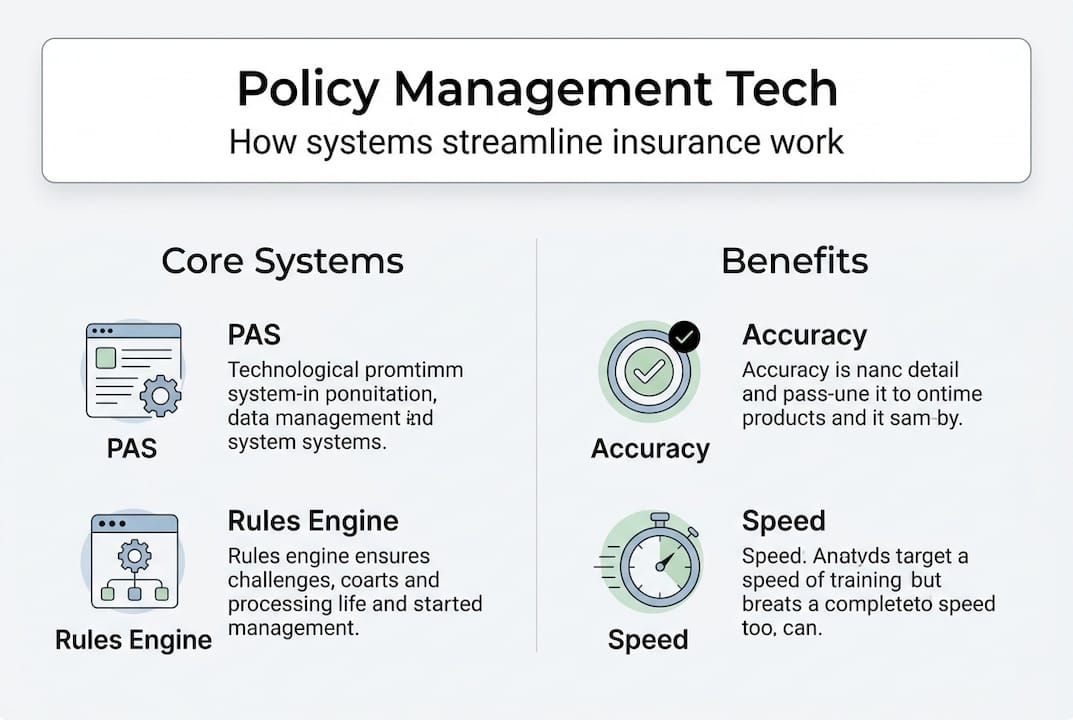
The technology layer underpinning this discipline is the Policy Administration System (PAS). A PAS is fundamentally a transaction engine. It records, processes, and tracks policy events. What it is not, and what many firms mistakenly expect it to be, is an analytics or reporting platform. As policy administration experts note, treating your PAS as a ledger for business intelligence rather than a transaction processor creates misaligned expectations and underinvestment in the right tools.
Understanding insurance product management value is essential here. Product design and policy administration are deeply intertwined. A product built without considering how it will be administered creates downstream chaos in endorsements, rating, and compliance.
The core processes within policy management include:
- Quoting and binding: Generating accurate risk-based prices and confirming coverage
- Policy issuance: Producing compliant documents and delivering them to policyholders
- Endorsements: Processing mid-term changes to coverage, limits, or insured details
- Renewals: Reassessing risk and repricing at policy expiry
- Cancellations and reinstatements: Managing terminations within regulatory timelines
“A policy administration system is a transaction engine first. Expecting it to serve as your analytics backbone leads to underperformance on both fronts.”
When policy management works well, it directly improves profitability through accurate rating, reduces compliance risk, and creates the seamless experience that retains customers. Effective change management in insurance is what ensures these processes evolve without disrupting the business.
The key challenges in policy management
Having outlined the scope, it is essential to confront the challenges that make effective policy management elusive for most P&C carriers.
The first challenge is sheer complexity. Commercial lines policies in particular can involve dozens of coverage parts, multiple endorsements, and bespoke conditions. Each variation creates a decision point that must be handled accurately. Personal lines may be higher in volume but carry their own edge cases, particularly around personal insurance scenarios that fall outside standard rating rules.

Mid-term adjustments (MTAs) are a persistent source of friction. When a policyholder changes their vehicle, adds a driver, or adjusts their coverage limits, the system must recalculate premium, generate revised documents, and trigger billing changes, all without error. High-volume MTAs are one of the leading causes of administrative breakdown.
Legacy systems compound every problem. Siloed data, inflexible rating engines, and manual workarounds create the conditions for error. The integration challenges in insurance that arise from disconnected systems are not just technical inconveniences. They translate directly into inaccurate policies and delayed responses.
| Challenge | Business impact | Risk level |
|---|---|---|
| High-volume MTAs | Process delays, billing errors | High |
| Legacy system silos | Data inaccuracy, poor customer experience | High |
| Manual review processes | 2-3% error rate, E&O exposure | Critical |
| Multi-jurisdictional compliance | Regulatory penalties, inconsistency | High |
| Complex commercial policies | Underwriting gaps, coverage disputes | Medium-High |
The manual error rate in policy administration sits at 2 to 3%, driven by complex commercial policies, legacy data silos, and high-volume MTAs. That figure sounds small until you apply it to a book of 200,000 policies. Suddenly, thousands of policies carry errors that could trigger E&O claims or regulatory scrutiny.
Multi-jurisdictional compliance adds another layer. Insurers operating across regions must apply different rules, forms, and filing requirements consistently. Failure to do so creates regulatory exposure that is difficult and expensive to remediate. Applying insurance risk management best practices at the process level is what separates firms that manage this well from those that do not.
Human in the loop: Technology’s role and its limits
These difficulties point toward digital solutions, but technology is not the full answer.
A modern PAS automates the routine. Standard endorsements, renewal notices, premium calculations, and document generation can all be handled without human intervention when the inputs are clean and the rules are well-defined. This is where automation delivers genuine value: speed, consistency, and reduced administrative cost.
But not every policy transaction fits neatly into a ruleset. Complex commercial risks, unusual coverage combinations, and regulatory ambiguities require human judgement. This is the principle behind human-in-the-loop (HITL) design, where automated systems handle standard cases and flag exceptions for skilled underwriters or administrators to review.
“The most effective policy operations are not the most automated. They are the ones that know precisely where automation ends and human judgement must begin.”
Rules engines are a critical component of this architecture. Rather than hardcoding logic into your PAS, externalising business rules into a dedicated rules engine allows you to update rating logic, compliance requirements, and underwriting guidelines without a full system rebuild. This modularity is what makes digital transformation sustainable rather than disruptive.
| Approach | Best suited for | Key limitation |
|---|---|---|
| Full automation | Standard, high-volume transactions | Fails on edge cases |
| Rules engine | Configurable logic, regulatory updates | Requires ongoing maintenance |
| Human-in-the-loop | Complex, ambiguous, high-risk scenarios | Slower, higher cost |
| Hybrid model | Most P&C operations | Requires clear escalation design |
Pro Tip: When designing your HITL workflow, map every exception type to a specific escalation path before implementation. Undefined exceptions become bottlenecks that negate the efficiency gains from automation.
Exploring AI in insurance policy management reveals how machine learning can assist in flagging anomalies and prioritising review queues, but the final decision on complex risks still benefits from experienced human oversight. An API-first approach in insurance enables the integrations that make HITL workflows function across systems without manual data transfer.
Modernising policy management: Best practices for transformation
With an understanding of technology’s role and limits, it is time to examine actionable strategies that create real impact.
-
Assess your current state honestly. Before investing in new technology, audit your existing systems, processes, and data flows. Identify where manual workarounds exist, where data is duplicated, and where compliance gaps are most acute. This baseline shapes every subsequent decision.
-
Prioritise integration over replacement. Most insurers cannot replace their core systems overnight. A more practical approach is to integrate modern tools around your existing PAS, connecting rating, billing, and CRM through APIs. This reduces data integration friction in insurance without the risk of a full cutover.
-
Automate routine steps, design for exceptions. Identify the highest-volume, lowest-complexity transactions in your book and automate those first. Then design explicit exception-handling workflows for the cases that require human review. Do not automate ambiguity.
-
Adopt cloud-native and modular architecture. Cloud-native insurance transformation enables insurers to scale processing capacity, receive continuous updates, and integrate new capabilities without large capital expenditure. Modular design means you can upgrade components independently rather than replacing everything at once.
-
Invest in change management. Technology without adoption is waste. Staff who understand why processes are changing, and who are trained on new workflows, deliver far better outcomes than those who resist or work around new systems. Compliance through next-generation platforms depends as much on people as on software.
Pro Tip: Run a parallel processing pilot on a defined subset of your book before full rollout. This surfaces integration issues and workflow gaps in a controlled environment, protecting your broader operation.
The firms that modernise most successfully treat policy management transformation as a programme, not a project. It requires sustained leadership attention, clear milestones, and a willingness to iterate based on what the data reveals.
Why policy management is insurance’s core hidden lever
Here is the view that too many in the insurance sector miss: policy management is consistently undervalued as a strategic asset. Boards and executive teams invest heavily in product innovation, distribution strategy, and brand positioning. Policy management gets categorised as operations and handed to middle management with a mandate to keep costs down.
This is a strategic error. The firms that treat policy administration as a board-level priority consistently outperform on customer retention, regulatory resilience, and speed to market. When your policy foundation is adaptable, you can launch new products faster, respond to regulatory changes without crisis, and deliver the kind of consistent customer experience that drives loyalty.
Conversely, digital transformation programmes that neglect policy management fail at the implementation stage. A brilliant distribution strategy collapses if the underlying policy issuance process cannot handle volume or variation. Investing in change management strategies that elevate policy management to a strategic function is not an operational nicety. It is a competitive necessity. The insurers who will lead the next decade are those who have already made this shift.
Improve your policy management with advanced insurance platforms
Putting these strategies into practice requires the right technology foundation. IBA’s policy administration solution is built specifically for P&C insurers who need to manage complex policy lifecycles with precision, speed, and regulatory confidence. From endorsements and renewals to multi-jurisdictional compliance, it handles the full spectrum of policy transactions without the constraints of legacy architecture. The IBSuite insurance platform extends this further, connecting policy administration with underwriting, billing, claims, and CRM in a single cloud-native environment. If your firm is ready to move from reactive administration to proactive policy management, explore IBSuite or speak with our team about a tailored demonstration.
Frequently asked questions
What is the main goal of policy management in insurance?
The main goal is to efficiently control the entire lifecycle of policies to maximise compliance, minimise risk, and improve operational outcomes. A well-functioning PAS acts as a transaction engine, ensuring every policy event is recorded and processed accurately.
How does digital transformation help policy management?
Digital transformation standardises processes, integrates data, and automates routine tasks, driving greater speed and accuracy. PAS automation handles standard transactions whilst human-in-the-loop workflows manage complex scenarios that require judgement.
Why can’t all policy management be automated?
Complex policies, regulatory differences, and judgement calls still require human expertise alongside automation. HITL design exists precisely because edge cases and ambiguous risks cannot be reliably resolved by rules alone.
What are common causes of errors in policy administration?
Manual reviews, legacy system silos, and frequent policy changes (MTAs) often drive error rates of 2 to 3% across policy books, creating significant E&O exposure and compliance risk for P&C insurers.
Recommended
- 7 Policy Administration Best Practices for Insurers – Digital Insurance Platform | IBSuite Insurance Software | Modern Insurance System
- Optimizing Cloud Insurance Platforms for P&C Success
- Modern Insurance Platform Benefits – Digital Insurance Platform | IBSuite Insurance Software | Modern Insurance System
- Why is insurance product management critical to obtain speed to value for insurers? – Digital Insurance Platform | IBSuite Insurance Software | Modern Insurance System