26.04.26
Streamline policy administration: practical steps for P&C insurers

Outdated policy administration processes are quietly costing P&C insurers far more than most executives realise. Fragmented workflows, manual data entry, and approval bottlenecks slow down underwriting cycles, frustrate customers, and introduce costly errors that erode margins. The good news is that digital transformation has matured significantly, and the tools available today make it genuinely practical to overhaul these processes without disrupting your entire operation. This article walks you through a structured, step-by-step approach to diagnosing inefficiencies, selecting the right technology, automating core workflows, and measuring lasting improvement.
Table of Contents
- Assessing your current policy administration processes
- Choosing and implementing digital solutions
- Automating and optimising key policy workflows
- Measuring results and maintaining continuous improvement
- A fresh perspective: re-thinking policy administration for future readiness
- Explore digital solutions to streamline your policy administration
- Frequently asked questions
Key Takeaways
| Point | Details |
|---|---|
| Evaluate workflows | Carefully assess your current policy administration to uncover inefficiencies and areas for improvement. |
| Adopt digital platforms | Choose and implement technology designed to automate and simplify policy administration tasks. |
| Automate tasks | Use automation and AI to optimise underwriting, renewals, and customer communication. |
| Monitor your metrics | Track key performance indicators and use analytics to drive continual process improvements. |
| Embrace adaptability | Foster a culture of ongoing innovation by regularly updating processes based on feedback and industry trends. |
Assessing your current policy administration processes
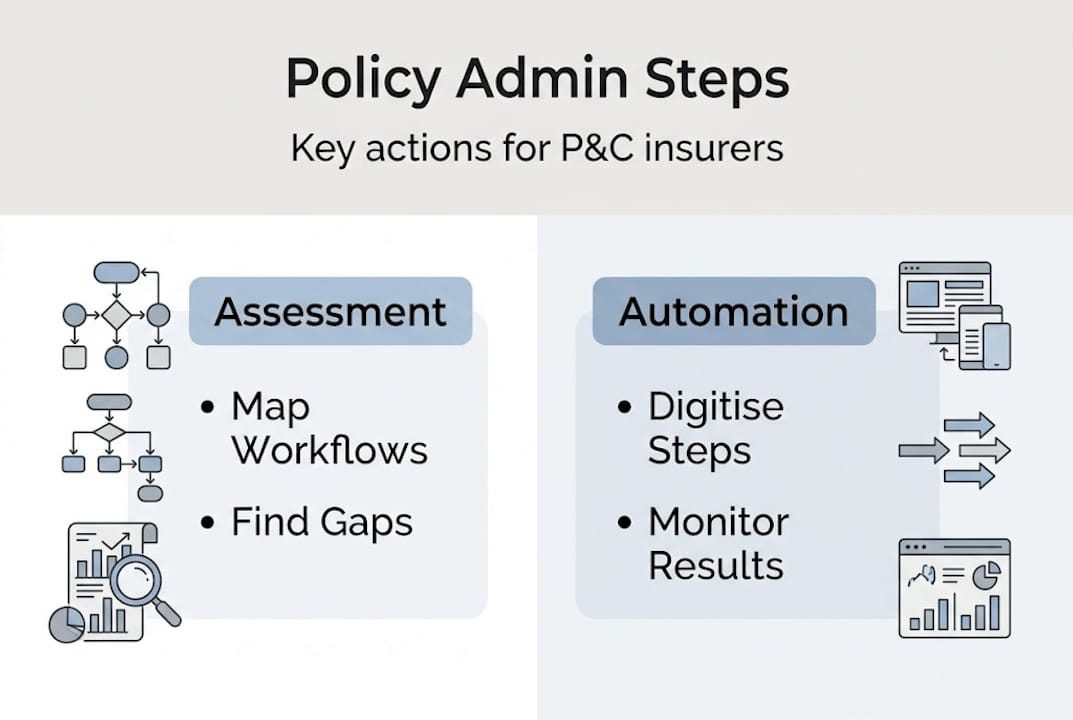
Before you can fix anything, you need to know exactly where the friction lives. Many insurers operate with inherited workflows that have never been formally mapped or challenged. Assumptions accumulate over years, and what started as a workaround becomes an entrenched process nobody questions. This diagnostic phase is where transformation actually begins.
Map your policy lifecycle end to end. Start at the quote stage and follow every step through to renewal. Document who touches each task, what systems are involved, how long each step takes, and where handoffs occur. This exercise alone tends to surface surprises. A workflow that feels routine to your operations team might involve six separate manual approvals that could be consolidated or eliminated entirely. Reviewing streamline policy management insights can help frame what an optimised lifecycle should look like before you begin your own mapping.
Key areas to scrutinise during this assessment include:
- Manual data re-entry between disconnected systems (for example, quoting tools that do not feed directly into policy issuance platforms)
- Repetitive document handling, such as manually attaching endorsements or generating renewal notices
- Approval queues that create delays when underwriters or managers are unavailable
- Error rates on policy documents, including incorrect coverage details, wrong premium calculations, or missing endorsements
- Customer complaint patterns that point to specific process failures, such as delayed certificates of insurance or inaccurate billing statements
Quantifying these issues matters enormously. Vague impressions that “renewals take too long” are hard to act on. Specific data, such as an average renewal cycle of 14 days with 30% requiring manual rework, gives you a benchmark to measure improvement against. Policy administration best practices consistently emphasise that workflow mapping and error quantification are foundational to any transformation effort.
To structure your findings, a simple readiness assessment table helps prioritise where to act first:
| Process area | Current cycle time | Error rate | Automation potential | Priority |
|---|---|---|---|---|
| Quote generation | 4 hours | 12% | High | Critical |
| Policy issuance | 2 days | 8% | High | Critical |
| Endorsement processing | 3 days | 15% | Medium | High |
| Renewal management | 14 days | 22% | High | Critical |
| Claims initiation | 1 day | 5% | Medium | Medium |
This kind of structured view makes it far easier to present the business case for investment to your board or CFO. It shifts the conversation from “we need new technology” to “here is exactly where we are losing time and money, and here is the projected return on fixing it.”
Choosing and implementing digital solutions
With your gap analysis complete, the next challenge is selecting the right platform. This is where many insurers make costly mistakes, either choosing a system that solves one problem while creating new integration headaches, or selecting an overly rigid platform that cannot adapt as your product lines evolve.
Essential features to evaluate in any policy administration platform include:
- Automated data entry and validation, which eliminates manual re-keying and catches errors at the point of input
- Built-in compliance checks that flag regulatory issues before a policy is issued rather than after
- Workflow orchestration, meaning the system can route tasks, trigger notifications, and manage approvals without human intervention
- Open API architecture, which allows the platform to connect cleanly with your existing rating engines, CRM, billing systems, and third-party data sources
- Configurable product setup, so your team can build and modify insurance products without waiting on custom development
When comparing platforms, look beyond the feature checklist. Automation and innovation in insurance demonstrate clearly that technology alone does not drive outcomes. Implementation quality, vendor support, and the platform’s ability to evolve with your needs are equally important factors.
Here is a practical comparison framework for evaluating platforms:
| Evaluation criterion | Legacy system | Mid-tier SaaS | Cloud-native platform |
|---|---|---|---|
| Time to launch new product | 6 to 12 months | 3 to 6 months | 4 to 8 weeks |
| API integration capability | Limited | Moderate | Extensive |
| Compliance update speed | Manual patches | Quarterly updates | Continuous (Evergreen) |
| Scalability | Constrained | Moderate | Elastic |
| Total cost of ownership | High | Medium | Lower long-term |
Once you have selected a platform, the implementation sequence matters enormously. A rushed rollout creates adoption problems that can take years to unwind. Follow this structured approach:
- Align stakeholders early. Involve underwriting, IT, compliance, and operations leads from the outset, not just at sign-off. Their input shapes the configuration and their buy-in drives adoption.
- Run a controlled pilot. Select one product line or one regional book of business to implement first. Measure results rigorously before expanding.
- Migrate data carefully. Map legacy data fields to the new system schema thoroughly, and validate output before switching off old systems.
- Train continuously, not just at launch. Build in refresher training and update sessions as the platform evolves.
You can also explore how to digitise insurance processes in a structured way to complement your implementation planning.
Pro Tip: Prioritise platforms with open, well-documented APIs from day one. Even if you do not need extensive integrations immediately, your future distribution channels, InsurTech partnerships, and data analytics initiatives will all depend on that connectivity being available.
Automating and optimising key policy workflows
With your platform selected and implemented, the focus shifts to what you can actually automate and how to do it intelligently. This is where the tangible efficiency gains accumulate.
Quote generation is typically the first and most impactful automation target. Connecting your rating engine directly to customer data inputs means quotes that once required underwriter intervention can be generated in seconds. This does not replace underwriter judgement for complex risks. It frees underwriters from routine work so they can focus on the accounts that genuinely require their expertise.

Policy issuance is another high-value automation point. Once a quote is accepted, the system should automatically generate policy documents, apply the correct endorsements, send confirmation to the policyholder, and update the billing system, all without a human touching it. The same logic applies to mid-term endorsements and cancellations.
Customer communication is an area many insurers underestimate. Automated, triggered messages at key policy milestones (renewal reminders, payment confirmations, policy change acknowledgements) significantly improve customer satisfaction scores while reducing inbound call volumes. It is a straightforward win that most insurers implement too late.
Integrating AI into these workflows adds another layer of value. AI models can identify anomalies in P&C insurance such as inconsistent coverage requests, unusual loss histories, or pricing outliers, flagging them for review rather than letting them pass through unchecked. This materially improves underwriting accuracy without slowing down straight-through processing for standard risks.
Statistic to note: Automation reduces administrative errors and average policy turnaround time by approximately 20%, translating directly into cost savings and improved customer retention.
For claims initiation, automation delivers particular value. When a new claim is lodged, automated triage can categorise severity, assign the appropriate claims handler, trigger the first-notice-of-loss communication, and initiate any required third-party data pulls. The impact of claims automation on customer satisfaction is well documented, with faster acknowledgement times directly correlating to higher net promoter scores.
Key automation priorities for P&C policy workflows include:
- Straight-through processing for low-complexity new business
- Automated renewal invitations with pre-populated data and premium indications
- Triggered endorsement workflows that route to underwriters only when rule thresholds are exceeded
- Real-time compliance validation at policy issuance
- Automated payment reconciliation between billing and policy systems
For a deeper set of practical recommendations, policy administration tips for P&C insurers offer specific guidance on sequencing these automation initiatives effectively.
Pro Tip: Do not wait until your entire platform is configured before measuring workflow performance. Set up analytics dashboards from week one. Early data helps you catch configuration problems quickly and demonstrates value to leadership while the broader rollout continues.
Measuring results and maintaining continuous improvement
Implementing technology and automating workflows is genuinely valuable, but only if you measure the outcomes and act on what you find. Many insurers invest in transformation and then fail to institutionalise the discipline of ongoing improvement. The result is a system that performs well at launch and gradually drifts as volumes grow and processes evolve.
Establish baseline metrics before you go live. You cannot measure improvement if you do not know where you started. The core metrics every P&C insurer should track in policy administration include:
- Policy cycle time, measured from quote request to policy issuance, broken down by product line and complexity tier
- Customer satisfaction scores, specifically at key touchpoints such as new business issuance, renewal, and endorsement processing
- Error frequency, tracking how often policies require correction after issuance and what types of errors recur most often
- Straight-through processing rate, the percentage of policies that complete without any manual intervention
- Renewal retention rate, since efficient renewal processing directly influences whether customers stay or shop elsewhere
Once you are live, use dashboards to monitor these metrics continuously rather than relying on periodic reports. Real-time visibility means you catch a spike in error rates or a slowdown in cycle time immediately, rather than discovering it in a quarterly review three months after the problem started.
“Modernised policy administration systems foster agile, scalable operations that allow insurers to respond to market changes with speed and precision, rather than being constrained by the weight of legacy processes.”
Build a formal review cadence into your operating model. A monthly review of workflow analytics with your operations leads, combined with a quarterly strategic review that includes underwriting and product management, creates the feedback loops needed for genuine continuous improvement. Sharing wins across teams is equally important. When an automation initiative cuts endorsement turnaround from three days to four hours, make sure the broader organisation knows about it. It builds momentum and encourages other teams to identify their own improvement opportunities.
Specialised systems that support insurance operations consistently highlight the correlation between measurement culture and long-term operational performance. Insurers who track, share, and act on operational data outperform those who treat measurement as a compliance exercise.
For customer-facing processes, incorporate feedback loops directly into the policy lifecycle. A brief satisfaction survey sent after policy issuance or renewal provides qualitative insight that pure process metrics cannot capture. Combined with CRM optimisation steps, this data helps you understand not just whether your processes are fast, but whether they are actually serving your customers well.
A fresh perspective: re-thinking policy administration for future readiness
Here is an uncomfortable truth many insurers avoid: automating a broken process just helps you fail faster. The step-by-step framework above is genuinely valuable, but the insurers who sustain long-term advantage treat it as a starting point, not a destination.
The conventional view of digital transformation focuses on replacing legacy systems with modern equivalents. That misses the point. The real opportunity is to redesign your operating model around agility rather than around any specific technology. A cloud-native platform is only as valuable as the culture and processes built on top of it.
Digital transformation in insurance that delivers lasting competitive advantage shares one consistent characteristic: it is driven by continuous feedback from both frontline staff and customers, not by technology roadmaps alone. Your claims handlers know where the process breaks down. Your underwriters know which automation rules are producing wrong answers. Your customers know when the renewal experience feels impersonal or confusing. If those voices are not systematically feeding your improvement cycle, you are operating blind.
Agility also means building processes that can absorb new product lines, new distribution channels, and regulatory changes without requiring a full implementation programme each time. This is why platform architecture matters as much as platform features.
Pro Tip: Schedule quarterly listening sessions with frontline operations staff specifically focused on identifying process friction. Their insights consistently surface improvements that neither your data nor your technology vendor will reveal.
Explore digital solutions to streamline your policy administration
For P&C insurers ready to move from diagnosis to action, the right platform makes all the difference. IBSuite from IBA is built specifically to address the policy administration challenges outlined in this article, from automating quote-to-issuance workflows to delivering real-time compliance checks and seamless system integrations. Our policy administration software gives your operations team the tools to eliminate manual bottlenecks and process policies faster without increasing headcount. Pair it with our claims management platform for end-to-end operational efficiency across the full insurance lifecycle. If you would like to see how IBSuite works in practice, book a demo with our team today.
Frequently asked questions
What are the key steps to streamline policy administration?
The core steps are assessing current workflows, selecting a digital platform, automating key processes, and measuring outcomes continuously. Policy administration best practices confirm that skipping the diagnostic phase is the most common cause of failed transformation projects.
How does automation improve accuracy in policy administration?
Automation eliminates manual data entry errors and enforces consistent rule application, which directly reduces policy defects and speeds up cycle times. P&C insurance automation analysis shows that higher accuracy at issuance translates to fewer mid-term corrections and stronger customer retention.
What metrics should insurers use to measure policy administration improvement?
Track policy cycle time, straight-through processing rate, customer satisfaction scores, and error frequency as your primary indicators. Efficient P&C operations depend on measuring these consistently rather than relying on anecdotal feedback from operations teams.
What features should I look for in a policy administration platform?
Prioritise automated workflows, open API connectivity, built-in compliance checks, configurable product setup, and intuitive dashboards. Insurance automation capabilities show that API flexibility is particularly critical for future scalability as distribution models evolve.
How often should insurers review and optimise their policy processes?
Monthly operational reviews combined with quarterly strategic assessments provide the right cadence for most P&C insurers. Markets shift, products evolve, and customer expectations rise continuously, so a quarterly optimisation review ensures your processes stay genuinely competitive rather than just functional.
Recommended
- 7 Policy Administration Best Practices for Insurers – Digital Insurance Platform | IBSuite Insurance Software | Modern Insurance System
- 7 Essential Policy Administration Tips for P&C Insurers
- Streamline policy management for insurance success
- Why policy administration is critical for efficient P&C ops