26.03.26
Insurance CRM optimisation steps to boost efficiency

Property and casualty insurers often struggle with CRM systems that fail to deliver the operational efficiency or customer engagement promised. Many implementations become underutilised due to poor data quality, fragmented policy information, or inadequate user adoption. Optimising your CRM requires a structured approach addressing data governance, phased rollout, automation, and continuous improvement. This guide provides proven steps tailored for insurance executives and IT decision-makers seeking measurable gains in efficiency and retention through strategic CRM enhancement.
Table of Contents
- Key takeaways
- Understanding the CRM optimisation challenge for insurance
- Preparing your insurance CRM for optimisation success
- Executing insurance CRM optimisation steps effectively
- Verifying results and continuous improvement in CRM optimisation
- Improve your insurance CRM with IBSuite policy administration
- FAQ
Key Takeaways
| Point | Details |
|---|---|
| Clean data foundation | Establish clear data ownership and quality standards and unify customer and policy information before adding advanced features. |
| Phased rollout adoption | Implement in staged phases with change management and training to secure lasting user adoption across teams. |
| Governance and alignment | Set robust data governance and align stakeholders on realistic timelines and measurable objectives. |
| Measurable efficiency targets | Benchmark twenty to thirty percent operational efficiency gains for property and casualty insurers through careful implementation and ongoing optimisation. |
Understanding the CRM optimisation challenge for insurance
Many P&C insurers invest heavily in CRM platforms only to see disappointing returns. The root cause often lies not in the technology itself but in foundational issues that undermine system effectiveness. CRM success depends on clean, unified data before adding sophisticated features. Without this groundwork, even the most advanced capabilities become unusable.
Fragmented customer and policy information creates immediate operational friction. When underwriters cannot access complete risk profiles or agents lack visibility into renewal histories, decision-making slows and errors multiply. This fragmentation stems from legacy systems that store data in silos, making it nearly impossible to construct a single customer view. The resulting inefficiency cascades through every touchpoint, from quote generation to claims processing.
User resistance presents another critical barrier. Many CRM initiatives fail because staff find systems overly complex or disconnected from daily workflows. Without adequate training and change management, employees revert to familiar spreadsheets and manual processes. This abandonment wastes implementation investment and perpetuates inefficiency. Clear governance structures and user-centred design become indispensable for driving adoption.
Overly ambitious implementations compound these challenges. Organisations sometimes deploy extensive feature sets before establishing data quality or process readiness. The complexity overwhelms users and IT teams alike, leading to partial adoption or complete abandonment. Successful optimisation requires addressing foundational elements first:
- Establish robust data governance policies covering accuracy, consistency, and accessibility
- Unify customer and policy information across all touchpoints and systems
- Align stakeholder expectations on realistic timelines and measurable objectives
- Design workflows that match actual user needs rather than theoretical best practices
- Plan for continuous training and support to sustain adoption over time
Recognising these challenges early allows insurers to build realistic optimisation roadmaps. The insurance CRM workflow guide offers practical frameworks for addressing common pitfalls. By understanding where implementations typically falter, you can structure your approach to avoid repeating industry-wide mistakes and achieve sustainable improvements.
Preparing your insurance CRM for optimisation success
Effective preparation determines whether your CRM optimisation delivers lasting value or becomes another failed initiative. Before implementing new features or workflows, establish the governance and alignment necessary for sustainable change. Data governance serves as the foundation for all subsequent improvements, ensuring accuracy and consistency across customer and policy records.
Begin by defining clear data ownership and quality standards. Assign specific teams responsibility for maintaining customer information, policy details, and claims histories. Document acceptable formats, validation rules, and update protocols. This governance framework prevents the data degradation that undermines CRM effectiveness. Without it, new features simply process unreliable information faster.
Stakeholder engagement early in the process builds alignment and reduces resistance. Involve underwriters, agents, claims handlers, and IT teams in defining optimisation goals. Their frontline experience reveals workflow pain points that executives might overlook. This collaborative approach ensures the CRM serves actual user needs rather than abstract efficiency targets. It also creates advocates who champion adoption across the organisation.
Assessing your current technology landscape identifies integration requirements and capability gaps. Map existing systems, data flows, and integration points. Determine which legacy platforms must connect with the CRM and what data synchronisation requirements exist. This technical inventory prevents surprises during implementation and helps you set realistic timelines. Understanding your starting point allows you to measure progress accurately.

Setting measurable objectives transforms vague efficiency goals into trackable outcomes. Define specific targets such as reducing quote generation time by 30%, increasing renewal rates by 15%, or achieving 95% user adoption within six months. These concrete metrics provide accountability and help you demonstrate ROI. They also guide prioritisation when competing demands emerge during implementation.
Pro Tip: Create a change management plan before technical work begins. Identify potential resistance points, plan communication strategies, and allocate training resources. Successful CRM optimisation depends as much on people as technology.
Preparation activities that support successful optimisation include:
- Conducting data quality audits to establish baseline accuracy and completeness
- Documenting current workflows to identify inefficiencies and automation opportunities
- Securing executive sponsorship to ensure adequate resources and organisational priority
- Establishing success metrics aligned with business objectives rather than technical specifications
- Building cross-functional teams that represent all user groups and technical stakeholders
This groundwork may seem time-consuming, but it prevents costly rework and abandoned implementations. The insurance operations optimisation tips resource offers additional guidance on building readiness. By investing in preparation, you create conditions where optimisation efforts can succeed and deliver measurable business value.
Executing insurance CRM optimisation steps effectively
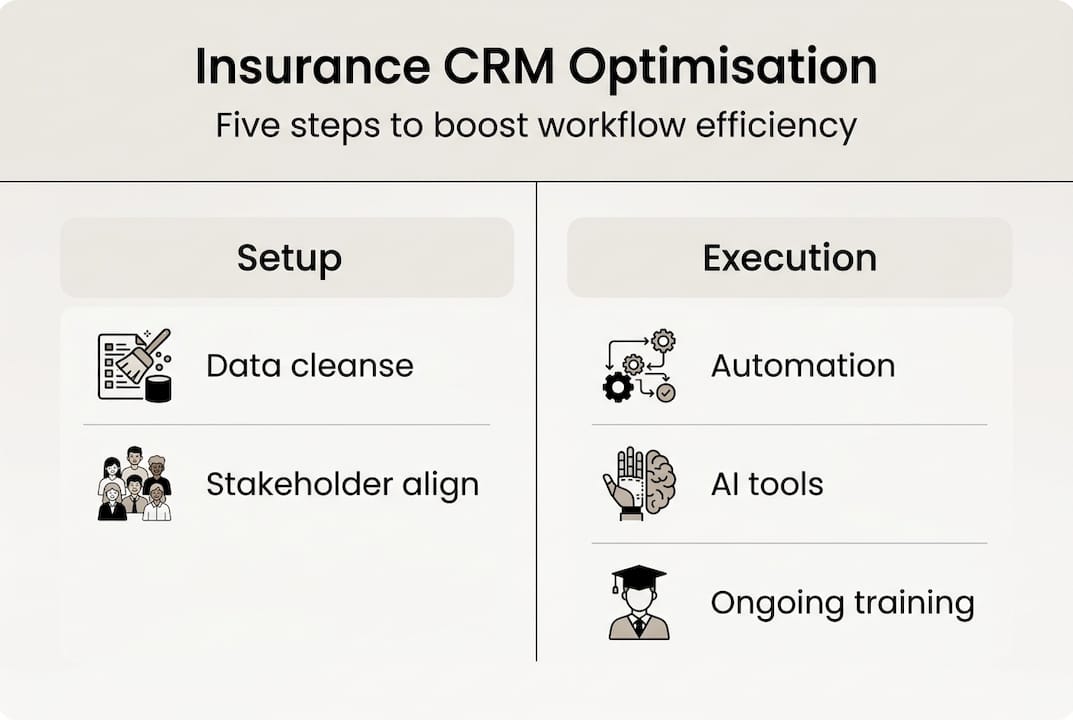
Once preparation establishes a solid foundation, execution translates strategy into operational reality. A structured, phased approach minimises disruption whilst building user confidence and demonstrating early wins. The following steps provide a proven sequence for optimising insurance CRM systems.
Step one focuses on data cleansing and unification. Deploy tools that identify duplicates, standardise formats, and merge fragmented customer records. This creates the single customer view essential for effective CRM operation. Automated data quality processes catch errors at entry points, preventing future degradation. Clean data enables all subsequent optimisation efforts, from automation to AI implementation.
Step two implements a phased rollout strategy beginning with pilot teams. Select a manageable user group, such as a single underwriting team or regional sales office. Phased rollout with strong change management achieves complete adoption by allowing you to refine processes before organisation-wide deployment. This approach identifies workflow issues early when they affect fewer users and are easier to resolve.
Step three automates renewal workflows to improve policy retention. Configure the CRM to trigger renewal reminders based on policy expiration dates, customer risk profiles, and historical retention patterns. Automated workflows ensure consistent customer contact whilst freeing agents to focus on complex cases. For P&C insurers, renewal optimisation directly impacts revenue stability and customer lifetime value. The insurance CRM workflow guide provides detailed renewal automation frameworks.
Step four integrates AI-based capabilities for fraud detection and risk scoring. AI and automation reduce fraud by 25-40% when properly implemented and validated. Machine learning models identify edge cases that manual review might miss, such as unusual claim patterns or inconsistent policy applications. However, bias validation remains critical to ensure fair treatment and regulatory compliance. Establish review processes where human underwriters verify AI recommendations before final decisions.
Step five establishes continuous training programmes that evolve with system capabilities. Initial training gets users started, but ongoing education ensures they leverage new features and maintain best practices. Create feedback loops where users report issues and suggest improvements. This input guides iterative refinement and demonstrates that leadership values user experience. Regular training sessions also reinforce adoption and prevent regression to manual processes.
Pro Tip: Document every workflow change and create quick reference guides. Users adopt new processes faster when they have accessible, practical resources rather than lengthy manuals.
| Optimisation step | Primary benefit | Implementation timeframe |
|---|---|---|
| Data cleansing and unification | Single customer view | 2-3 months |
| Phased rollout with pilot teams | Risk mitigation and refinement | 3-6 months |
| Renewal workflow automation | Increased retention rates | 1-2 months |
| AI fraud detection integration | Reduced fraud losses | 3-4 months |
| Continuous training programme | Sustained user adoption | Ongoing |
These execution steps build upon one another, creating cumulative value. Early data quality work enables effective automation. Pilot programmes inform full deployment. AI capabilities deliver returns because underlying data and processes support them. The automation and AI in P&C insurance resource explores advanced implementation strategies. By following this sequence, you avoid common pitfalls and maximise the probability of achieving your optimisation objectives.
Verifying results and continuous improvement in CRM optimisation
Measuring optimisation outcomes separates genuine improvement from activity that consumes resources without delivering value. Establish clear metrics before implementation begins, then track them consistently to verify results. This data-driven approach demonstrates ROI and identifies areas requiring further refinement.
User adoption rates provide the most fundamental success indicator. If staff avoid the CRM or use only basic features, optimisation efforts fail regardless of technical sophistication. Monitor login frequency, feature utilisation, and workflow completion rates. Target 95% adoption within six months of full deployment. Low adoption signals training gaps, workflow misalignment, or usability issues requiring immediate attention.
Operational efficiency metrics reveal whether optimisation translates into tangible business benefits. P&C insurers can benchmark 20-30% improvements in processing times, quote generation speed, and administrative overhead. Compare pre-optimisation and post-optimisation performance across key workflows. Document time savings, error reduction, and resource reallocation. These concrete outcomes justify investment and build support for ongoing enhancement.
Renewal rates and customer retention directly reflect CRM effectiveness in managing policyholder relationships. Track renewal percentages by product line, customer segment, and agent. Improved CRM workflows should increase retention by enabling timely, personalised outreach. If renewal rates remain static or decline, investigate whether automated workflows reach customers at optimal times or whether messaging requires refinement.
Fraud detection accuracy and claims processing efficiency demonstrate AI integration success. Measure false positive rates, fraud identification percentages, and claims cycle times. Effective AI implementation should reduce fraud losses whilst maintaining or improving customer experience. High false positive rates indicate model tuning requirements or insufficient training data.
| Metric category | Key indicators | Target improvement |
|---|---|---|
| User adoption | Login frequency, feature utilisation | 95% within 6 months |
| Operational efficiency | Processing times, quote generation speed | 20-30% reduction |
| Customer retention | Renewal rates by segment | 10-15% increase |
| Fraud detection | Fraud identification, false positive rate | 25-40% fraud reduction |
Continuous improvement processes ensure optimisation gains persist and expand over time. Schedule quarterly reviews where cross-functional teams analyse performance data, user feedback, and emerging business needs. These sessions identify opportunities for incremental enhancement and prevent complacency. Technology and market conditions evolve constantly, requiring corresponding CRM adjustments.
Feedback loops connecting frontline users to IT and management accelerate improvement cycles. Create channels where agents, underwriters, and claims handlers report issues and suggest workflow refinements. Respond to this input with visible changes, demonstrating that leadership values user experience. This responsiveness builds trust and encourages ongoing engagement. The insurance operations optimisation tips resource offers frameworks for sustaining improvement momentum.
Regular technology assessments keep your CRM aligned with industry advances. New capabilities in AI, automation, and integration emerge continuously. Evaluate whether these innovations address current pain points or enable new business models. Maintain an optimisation roadmap that balances quick wins with strategic enhancements. This forward-looking approach prevents your CRM from becoming outdated and ensures ongoing competitive advantage.
Key verification and improvement practices include:
- Establishing baseline metrics before optimisation begins to enable accurate comparison
- Creating executive dashboards that visualise performance trends and highlight issues
- Conducting user satisfaction surveys to identify friction points not visible in quantitative data
- Benchmarking against industry standards to contextualise your results
- Allocating dedicated resources for ongoing enhancement rather than treating optimisation as a one-time project
By combining rigorous measurement with structured improvement processes, you transform CRM optimisation from a project into a sustainable capability. This discipline ensures your investment continues delivering value as business requirements and technology capabilities evolve.
Improve your insurance CRM with IBSuite policy administration
Successful CRM optimisation requires technology that supports data unification, workflow automation, and seamless integration across your insurance value chain. IBSuite policy administration provides a cloud-native platform designed specifically for P&C insurers seeking to enhance operational efficiency and customer engagement. Its API-first architecture enables the data flows and process automation essential for effective CRM operation.
IBSuite supports the complete insurance lifecycle, from sales and underwriting through claims and billing, with built-in CRM capabilities that eliminate data silos. This unified approach ensures customer information remains consistent across all touchpoints, addressing the fragmentation that undermines many CRM initiatives. Evergreen updates keep your platform current without disruptive upgrade projects, allowing you to focus on business value rather than technical maintenance.
Explore how IBSuite can support your CRM optimisation goals by scheduling a conversation with our team. Book a demo to see how modern policy administration infrastructure enables the efficiency and engagement improvements outlined in this guide.
FAQ
What is the first step in insurance CRM optimisation?
The first step involves establishing robust data governance to ensure unified and clean customer and policy data across all systems. Without this foundation, subsequent CRM improvements lack the reliable information necessary to deliver value. Data governance policies define ownership, quality standards, and validation rules that prevent the fragmentation undermining many implementations.
How can AI enhance insurance CRM systems?
AI automates edge cases such as fraud detection and risk scoring, reducing fraud losses by up to 40% when properly implemented. Machine learning models identify patterns that manual review might miss, improving accuracy whilst reducing processing time. However, validation against bias remains crucial to ensure fair treatment and maintain regulatory compliance.
Why is phased rollout important in CRM optimisation?
Phased rollout allows focused change management that ensures complete user adoption by addressing issues when they affect smaller groups. This approach minimises disruption to daily operations whilst building user confidence gradually. It also enables refinement based on real-world feedback before organisation-wide deployment, significantly improving success rates.
What operational gains can insurers expect from CRM optimisation?
Insurers typically achieve 20-30% improvements in operational efficiency following comprehensive CRM optimisation, including reduced processing times and lower administrative overhead. Results vary based on implementation scope, existing system maturity, and organisational change management effectiveness. Measuring baseline performance before optimisation enables accurate assessment of gains and ROI demonstration.
Recommended
- Insurance CRM workflow guide for P&C firms: cut costs 65%
- 7 Essential Insurance Billing Optimisation Tips for Managers
- How to Optimise Underwriting Workflows for Efficiency
- CRM – Digital Insurance Platform | IBSuite Insurance Software | Modern Insurance System
- Simetrix Consult – Microsoft 365 and Dynamics 365/CRM consulting services