16.04.26
Solving insurance compliance challenges: 5 proven strategies

TL;DR:
- Regulatory demands in insurance are accelerating, requiring continuous, integrated compliance processes.
- Modern technology such as RegTech and AI governance tools enable real-time monitoring and scalable compliance management.
- Embedding compliance into organizational culture and risk management transforms it into a strategic operational advantage.
Regulatory expectations for property and casualty insurers are accelerating faster than most compliance functions can absorb. NAIC’s 2026 priorities are reshaping capital frameworks, AI governance, and climate resilience obligations simultaneously, leaving executives and compliance officers caught between legacy processes and mounting regulatory demands. Compliance is no longer a back-office function. It is a direct expression of your organisation’s operational integrity, and the insurers who treat it as such are pulling ahead. This guide breaks down the key compliance challenges facing P&C insurers today, explores the technology solutions transforming the function, and offers practical strategies you can act on immediately.
Table of Contents
- The evolving compliance landscape in insurance
- Core compliance challenges: From multi-state complexity to cyber risk
- Modernising compliance: RegTech, AI, and automation
- Best practices for stronger compliance and operational integrity
- Why compliance must become a strategic advantage—not a burden
- How IBSuite empowers your compliance transformation
- Frequently asked questions
Key Takeaways
| Point | Details |
|---|---|
| Compliance landscape evolves rapidly | Regulatory demands around AI, cyber, and climate are reshaping insurance compliance. |
| Technology can streamline compliance | AI and RegTech give insurers real-time oversight and automated reporting. |
| Multi-state complexity is a core challenge | Effective compliance requires tools that address varying state regulations and integration issues. |
| Strategic compliance drives advantage | Treating compliance as an innovation driver enhances resilience and competitiveness. |
The evolving compliance landscape in insurance
The pace of regulatory change in 2026 is not just fast. It is structurally different from anything insurers have navigated before. Regulators are no longer simply adjusting rates or tweaking disclosure requirements. They are rewriting the rules around how risk is assessed, how data is used, and how organisations govern their own systems.
NAIC’s 2026 strategic priorities include strengthened capital frameworks, AI model governance standards, and climate resilience mandates. Each of these represents a distinct compliance domain requiring specialised expertise, dedicated technology, and cross-functional coordination. No single team can absorb all of it through manual processes alone.
The compliance landscape now spans several interconnected risk areas:
- AI governance: Regulators are scrutinising how algorithms influence underwriting decisions, pricing, and claims outcomes.
- Cyber risk: Insurers must demonstrate robust controls not just for their own systems, but across their entire vendor ecosystem.
- Climate resilience: Exposure modelling and capital adequacy requirements are being recalibrated in response to worsening catastrophe losses.
- Consumer protection: Data privacy, fair treatment, and transparent pricing are under increasing regulatory scrutiny.
The uncomfortable truth is that process-oriented compliance, built around annual audits and periodic reviews, is becoming obsolete. Regulators expect continuous visibility, not snapshots. The insurers leading on compliance innovation in insurance have already moved from reactive checklists to proactive, integrated frameworks that embed compliance into daily operations.
“Compliance is not a destination. It is a continuous operating discipline that must be woven into every product, process, and system decision an insurer makes.”
The shift requires more than technology. It demands a change in how compliance is resourced, governed, and measured across the organisation. Executives who treat compliance as a cost centre will find themselves perpetually behind. Those who treat it as a core capability will find it becomes a genuine source of competitive strength.
Core compliance challenges: From multi-state complexity to cyber risk
Understanding the landscape is one thing. Confronting the specific pain points that compliance officers face every day is another matter entirely.
The most persistent challenge for P&C insurers operating across multiple states is the sheer fragmentation of regulatory requirements. NAIC model laws provide a framework, but each state adopts, modifies, and interprets them differently. Multi-state NAIC adoption creates compliance complexity that compounds with every new product launch or market entry. A policy form approved in one state may require material changes in another, and tracking those variations manually is both error-prone and resource-intensive.

| Compliance challenge | Primary risk | Typical impact |
|---|---|---|
| Multi-state regulatory variation | Product non-compliance | Fines, market withdrawal |
| Vendor and third-party risk | Data breach, liability | Regulatory censure |
| AI fairness in underwriting | Discriminatory outcomes | Enforcement action |
| Cyber incident response | Operational disruption | Reputational damage |
Beyond multi-state complexity, the rise of cyber and hybrid risks is creating entirely new compliance obligations. Insurers must now maintain insurance platform cybersecurity standards that satisfy both internal governance requirements and external regulatory mandates. Data privacy obligations under state-level frameworks add another layer of complexity, particularly for insurers handling sensitive health or financial data.
Here are the four most pressing compliance challenges compliance officers are managing right now:
- Translating NAIC model rules into state-specific controls without creating gaps or inconsistencies.
- Managing vendor risk across a growing ecosystem of third-party technology and data providers.
- Governing AI models used in underwriting and claims to ensure fairness and explainability.
- Responding in real time to cyber incidents in ways that satisfy both regulators and policyholders.
Pro Tip: Build a compliance matrix that maps each NAIC model rule to its adopted form in every state where you operate. Pair this with integration for state-level compliance to automate tracking and flag divergences before they become violations.
Some insurers are also addressing the talent dimension by investing in regional recruitment for compliance, recognising that local regulatory expertise is difficult to replicate from a centralised team.
Modernising compliance: RegTech, AI, and automation
The good news is that the same technology disrupting compliance is also providing the tools to manage it more effectively. RegTech, the application of technology to regulatory compliance, has matured significantly and is now a practical option for insurers of all sizes.
The P&C core platform market is projected to triple by 2034, driven in large part by demand for compliance functionality including AI governance tools and cloud-based regulatory reporting. This is not speculative growth. It reflects the urgent need insurers have to replace brittle, manual compliance processes with scalable, automated alternatives.
RegTech enables real-time monitoring and AI-driven alerts that flag potential compliance breaches before they escalate. Rather than discovering a problem during an audit, compliance officers receive continuous signals from their systems, allowing for faster remediation and better documentation.
Key capabilities that modern compliance technology delivers:
- Automated regulatory reporting: Structured data outputs that map directly to state filing requirements, reducing manual preparation time.
- Continuous monitoring dashboards: Real-time visibility into compliance status across products, geographies, and risk categories.
- Model governance frameworks: Audit trails for AI models used in underwriting, including version control and bias testing results.
- Cloud-based scalability: The ability to onboard new regulatory requirements without rebuilding core systems.
| Technology capability | Compliance benefit | Maturity level |
|---|---|---|
| Automated filing | Reduced manual error | High |
| Real-time monitoring | Faster breach detection | Growing |
| AI model governance | Fairness and explainability | Emerging |
| Cloud integration | Scalable compliance infrastructure | High |
For insurers exploring AI in insurance compliance, the priority should be model governance. Regulators are increasingly asking insurers to demonstrate not just what their models do, but why they make the decisions they make. Building explainability into AI systems from the outset is far easier than retrofitting it later.
Pro Tip: When evaluating cloud compliance strategies, prioritise platforms that offer Evergreen updates. Regulatory requirements change constantly, and a platform that updates automatically ensures your compliance posture keeps pace without costly IT projects. Pairing this with automation in regulatory reporting can dramatically reduce the burden on your compliance team.
Best practices for stronger compliance and operational integrity
Technology is a powerful enabler, but compliance requires robust practices and ongoing vigilance. Here is how to build resilience into every layer of your organisation.
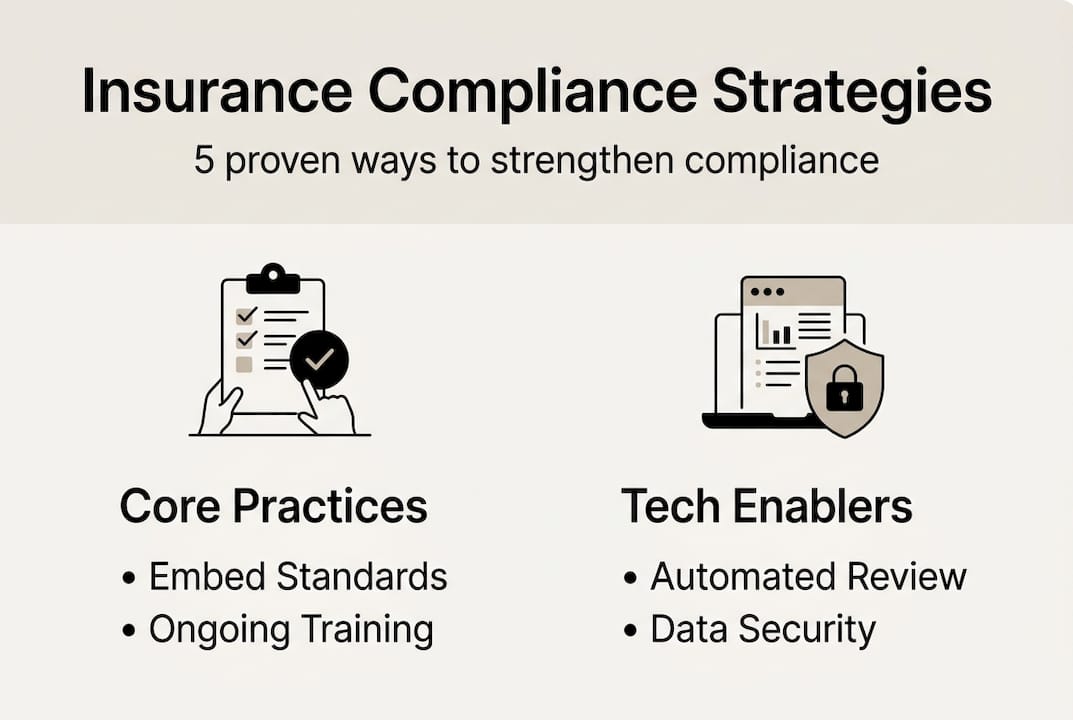
The most resilient compliance programmes share one characteristic: compliance is embedded in the business, not bolted on. This means compliance considerations are part of product design, underwriting guidelines, vendor selection, and technology procurement from the very beginning.
Integrating ERM with compliance management is essential for meeting ORSA (Own Risk and Solvency Assessment) obligations. When enterprise risk management and compliance functions operate in silos, gaps inevitably appear. Aligning them creates a unified view of risk that satisfies regulators and strengthens internal decision-making.
Here are five steps to build a more resilient compliance function:
- Embed compliance in culture: Make compliance accountability part of every role, not just the compliance team’s remit.
- Align ERM and compliance: Ensure risk assessments feed directly into compliance controls and vice versa.
- Strengthen vendor oversight: Apply the same rigour to third-party compliance as you do to internal controls.
- Invest in incident response: Build and regularly test a response plan that satisfies both regulatory notification requirements and operational recovery needs.
- Treat audits as learning opportunities: Post-audit reviews should drive process improvements, not just remediation of findings.
On the technology side, insurance data security measures and cybersecurity practices for insurers are foundational. Regulators increasingly expect insurers to demonstrate not just that they have controls in place, but that those controls are tested, documented, and continuously improved.
Pro Tip: Schedule quarterly compliance reviews rather than relying solely on annual audits. Regulatory requirements shift throughout the year, and quarterly reviews allow you to course-correct before small gaps become significant exposures.
Building a compliance culture also means investing in training that goes beyond annual tick-box exercises. When underwriters, claims handlers, and product managers understand why compliance matters, they make better decisions every day.
Why compliance must become a strategic advantage—not a burden
Here is a perspective that most compliance consultants will not tell you: the insurers who treat compliance as a minimum threshold to clear are systematically underinvesting in one of their most powerful competitive assets.
We have observed, across years of working with P&C insurers, that the organisations with the most robust compliance frameworks are also the ones that launch products faster, enter new markets more confidently, and recover from incidents more quickly. That is not a coincidence. Strong compliance infrastructure is, at its core, strong operational infrastructure.
The mindset shift required is from compliance as a checklist to modern compliance transformation as a strategic discipline. When compliance is genuinely integrated, it accelerates decision-making rather than slowing it down. Underwriters know what they can and cannot do. Product teams know which markets are viable. Executives have the visibility to act decisively.
The insurers who will lead in 2026 and beyond are not the ones who comply. They are the ones who build compliance into their identity.
How IBSuite empowers your compliance transformation
If the strategies in this article resonate, IBSuite provides the technology foundation to put them into practice. IBSuite’s policy administration platform is built for the compliance demands of modern P&C insurance, offering real-time monitoring, automated regulatory reporting, and Evergreen updates that keep your systems aligned with evolving requirements. From AI model governance to multi-state product management, IBSuite reduces the manual burden on your compliance team and closes the gaps that legacy systems leave open. Advanced automation minimises the risk of human error across underwriting, billing, and claims workflows. To see how IBSuite can strengthen your compliance posture and operational integrity, book a demo with our team today.
Frequently asked questions
What are the biggest compliance risks insurers face in 2026?
NAIC 2026 priorities highlight AI governance, cyber risk, and climate resilience as the dominant compliance challenges, alongside the persistent complexity of multi-state regulatory variation.
How does technology help insurers meet compliance obligations?
RegTech enables real-time monitoring and automated alerting, allowing compliance officers to identify and address potential breaches before they escalate into regulatory violations.
What is the role of enterprise risk management in compliance?
Integrating ERM with compliance ensures that risk assessments and compliance controls are aligned, which is a core requirement for meeting ORSA obligations under NAIC guidelines.
How can insurers handle multi-state regulatory differences?
Multi-state NAIC adoption creates genuine complexity, but centralised compliance management platforms, combined with robust data integration, allow insurers to track state-level variations and respond to changes systematically.
Recommended
- The Top 5 Challenges Facing the Insurance Industry Today – Digital Insurance Platform | IBSuite Insurance Software | Modern Insurance System
- Embracing Compliance through Next-Generation Insurance Platforms – Digital Insurance Platform | IBSuite Insurance Software | Modern Insurance System
- Cloud Security and Compliance for Insurers: Navigating 2025 Risks – Digital Insurance Platform | IBSuite Insurance Software | Modern Insurance System
- Understanding Insurance Compliance Automation Explained – Digital Insurance Platform | IBSuite Insurance Software | Modern Insurance System