10.03.26
Boost cybersecurity in cloud-native insurance platforms

Cyberattacks targeting insurance platforms surged by 64% in Central Europe during 2025, with ransomware incidents affecting one in four P&C insurers. Cloud-native systems offer transformative agility but introduce complex security challenges that demand rigorous controls. This guide explores how insurance executives can strengthen cybersecurity posture whilst navigating stringent regulatory requirements and evolving threat landscapes in 2026.
Table of Contents
- Introduction To Cybersecurity In Cloud-Native Insurance Platforms
- Regulatory Compliance Impact On Insurance Cybersecurity In Central Europe
- Understanding The Cyber Threat Landscape For Cloud Insurance Systems
- Common Misconceptions About Cybersecurity In Insurance Platforms
- Frameworks And Technical Strategies For Cyber Risk Management
- Operationalising Cybersecurity In Cloud-Native Platforms
- Case Studies And Lessons Learned From European P&C Insurers
- Conclusion: Enhancing Resilience And Compliance For Future-Ready Insurance Platforms
- Explore Secure Digital Insurance Platform Solutions
- Frequently Asked Questions
Key takeaways
| Point | Details |
|---|---|
| Regulatory compliance | GDPR and NIS2 mandate data protection by design and incident reporting with penalties reaching €10 million. |
| Cyber threat evolution | Ransomware, API vulnerabilities, and third-party risks now dominate the cloud insurance threat landscape. |
| Security frameworks | Zero Trust architecture and continuous monitoring provide essential defence layers beyond perimeter security. |
| Operational security | Automated patching, incident response drills, and API governance reduce vulnerability windows significantly. |
| Misconception risks | Cloud adoption alone does not guarantee security without proper configuration and ongoing risk management. |
Introduction to cybersecurity in cloud-native insurance platforms
Cloud-native adoption in insurance has transformed how P&C platforms operate since 2010, enabling unprecedented agility through API-first architectures. Whilst these systems accelerate product launches and integration capabilities, they simultaneously expand attack surfaces that malicious actors actively exploit.
P&C insurance platforms process vast quantities of sensitive personal and financial data across policy administration, claims processing, and billing workflows. A single data breach exposes millions of policyholder records, triggering regulatory penalties, reputational damage, and operational disruption. The stakes have never been higher.
Cyber threat actors increasingly target insurance entities because these organisations hold rich datasets valuable for identity theft, fraud, and corporate espionage. Attack frequency against insurers rose sharply in 2025, with threat intelligence showing sophisticated campaigns leveraging automation and social engineering to penetrate cloud environments.
Regulatory frameworks directly shape cybersecurity strategies for European insurers:
- GDPR enforces strict data protection obligations requiring privacy by design across all platform components
- NIS2 Directive imposes mandatory incident reporting and robust security governance with severe penalties
- Industry-specific standards demand continuous auditability and risk documentation
- Cross-border data transfer regulations add complexity for multinational operations
Understanding cybersecurity tools and best practices forms the foundation for building resilient cloud-native insurance platforms. Security excellence requires integrating compliance requirements into platform architecture from the earliest design stages rather than retrofitting controls later.
Regulatory compliance impact on insurance cybersecurity in Central Europe
GDPR remains the cornerstone of data protection regulation across Europe, mandating that insurers implement data protection by design and maintain continuous privacy integration throughout system lifecycles. Controllers must demonstrate accountability through comprehensive documentation, regular impact assessments, and transparent data processing practices.
The NIS2 Directive introduces stringent penalties reaching €10 million or 2% of global turnover for organisations failing to meet cybersecurity standards. This regulation specifically targets essential service providers, including insurers managing critical infrastructure, demanding robust incident detection, immediate reporting protocols, and comprehensive audit trails.
“Regulatory compliance failures in 2025 cost European insurers over €240 million in combined penalties, operational remediation expenses, and litigation settlements, demonstrating that prevention costs far less than non-compliance.”
Heavy financial penalties represent only part of the compliance risk equation. Reputational damage following regulatory enforcement actions erodes customer trust, complicates vendor relationships, and triggers insurance coverage exclusions. Executives face personal liability under certain circumstances, particularly when governance failures demonstrate wilful neglect.
Integrating compliance requirements fundamentally shapes platform security architecture through these mechanisms:
- Privacy-enhancing technologies must be embedded within core system design, not added as afterthoughts
- Automated compliance monitoring tools provide continuous validation against regulatory baselines
- Incident response workflows incorporate mandatory reporting timelines and stakeholder notification protocols
- Regular third-party audits verify control effectiveness and identify gaps before regulators discover them
Successful compliance integration transforms regulatory obligations from burdensome constraints into competitive advantages. Platforms demonstrating strong governance attract customers increasingly concerned about data protection whilst reducing total cost of ownership through efficient, automated compliance processes.
Understanding the cyber threat landscape for cloud insurance systems
Ransomware attacks now represent the primary threat vector targeting cloud-native insurance platforms, with attackers encrypting critical policy data and demanding substantial payments for decryption keys. Average ransom demands increased to €2.3 million in 2025, though paying ransoms provides no guarantee of data recovery or prevents subsequent extortion attempts.

Data exfiltration attacks often precede or accompany ransomware deployments, with threat actors stealing sensitive policyholder information for sale on dark web marketplaces. Stolen insurance data commands premium prices because it combines financial details, health records, and personal identifiers valuable for identity fraud schemes.
| Threat Type | Attack Vector | Primary Impact | Detection Difficulty |
|---|---|---|---|
| Ransomware | Phishing, vulnerable endpoints | Operational shutdown, data loss | Medium |
| API exploitation | Authentication bypass, injection attacks | Unauthorised data access | High |
| Insider threats | Privileged access abuse | Data theft, sabotage | Very High |
| Supply chain compromise | Third-party vulnerabilities | Widespread exposure | High |
| DDoS attacks | Infrastructure flooding | Service disruption | Low |
API-first architectures essential for cloud-native platform flexibility create expanded attack surfaces requiring specialised security attention. Each API endpoint represents a potential entry point for unauthorised access if authentication mechanisms, rate limiting, or input validation prove inadequate. Attackers systematically probe APIs seeking misconfigurations or logic flaws enabling data manipulation.
Insider threats introduce particularly challenging risks because authorised users possess legitimate access credentials and understand system architectures. Malicious insiders exploit privileged positions to exfiltrate data, modify records, or create backdoors for external collaborators. Detection requires behavioural analytics identifying anomalous activity patterns amongst normal operational noise.
Third-party vendors and integration partners compound risk exposure through:
- Software vulnerabilities in external components incorporated into platform stacks
- Inadequate security practices by vendors handling sensitive insurance data
- Supply chain attacks targeting software update mechanisms
- Credential sharing across interconnected systems
Continuous monitoring paired with threat intelligence feeds enables timely detection of emerging attack patterns before they cause substantial damage. Security operations centres analyse network traffic, system logs, and user behaviour to identify indicators of compromise requiring immediate investigation and response.
Common misconceptions about cybersecurity in insurance platforms
Cloud infrastructure provides robust security foundations, yet organisations frequently assume inherent protection without implementing proper configuration management. Default cloud settings prioritise flexibility over security, leaving platforms vulnerable unless teams actively harden configurations, restrict access, and enable comprehensive logging.
Compliance checklists create dangerous false confidence when treated as comprehensive security strategies rather than minimum baselines. Ticking regulatory boxes satisfies auditors but fails to address organisation-specific risks, emerging threats, or sophisticated attack techniques that regulations cannot anticipate. Security requires continuous risk assessment beyond static compliance frameworks.
Third-party integrations often receive insufficient security scrutiny because organisations assume reputable vendors maintain adequate controls. Reality proves more complex:
- Vendors may subcontract components introducing hidden vulnerabilities
- Security postures degrade over time without ongoing assessment
- Integration points create trust boundaries requiring explicit validation
- Vendor breaches frequently expose customer data through shared infrastructure
Security strategies focused exclusively on regulatory compliance miss critical threats whilst allocating resources inefficiently. Modern insurance platforms demand risk-based approaches prioritising controls protecting highest-value assets and addressing most probable attack scenarios.
Pro Tip: Conduct quarterly threat modelling exercises mapping specific attack paths against your platform architecture. This practical activity identifies gaps invisible to compliance checklists whilst building security awareness across technical teams.
Penetration testing represents another area where misconceptions flourish. Annual compliance-driven tests provide snapshots quickly becoming obsolete as platforms evolve and new vulnerabilities emerge. Effective security programmes incorporate continuous testing methodologies identifying weaknesses before attackers exploit them.
Assuming cloud providers handle all security responsibilities ignores the shared responsibility model fundamental to cloud computing. Providers secure underlying infrastructure whilst customers remain accountable for application security, data protection, identity management, and configuration choices. This division requires clear understanding and appropriate resource allocation.
Frameworks and technical strategies for cyber risk management
Risk assessment frameworks provide structured methodologies for identifying, prioritising, and mitigating cybersecurity threats aligned with business objectives. Leading approaches combine quantitative metrics measuring potential financial impact with qualitative assessments evaluating likelihood based on threat intelligence and vulnerability data.
Continuous monitoring infrastructure captures real-time security telemetry across cloud environments, enabling rapid threat detection and response. Security Information and Event Management (SIEM) platforms aggregate logs from diverse sources, apply correlation rules identifying suspicious patterns, and trigger automated responses or analyst investigations.
| Security Approach | Traditional Perimeter | Zero Trust Architecture |
|---|---|---|
| Trust model | Implicit inside network | Verify every access |
| Access control | Network location-based | Identity and context-based |
| Lateral movement | Easily achievable | Severely restricted |
| Breach containment | Difficult | Automatic micro-segmentation |
| Implementation complexity | Lower initially | Higher but more resilient |
Zero Trust architecture eliminates implicit trust based on network location, instead requiring continuous authentication and authorisation for every access request. This model assumes breach scenarios where attackers have penetrated perimeters, implementing granular controls limiting lateral movement and containing damage.
Implementing Zero Trust involves these sequential steps:
- Map all data flows and identify critical assets requiring protection
- Implement strong identity and access management with multi-factor authentication
- Deploy micro-segmentation restricting network communication to necessary paths
- Enforce least-privilege access granting minimum permissions required for tasks
- Monitor and log all access attempts for anomaly detection
- Regularly review and update access policies as roles and systems evolve
Automated Evergreen updates delivered continuously reduce vulnerability windows compared to traditional patch cycles requiring manual intervention. Insurance platform security fundamentals include automatic security patching ensuring systems remain protected against known exploits without operational disruption.
Pro Tip: Establish security metrics dashboards providing executives with clear visibility into risk posture, incident trends, and control effectiveness. Quantifiable metrics enable informed investment decisions and demonstrate security programme value to stakeholders.
SIEM platforms enable real-time correlation of security events across distributed cloud environments, identifying attack patterns invisible when examining individual system logs. Advanced implementations incorporate machine learning models detecting anomalous behaviours indicating potential breaches requiring immediate investigation.
Operationalising cybersecurity in cloud-native platforms
Automating security patching through Evergreen update mechanisms eliminates human delays that create vulnerability exposure windows. Modern platforms deliver security fixes continuously without requiring downtime or manual intervention, ensuring protection against newly discovered exploits within hours rather than weeks.
Incident response planning transforms chaotic breach scenarios into coordinated containment efforts minimising damage and recovery time. Effective plans document:
- Clear roles and responsibilities for incident response team members
- Communication protocols for internal stakeholders and external parties
- Technical procedures for isolating affected systems and preserving evidence
- Recovery workflows restoring operations whilst maintaining security
- Post-incident review processes capturing lessons and improving defences
Regular incident response drills test plan effectiveness and build team proficiency before real crises demand flawless execution. Tabletop exercises simulate breach scenarios whilst technical drills validate backup restoration, failover mechanisms, and communication systems under pressure.
API security requires rigorous controls beyond basic authentication, including:
- Rate limiting preventing abuse and denial-of-service attacks
- Input validation blocking injection attacks and malformed requests
- Output encoding preventing data leakage through error messages
- Comprehensive logging capturing all API access for audit and forensics
- Regular security testing identifying logic flaws and authentication bypasses
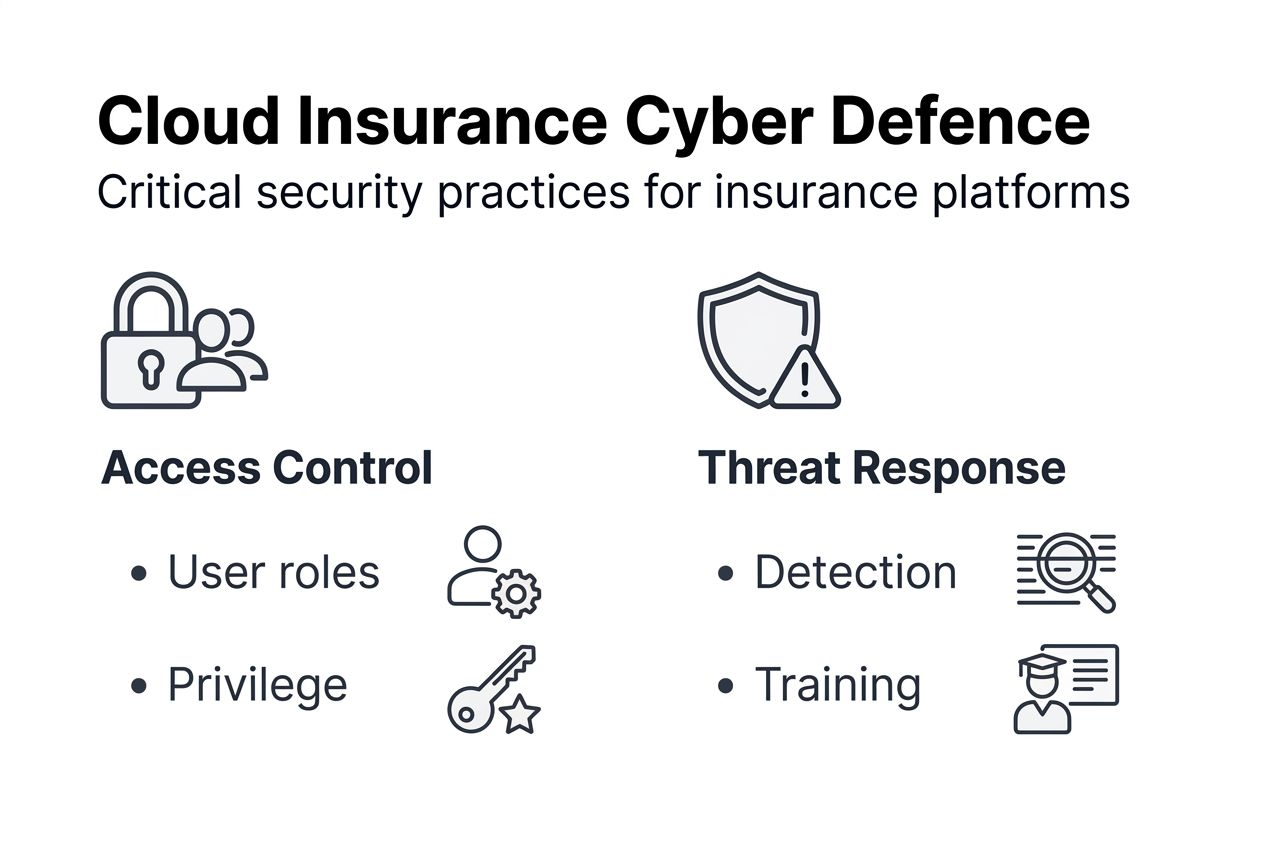
Granular access controls implement least-privilege principles ensuring users and systems access only resources necessary for legitimate functions. Role-based access control (RBAC) simplifies permission management whilst attribute-based access control (ABAC) enables context-aware policies considering factors like location, device posture, and time.
Pro Tip: Implement automated security scanning within continuous integration pipelines, blocking deployments containing known vulnerabilities before reaching production environments. This shift-left approach catches issues early when remediation costs remain minimal.
Third-party vendor risk management demands ongoing assessment rather than one-time due diligence during procurement. Insurers should establish vendor security programmes including:
- Initial security assessments evaluating vendor controls and certifications
- Contractual requirements mandating security standards and breach notification
- Continuous monitoring tracking vendor security posture through external ratings
- Regular audits validating vendor compliance with contractual obligations
- Contingency planning for vendor failures or security incidents
Digital transformation drivers accelerate cloud adoption whilst simultaneously elevating cybersecurity importance. Successfully digitising insurance processes requires embedding security controls throughout transformation initiatives rather than treating security as afterthought.
Security awareness training transforms employees from vulnerability sources into defensive assets capable of identifying and reporting threats. Effective programmes deliver engaging, role-specific content through multiple formats whilst measuring comprehension through simulated phishing campaigns and knowledge assessments. Training frequency matters; quarterly refreshers maintain awareness better than annual sessions.
Case studies and lessons learned from European P&C insurers
A major Central European insurer reduced breach incidents by 37% following comprehensive cloud security programme implementation combining Zero Trust architecture, automated patching, and enhanced monitoring. The transformation required 18 months but delivered measurable risk reduction and improved regulatory compliance audit outcomes.
Incident response preparedness proved critical when a mid-sized P&C platform detected ransomware deployment attempts during routine monitoring. Immediate activation of rehearsed response procedures isolated affected systems within 12 minutes, preventing encryption of critical policy data. Post-incident analysis revealed the attack vector involved compromised vendor credentials, prompting enhanced third-party access governance.
Key lessons from successful security implementations include:
- Executive sponsorship accelerates security initiatives by allocating adequate resources and removing organisational barriers
- Cross-functional collaboration between security, operations, and development teams prevents silos undermining defence effectiveness
- Continuous risk monitoring identifies emerging threats faster than periodic assessments
- Third-party risk management requires ongoing vigilance beyond initial vendor due diligence
- Security metrics aligned with business objectives demonstrate programme value and justify continued investment
Best practices emerging from peer experiences emphasise automation wherever possible to reduce human error and response latency. Manual security processes cannot scale with cloud platform growth or match attack speeds requiring sub-second detection and response.
Proactive security integration during platform design costs substantially less than retrofitting controls into existing systems whilst delivering superior protection. Early security involvement identifies architectural decisions creating long-term vulnerabilities, enabling course corrections before technical debt accumulates.
Operational resilience improvements following security enhancements extend beyond breach prevention to include faster recovery from incidents, reduced regulatory scrutiny, and improved customer confidence. Insurers demonstrating strong security postures differentiate themselves in competitive markets where data protection increasingly influences purchasing decisions.
Conclusion: enhancing resilience and compliance for future-ready insurance platforms
Cybersecurity demands continuous commitment rather than one-time projects, with threat landscapes evolving faster than annual security reviews can address. Insurance executives must champion ongoing investment in detection capabilities, response readiness, and architectural improvements maintaining protection against emerging attack techniques.
Compliance and security integration from design through operation creates platforms simultaneously meeting regulatory obligations and defending against sophisticated threats. Cloud-native architectures enable this integration through automated controls, comprehensive logging, and API-driven security enforcement replacing manual processes.
Cloud platforms drive operational agility whilst enhancing security when organisations implement proper governance, continuous monitoring, and risk-based control frameworks. The combination of technological capability and disciplined security practices positions insurers to compete effectively whilst protecting sensitive policyholder data against evolving cyber threats throughout 2026 and beyond.
Explore secure digital insurance platform solutions
IBSuite delivers cloud-native insurance software purpose-built with security and compliance embedded throughout its modular architecture. Our policy administration platform and claims management system incorporate Evergreen updates, comprehensive audit trails, and API security controls supporting your cybersecurity objectives.
Built on AWS infrastructure with Zero Trust principles, IBSuite enables P&C insurers to accelerate digital transformation whilst maintaining robust data protection and regulatory compliance. Our platform supports GDPR requirements and NIS2 obligations through configurable privacy controls and automated compliance reporting.
Discover how IBSuite strengthens your security posture whilst delivering operational agility. Book a demo to explore how our secure, cloud-native platform addresses your specific cybersecurity and compliance requirements.
Frequently asked questions
What are the main cybersecurity challenges in cloud-native insurance platforms?
API-first architectures create broader attack surfaces requiring specialised security controls beyond traditional perimeter defences. Ransomware threats continue evolving with attackers developing sophisticated techniques targeting cloud storage and backup systems. Third-party integration risks multiply as platforms connect with external vendors, distribution partners, and data providers. Complex regulatory compliance demands add further challenges requiring continuous documentation and control validation.
How does the NIS2 Directive affect insurance platform security?
NIS2 mandates robust incident detection capabilities, immediate reporting protocols, and comprehensive security governance frameworks for essential service providers including insurers. Non-compliance risks include fines reaching €10 million or 2% of global annual turnover, whichever proves higher. The directive requires board-level oversight of cybersecurity risks and regular third-party audits validating control effectiveness.
What practical steps can insurers take to improve platform cybersecurity?
Implement Zero Trust architectures verifying every access request regardless of network location or user role. Automate security patch deployment through Evergreen update mechanisms eliminating manual delays creating vulnerability windows. Conduct regular incident response drills testing team readiness and plan effectiveness before actual breaches occur. Enforce comprehensive third-party risk governance including continuous vendor security monitoring and contractual security requirements. Deploy SIEM tools providing real-time threat detection across distributed cloud environments.
Are cloud platforms inherently secure for insurance data?
Cloud infrastructure alone provides baseline security capabilities but requires proper configuration, monitoring, and governance to protect insurance data effectively. Shared responsibility models mean providers secure underlying infrastructure whilst customers remain accountable for application security, access management, and data protection. Default cloud settings prioritise flexibility over security, demanding active hardening and continuous validation. Successful cloud security combines provider capabilities with customer-implemented controls addressing organisation-specific risks and regulatory requirements.
Recommended
- Cybersecurity for Insurers, tools and best practices – Digital Insurance Platform | IBSuite Insurance Software | Modern Insurance System
- Complete Guide to Insurance Platform Security Fundamentals – Digital Insurance Platform | IBSuite Insurance Software | Modern Insurance System
- Optimizing Cloud Insurance Platforms for P&C Success
- Insurance Data Security Best Practices for Modern Insurers
- RareCloud.io – Unconventional Cloud Services