29.05.26
How to scale insurance offerings in 2026

Knowing how to scale insurance offerings is one of the most pressing challenges facing P&C executives in Europe right now. The gap between running a successful pilot and operating at genuine scale is wide, and most insurers underestimate it. Siloed organisations, legacy administration systems, and underinvestment in governance are the real obstacles. Technology is rarely the bottleneck. This article covers the prerequisites, execution strategies, and verification frameworks you need to expand insurance services sustainably, with specific attention to European regulatory demands and 2026 market conditions.
Table of Contents
- Key takeaways
- Prerequisites for scaling insurance offerings
- Step-by-step strategies to scale effectively
- Common pitfalls during the scaling process
- Measuring success and iterating
- My perspective on what most executives get wrong
- Scale your insurance products with IBSuite
- FAQ
Key takeaways
| Point | Details |
|---|---|
| Organisational readiness comes first | Cross-functional teams and governance frameworks must be in place before technology investment pays off. |
| Automate underwriting at scale | Target 70–80% straight-through processing for standard policies to make scaling economically viable. |
| Embedded insurance accelerates growth | API-driven partner ecosystems allow rapid market entry without building distribution from scratch. |
| Measure the right metrics | Track policies per FTE, cost per policy, and loss ratios to catch operational problems early. |
| Pilots are not scale | Building operational durability and flexible processes is what separates scaled insurers from those stuck in pilot mode. |
Prerequisites for scaling insurance offerings
Before you execute on any growth strategy, get your house in order. The most common reason scaling fails is not a technology gap. It is an organisational one.
From siloed functions to cross-functional teams
Scaling insurance requires moving away from siloed departments where underwriting, claims, and product sit in separate kingdoms. Cross-functional teams with clear ownership, shared metrics, and decision-making authority are the foundation. This is not a restructuring exercise for its own sake. It is the only way to move quickly when launching a new product line or entering a new segment without bottlenecks cascading across every function.
The governance model matters just as much. AI governance requirements, including model risk management and bias detection, are now aligned with European regulator expectations. If you have not embedded these into your operational workflows, you are not ready to scale AI-enabled processes. Regulators across the EU are watching closely, and retrofitting compliance after the fact is far more expensive than building it in from the start.
Technology foundations that actually support scale
Your policy administration system is the backbone of everything. If it cannot support quoting, binding, premium collection, renewals, and claims in a single integrated lifecycle, you will hit a ceiling quickly. Many insurers discover this when they cross 200 policies in a new product and find the workflow collapses into spreadsheets and manual email chains. Many pilots collapse beyond 100 to 200 policies precisely because the administration layer was never built for volume.

Automated underwriting is non-negotiable. The target for standard, lower-complexity policies is 70–80% processed without manual intervention. This requires integration with third-party data sources, real-time scoring, and exception routing for complex risks only. Reserving human review for genuine edge cases is what keeps your cost per policy competitive as volume grows.
Pro Tip: Before committing to a technology platform for scale, audit your current system against three questions: Can it process your target volume without architectural changes? Does it expose APIs for partner integration? Does it support regulatory reporting across the markets you intend to enter? If the answer to any of these is no, plan for that gap before you launch.
Data infrastructure deserves its own budget line. Real-time monitoring, integration with geospatial or weather data feeds for P&C lines, and a clean data layer for AI model training are prerequisites, not afterthoughts. The drivers of digital transformation for European insurers consistently point to data quality as the single biggest limiter of AI value in production.
Step-by-step strategies to scale effectively
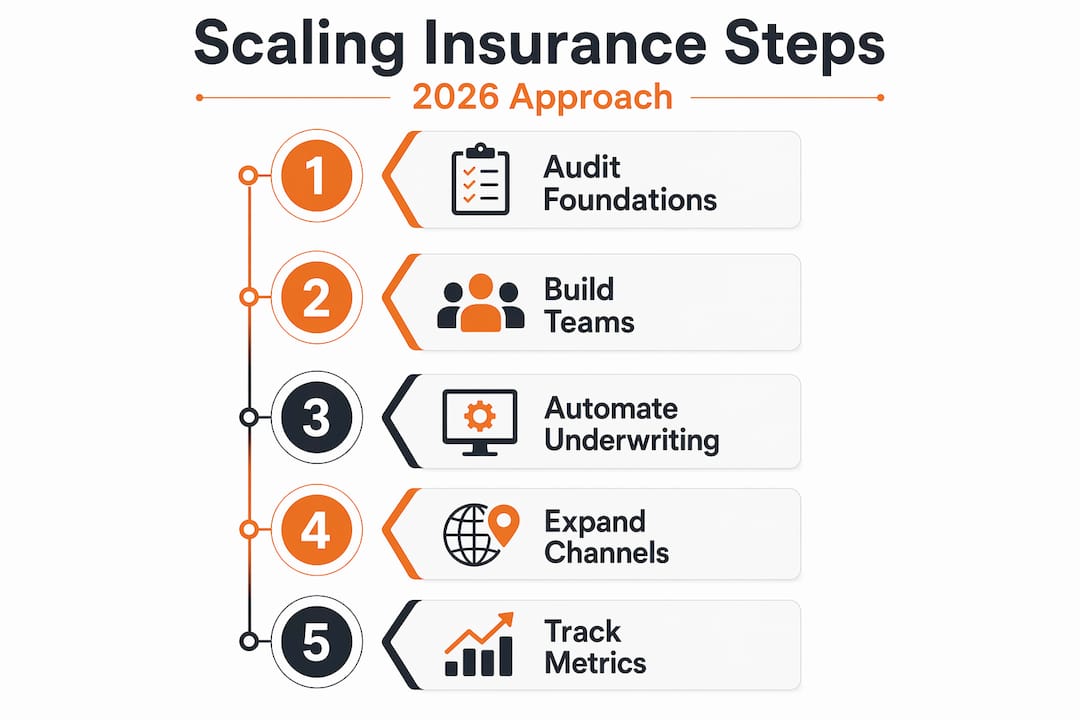
With the foundations in place, you can move into execution. The following steps reflect the order in which successful insurers approach scaling insurance products, not just theoretical best practice.
-
Validate product-market fit before committing to scale investment. Renewal rates are the most honest signal available. If renewal rates in your pilot are below 70%, you have a pricing or experience problem that will amplify at scale, not disappear. Fix it before you build operational capacity around a product that customers will churn from.
-
Build automated underwriting and policy management workflows. This is the operational engine of scale. Automated underwriting is not just about speed. It is about unit economics improving 40–60% as volume increases. Without this, hiring more underwriters is your only lever, and that breaks the margin model immediately. See how automated underwriting reshapes operational capacity for P&C insurers in practice.
-
Invest in digital distribution and ecosystem partnerships. Embedded insurance is one of the most capital-efficient ways to expand insurance services without building a direct distribution network from zero. API-driven platforms now enable product-agnostic programmes at scale across multiple European markets with AI-enhanced claims handling. For executives looking to increase insurance offerings quickly, affinity and embedded partnerships compress your time to market significantly. Explore how embedded microinsurance strategy works as a distribution model at scale.
-
Negotiate multi-year reinsurance agreements early. Capacity uncertainty is a scaling killer. If your reinsurance arrangements are annual and volume-sensitive, your ability to commit to distribution partners or pricing consistency is limited. Multi-year agreements with volume thresholds give you the certainty to plan capacity investments properly.
-
Redesign your operating model around AI, not alongside it. This is where most insurers stall. 70% of the effort in truly AI-first P&C insurers goes toward building an agent-first operating model, covering talent, process, and incentive redesign, not the AI tools themselves. Buying a model is easy. Changing how your organisation makes decisions around that model is the hard part.
-
Build a regulatory and operational risk governance framework. European markets are not uniform. Solvency II requirements, local conduct rules, and data protection obligations differ across jurisdictions. A governance framework that treats regulatory compliance as a product, with ongoing model risk management and explainability built into workflows, is the only sustainable approach to operating across borders.
Pro Tip: When building embedded or affinity distribution channels, treat each partner integration as a product launch in its own right. Assign a dedicated owner, define SLAs, and build monitoring dashboards specific to that channel. Partnerships that lack this discipline tend to underperform and erode the economic case for the model.
| Strategy | Primary benefit | Risk if skipped |
|---|---|---|
| Automated underwriting | Cost per policy reduction | Margin collapse at volume |
| Embedded distribution | Faster market entry | Slow growth, high customer acquisition cost |
| Multi-year reinsurance | Capacity certainty | Inability to commit to partners or pricing |
| AI operating model redesign | Sustained efficiency gains | AI investment delivers no operational change |
| Governance framework | Regulatory confidence | Fines, remediation costs, or market exit |
Common pitfalls during the scaling process
Even well-funded insurers with strong technology make predictable mistakes. Knowing what these are in advance changes the risk profile of your scaling programme significantly.
-
Treating scaling as a series of pilots. Incremental pilots without operational capacity are how products stay niche. A pilot mindset optimises for learning. A scaling mindset optimises for repeatability and durability. These require different organisational muscles, and confusing them is extremely common.
-
Misaligning organisational structure with scaling goals. If your product team cannot approve a new coverage feature without a six-week sign-off chain, you cannot scale at market speed. Structural misalignment between governance and agility is the silent killer of insurance growth strategies.
-
Underestimating integration complexity. Purpose-built platforms for scaling can take 6 to 12 months and cost up to £1.5 million beyond pilot tooling. Executives who plan for a three-month integration and find themselves at month nine, mid-launch, have created a credibility problem internally and a reliability problem externally.
-
Ignoring cultural resistance to AI. Only 7% of insurers have successfully scaled AI systems, while two-thirds of implementations remain in pilot. The primary barriers are not technical. They are cultural and accountability-related. See how AI in P&C insurance creates organisational challenges as much as technical ones.
-
Skipping European regulatory complexity. GDPR, the EU AI Act, Solvency II, and country-level conduct rules do not wait for your product roadmap. Insurers who enter new European markets without dedicated regulatory scoping consistently face remediation costs and delays that dwarf the original compliance budget.
“Technology adoption alone does not guarantee agility. Organisational redesign and governance enable true scale.” — PwC Ireland, Next in Insurance 2026
The most telling early warning sign of a scaling problem is a rising loss ratio combined with flat or falling customer satisfaction scores. If both are moving in the wrong direction simultaneously, you have either a pricing problem, an operational problem, or both. Neither resolves itself with more volume.
Measuring success and iterating
Scaling without measurement is expansion without control. The metrics that matter most are not vanity metrics. They are operational indicators that tell you whether your model is working at the unit level.
| Metric | What it signals | Target benchmark |
|---|---|---|
| Policies per FTE | Operational efficiency | Improvement of 30–40% post-automation |
| Cost per policy | Unit economics at scale | Declining as volume grows |
| Claims processing time | Operational and customer experience quality | Reduction of 20–30% within 12 months |
| Renewal rate | Product-market fit and customer satisfaction | Above 70% for standard lines |
| Loss ratio trend | Pricing accuracy and risk selection quality | Stable or improving quarter-on-quarter |
Pricing requires particular attention. Scaling insurance pricing evolves from conservative pilot rates toward actuarially indicated levels, typically revised two to three times across the first three years. Build pricing flexibility into your reinsurance and distribution agreements from the outset, or you will face renegotiations at the worst possible moment.
Codify every lesson into a living playbook. The insurers who sustain scale are the ones who treat operational knowledge as a product asset. They update their playbook quarterly, run retrospectives on each product launch, and invest systematically in upskilling underwriters, claims handlers, and product managers to work alongside automated systems rather than around them. Centralised, tech-driven platforms can deliver 30 to 40% net efficiency gains, but only when the human operating model evolves alongside the technology.
My perspective on what most executives get wrong
In my experience, the executives who struggle most with scaling are not the ones with bad technology. They are the ones who believe that better technology is the answer to an organisational problem.
I have seen insurers invest heavily in AI-powered underwriting tools only to find that most AI value comes from workflow redesign, not algorithms alone. The tool sits on top of a process that was not designed for it, and the gains evaporate. The uncomfortable reality is that scaling insurance businesses requires you to change how people think about their roles, not just what software they use.
What I find most underrated is the embedded insurance model as a growth vehicle. Executives tend to treat it as a niche add-on rather than a primary distribution channel. In practice, it is often the fastest route to meaningful volume at controlled acquisition cost. The insurers I respect most are building partner ecosystems with the same rigour they bring to core product development.
My honest take is this: if your organisation cannot make a product decision in under two weeks, you are not ready to scale. Fix the decision-making architecture before you fix the technology stack.
— Tuna
Scale your insurance products with IBSuite
If the strategies above resonate, the next question is whether your core platform can support them. Ibapplications built IBSuite precisely for insurers who are ready to move beyond pilots and build operationally durable product portfolios. IBSuite’s policy administration system manages the full insurance lifecycle, from quoting and binding through to renewals and compliance reporting, on a cloud-native, API-first architecture built on AWS.
For executives focused on insurance growth strategies, IBSuite supports automated underwriting workflows, embedded distribution integrations, and cross-European regulatory compliance out of the box. It is designed to reduce IT complexity while giving your product teams the agility to launch and iterate quickly. If you are evaluating how to build the operational foundation for scale, book a tailored demo to see how IBSuite maps to your specific context.
FAQ
What is the biggest barrier to scaling insurance offerings?
Organisational structure and culture are the primary barriers, not technology. Only 7% of insurers have successfully scaled AI systems, with two-thirds stuck in pilot mode due to accountability gaps and cultural resistance rather than technical limitations.
How much automation is needed to scale underwriting profitably?
Automated underwriting should handle 70 to 80% of standard policies without manual intervention. Below this threshold, unit economics deteriorate rapidly as volume grows and the cost-per-policy model becomes unsustainable.
How should insurers measure scaling success?
Track policies per full-time employee, cost per policy, renewal rate, claims processing time, and loss ratio trends. These five metrics together give a reliable picture of whether your operating model is improving or degrading as volume increases.
What role does embedded insurance play in scaling?
Embedded insurance via API-driven partner ecosystems is one of the most capital-efficient ways to expand insurance services across European markets. It reduces customer acquisition costs and compresses time to market significantly compared to building direct distribution infrastructure.
How long does it take to scale an insurance product properly?
From operational readiness to genuine scale typically takes 18 to 36 months, accounting for platform integration, regulatory approvals, distribution partnership development, and at least two pricing revision cycles based on emerging loss experience.
Recommended
- Embracing Compliance through Next-Generation Insurance Platforms – Digital Insurance Platform | IBSuite Insurance Software | Modern Insurance System
- Modern Insurance Platforms: What to look for – Digital Insurance Platform | IBSuite Insurance Software | Modern Insurance System
- Cloud Scalability in Insurance: Enabling Rapid Growth
- Insurance marketplace models 2026: 50% faster launches