19.04.26
Cloud security’s impact on insurance: protecting value

TL;DR:
- Cloud security is vital for insurers due to high breach costs and operational risks.
- Implementing key controls like MFA, EDR, and immutable backups reduces breach impact and premiums.
- Treat cloud security as a strategic, tailored capability rather than just compliance checklist completion.
The global average breach cost sits at $4.44M, but for financial services, that figure climbs to $5.56M per incident. Yet many P&C insurance executives still assume that moving to the cloud inherently solves their security exposure. It does not. The cloud reduces certain risks while introducing entirely new ones, particularly when responsibility boundaries are blurred and controls are poorly configured. This article covers why cloud security deserves serious strategic attention from insurance leaders, what frameworks and components genuinely matter, where hidden risks tend to emerge, and how targeted investments can reduce breach costs, improve compliance, and strengthen your position when negotiating cyber insurance coverage.
Table of Contents
- Why cloud security matters more than ever for insurers
- Core components and frameworks of cloud security in insurance
- Navigating shared responsibility and edge case risks
- Cloud security levers: Reducing incident cost, meeting compliance, and enhancing insurability
- A new insurance reality: The hidden obstacles and strategic dividends of cloud security
- See how modern platforms solve cloud security in insurance
- Frequently asked questions
Key Takeaways
| Point | Details |
|---|---|
| Cloud security is critical | Robust cloud security is foundational to protecting data, reputation, and operations for insurance providers. |
| Compliance lowers loss risk | Aligning with standards and insurer mandates reduces breach incidents and insurance costs. |
| Misunderstood risks abound | Executives commonly underestimate shared responsibility gaps and third-party risks. |
| AI is a proven lever | Deploying AI-driven security cuts lifecycle and loss per incident significantly for insurers. |
Why cloud security matters more than ever for insurers
Digital transformation has accelerated cloud adoption across P&C insurance at a pace few predicted five years ago. Underwriting, policy administration, claims processing, and customer engagement platforms are all moving to cloud environments. Each migration expands the attack surface. More endpoints, more integrations, and more third-party data exchanges mean more vectors for adversaries to exploit.
Insurers carry a particularly high-value target profile. You hold sensitive personal data, financial records, and health information across millions of policyholders. Regulatory scrutiny is intense, and reputational damage from a breach can erode customer trust faster than almost any other incident type. This is not a theoretical concern. The cyber insurance market reached $16.6B in 2026, driven partly by the sheer scale of digital risk that insurers and their clients now face.
Cloud security also directly influences operational resilience. A compromised cloud environment does not just create a data breach. It can halt claims processing, freeze underwriting workflows, and disrupt billing cycles at precisely the moment policyholders need you most. That operational dimension is what separates cloud security from an IT concern and makes it a board-level priority.
“Organisations that implement strong cloud security recommendations consistently report fewer incidents and lower recovery costs than those treating cloud security as a compliance checkbox.”
The good news is that action works. Compliance with recognised controls produces a 65% reduction in ransomware incidents, which is a significant measurable return on investment. The key levers that drive this improvement include:
- Multi-factor authentication (MFA): Blocks the majority of credential-based attacks before they escalate
- Endpoint detection and response (EDR): Provides real-time visibility and automated containment of active threats
- Immutable backups: Ensures ransomware cannot encrypt or delete recovery data, preserving business continuity
- Continuous monitoring and logging: Creates the audit trail regulators expect and incident responders need
For executives reviewing their insurance cybersecurity best practices, the starting point is always understanding which controls you currently have, which are missing, and which gaps create the most exposure. Embedding strong data security practices and achieving security compliance in insurance are no longer optional steps. They are competitive differentiators.
Core components and frameworks of cloud security in insurance
Building a robust cloud security strategy requires clarity on what the essential components actually are, and how the relevant frameworks map to your obligations as an insurer.
The dominant frameworks shaping cloud security in insurance today include the shared responsibility model, zero trust architecture, ISO 27001 and ISO 27017, GDPR, and for European insurers, DORA (Digital Operational Resilience Act). Each framework addresses a specific dimension of risk, and together they create a layered defence posture. Reviewing ISO 27017 security measures gives executives a practical lens for evaluating cloud-specific controls that go beyond general information security standards.
Here is a summary of what insurers and regulators currently consider non-negotiable:
| Control | Requirement level | Primary benefit |
|---|---|---|
| Multi-factor authentication (MFA) | Mandatory | Blocks credential attacks |
| Endpoint detection and response (EDR) | Mandatory | Real-time threat containment |
| Immutable backups | Mandatory | Ransomware resilience |
| SLA compliance mapping | Required | Regulatory and contractual clarity |
| Encryption at rest and in transit | Required | Data confidentiality |
| Access control and least privilege | Required | Limits lateral movement |
The scale of adoption pressure is significant. 96% of insurers require MFA, 88% require EDR, and 82% require immutable backups as conditions of cyber coverage. If your organisation cannot demonstrate these controls, coverage gaps and higher premiums are the immediate consequence.
Zero trust architecture deserves particular attention. The principle of “never trust, always verify” removes the assumption that anything inside the network perimeter is safe. For insurers running hybrid cloud environments with legacy integrations and multiple third-party APIs, zero trust is not idealistic. It is pragmatic risk management.

You should also review the insurance security fundamentals that underpin any cloud-native platform security posture, as these guide how controls are embedded at the platform level rather than bolted on afterwards.
Pro Tip: Map your current control inventory directly against cyber insurance eligibility criteria before your next renewal. Gaps you close today reduce both your premium and your exposure simultaneously.
Navigating shared responsibility and edge case risks
The shared responsibility model is one of the most misunderstood concepts in cloud security. Put simply, cloud providers secure the infrastructure (servers, networking, physical facilities), while the insurer remains responsible for everything built on top of that infrastructure: data, configuration, access management, and application security.
Where things go wrong is in the assumption that “the cloud provider handles it.” 59% of breaches trace back to cloud misconfigurations and third-party risks, neither of which the provider controls. Reviewing your cloud provider obligations helps clarify exactly where the boundary sits.
| Risk area | In-house responsibility | Provider responsibility |
|---|---|---|
| Data classification and access | Insurer | Not applicable |
| Application configuration | Insurer | Not applicable |
| Infrastructure patching | Shared (varies by model) | Provider (IaaS core) |
| Physical security | Not applicable | Provider |
| API security | Insurer | Not applicable |
| Regional outage response | Insurer (planning) | Provider (remediation) |
Systemic cloud outages add a further layer of complexity that many executives underestimate. When a major cloud region goes down, business interruption claims across multiple policyholders can emerge simultaneously, creating a correlated loss event that challenges traditional actuarial models. For insurers operating their own cloud-based systems, a regional outage also affects internal operations, doubling the exposure.
Steps to strengthen your weakest links:
- Conduct a configuration audit across all active cloud environments every quarter
- Inventory all third-party integrations and assess their security posture formally
- Map your SLAs against realistic outage and incident scenarios, not best-case assumptions
- Establish a shadow IT discovery process to surface unauthorised cloud tools and AI applications
- Test your incident response plan against a simulated regional outage at least annually
For P&C insurers, the data security for P&C considerations are particularly acute given the volume and sensitivity of claims data. Understanding the cloud value for insurers also means understanding what you are taking on when you migrate.
Pro Tip: Never accept a cloud provider SLA at face value. Model what a four-hour regional outage means for your claims, billing, and underwriting operations, then verify whether your SLA actually covers that scenario or excludes it.
Cloud security levers: Reducing incident cost, meeting compliance, and enhancing insurability
Cloud security is not just a cost centre. Approached strategically, it produces measurable financial returns. The evidence is now clear enough that executives can build a business case on hard numbers rather than theoretical risk reduction.
The headline figure: AI-driven security cuts the breach lifecycle by 80 days and saves $1.9M per incident. For insurers already investing in AI and automation in insurance, extending that investment into the security layer is a natural and financially justified step.
Statistic to note: Insurers using AI-powered security tools contain breaches 80 days faster and reduce per-incident costs by $1.9M compared to those relying on manual detection and response.
The top security levers delivering the most measurable value for P&C insurers are:
- AI and automation: Accelerates threat detection, reduces manual analysis load, and cuts incident response time dramatically
- EDR tools: Provide continuous endpoint visibility across cloud workloads, catching lateral movement before it escalates
- MFA across all access points: Eliminates the most common attack vector with minimal operational friction
- Immutable backup architecture: Ensures recovery capability even in a total ransomware scenario, preserving claims continuity
- Compliance automation: Reduces the manual burden of regulatory reporting while improving audit readiness
Meeting insurer and regulator requirements through these controls has a direct pricing benefit. Underwriters view documented compliance as lower risk, which translates into more favourable premium terms and broader coverage eligibility. Understanding the broader AI impact in insurance helps executives see where security investment connects to wider operational gains across the value chain.
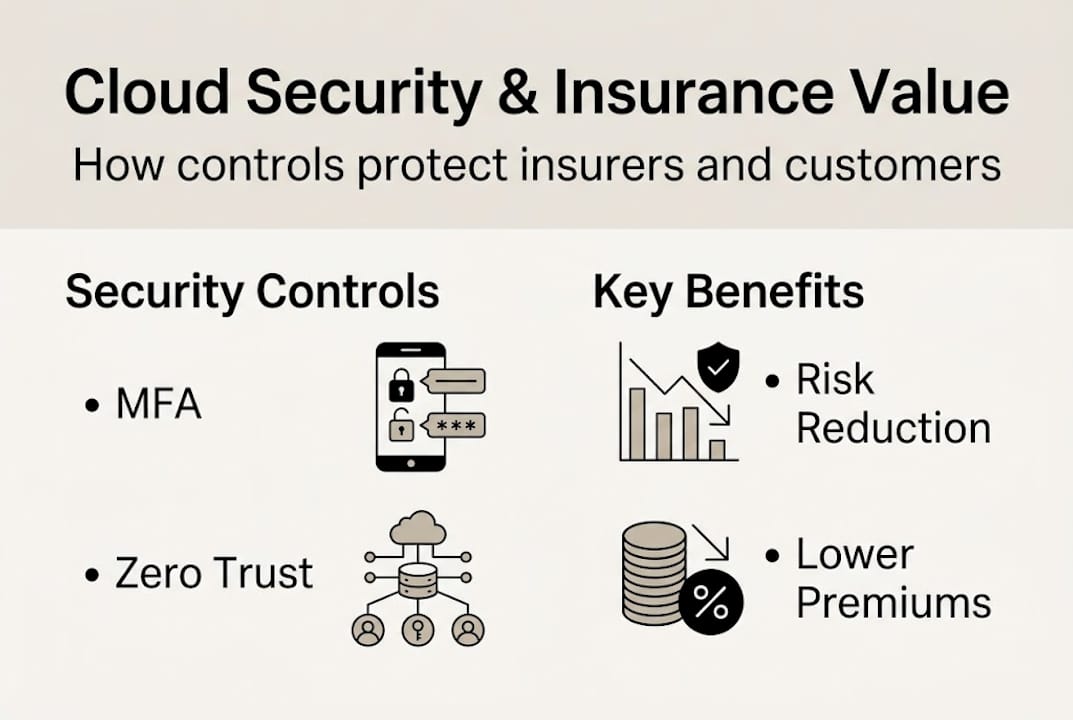
The cumulative effect is significant. Insurers who invest in the right combination of controls are not simply avoiding loss. They are improving their cost structure, satisfying regulators, and building the kind of operational resilience that supports long-term growth.
A new insurance reality: The hidden obstacles and strategic dividends of cloud security
Most cloud security conversations in insurance still revolve around compliance checklists. Do you have MFA? Yes. Do you have EDR? Yes. Tick, tick, done. That approach misses the point entirely.
The executives who will differentiate their organisations over the next five years are those who treat cloud security as a strategic capability rather than a minimum requirement. Compliance gets you to the table. Real security keeps you there.
We have observed that many insurers over-trust their cloud provider’s SLA, assuming contractual language covers the full range of operational scenarios. It rarely does. Systemic outages, correlated losses, and ambiguous configuration responsibilities create gaps that only surface when something goes wrong. Reviewing cloud security best practices and running genuine scenario tests, not paper exercises, is where real resilience is built.
The deeper opportunity lies in customising controls to reflect your specific business risk profile rather than adopting generic frameworks wholesale. An insurer running a digital-first, API-heavy distribution model faces different exposure than one with a traditional broker channel. Using cybersecurity tools in insurance that are tailored to your architecture creates genuine competitive advantage. Generic compliance creates generic protection. Specific, risk-calibrated security creates real resilience.
See how modern platforms solve cloud security in insurance
If the controls, frameworks, and risk scenarios covered in this article feel like a significant undertaking to implement from scratch, that is precisely where a purpose-built platform changes the equation. IBSuite is built on AWS and designed from the ground up with cloud-native security, compliance, and operational resilience embedded at every layer. Evergreen updates, built-in compliance mapping, and secure API-first architecture mean you are not retrofitting security onto an ageing system. You are starting from a position of strength. Explore why IBSuite is the platform of choice for P&C insurers serious about digital transformation and security, and speak with our team to see how it maps to your specific risk and compliance requirements.
Frequently asked questions
What is the shared responsibility model in insurance cloud security?
It outlines which security duties rest with the insurer versus the cloud provider. Insurers remain accountable for data, configuration, and access management, while providers secure the core infrastructure. As expert analysis confirms, this boundary is frequently misunderstood, leaving insurers exposed to risks they assumed were covered.
How can cloud security measures lower cyber insurance costs?
Implementing controls such as MFA, EDR, and compliance frameworks reduces the likelihood and severity of incidents, making your organisation a lower-risk proposition for underwriters. Extensive security controls can reduce ransomware incidents by 65% and improve your eligibility for broader, more affordable cyber coverage.
What edge risks threaten insurers in the cloud?
Misconfigured services, third-party supplier vulnerabilities, legacy system integrations, and regional cloud outages account for the majority of substantial breach and disruption events. These are insurer-side responsibilities that cloud providers do not cover under standard agreements.
Does adopting AI in cloud security really cut costs?
Yes. AI and automation reduce breach lifecycles by 80 days and save insurers approximately $1.9M per incident, making the investment case straightforward for most P&C organisations.
Recommended
- The Cloud: Accessing Value for Insurers – Digital Insurance Platform | IBSuite Insurance Software | Modern Insurance System
- Cloud Security and Compliance for Insurers: Navigating 2025 Risks – Digital Insurance Platform | IBSuite Insurance Software | Modern Insurance System
- Boost cybersecurity in cloud-native insurance platforms
- Cybersecurity for Insurers, tools and best practices – Digital Insurance Platform | IBSuite Insurance Software | Modern Insurance System
- 7 esempi di misure preventive ISO 27017 per la sicurezza cloud – Security Hub