15.04.26
Why integrations matter in insurance: efficiency and ROI

TL;DR:
- Integrations can save insurers millions annually and significantly improve operational efficiency.
- Connected systems enable seamless, real-time customer experiences and reduce policyholder friction.
- Successful integration requires leadership focus, strategic planning, and leveraging modern, API-driven platforms.
One P&C insurer saved $12M annually by integrating process intelligence into its core operations. That figure alone should reframe how insurance executives think about integrations. Too often, they are dismissed as back-office IT detail, the domain of developers rather than the boardroom. In reality, integrations sit at the heart of operational performance and customer satisfaction. This guide cuts through the technical noise to show you precisely why integrations are now mission-critical, how they deliver measurable returns, and what practical steps you can take to harness their full potential across your P&C organisation.
Table of Contents
- The hidden cost of disconnected insurance systems
- How integrations supercharge operational efficiency
- Delighting the modern insurance customer
- Making integrations work: best practices for insurers
- Why integration mindsets separate insurance leaders from laggards
- Take the next step with smarter insurance integrations
- Frequently asked questions
Key Takeaways
| Point | Details |
|---|---|
| Integrations cut costs | Insurers leveraging integrated systems experience major savings and operational efficiency gains. |
| Customer experience boost | Integrated platforms enable seamless, personalised, and omni-channel policyholder journeys. |
| Strategic advantage | Those who prioritise integrations now will lead in digital transformation and market growth. |
| Quick wins available | Starting with core policy and claims integrations can deliver fast, measurable results. |
The hidden cost of disconnected insurance systems
Most P&C insurers carry a technology estate built over decades. Core policy administration systems, claims platforms, billing engines, and CRM tools were often procured separately, at different times, from different vendors. The result is a fragmented landscape where data lives in silos, staff re-key information between systems, and even simple policy changes require multiple manual steps.
This fragmentation is not just an inconvenience. It creates genuine financial and operational drag. When a claims handler must log into three separate systems to retrieve policyholder history, process time stretches. When billing and underwriting data do not synchronise automatically, errors creep in. When customer-facing portals cannot pull real-time policy data, policyholders are left waiting for answers that should be instant.
The hidden costs accumulate in three distinct areas:
- Claims delays: Manual handoffs between disconnected systems slow adjudication, increase cycle times, and frustrate claimants at their most vulnerable moments.
- Compliance risk: Fragmented data makes it harder to produce accurate regulatory reports, exposing insurers to audit failures and potential penalties.
- Customer frustration: Policyholders who experience slow responses, repeated requests for the same information, or inconsistent service across channels are far more likely to lapse or switch.
Integrations directly reduce policyholder friction, enabling personalised, seamless experiences across every channel a customer uses.
Understanding overcoming integration challenges is therefore not a technical exercise. It is a strategic imperative. The drivers of digital transformation in insurance all point in the same direction: connected systems are the foundation of a competitive, customer-centred business. Now that we have acknowledged the true cost of technical disconnects, let us see how integrations tackle these challenges directly.
How integrations supercharge operational efficiency
The efficiency case for integrations is not theoretical. Real insurers are recording dramatic, measurable gains when they connect their systems intelligently. A Fortune 50 P&C carrier achieved a 230% ROI and $12M in annual savings through process intelligence integration, while also reclaiming 2,250 staff hours previously lost to manual workflows. Those are not marginal improvements. They are transformational.
The table below illustrates what integration does to core operational metrics:
| Metric | Disconnected workflows | Integrated workflows |
|---|---|---|
| Claims processing time | 8 to 12 days average | 2 to 4 days average |
| Operational cost per claim | High, due to manual effort | Reduced by 30 to 50% |
| Data entry error rate | Frequent, multi-system re-keying | Near-zero with automated data flow |
| Staff hours on admin tasks | High, repetitive manual steps | Significantly reduced |
| Customer update speed | Delayed, batch-driven | Real-time, event-driven |
The gains come from removing the friction between systems. When policy, claims, billing, and analytics platforms share data in real time, decisions happen faster, errors fall away, and staff focus on higher-value work. Automation in P&C insurance acts as a force multiplier here. Automation alone delivers incremental gains. But automation layered on top of well-integrated systems delivers exponential returns.

Integrating with CRM and ERP platforms via AI workflows extends this further, enabling intelligent routing, predictive analytics, and automated customer communications that would be impossible in a siloed environment.
Pro Tip: When evaluating integration partners, prioritise platforms with pre-built connectors for common insurance data sources. Building every integration from scratch multiplies both cost and risk. An API-first core system dramatically shortens time to value.
Having established integration’s efficiency edge, it is equally important to look at the impact on the customer experience.
Delighting the modern insurance customer
Efficiency gains matter enormously inside the organisation. But integrations also reshape what policyholders actually feel when they interact with their insurer. The modern customer expects the same seamless, real-time experience from their insurer that they get from their bank or their favourite retailer. Disconnected systems make that expectation impossible to meet.
When systems are integrated, the policyholder journey transforms. Here is how a typical interaction changes:
- Policyholder submits a claim via a mobile app or web portal.
- The claim is automatically logged in the claims system, with policyholder history pulled instantly from the policy administration platform.
- Automated acknowledgement is sent via the customer’s preferred channel, whether email, SMS, or app notification.
- Real-time status updates are pushed to the customer as the claim progresses through adjudication.
- Payment is triggered automatically upon approval, with the billing system updated simultaneously.
- Post-claim communication is personalised based on the customer’s history and preferences, using data from the integrated CRM.
This kind of frictionless journey is only possible when systems talk to each other. Personalised, seamless customer experiences across channels are not a luxury feature. They are increasingly the baseline expectation. Insurers who cannot deliver them face higher lapse rates and weaker Net Promoter Scores.
Integrations also enable self-service, which customers increasingly prefer. Conversational AI solutions can handle routine enquiries, policy changes, and first-notice-of-loss submissions when they are connected to live policy and claims data. Understanding the full range of modern insurance platform benefits and how data integration in insurance underpins them is essential for any leader serious about customer engagement.
We have seen the customer impact, so what are the strategic building blocks for successful insurance integrations?
Making integrations work: best practices for insurers
Knowing that integrations deliver value is one thing. Executing them well is another. Many integration programmes stall or underdeliver because of avoidable mistakes. The table below maps common integration types to their expected impact and typical implementation timescales:
| Integration type | Expected impact | Typical timeline |
|---|---|---|
| Claims system to policy admin | Faster adjudication, fewer errors | 3 to 6 months |
| CRM to underwriting platform | Better risk profiling, personalised service | 4 to 8 months |
| Payment gateway to billing | Automated reconciliation, reduced manual effort | 2 to 4 months |
| Analytics to core systems | Real-time reporting, predictive insights | 6 to 12 months |
| Customer portal to all core systems | Self-service capability, real-time updates | 4 to 9 months |
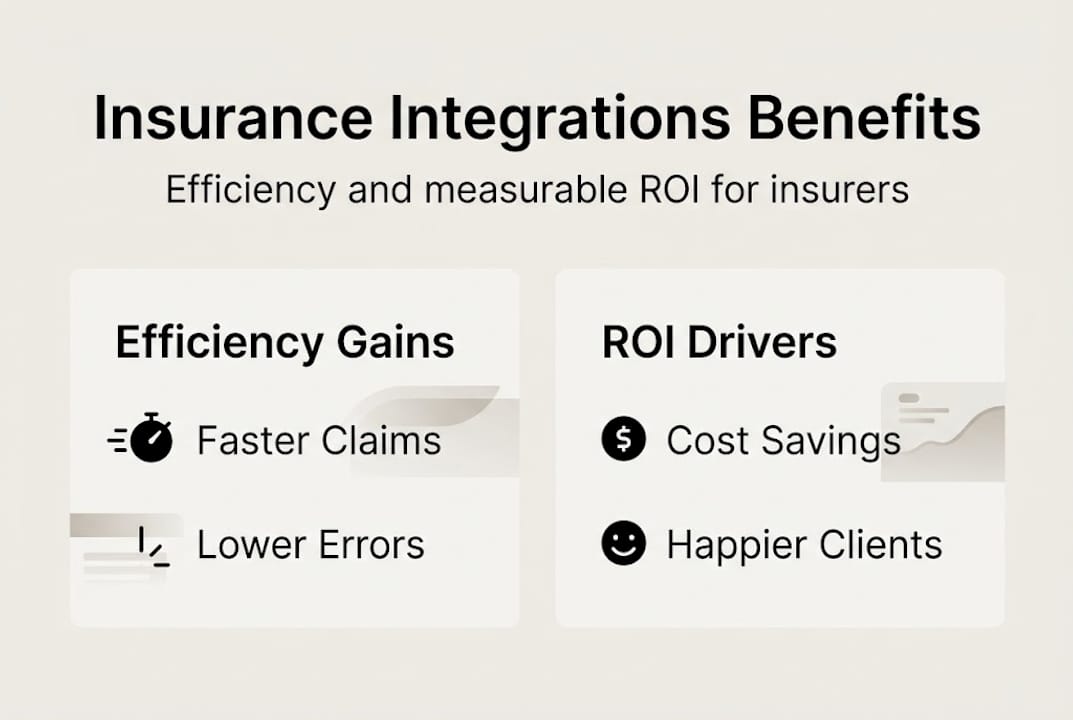
The 230% ROI benchmark achieved by leading P&C carriers demonstrates that the returns justify the investment when integrations are executed with clear objectives.
Common mistakes to avoid include:
- Partial integration: Connecting some systems but leaving others isolated creates new data gaps and undermines the value of the integrations you have built.
- Weak governance: Without clear ownership of data standards and integration architecture, inconsistencies multiply over time.
- Neglecting customer-facing touchpoints: Integrations that only improve back-office workflows miss half the value. Customer portals, communication channels, and self-service tools must be connected too.
Pro Tip: Start with high-impact, quick-win integrations such as claims-to-policy admin or payment gateway connections. Early wins build internal momentum and make the case for broader investment.
Exploring driving integration efficiency in depth and understanding how to leverage APIs in insurance will sharpen your execution strategy. For technical teams, a robust approach to third-party API integration is foundational to long-term interoperability.
With best practices in hand, it is time to step back for an industry-wide perspective.
Why integration mindsets separate insurance leaders from laggards
Here is the uncomfortable truth most industry conversations avoid: the majority of P&C insurers over-invest in core system upgrades while systematically underinvesting in interoperability. They spend years and significant budget replacing a policy administration system, then connect it to the rest of the business with brittle, point-to-point integrations that break every time something changes. The new core system becomes the new silo.
True leaders think differently. They treat integration as a strategic capability, not a project deliverable. They ask, before any technology investment, how this new system will connect to everything else and how quickly those connections can evolve as the business changes. That mindset is what enables faster product launches, more agile responses to regulatory change, and customer experiences that genuinely differentiate.
We have seen this pattern clearly across the industry. Insurers who invest in modern insurance platforms built on open APIs and designed for interoperability consistently outpace those who treat integration as an afterthought. Integration is not a technology decision. It is a leadership decision.
Take the next step with smarter insurance integrations
The evidence is clear. Integrations deliver measurable efficiency gains, reduce operational costs, and create the connected experiences that modern policyholders expect. IBSuite, IBA’s API-first core insurance platform, is built specifically to make these integrations fast, reliable, and scalable for P&C insurers. From policy administration to claims management, IBSuite connects every part of the insurance value chain, so your teams spend less time managing systems and more time serving customers. If you are ready to see what a truly integrated platform looks like in practice, book a demo and let us show you what is possible.
Frequently asked questions
What are the primary benefits of integrations for property and casualty insurers?
Integrations cut costs, reduce manual effort, and create seamless experiences for policyholders and staff. Leading P&C carriers have recorded savings of $12M annually and a 230% ROI through well-executed integration programmes.
How do integrations improve customer engagement in insurance?
They reduce friction, make information instantly available, and support omnichannel communication. Seamless cross-channel experiences are only achievable when policy, claims, and CRM systems share data in real time.
What is an example of ROI from insurance system integrations?
A leading insurer achieved a 230% ROI and $12M in savings per year by integrating process intelligence and loss control capabilities into its core operations.
Which integrations deliver the quickest wins for insurance companies?
Policy administration, claims, and customer portal integrations yield rapid operational improvements and measurable ROI, typically within two to six months of implementation.
Recommended
- Integrations in insurtech: driving efficiency in 2026
- Overcoming Integration Challenges – Digital Insurance Platform | IBSuite Insurance Software | Modern Insurance System
- Data Integration in Insurance: Driving Insight and Efficiency
- Key types of API integrations for insurance success
- CRM/ERP integration with AI workflows – Proud Lion Studios | App, Blockchain & Game Development Company in Dubai UAE
- AI in business: efficiency, automation, and growth