29.07.26
Insurance modernisation explained: a guide for Central European insurers

Insurance modernisation is a strategic programme to replace brittle legacy estates with modular platforms, modern data fabrics and new operating models so insurers can comply with regulation, launch products faster and scale digital distribution. It is not a technology refresh. It is capacity building.
TL;DR for the board:
- Cloud-native platforms replace monolithic policy, claims and underwriting systems with modular, API-first cores.
- Data fabric and governance give underwriters, actuaries and regulators access to clean, auditable, real-time data.
- API ecosystems open distribution to embedded channels, MGAs and third-party partners.
- Automation and CI/CD cut time-to-market for new products and reduce manual operational risk.
- Governance and operating model change sustains the programme across multiple years and budget cycles.
- Regulatory constraints — EIOPA guidance, DORA, GDPR and the EU AI Act — are design inputs, not compliance checkboxes to address at the end.
- IBSuite by IBA is an example of a cloud-native, API-first platform available in Central Europe and discussed in detail later.
Table of Contents
- Why are Central European insurers modernising right now?
- What are the core technical and organisational components?
- How do you build a practical modernisation roadmap?
- How do you change governance and culture so modernisation sticks?
- How does data modernisation enable underwriting, pricing and AI?
- What are the key risks and regulatory pitfalls for Central European insurers?
- How do you choose platforms and partners in Central Europe?
- IBSuite and IBA: what to look for in a Central European context
- Your first 12-month checklist: deliverables and owners
- Key takeaways
- What practitioners get wrong about Central European transformations
- Accelerate your first pilot with a structured demo
- Useful sources and further reading
- FAQ
Why are Central European insurers modernising right now?
The pressure is coming from three directions simultaneously, and none of them is easing.
Market drivers are the most visible. Customers now expect digital self-service, real-time claims updates and personalised pricing as a baseline, not a differentiator. MGAs and insurtechs have demonstrated that a new product can go from concept to market in weeks on a modern stack. Embedded insurance — cover sold at the point of purchase through a retailer, bank or mobility platform — is growing rapidly across EMEA, and capturing those channels requires mature API capabilities that most legacy estates simply cannot provide. For incumbents, the competitive gap widens every quarter they delay.
Regulatory drivers are arguably more urgent for Central European firms. EIOPA advises insurers to treat digital transformation as strategic capacity building, with explicit expectations around operational resilience and governance. DORA, which applies across the EU financial sector, requires documented ICT risk management, resilience testing, incident reporting and third-party oversight — obligations that are difficult to meet on undocumented, brittle legacy systems. GDPR intersects with data-driven product innovation in ways that create real compliance tension: personalised pricing requires granular data, yet GDPR imposes strict consent and purpose-limitation rules. The EU AI Act adds a further layer, classifying AI used for risk assessment and pricing in life and health insurance as high-risk, with mandatory data governance, explainability and human oversight requirements. Taken together, these frameworks turn legacy fragility from a technical inconvenience into a board-level risk.
Operational drivers close the case. A Clearwater Analytics survey of EU insurers found that Clearwater Analytics research indicates that 90% of insurers say their current operating models are not fit for future needs, and data access, accuracy and aggregation remain the top obstacles to digital operating models. Legacy IT cost bases are rising as specialist skills become scarcer. And without clean, accessible data, AI models for pricing, fraud detection and claims triage cannot be built, validated or deployed responsibly. The drivers of digital transformation are now structural, not cyclical.
Key statistic: 98% of EU insurers say a digital data strategy is critical to their future operating model, yet many still struggle to access accurate data from their own systems.
Meanwhile, a separate Adacta 2025 survey found that 46% of insurers cited inflexibility to adapt to market changes as a primary limitation of their core systems, ahead of integration challenges and high maintenance costs.
What are the core technical and organisational components?
A modernisation programme has six interdependent building blocks. Treating any one of them in isolation is a common reason programmes stall.

| Component | What it means in practice | Key design decision |
|---|---|---|
| Cloud/hybrid platform | AWS, Azure or private cloud hosting with infrastructure-as-code and auto-scaling | Single cloud vs. multi-cloud; data residency for Central Europe |
| Core insurance platform | Policy, claims, underwriting, billing and rating on a modular, API-first core | Microservices vs. modular monolith; vendor vs. build |
| API and integration layer | Event-driven APIs, canonical data models, partner onboarding tooling | Synchronous REST vs. async event streams; API gateway governance |
| Identity, security and observability | Zero-trust access, SIEM, run-book automation, distributed tracing | DORA incident reporting integration; audit log retention |
| CI/CD and test automation | Automated pipelines, contract testing, feature flags and canary releases | Test coverage targets; AI-assisted test generation |
| Data fabric and governance | Streaming and batch pipelines, master data management, data catalogue | Domain data lakes vs. centralised warehouse; lineage tooling |
Architecture choices matter more than vendor choices. Domain-driven design — partitioning the estate by business capability (motor, property, health) rather than by technical layer — reduces the blast radius of any single change. A modular monolith is often a safer starting point than a full microservices decomposition for a team new to distributed systems; the boundary discipline is what matters, not the deployment topology. Event streams and canonical data models are the connective tissue that let domains evolve independently without breaking downstream consumers.
The non-technical components are where most programmes underestimate effort. Skills gaps in cloud engineering, data platform development and API design are acute across Central Europe. Vendor governance — knowing which third parties hold your data, what their resilience SLAs are and how you would exit — is a DORA obligation, not a procurement nicety. Procurement and outsourcing models need to shift from fixed-scope contracts to outcome-based engagements with clear exit provisions.
Pro Tip: Favour incremental, domain-scoped reconstruction over big-bang replacement. Identify the product line or delegated authority flow where the legacy system most constrains commercial value, modernise that domain first, and use the learnings to calibrate cost and pace for the rest of the estate.
AI and observability tools now materially reduce the cost of the discovery phase. Automated dependency mapping, AI-assisted code analysis and test generation make it feasible to understand a legacy estate in weeks rather than months, which changes the economics of incremental reconstruction significantly.
How do you build a practical modernisation roadmap?
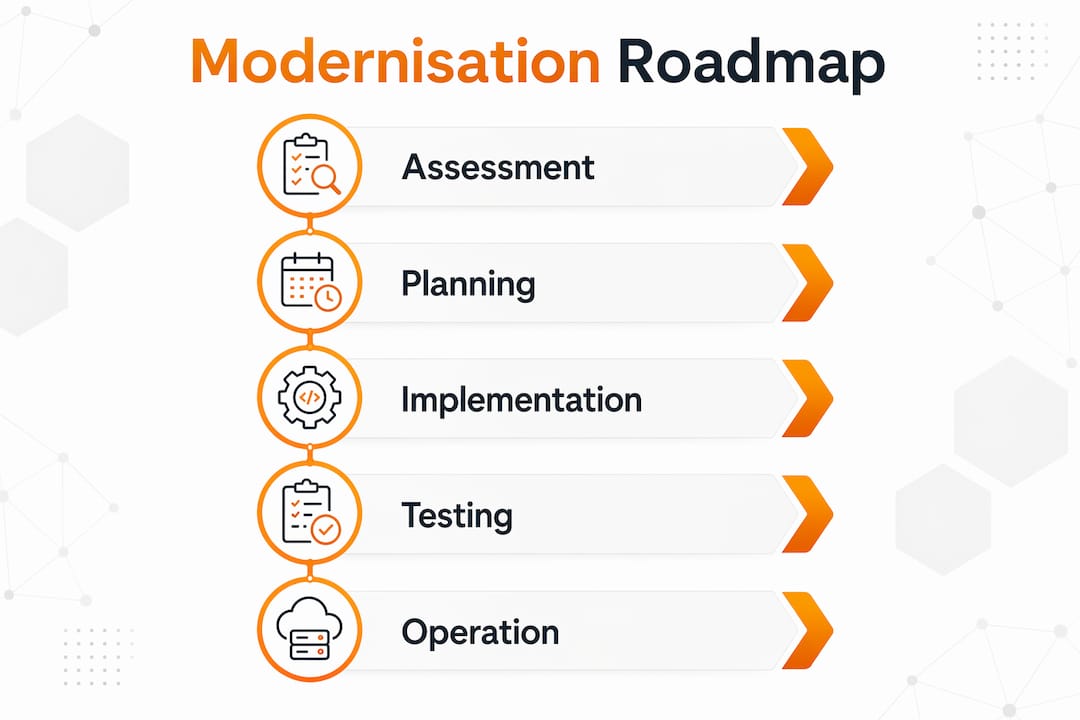
A well-structured programme runs across four phases over roughly 0–36 months. The exact durations depend on estate complexity, regulatory obligations and organisational capacity, but the sequencing is consistent.

Phase timeline and ownership
| Phase | Typical duration | Key milestones | Primary owner |
|---|---|---|---|
| Assess and prioritise | Months 1–3 | Dependency map, fitness-for-purpose scoring, regulatory gap analysis | CIO + Business sponsor |
| Quick wins and de-risk | Months 3–9 | PoC live, first integration tested, data catalogue started, DORA gap closed | Platform lead + Product owner |
| Incremental reconstruction | Months 9–24 | First domain migrated, parallel run completed, run-book handed over | Product teams + Data steward |
| Scale and operate | Months 24–36+ | Full domain coverage, AI models in production, cost-to-serve measured | Platform team + Security lead |
Milestone checklist by phase
- Assess and prioritise: Complete automated dependency mapping of the legacy estate; score each domain against fitness-for-purpose criteria; produce a regulatory gap analysis covering DORA, GDPR and AI Act obligations; agree a prioritised domain backlog with the business sponsor.
- Quick wins and de-risk: Run a time-boxed proof of concept on the highest-priority domain; validate integration patterns with at least one external partner; start the data catalogue and lineage documentation; close the most critical DORA ICT risk management gaps.
- Incremental reconstruction: Deliver iterative releases on a six-to-eight-week cadence; complete parallel run for the first domain cutover; hand over run-books to operations; demonstrate a measurable reduction in time-to-market for a new product.
- Scale and operate: Extend the pattern to remaining domains; operationalise the first AI model with documented explainability; measure cost-to-serve against the baseline; conduct a DORA resilience test.
Cost drivers to budget for
- Data migration and remediation: often the largest single cost item; undocumented data models and poor data quality require significant cleansing effort before migration.
- Integration work: connecting the new platform to distribution partners, reinsurers and regulatory reporting systems is rarely trivial.
- Parallel run costs: running old and new systems simultaneously during cutover adds temporary operational cost.
- Testing: contract testing, regression suites and user acceptance testing require dedicated resource.
- Change management: training, communication and process redesign are consistently underbudgeted.
European insurers broadly expect higher IT costs in the short term as they invest in data, compliance and resilience, with the payoff in agility and product velocity arriving in the medium term. Outcome-based funding — allocating budget to measurable business outcomes rather than project phases — keeps the programme honest and makes it easier to justify continued investment to the board. For core system strategies, phasing options and funding models, the four-strategy framework is a useful reference.
How do you change governance and culture so modernisation sticks?
Technology changes are reversible. Governance and culture changes are what make them permanent. This is where most multi-year programmes either succeed or quietly regress to the old model.
The structural shifts required are:
- Product teams own end-to-end delivery for a business domain (motor claims, commercial property underwriting) and hold the budget, the backlog and the outcome metrics.
- Platform teams provide the cloud infrastructure, CI/CD pipelines, API gateway and security tooling as internal services, reducing cognitive load on product teams.
- Central governance sets architecture guardrails, manages the regulatory reporting obligations and owns the vendor governance framework — it does not approve every technical decision.
- Accountable business owners sit alongside technology leads, not above them in a waterfall approval chain. They own the outcome KPIs and have the authority to make trade-off decisions.
Outcome-based funding replaces annual project budgets with persistent product team funding tied to measurable results. Architecture runway — a rolling investment in platform capabilities slightly ahead of product team demand — prevents the technical debt accumulation that derails later phases.
The KPIs that matter most for a modernisation programme are: time-to-market for new products (target: weeks, not quarters); change lead time (time from code commit to production); mean time to recover from incidents (a DORA-relevant metric); and cost-to-serve per policy. These four metrics tell you whether the programme is delivering commercial and operational value, not just technical change. For practical digital transformation guidance, including change management patterns for insurance teams, the linked resource covers the organisational dimension in detail.
Executive sponsorship is not a launch-day gesture. Programmes that succeed over 24–36 months have a named executive who actively removes blockers, sustains funding through budget cycles and visibly prioritises the programme against competing demands. When that sponsorship wavers, delivery teams fill the vacuum with compromise decisions that accumulate into the next generation of technical debt.
How does data modernisation enable underwriting, pricing and AI?
Data is the constraint that limits everything else. Clearwater Analytics found that data access and accuracy are the primary obstacles to digital operating models for EU insurers. Without clean, governed, accessible data, AI models cannot be built, regulatory reports cannot be trusted and pricing cannot be personalised.
Data architecture choices
The practical architecture decision is not “data lake vs. data warehouse” but how to combine streaming and batch pipelines to serve different consumers. Underwriting models need near-real-time data; regulatory reports can tolerate batch. Domain data lakes — each business domain owning its data and publishing it via a canonical model — prevent the central data team bottleneck that kills data programmes. Master data management for policy, customer and risk entities is unglamorous but foundational: without it, the same customer appears as three different records across claims, billing and CRM.
Governance checklist
- Document data lineage from source system to regulatory report for every material data flow.
- Build and maintain a data catalogue with ownership, classification and access controls.
- Implement consent management that satisfies GDPR’s purpose-limitation requirements and is auditable.
- Define data quality rules and automated monitoring before migrating data to the new platform.
- Establish a data stewardship function with named owners per domain.
AI readiness
| Capability | What good looks like | Common gap |
|---|---|---|
| Model development lifecycle | Versioned, reproducible training pipelines with documented data lineage | Ad hoc notebooks with no reproducibility |
| Explainability | Model outputs interpretable by underwriters and auditable by regulators | Black-box models with no explanation layer |
| Validation and testing | Independent validation of model performance and bias before deployment | Self-certification by the model development team |
| Operationalisation | Monitored in production with drift detection and retraining triggers | Models deployed and forgotten |
The EU AI Act classifies AI used for risk assessment and pricing in life and health insurance as high-risk, requiring documented data governance, bias testing and human oversight. EIOPA’s digital transformation paper highlights the tension between GDPR’s data minimisation principle and the data-intensive requirements of personalised insurance products — a tension that must be resolved at the architecture level, not the legal review stage.
Pro Tip: Treat DORA, the AI Act and GDPR as design constraints for your data architecture from day one. Retrofitting audit trails, consent management and explainability onto a live data platform costs three to five times more than building them in from the start.
What are the key risks and regulatory pitfalls for Central European insurers?
The failure modes are well documented. The question is whether your programme has explicit controls against each of them.
Risk and mitigation table
| Risk | Practical control | Owner |
|---|---|---|
| Hidden legacy dependencies | Automated dependency mapping before any migration; no cutover without a dependency register | Platform lead |
| DORA non-compliance | Map ICT risk management gaps in Phase 1; integrate incident reporting into run-books | Security lead + CIO |
| GDPR / AI Act intersection | Data protection impact assessments for all AI use cases; legal review of data flows before build | Data steward + Legal |
| Vendor lock-in | Contractual exit provisions; data portability standards; avoid proprietary data formats | Procurement lead |
| Underbudgeted parallel run | Model parallel run costs explicitly; include in business case; time-box the parallel period | Business sponsor |
| Skills gaps | Identify critical roles in Phase 1; plan training and hiring in parallel with technical delivery | CIO + HR |
| Brittle integrations | Contract testing for every integration point; no integration without a test suite | Platform lead |
Regulatory checklist for Central European programmes:
- DORA: ICT risk management framework documented and tested; third-party ICT provider register maintained; major incident reporting process live before go-live.
- EIOPA guidance: governance and operational resilience expectations met; digital transformation treated as a board-level strategic programme, not an IT project.
- GDPR: data flows mapped and documented; consent management in place; data subject rights processes automated where possible.
- EU AI Act: high-risk AI use cases identified; conformity assessment process defined; human oversight mechanisms built into model deployment.
The compliance challenges that arise during modernisation are predictable. Embedding compliance features into the platform — audit trails, data residency controls, access logging — is far cheaper than adding them retrospectively. Next-generation platforms that treat compliance as a built-in capability rather than a bolt-on are a material risk reduction for Central European insurers operating under DORA and GDPR simultaneously.
How do you choose platforms and partners in Central Europe?
Vendor selection is where good strategy meets procurement reality. The evaluation criteria that matter most for Central European insurers are different from those that dominate generic analyst frameworks.
Evaluation checklist:
- Regulatory fit: Does the platform produce outputs that satisfy EIOPA reporting requirements? Does it support data residency within the EU? Are audit trails built in?
- API maturity: Is the platform genuinely API-first, or does it have an API layer bolted onto a legacy core? Can partners onboard without bespoke integration work?
- Cloud model: Is it cloud-native (built for cloud from the ground up) or cloud-hosted (a legacy system running on a cloud VM)? The distinction matters for DORA resilience testing and auto-scaling.
- Upgrade model: Does the vendor provide Evergreen updates that keep the platform current without disruptive major version upgrades? What is the upgrade cadence and how are breaking changes managed?
- Exit planning: What does data portability look like? Can you extract your data in open formats? What are the contractual exit provisions?
- Central European references: Has the vendor deployed in Central Europe? Can they provide references from insurers operating under DORA and GDPR?
Procurement considerations:
- Define TCO over a five-to-seven-year horizon, not just licence cost. Include integration, migration, training and parallel run costs.
- Require evidence of Central European deployments, not just EMEA references.
- Assess the vendor’s own DORA compliance as a third-party ICT provider — you are responsible for their resilience under your DORA obligations.
- Include exit provisions and data portability requirements in the contract before signing.
PoC template: A short pilot should prove four things: data can flow from your legacy system to the new platform without loss; a new product can be configured and launched without vendor involvement; at least one external integration (a distribution partner or reinsurer) works end-to-end; and the platform can recover from a simulated incident within your target RTO. If a vendor cannot support all four in a six-to-eight-week PoC, that is a signal worth taking seriously.
IBSuite and IBA: what to look for in a Central European context
IBSuite, built by Insurance Business Applications (IBA), is a cloud-native, API-first insurance platform that covers the full P&C value chain: sales, underwriting, policy administration, claims, billing, rating, CRM and financial sub-ledger. It has been available since 2010 and is built on AWS with Evergreen updates, meaning the platform stays current without disruptive major version upgrades. For Central European insurers, the relevant questions to ask of any platform in this category — using IBSuite as the reference example — are:
- Data residency: Is EU data residency supported? Can data be confined to specific AWS regions within the EU?
- Regulatory reporting: Does the platform produce outputs compatible with EIOPA and national supervisory reporting requirements? Is the audit trail complete and exportable?
- Resilience SLAs: What are the documented uptime and recovery SLAs? How does the vendor demonstrate DORA-aligned resilience testing?
- Upgrade cadence: How frequently are updates released? How are breaking changes communicated and managed?
- Central European deployments: Can the vendor provide references from insurers operating under DORA and GDPR in Central Europe?
- API ecosystem: How mature is the partner onboarding process? How many live integrations exist with distribution partners, reinsurers and data providers relevant to Central Europe?
IBSuite’s API-first architecture means that a new distribution channel — an embedded partner, an MGA or a digital broker — can be onboarded without rebuilding the core platform. For Central European insurers trying to capture embedded insurance growth, that capability is the difference between a six-week integration and a six-month project.
The case for modernising European core systems is well established. The practical value of using an in-market example like IBSuite during vendor evaluation is that it gives your team a concrete reference point for what “API-first” and “cloud-native” actually mean in a production insurance context, rather than in a vendor presentation.
Your first 12-month checklist: deliverables and owners
The first year is about building credibility, closing the most critical regulatory gaps and proving the technical approach before committing to full-scale reconstruction.
Quarter 1 (Months 1–3): Discovery and prioritisation
- Commission automated dependency mapping of the legacy estate; produce a documented dependency register.
- Complete a regulatory gap analysis: DORA ICT risk management, GDPR data flows, AI Act applicability.
- Score each business domain against fitness-for-purpose criteria; agree the pilot domain with the business sponsor.
- Appoint named owners: business sponsor, product owner, platform lead, data steward, security lead, vendor engagement lead.
Quarter 2 (Months 4–6): Proof of concept and quick wins
- Launch a time-boxed PoC on the priority domain; validate data flows, product configuration speed and integration patterns.
- Start the data catalogue; document lineage for the five most material data flows.
- Close the highest-priority DORA ICT risk management gaps.
- Demonstrate one quick win to the board: a new product configured and launched, or a delegated authority flow automated.
Quarter 3 (Months 7–9): Iterative delivery begins
- Begin iterative delivery on the pilot domain; target six-to-eight-week release cycles.
- Complete at least one external integration end-to-end (distribution partner or reinsurer).
- Establish baseline metrics: time-to-market, change lead time, cost-to-serve.
- Conduct a tabletop DORA incident response exercise.
Quarter 4 (Months 10–12): Cutover preparation and run-book handover
- Complete parallel run for the pilot domain; validate data integrity against the legacy system.
- Hand over run-books to operations; confirm incident reporting processes are live.
- Present measured outcomes to the board: time-to-market improvement, cost-to-serve movement, regulatory gap closure.
- Agree funding and scope for Phase 3 (incremental reconstruction of remaining domains).
Owner roles at a glance:
- Business sponsor: sustains funding, removes blockers, owns the board narrative.
- Product owner: owns the domain backlog, prioritises features against outcome metrics.
- Platform lead: owns the technical architecture, dependency register and integration patterns.
- Data steward: owns the data catalogue, lineage documentation and consent management.
- Security lead: owns DORA compliance, incident reporting and third-party risk.
- Vendor engagement lead: manages the platform vendor relationship, SLAs and exit provisions.
For back-office transformation priorities and timeline examples relevant to 2026, the linked resource provides additional detail on sequencing and milestone ownership.
Key takeaways
Insurance modernisation succeeds when it is treated as a multi-year capacity-building programme with regulatory compliance as a design constraint, outcome-based funding, and executive sponsorship sustained across every budget cycle.
| Point | Details |
|---|---|
| Modernisation is strategic, not technical | Replace legacy estates with modular platforms, data fabrics and new operating models to meet DORA, GDPR and AI Act obligations. |
| Compliance is a design input | Embed DORA, GDPR and AI Act requirements into architecture from day one; retrofitting costs far more. |
| Favour incremental reconstruction | Start with the domain where legacy most constrains value; use learnings to calibrate cost and pace for the rest. |
| Measure what matters | Track time-to-market, change lead time, mean time to recover, and cost-to-serve to demonstrate commercial and operational value. |
| IBSuite as a reference example | IBSuite by IBA is a cloud-native, API-first platform available in Central Europe, covering the full P&C value chain with Evergreen updates and EU data residency support. |
What practitioners get wrong about Central European transformations
The conventional wisdom on insurance modernisation focuses almost entirely on technology selection. Choose the right platform, the argument goes, and the rest follows. After watching several Central European programmes up close, that framing misses the harder problem.
The technology is rarely what fails. What fails is governance. Specifically: the moment a programme moves from the exciting discovery phase into the grinding middle of incremental reconstruction, executive attention drifts. Budget cycles create pressure to declare victory early. Business owners who were enthusiastic sponsors in month three become passive observers by month eighteen. The technical team, deprived of active sponsorship, starts making compromise decisions — keeping a legacy integration “temporarily”, deferring the data catalogue, skipping the contract test suite. Each compromise is individually defensible. Collectively, they rebuild the technical debt the programme was meant to eliminate.
The second thing practitioners underestimate is the cultural distance between a traditional insurance operating model and a product-team model. Central European insurers often have strong actuarial and underwriting cultures with deep domain expertise, but governance structures built around annual planning cycles and committee approval chains. Shifting to outcome-based funding and empowered product teams is not a process change; it is a change in who holds authority and how decisions get made. That takes longer than any technology migration, and it requires the same executive persistence.
The practical lesson: budget for governance and culture change as explicitly as you budget for cloud infrastructure. Treat the operating model design as a deliverable in Phase 1, not an aspiration for Phase 3. And keep the executive sponsor’s name on the programme board, not just the launch announcement.
Accelerate your first pilot with a structured demo
If you are at the stage of validating platform assumptions before committing to a full business case, a structured demo or short advisory engagement can compress months of evaluation into a few focused sessions. Ibapplications offers demo sessions for IBSuite that walk through product configuration speed, API integration patterns and regulatory reporting outputs in a Central European context. This is not a substitute for your own procurement process and due diligence, but it is a practical way to test whether a cloud-native, API-first platform can actually deliver what the vendor claims before you write the business case. Book a demo to see IBSuite in a scenario relevant to your product lines and regulatory obligations.
Useful sources and further reading
The sources below are the primary references used in this article. They are listed by audience relevance.
For regulators and compliance leads:
- EIOPA: Digital Transformation in Insurance — Lessons Learned and Future Priorities — the definitive European regulatory perspective on digital transformation, DORA, GDPR and the AI Act interaction. Read this first.
- EIOPA: Supervising Digital Transformation in the Age of AI — covers AI Act obligations, high-risk AI classification and EIOPA’s supervisory expectations.
- EIOPA: Regulatory Framework Applicable to AI Systems in the Insurance Sector — practical factsheet on AI Act requirements for insurers.
For technologists and programme leads:
- Thoughtworks: Insurance in EMEA — Key Tech Trends for 2026 — market trends, embedded insurance projections and platform architecture guidance.
- Thoughtworks: Legacy Modernisation in Insurance — Why Insurers Should Act Now — practical case for incremental, domain-scoped modernisation with AI and automation support.
- Clearwater Analytics: The Digital Promise — Operational Challenges for EU Insurers — EU insurer survey data on data strategy, operating model fitness and IT cost trends.
For programme sponsors:
- Adacta: State of Insurance Core System Legacy Modernisation, Market Survey 2025 — survey data on core system pain points and modernisation priorities.
- Ibapplications: Why European Insurers Are Modernising Core Systems — region-specific context and implementation considerations for Central Europe.
- Ibapplications: Regulatory Compliance in Insurance — 2026 Guide — Central European regulatory overview and practical compliance timelines.
FAQ
What is insurance modernisation?
Insurance modernisation is a strategic programme to replace legacy core systems with cloud-native platforms, modern data architecture and new operating models, enabling insurers to meet regulatory obligations (DORA, GDPR, AI Act), launch products faster and scale digital distribution.
How long does an insurance modernisation programme take?
A phased programme typically runs 24–36 months from initial assessment to steady-state operation, with the first measurable outcomes — a PoC live, a new product launched, critical DORA gaps closed — achievable within the first six to nine months.
What does DORA require of insurers modernising their systems?
DORA requires documented ICT risk management, resilience testing, major incident reporting and a maintained register of third-party ICT providers. For modernisation programmes, this means dependency mapping, run-book documentation and vendor governance must be built in from Phase 1, not added at go-live.
What is IBSuite and why is it relevant for Central European insurers?
IBSuite is a cloud-native, API-first insurance platform by Ibapplications that covers the full P&C value chain, built on AWS with Evergreen updates and EU data residency support. It is relevant for Central European insurers because it is designed to meet DORA and GDPR obligations while enabling rapid product configuration and embedded distribution.
How does the EU AI Act affect insurance modernisation?
The EU AI Act classifies AI used for risk assessment and pricing in life and health insurance as high-risk, requiring documented data governance, bias testing, explainability and human oversight. Insurers modernising their data and AI capabilities must build these requirements into their data architecture and model development lifecycle from the outset.