09.04.26
Modern insurance infrastructure: a guide for P&C transformation

TL;DR:
- Nearly 74% of insurance infrastructure transformations fail due to poor approach rather than technology. Modernisation offers significant benefits like faster product launches, cost reductions, and improved customer experience. Successful programmes focus on business transformation involving people, processes, and technology, not just IT upgrades.
Nearly 74% of insurance infrastructure transformations fail, not because the technology is wrong, but because the approach is. For P&C insurers, the pressure to modernise has never been sharper. Climate volatility, AI-driven competition, and rising customer expectations are reshaping the market faster than legacy systems can respond. This guide cuts through the noise to give insurance executives and IT leaders a practical, evidence-based framework for modernising core infrastructure. You will find methodologies, real-world benchmarks, and honest guidance on what separates successful transformations from costly failures.
Table of Contents
- Why modern insurance infrastructure matters now
- Core approaches to modernising insurance infrastructure
- Benchmarks, outcomes and real-world impact
- Addressing challenges and choosing the best-fit path
- A practical perspective: What actually works in insurance modernisation
- How to accelerate your insurance infrastructure transformation
- Frequently asked questions
Key Takeaways
| Point | Details |
|---|---|
| Modernisation is critical | Updating infrastructure is essential for competitiveness and cost-efficiency in P&C insurance. |
| Mindset trumps technology | Successful projects prioritise people, processes, and measurable business outcomes over pure tech solutions. |
| Benchmarks drive credibility | Evidence from leading insurers shows double-digit efficiency gains and rapid payback. |
| No one-size-fits-all | Pick the methodology—rip-and-replace, incremental, or hybrid—best suited to your organisation’s context. |
Why modern insurance infrastructure matters now
Legacy core systems are no longer just a technical inconvenience. They are a strategic liability. Insurers running on outdated policy administration, billing, and claims platforms routinely face product launch cycles measured in months, not days. IT teams spend the majority of their budget maintaining systems that were never designed for APIs, cloud, or real-time data exchange. The result is a compounding disadvantage as competitors move faster and customers expect more.
The strategic case for change is clear. Modernisation is existential for competitiveness amid AI advances, climate risk, and talent gaps, with potential savings of up to 1% of gross written premium. For a mid-sized P&C insurer writing £500 million in GWP, that is a £5 million annual saving. Not a rounding error.
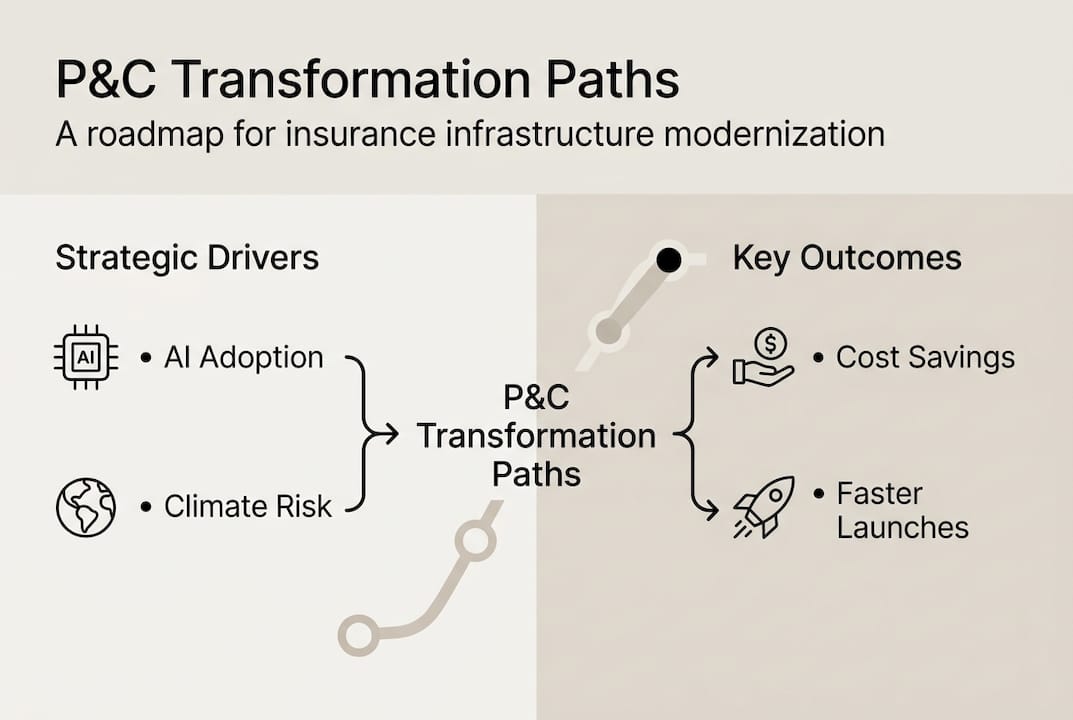
Capital expenditure for modernisation typically runs at 2 to 4% of GWP, with operational savings of 0.5 to 1% once the new platform is fully embedded. The payback period is real, but so is the risk of doing nothing. Insurers that delay are watching their insurance transformation drivers compound: talent who understand legacy COBOL systems are retiring, and the cost of technical debt grows every year.
Modern infrastructure also enables capabilities that legacy systems simply cannot support. Insurers are already experimenting with stablecoin premiums as a new payment model, a move that requires real-time API connectivity and flexible billing architecture. That kind of experimentation is impossible on a monolithic core.
Here are the key benefits that a modern insurance platform delivers:
- Speed to market: New products and endorsements can be configured in days rather than months
- Regulatory agility: Built-in compliance tools adapt to changing rules without custom development
- Customer experience: Real-time data and omnichannel support enable personalised, responsive service
- IT cost reduction: Cloud-native architecture eliminates expensive on-premise infrastructure
- AI readiness: Clean, structured data and open APIs make AI integration straightforward
- Scalability: Elastic cloud capacity handles volume spikes without manual intervention
The opportunity is significant. The risk of inaction is greater.
Core approaches to modernising insurance infrastructure
There is no single path to modernisation. The right approach depends on your organisation’s risk appetite, existing architecture, and strategic priorities. Understanding the main methodologies is the first step to choosing wisely.
Core modernisation involves transitioning to cloud-native SaaS platforms using microservices and agentic AI across all policy, claims, and billing operations. Each methodology has distinct strengths.
| Methodology | Pros | Cons | Best use case |
|---|---|---|---|
| Agentic AI integration | Accelerates discovery and migration | Requires clean data | Complex legacy environments |
| Microservices architecture | Modular, independently deployable | Higher initial complexity | Large, multi-product insurers |
| SaaS platform adoption | Fast deployment, Evergreen updates | Less customisation | Growth-stage or regional carriers |
| Zero-based design | Clean slate, no legacy constraints | High disruption risk | Greenfield or spin-off entities |
| API-first decoupling | Preserves legacy while enabling change | Slower full transformation | Insurers with stable core but digital ambitions |
For most established P&C insurers, a phased migration strategy offers the best balance of speed and risk management. Here is a practical sequence:
- Assess and map: Catalogue all systems, data flows, and integration points. Agentic AI tools can automate this discovery phase significantly.
- Define the target architecture: Agree on the future-state platform, whether SaaS, hybrid, or cloud-native build.
- Decouple via APIs: Introduce an API layer between legacy and new systems to enable parallel operations.
- Migrate incrementally: Move one domain at a time, starting with billing or rating where risk is lower.
- Validate and stabilise: Run parallel operations, validate data integrity, and confirm business continuity.
- Decommission legacy: Only retire old systems once the new platform is fully proven in production.
Pro Tip: Start with APIs before touching the core. An API layer lets you connect modern front-end tools and third-party services to your legacy system immediately, delivering business value while the deeper platform transformation proceeds in the background. This approach also gives your team time to build confidence in the new architecture before the high-stakes cutover.
A well-documented example of this in practice is the pet insurance automation case, where phased automation delivered measurable results without disrupting live operations.
Benchmarks, outcomes and real-world impact
Methodologies are only credible when backed by evidence. The good news is that the data from leading modernisation programmes is compelling.
Swiss Life’s cloud transformation delivered a 25% reduction in IT costs and 98% less time spent on SQL server management. DICEUS-led programmes achieved 65 to 75% less manual processing, with time-to-change dropping from 8 to 16 weeks down to just 3 to 5 days. These are not marginal gains. They represent a fundamental shift in operating capability.

| Metric | Before modernisation | After modernisation |
|---|---|---|
| IT cost as % of GWP | 4.5%+ | 3.0 to 3.5% |
| Product launch cycle | 3 to 6 months | 1 to 4 weeks |
| Manual processing rate | High (65 to 75% of tasks) | Near-automated |
| Time-to-change (core config) | 8 to 16 weeks | 3 to 5 days |
| SQL server management burden | Significant | Reduced by 98% |
The insurance cloud migration outcomes above are achievable, but they require disciplined execution. Insurers that treat modernisation as a pure IT project, rather than a business transformation, consistently underperform.
Why 74% of transformations fail: The most common failure modes are not technical. They include insufficient executive sponsorship, underestimating change management complexity, attempting to migrate everything at once, and failing to align IT deliverables with business outcomes. Programmes that succeed treat people and process change as equal priorities alongside technology.
The modern platform benefits extend beyond cost. Insurers report faster regulatory filings, improved NPS scores, and the ability to launch in new markets without building bespoke systems. These strategic gains are harder to quantify but often more valuable than the IT savings alone.
Addressing challenges and choosing the best-fit path
The benefits are clear, but how do you navigate real-world challenges? Even well-resourced programmes encounter significant friction. Understanding the most common obstacles before you start is the difference between a managed programme and a crisis.
Key edge cases include multi-country regulatory requirements, massive system dependencies, high migration risks, vendor lock-in, and siloed data that blocks effective AI deployment. The debate between full replacement versus incremental enhancement is live in every boardroom, with no universal answer.
The most common practical challenges are:
- Regulatory complexity: Multi-jurisdiction compliance requirements can make a single configuration change a months-long legal review process
- Data quality and migration risk: Legacy systems often contain decades of inconsistent, poorly structured data that must be cleansed before migration
- Vendor lock-in: Proprietary platforms can create new dependencies that are as constraining as the legacy systems they replaced
- Siloed data architecture: Disconnected systems prevent the unified data model that AI and analytics require
- Organisational resistance: Business units that have built workarounds on legacy systems often resist change, even when the new platform is objectively better
Choosing between full rip-and-replace, incremental enhancement, or a hybrid buy-and-configure model requires honest assessment of your organisation’s risk tolerance and timeline. Use risk assessment tools to quantify migration complexity before committing to a path.
An API-first approach reduces migration risk significantly by allowing legacy and modern systems to coexist during transition. For insurers with complex regulatory environments, this is often the only viable path. The critical modernisation challenges facing P&C insurers are well documented, and integration challenge solutions exist for most scenarios.
Pro Tip: Establish federated governance from day one. Assign clear ownership of data, processes, and outcomes across both IT and business units. Set KPIs tied to business results, such as time-to-market and claims cycle time, not just technical milestones like server migrations. This keeps the programme accountable to value, not activity.
A practical perspective: What actually works in insurance modernisation
After working with P&C insurers across multiple markets, one pattern stands out clearly. Programmes that treat modernisation as a technology procurement exercise almost always underdeliver. The ones that succeed treat it as a business transformation that happens to involve technology.
70% of transformation success depends on people and processes, not just the technology itself. Yet most budgets and timelines are allocated almost entirely to software and infrastructure. That imbalance is where programmes quietly fail.
The 10-20-70 rule is instructive here. Roughly 10% of transformation value comes from the data and tools, 20% from the algorithms and platform capabilities, and 70% from the people, processes, and organisational behaviours that determine whether the platform is actually used well. Choosing the right software stack matters, but it is not the differentiator.
What actually moves the needle is aligning business and IT leadership from the very first day, setting outcome-based KPIs rather than milestone-based ones, and maintaining executive sponsorship through the inevitable friction of a live migration. The transformation drivers are real and urgent, but urgency without discipline produces expensive failures. Slow down to go fast.
How to accelerate your insurance infrastructure transformation
Applying this perspective can be accelerated with the right platform and partner. IBSuite, built by Insurance Business Applications (IBA), is a cloud-native, API-first core insurance platform designed specifically for P&C insurers. It covers the full value chain, from policy administration and underwriting to claims, billing, rating, and CRM, all within a single, Evergreen-updated platform built on AWS. IBA’s approach is grounded in the same evidence-based principles covered in this guide: phased migration, API-first decoupling, and outcome-focused delivery. If you are ready to move from planning to action, book a demo to see how IBSuite can fit your modernisation roadmap.
Frequently asked questions
What is modern insurance infrastructure?
Modern insurance infrastructure combines cloud-native, API-driven systems, agentic AI, and modular SaaS platforms to support efficient, digital-first operations. It replaces monolithic legacy cores with flexible, interconnected components that can evolve without full system replacements.
How can agentic AI help insurers modernise core systems?
Agentic AI is used across eight modernisation phases, from discovery to migration, accelerating process mapping, reducing manual handling, and cutting integration errors. It makes complex migrations faster and less risky than traditional approaches.
What are common pitfalls in insurance modernisation?
The biggest pitfalls include underestimating change management, siloed data, regulatory complexity, and misaligned business-IT priorities. As the 74% failure rate shows, people and process issues cause more programme failures than technology choices.
How much can insurers save by modernising their infrastructure?
Savings typically reach 0.5 to 1% of GWP, alongside a 25% reduction in IT costs and 65 to 75% less manual processing. For large P&C carriers, these figures represent tens of millions in annual operational improvement.
Recommended
- How to Digitize Insurance Processes for P&C Insurers – Digital Insurance Platform | IBSuite Insurance Software | Modern Insurance System
- Insurance Change Management: How It Drives P&C Transformation – Digital Insurance Platform | IBSuite Insurance Software | Modern Insurance System
- Optimizing Cloud Insurance Platforms for P&C Success
- Digital Transformation Roadmap for P&C Insurance Success – Digital Insurance Platform | IBSuite Insurance Software | Modern Insurance System
- Demivolt | News – Aon Tests Stablecoin Payments for Insurance Premiums