05.03.26
How to modernise insurance systems: cut costs 35-50% in 2026

Legacy policy and claims systems cause 35-50% higher IT maintenance costs for 45% of insurers, risking competitiveness in a digital-first market. Modernisation is no longer optional. It’s vital to meet customer expectations, regulatory demands, and operational efficiency goals. This guide walks you through preparing, executing, and measuring successful modernisation projects that transform your P&C insurance operations.
Table of Contents
- Prerequisites And Preparations For Modernisation
- Core Steps For Modernising Insurance Systems
- Modernisation Strategies And Vendor Selection Tradeoffs
- Common Mistakes And Troubleshooting Modernisation Projects
- Expected Results And Timelines For Modernisation
- Explore Modern Insurance Platforms To Accelerate Your Transformation
- Frequently Asked Questions
Key takeaways
| Point | Details |
|---|---|
| Legacy systems drain budgets | Outdated P&C platforms increase IT costs by 35-50%, limiting innovation and agility. |
| Preparation drives success | Executive buy-in, IT readiness, and stakeholder alignment are essential before modernisation begins. |
| Cloud-native and AI accelerate outcomes | Modern platforms with API-first architecture and AI integration cut processing times by 25% and improve customer satisfaction. |
| Incremental upgrades balance risk | Phased modernisation spreads costs, reduces upfront risk, and allows continuous validation of results. |
| Projects deliver measurable ROI | Typical implementations complete in 12-24 months with significant cost reductions and operational improvements. |
Prerequisites and preparations for modernisation
Secure executive leadership buy-in and strategic clarity before any modernisation initiative. Without C-suite sponsorship, projects stall due to budget constraints and competing priorities. Define clear strategic goals that align with business outcomes, whether reducing costs, improving customer experience, or accelerating product launches.
Ensure your IT infrastructure supports cloud-native and API-first architectures. Legacy environments often lack the flexibility needed for modern platforms, so assess current capabilities early. Robust data governance frameworks are non-negotiable. Inconsistent data standards create migration headaches and compromise system integrity.
Engage stakeholders across underwriting, claims, IT, and compliance from day one. Early involvement builds consensus and surfaces technical or regulatory concerns before they derail timelines. Transparent communication keeps all parties aligned on objectives, milestones, and expected outcomes.
Develop detailed migration plans that map data flows, integration points, and rollback procedures. Underestimating this complexity causes cost overruns in 40% of projects. Consider how modern insurance platform benefits support your strategic goals and explore cloud insurance platforms for P&C success to understand infrastructure requirements.
Pro Tip: Establish a dedicated modernisation steering committee with representatives from all key departments. This cross-functional team ensures decisions reflect operational realities and accelerates issue resolution.
With solid preparations in place, we move on to the core steps for executing the modernisation successfully.
Core steps for modernising insurance systems
Start by assessing your legacy systems comprehensively. Document technical debt, integration dependencies, and business-critical workflows. This audit reveals which components need immediate replacement versus gradual retirement.
Secure leadership support with a business case that quantifies expected savings and efficiency gains. Allocate budget for software licences, implementation services, training, and contingency reserves. Realistic funding prevents mid-project compromises that undermine outcomes.
Establish data governance policies and detailed migration strategies before touching production systems. Clean, standardised data ensures smooth transitions and accurate reporting post-migration. Validate data quality through pilot runs that catch issues early.
Select cloud-native, API-first core platforms designed for scalability and agility. These architectures support rapid product innovation and seamless integrations with third-party services. Evaluate vendors based on their ability to support your specific lines of business and regulatory requirements.

Implement AI to automate underwriting, claims processing, and risk analysis. AI integration reduces processing times by 25% and improves accuracy in risk assessment. AI-powered claims transformation achieves resolution times under 10 days with customer satisfaction scores exceeding 760 out of 1000.
Follow this implementation sequence:
- Launch pilot projects with non-critical business lines to validate platform capabilities.
- Monitor key performance indicators like processing speed, error rates, and user satisfaction.
- Iterate based on feedback before scaling to core operations.
- Roll out full deployment in phases, maintaining parallel operations initially.
- Decommission legacy systems only after confirming stable production performance.
Continuous testing and validation reduce the risk of disruptions. Consider how AI integration in underwriting and claims transforms operations and explore API-first core insurance platforms to understand architecture benefits.
Pro Tip: Assign dedicated product owners to oversee each modernisation workstream. Their accountability ensures issues get resolved quickly and project momentum stays strong.
Having established the step-by-step process, we next weigh the different modernisation strategies and vendor selection tradeoffs.
Modernisation strategies and vendor selection tradeoffs
Incremental modernisation by hollowing out legacy systems mitigates risk and spreads investment over manageable phases. This approach replaces modules gradually, maintaining business continuity throughout. You validate each upgrade before proceeding, reducing the chance of catastrophic failures.
Full system replacements deliver faster end-state outcomes but carry higher initial risk. Big-bang implementations can disrupt operations if not executed flawlessly. They require extensive testing and robust contingency planning to handle unforeseen issues.
Vendor cloud-native platforms accelerate timelines by 20-30% compared to in-house development. Established vendors bring domain expertise, pre-built integrations, and continuous platform improvements. In-house builds offer customisation but demand significant internal resources and longer development cycles.
Key evaluation criteria for vendor platforms include:
- API-first design enabling flexible integrations with existing and future systems
- Scalability to handle volume growth without performance degradation
- Ecosystem partnerships providing pre-built connectors to essential third-party services
- Regulatory compliance support for jurisdictions where you operate
- Implementation track record with similar P&C insurers
Compare approaches based on your organisation’s capabilities and risk tolerance:
| Strategy | Cost | Timeline | Risk | Best For |
|---|---|---|---|---|
| Incremental modernisation | Spread over phases | 18-24 months | Low to medium | Risk-averse organisations with complex legacy systems |
| Full replacement | Higher upfront | 12-18 months | Medium to high | Insurers with clear end-state vision and strong change management |
| Vendor platform | Licence fees plus implementation | 12-18 months | Low to medium | Most P&C insurers seeking proven solutions and faster deployment |
| In-house build | Development resources plus ongoing maintenance | 24-36 months | High | Large insurers with specialised requirements and deep technical teams |
Tradeoffs involve balancing speed against risk, cost against control, and standardisation against customisation. Explore core platform vendor evaluation to understand selection criteria in depth.
Understanding strategies helps avoid pitfalls, so let’s explore common mistakes and how to troubleshoot them.
Common mistakes and troubleshooting modernisation projects
Data migration complexity gets underestimated in 40% of projects, causing cost overruns and timeline delays. Legacy data often contains inconsistencies, duplicates, and outdated formats that require extensive cleansing. Plan meticulously with expert help to map every data element and validate transformations through multiple test cycles.
Failing to align stakeholders creates resistance that stalls progress. Technical teams may prioritise different features than business users, leading to friction and rework. Regular workshops and transparent roadmaps keep everyone focused on shared objectives.
Incomplete vendor evaluation causes poor platform fit and costly rework. Rushing procurement decisions without thoroughly testing capabilities against your requirements leads to gaps discovered mid-implementation. Conduct proof-of-concept trials with real data and workflows before signing contracts.
Neglecting change management reduces adoption and undermines transformational benefits. Users revert to workarounds if training is inadequate or new systems feel cumbersome. Invest in comprehensive training programmes and communicate benefits clearly to build enthusiasm.
Successful modernisation requires treating people and processes with the same rigour as technology. Continuous communication and hands-on support during transitions make or break adoption rates.
Mitigation strategies include:
- Appointing data migration specialists early to assess complexity and build realistic plans
- Holding bi-weekly stakeholder reviews to surface concerns and adjust course
- Running extended vendor evaluations with pilots on representative workloads
- Developing role-based training tailored to each user group’s daily tasks
- Establishing support channels for post-launch questions and feedback
Learn more about managing change during modernisation to reduce resistance and accelerate adoption.
Pro Tip: Create a lessons-learned repository after each project phase. Documenting what worked and what didn’t helps refine your approach for subsequent rollouts and builds institutional knowledge.
With risks managed, it’s important to set realistic expectations on results and timelines, which we cover next.
Expected results and timelines for modernisation
Projects generally complete within 12 to 24 months with proper planning and phased execution. Complexity, organisational readiness, and vendor capabilities influence actual duration. Incremental approaches trend towards the longer end whilst full replacements can compress timelines if executed well.
IT maintenance costs drop by 35-50% post-modernisation as cloud-native platforms eliminate legacy infrastructure overhead. Automated updates and scalable architectures reduce the need for manual patching and capacity planning.
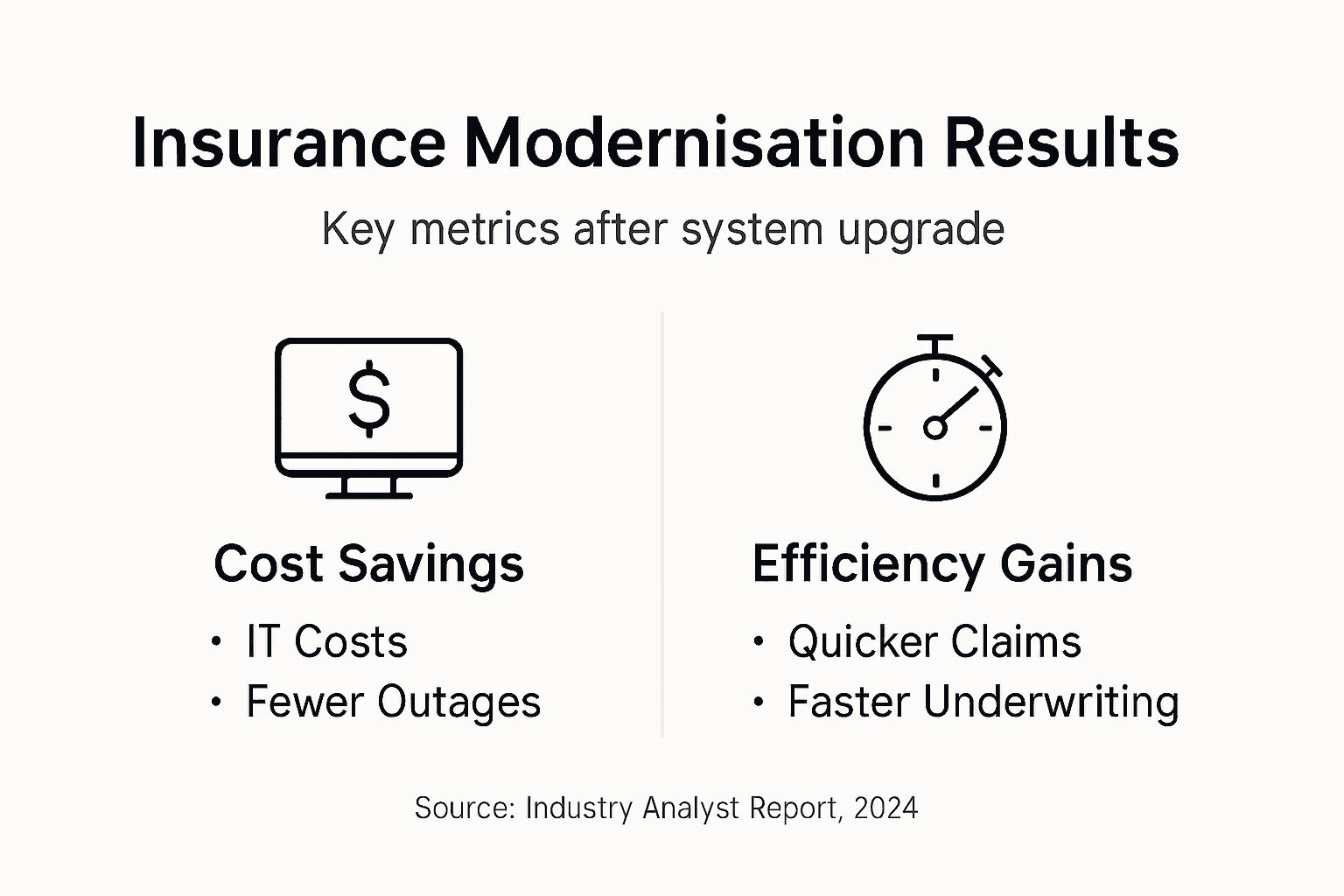
Processing times for underwriting and claims cut by 25% or more through AI automation and streamlined workflows. Faster cycle times improve customer satisfaction and free staff for higher-value activities. Claims resolved under 10 days drive satisfaction scores above 760 out of 1000, significantly boosting retention and referrals.
Key performance indicators to track:
| Metric | Baseline | Target Post-Modernisation |
|---|---|---|
| IT maintenance cost as % of revenue | 15-20% | 8-12% |
| Average underwriting cycle time | 7-10 days | 3-5 days |
| Claims resolution time | 15-20 days | Under 10 days |
| Customer satisfaction score | 650-700/1000 | Over 760/1000 |
| Product launch timeline | 6-12 months | 2-4 months |
Success depends on clear KPIs established before implementation and ongoing optimisation after go-live. Monitor system performance, user adoption rates, and business outcomes monthly. Adjust configurations and training based on real-world usage patterns.
Expect initial productivity dips during transitions as users adapt to new interfaces and workflows. Provide extra support during this learning curve to maintain morale and prevent reversion to old habits.
Now that expectations are clear, let’s bridge to practical solutions offered to help you modernise confidently.
Explore modern insurance platforms to accelerate your transformation
IBSuite offers cloud-native, API-first platforms tailored for P&C insurers seeking to modernise core systems efficiently. Our solutions integrate AI and modular architectures that deliver scalability, agility, and faster time-to-market for new products. We support the full insurance value chain from sales and underwriting to policy administration, claims, billing, and financial sub-ledger.
Explore modern insurance platform benefits to understand how end-to-end solutions transform operations. Learn how API-first insurance platforms enable seamless integrations and rapid innovation. Book a demo to see how IBSuite can support your modernisation goals and accelerate your digital transformation journey.
Frequently asked questions
How long does it take to modernise P&C insurance systems?
Modernisation projects generally take 12 to 24 months depending on scale, complexity, and chosen approach. Phased implementations allow for risk management, continuous validation, and ongoing improvements throughout the journey. Proper planning and stakeholder alignment significantly influence actual timelines.
What benefits does AI integration bring to insurance modernisation?
AI reduces underwriting and claims processing times by around 25%, improving operational efficiency substantially. It enhances risk assessment accuracy through advanced analytics and accelerates claims resolution to under 10 days. Faster processing drives customer satisfaction scores above 760 out of 1000, boosting retention and competitive positioning.
Should we build insurance systems in-house or select a vendor platform?
Vendor platforms accelerate timelines by 20-30% compared to in-house development and bring proven domain expertise. They offer pre-built integrations, continuous platform improvements, and lower ongoing maintenance costs. In-house builds provide customisation but require significant resources, longer development cycles, and higher risk of execution challenges.
What common mistakes should be avoided in modernisation projects?
Underestimating data migration complexity and poor stakeholder alignment cause delays and cost overruns in 40% of projects. Incomplete vendor evaluation leads to poor platform fit requiring costly rework. Early engagement, detailed planning, and comprehensive change management mitigate these risks effectively and improve success rates.
How can insurance companies reduce costs during modernisation?
Adopt incremental modernisation to spread investments over manageable phases and reduce upfront financial strain. Select cloud-native, modular platforms that offer scalability, automated updates, and lower maintenance expenses. Phased approaches allow continuous validation whilst controlling costs and minimising disruption to ongoing operations.
Recommended
- Why Modernizing Insurance Systems is Crucial for Growth – Digital Insurance Platform | IBSuite Insurance Software | Modern Insurance System
- Future-Proofing Insurance: 4 Key Strategies for Core System Modernization and Optimization – Digital Insurance Platform | IBSuite Insurance Software | Modern Insurance System
- The Real Cost of Doing Nothing: Insurance Core Replacement – Digital Insurance Platform | IBSuite Insurance Software | Modern Insurance System
- Modernizing Insurance Operations for Digital Agility – Digital Insurance Platform | IBSuite Insurance Software | Modern Insurance System
- Trend sicurezza informatica 2025: cosa cambia per le imprese italiane – Security Hub
- How Purifiers Save Cost for Homes and Businesses – Coway Water Purifier