27.01.26

Integrating New Insurance Channels for Seamless Growth

New digital channels promise fresh growth, yet legacy systems often hold insurers back from seizing these opportunities. As property and casualty leaders in Central Europe rethink operations, aligning technology with business objectives has never felt more urgent. With digitalisation increasingly impacting insurance operations, distribution, and pricing processes, this step-by-step guide highlights how to assess, prioritise, and realise effective integration across both core systems and emerging partner channels.
Table of Contents
- Step 1: Assess Existing Systems And Business Needs
- Step 2: Define Target Channels And Integration Scope
- Step 3: Configure IBSuite For New Channel Integration
- Step 4: Establish Secure API Connections With Partners
- Step 5: Test Data Flows And Channel Effectiveness
- Step 6: Monitor Performance And Optimise Integration
Quick Summary
| Key Point | Explanation |
|---|---|
| 1. Assess Current Systems First | Evaluate your existing infrastructure to identify weaknesses that might hinder growth. |
| 2. Define Target Channels Clearly | Select distribution channels based on your market strategy and customer preferences. |
| 3. Secure API Connections Essential | Implement robust security measures for API connections to protect customer data effectively. |
| 4. Test Data Flows Thoroughly | Conduct extensive testing of data flows across channels to ensure smooth operations. |
| 5. Monitor & Optimise Performance | Continuously track key metrics post-launch to identify areas for improvement and optimisation. |
Step 1: Assess existing systems and business needs
Before you integrate new insurance channels, you need a clear picture of what you’re working with. This assessment tells you whether your current systems can support growth or whether they’ll become bottlenecks. Start by documenting your existing infrastructure, from core policy administration platforms to claims management systems and customer relationship tools.
Gather your IT and business teams together to map out which systems are performing well and which ones are struggling. Ask straightforward questions: Where are manual handoffs creating delays? Which systems struggle to communicate with each other? Where does data live in silos instead of flowing freely across departments? These pain points reveal where integration efforts will deliver the most value.
Data capabilities matter enormously here. Digitalisation is increasingly impacting the insurance sector’s operations, distribution, and pricing processes, and insurers in Central Europe are gathering more data and applying smarter analytics to enable personalised products and acceptance policies. Your assessment should evaluate whether your current systems can collect, store, and analyse customer data effectively. Can you personalise offerings? Can you make faster underwriting decisions based on analytics? If not, that’s a gap worth addressing.
Next, clarify your business objectives for the next two to three years. Are you planning to launch direct online sales channels? Expand through broker partnerships? Enter new geographic markets? Each objective requires different capabilities. Understanding why modernising insurance systems is crucial for growth helps you prioritise which legacy system weaknesses to address first.
Document your findings in a simple matrix showing each system, its current performance, its age, the vendor support status, and any integration capabilities. This becomes your roadmap for determining which systems need replacement, enhancement, or integration work.
Pro tip: Involve your customer-facing teams early in this assessment. They see firsthand where systems fail customers, and their insights often reveal hidden friction points that purely technical assessments miss.
Step 2: Define target channels and integration scope
Now that you understand your current systems and business goals, it’s time to decide which distribution channels make sense for your business. This step determines what you’ll actually build and integrate, so choose deliberately based on your market position and customer base.
Start by identifying all possible channels you might use. Direct online sales, broker partnerships, agent networks, comparison platforms, workplace benefits platforms, and partnerships with banks or retailers all represent viable options. The question is which ones align with your strategy and your customers’ preferences. Some channels work brilliantly in one European market but struggle in another due to cultural preferences and regulatory differences.
Understand that insurance product manufacturers must carefully select distribution channels appropriate for the target market and product characteristics. Your chosen channels need to match both your products and the customers you’re trying to reach. A complex commercial liability product requires a different channel strategy than simple personal motor insurance.
Research your specific markets thoroughly. Distribution channels in Europe vary significantly by country and product type, with direct distribution via internet or telephone growing but still secondary in many markets. What works in Germany might not work in Poland. Understand whether your target customers prefer online self-service, personal advice from brokers, or a hybrid approach. This intelligence shapes your integration priorities.
For each channel you select, define the integration scope clearly. Does the channel need real-time policy data? Must it connect to your underwriting systems? Does it require claims reporting capabilities? The deeper the integration, the more complex and costly the work becomes. Prioritise channels that deliver the highest business impact first, then plan subsequent integrations accordingly.

Create a simple one-page summary for each channel showing why you selected it, which customer segments it serves, what products flow through it, and which systems it must connect to. This becomes your integration roadmap.
Here’s an overview of typical insurance distribution channels and their key advantages:
| Channel Type | Main Advantage | Typical Products | Customer Preference |
|---|---|---|---|
| Direct online sales | Immediate access, low cost | Simple personal insurance | Digital-first consumers |
| Broker partnerships | Expert advice, trust factor | Complex commercial lines | Businesses, professionals |
| Agent networks | Local presence, relationships | Life and property policies | Traditional, relationship-driven |
| Comparison platforms | Price transparency, choice | Motor, travel, life | Value-focused buyers |
| Bank/Retail partners | Bundle with existing services | Mortgage, life, accident | Convenience-seeking customers |
Pro tip: Start with one channel that offers quick wins rather than attempting to integrate everything simultaneously. Early success builds momentum and teaches your teams valuable lessons before tackling more complex integrations.
Step 3: Configure IBSuite for new channel integration
With your channels defined and integration scope mapped out, you’re ready to configure your core platform. IBSuite’s API-first architecture makes this stage significantly more manageable than attempting integrations with legacy systems. Your goal here is to prepare the platform to connect with your chosen channels whilst maintaining data consistency and business logic across all touchpoints.
Begin by mapping your channel requirements against IBSuite’s capabilities. Which data fields must flow from your channels into policy administration? What underwriting rules need to apply regardless of sales channel? How should claims reporting work when customers interact through different channels? Document these requirements clearly because they’ll drive your configuration decisions.
IBSuite’s modular design allows you to activate features aligned with your specific channels. If you’re launching broker partnerships, you’ll configure partner portals and commission management. For direct online sales, you’ll set up self-service policy purchase workflows and digital document handling. The platform supports multiple configurations simultaneously, meaning different channels can have tailored experiences whilst sharing underlying data integrity.
API connectivity is where modern integration becomes straightforward. Configure the integration points between IBSuite and your chosen channels by defining API endpoints, authentication protocols, and data mapping rules. The platform’s cloud-native architecture handles the heavy lifting of maintaining consistency across channels. When a customer purchases through one channel and later contacts support through another, their data remains unified and accessible.
Then establish your operational workflows. Configure notifications, approval chains, and handoffs between systems. Define how underwriting decisions flow back to channels, how claims progress updates reach customers, and how billing information syncs across platforms. IBSuite’s CRM integration demonstrates how seamlessly the platform connects customer interactions across touchpoints, enabling your teams to work more efficiently.
Test each configuration thoroughly before going live with channels. Run scenarios through your new workflows to ensure data flows correctly, calculations are accurate, and customer experiences feel seamless regardless of entry point.
Pro tip: Configure one channel end-to-end first, test it thoroughly in production, then use that successful configuration as your template for subsequent channels. This approach reduces errors and accelerates your overall integration timeline.
Step 4: Establish secure API connections with partners
Secure API connections form the backbone of your channel integrations. This step protects sensitive customer data, ensures regulatory compliance, and builds trust with your partners. Done properly, secure APIs enable seamless data exchange without compromising security or creating operational friction.
Start by implementing HTTPS encryption for all API traffic. This is your baseline. Every connection between IBSuite and your partner systems must use HTTPS to protect data in transit. Beyond encryption, you’ll need robust authentication mechanisms. OAuth2 is the industry standard for insurance integrations, allowing partners to access specific data sets without ever seeing your core credentials. This approach gives you granular control over what each partner can access.
Configure your API gateway to enforce these security standards consistently. The gateway acts as a gatekeeper, validating every request before it reaches your systems. Set rate limiting to prevent accidental or malicious overloads. Monitor all API traffic continuously to catch suspicious patterns early. Establishing secure API connections requires implementing HTTPS, authentication mechanisms like OAuth2, API gateway configuration, rate limiting, and continuous monitoring.
Understand your regulatory obligations. Open Insurance driven by API integrations creates new opportunities for insurers and partners, enabling seamless data exchange under regulatory frameworks emphasising data protection and consumer consent. You must obtain explicit customer consent before sharing personal data with partners. Document which partners can access which data elements and maintain audit trails showing exactly what was accessed and when.
Test your security architecture thoroughly before connecting live partner systems. Conduct penetration testing to identify vulnerabilities. Have partners test their side of the connection as well. Create clear documentation for partners about authentication requirements, data formats, and security protocols they must follow.
Once live, monitor API connections continuously. Set up alerts for unusual access patterns, failed authentication attempts, or data requests outside normal parameters. Regular security reviews should examine logs and access patterns quarterly.
Pro tip: Start with one trusted partner to validate your API security setup before expanding to others. This allows you to identify and resolve security issues in a controlled environment rather than discovering them under production pressure.
Step 5: Test data flows and channel effectiveness
Before your new channels go live to customers, you need confidence that data moves correctly through your systems and that channels actually deliver business results. This testing phase reveals problems in controlled conditions rather than during peak trading.
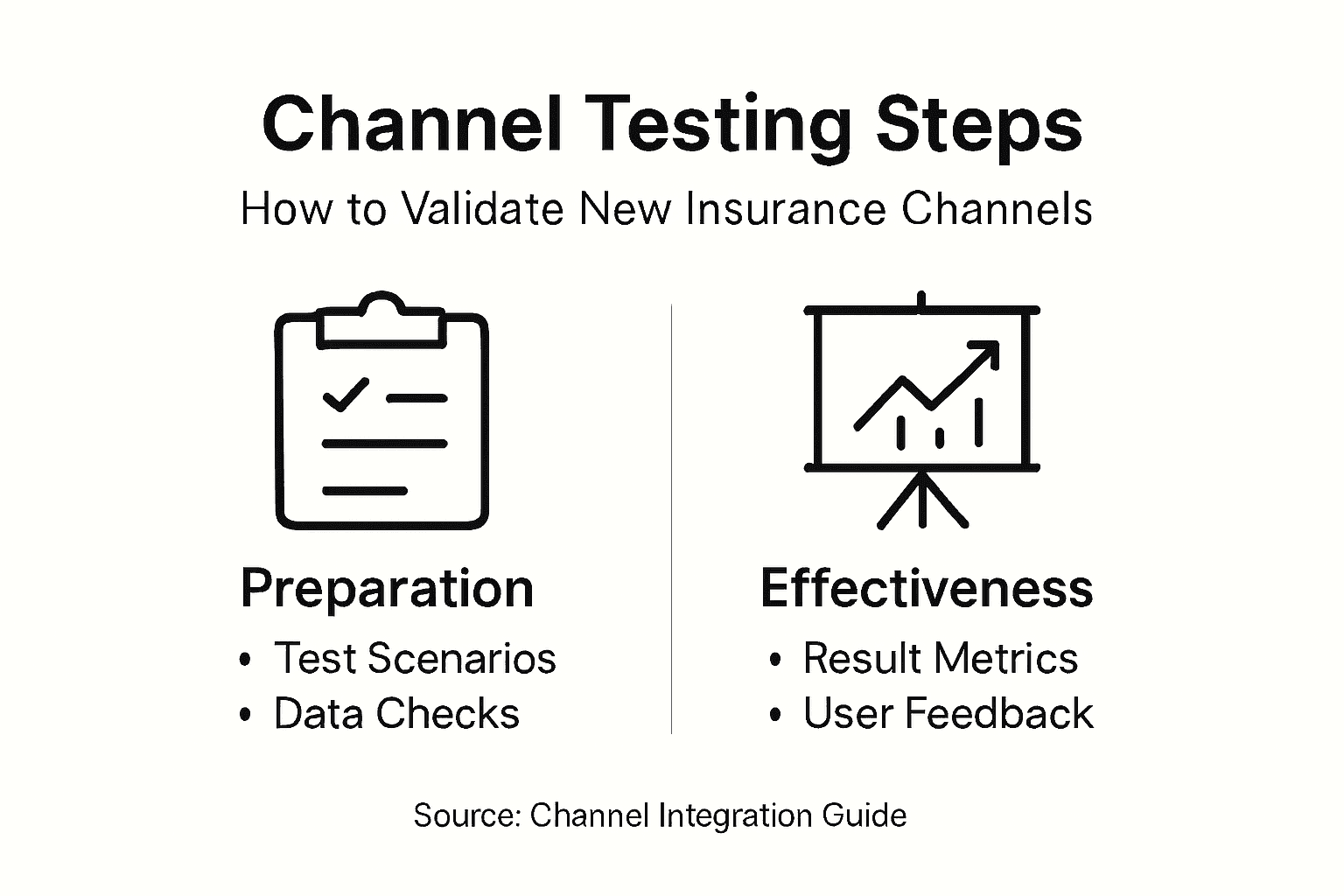
Start by creating test scenarios that mirror real customer journeys through each channel. If you’re launching broker partnerships, simulate policy submissions from brokers, underwriting approvals, and commission calculations. For direct online sales, test complete purchase workflows from quote to policy issuance. Run these scenarios repeatedly, checking that data arrives intact in IBSuite, calculations are accurate, and downstream systems receive correct information.
Monitor data quality throughout your test runs. Do customer names come through correctly? Are premium calculations consistent across channels? Does claims data sync properly when customers file reports through different touchpoints? Testing data flows and distribution channel performance identifies opportunities and challenges in expanding digital insurance services, with pilot testing and continuous monitoring ensuring seamless operation of new channels.
Measure channel effectiveness using concrete metrics. Distribution channel effectiveness analysis involves segmenting sales by channel, measuring premium revenues, persistency rates, and conversion rates, and evaluating acquisition costs and ROI. Track how many customers complete purchases through each channel. Calculate your cost per acquisition. Examine which customer segments prefer which channels. This data shows you which channels deliver genuine business value and which may need refinement.
Load testing matters significantly. Push realistic volumes through your channels to ensure systems remain responsive under stress. If you expect 500 online quotes daily, test with 750 to see how performance holds. Identify bottlenecks before customers experience delays.
Involve your operational teams in testing. They’ll catch workflows that technically work but create unnecessary manual effort. Their feedback often reveals practical issues that technical testing alone misses.
Pro tip: Run a limited pilot with real customers using one channel before full rollout. This exposes issues in production conditions whilst limiting customer impact, and gives your teams valuable experience handling real transactions.
Step 6: Monitor performance and optimise integration
Your channels are now live, but the work doesn’t end there. Continuous monitoring reveals what’s working brilliantly and what needs adjustment. This step transforms your integration from a static launch into a dynamic system that improves over time.
Establish a monitoring dashboard that tracks the metrics that matter most to your business. Watch conversion rates by channel. Monitor average response times when customers interact with your systems. Track error rates and failed transactions. Measure customer satisfaction scores disaggregated by channel. These metrics tell you immediately whether your integration is delivering the experience you promised.
Pay close attention to data quality issues that emerge in production. Real customer behaviour often reveals edge cases your testing didn’t anticipate. Are some customer data fields consistently incomplete? Are calculations occasionally producing unexpected results? Flag these patterns and investigate root causes. European insurers prioritise digital maturity and operational resilience, investing in digital-first strategies and channel optimisation, with continuous monitoring of channel performance informing ongoing refinement of distribution strategies.
Analyse which channels drive the most valuable customers. Some channels attract high-volume but low-retention customers. Others bring fewer customers but with excellent long-term value. The European insurance distribution market increasingly leverages data analytics for performance monitoring and channel optimisation, using comprehensive metrics to guide strategic decisions on acquisitions, partnerships, and technological enhancements. Use this insight to allocate marketing budgets more effectively and refine your channel strategy.
Schedule regular optimisation cycles. Monthly reviews work well for most organisations. Examine what’s changed in customer behaviour, which integrations show bottlenecks, and where partner feedback suggests friction. Prioritise improvements that deliver the highest impact. Maybe broker partners need faster claims status updates. Perhaps online customers struggle with a specific policy type. Address these systematically.
Keep your partners informed about performance. Share relevant metrics with them and work collaboratively to resolve issues. Strong partner relationships depend on transparency and shared commitment to continuous improvement.
Below is a summary of key metrics for monitoring new insurance channel performance:
| Metric | Description | Business Impact |
|---|---|---|
| Conversion rate | Percentage of leads converting to sales | Indicates channel effectiveness |
| Persistency rate | Ongoing policy retention rate | Reveals customer satisfaction |
| Average response time | Speed of system interactions | Affects client experience |
| Acquisition cost | Cost per new policy sold | Guides budget allocation |
| Customer satisfaction | Scores by channel | Highlights improvement areas |
Pro tip: Create automated alerts for critical performance thresholds rather than waiting for monthly reviews. If conversion rates drop suddenly or error rates spike, detecting these patterns immediately allows you to investigate before customer impact grows.
Accelerate Your Insurance Channel Integration for Seamless Growth
Integrating new insurance channels can feel complex when legacy systems cause delays, data silos, and inconsistent customer experiences. This article highlights the challenges of assessing existing infrastructures, securely connecting diverse channels, and maintaining flawless data flows while meeting regulatory demands. If your goal is to expand through broker partnerships, direct online sales or comparison platforms but you struggle with technical bottlenecks or integration complexity, you are not alone. Addressing these pain points with an API-first, cloud-native solution can transform friction into opportunity.
Insurance Business Applications (IBA) specialises in helping insurers overcome these exact problems with IBSuite — a fully integrated platform designed for effortless channel integration, secure API connections, and real-time data consistency across all touchpoints. With IBSuite, you gain:
- Streamlined onboarding of new distribution channels aligned to your business goals
- Comprehensive API security controls to safeguard customer data
- Modular features tailored for brokers, direct sales, and partner ecosystems
- End-to-end workflows that ensure seamless customer journeys regardless of channel
Do not let outdated systems hold back your growth ambitions. Discover how you can modernise your insurance distribution with confidence. Explore the advantages of an API-first insurance platform and start your transformation journey today. Book a demo now and unlock faster product launches, operational resilience, and stronger customer engagement.
Frequently Asked Questions
What are the first steps to assess my current insurance systems before integrating new channels?
Begin by documenting your existing infrastructure, including core policy administration platforms and claims management systems. Involve both IT and business teams to identify areas where manual processes create delays or lead to data silos.
How do I define which distribution channels to integrate into my insurance business?
Identify potential channels like direct online sales, broker partnerships, and comparison platforms that align with your business goals. Research customer preferences and product characteristics in your target market to select channels that will effectively reach your audience.
What should I consider when configuring IBSuite for new channel integration?
Map your channel requirements to IBSuite’s capabilities, detailing necessary data flows and underwriting rules. Ensure that each channel’s configuration also aligns with the overall business logic and data consistency across all touchpoints.
How can I ensure secure API connections with my partners during integration?
Implement HTTPS encryption and robust authentication mechanisms, such as OAuth2, to protect data exchange. Regularly monitor API traffic and establish clear security protocols for partners to follow for a secure integration process.
What metrics should I monitor to evaluate the effectiveness of my new insurance channels?
Track concrete metrics such as conversion rates, acquisition costs, and customer satisfaction scores specific to each channel. Regularly analyse this data to identify patterns and areas for improvement to optimise overall channel performance.
How can I test data flows effectively before launching new insurance channels?
Create test scenarios that reflect real customer journeys through your new channels, ensuring data moves accurately within your systems. Repeat these tests to identify any inconsistencies or issues before full rollout to customers.
Recommended
- Overcoming Integration Challenges – Digital Insurance Platform | IBSuite Insurance Software | Modern Insurance System
- Solving Product Development Challenges – Digital Insurance Platform | IBSuite Insurance Software | Modern Insurance System
- How Insurers Can Unlock Growth with Ecosystem APIs – Digital Insurance Platform | IBSuite Insurance Software | Modern Insurance System
- 7 Types of P&C Insurance Distribution for Insurers
- Conversational AI in Insurance Guide | singleclic