20.01.26
Evergreen Technology in Insurance: Lasting Value for P&C

Outdated technology slows growth and exposes insurers to unnecessary risk. For Property and Casualty leaders across Central Europe, the real challenge is finding a system transformation approach that balances resilience with rapid innovation. By adopting evergreen technology, insurers can achieve continuous upgrades, seamless integration, and strong compliance without disruptive overhauls, enabling lasting agility in a fast-moving market.
Table of Contents
- Defining Evergreen Technology for Insurers
- Core Principles and Continuous Upgrades
- Seamless Integration Across Insurance Value Chain
- Compliance and Security in a Dynamic Market
- Operational Benefits and Pitfalls to Avoid
Key Takeaways
| Point | Details |
|---|---|
| Evergreen technology offers continuous updates | This approach avoids disruptive IT overhauls, enabling insurers to remain agile in a rapidly changing market. |
| Modular and API-driven architecture enhances integration | Insurers can seamlessly connect operations across various departments, improving efficiency and responsiveness. |
| Focus on compliance and security | Continuous updates help insurers maintain compliance and strengthen security against evolving threats. |
| Strategic implementation is crucial | A phased approach with staff training and clear change management can mitigate risks during the transition to evergreen technology. |
Defining Evergreen Technology for Insurers
Evergreen technology represents a transformative approach for property and casualty insurers seeking to modernise their core systems. This innovative technological paradigm goes beyond traditional software models by providing continuous, seamless updates that eliminate the need for massive, disruptive IT infrastructure overhauls. Evergreen systems support automation that enable insurers to remain resilient and responsive to rapidly changing market dynamics.
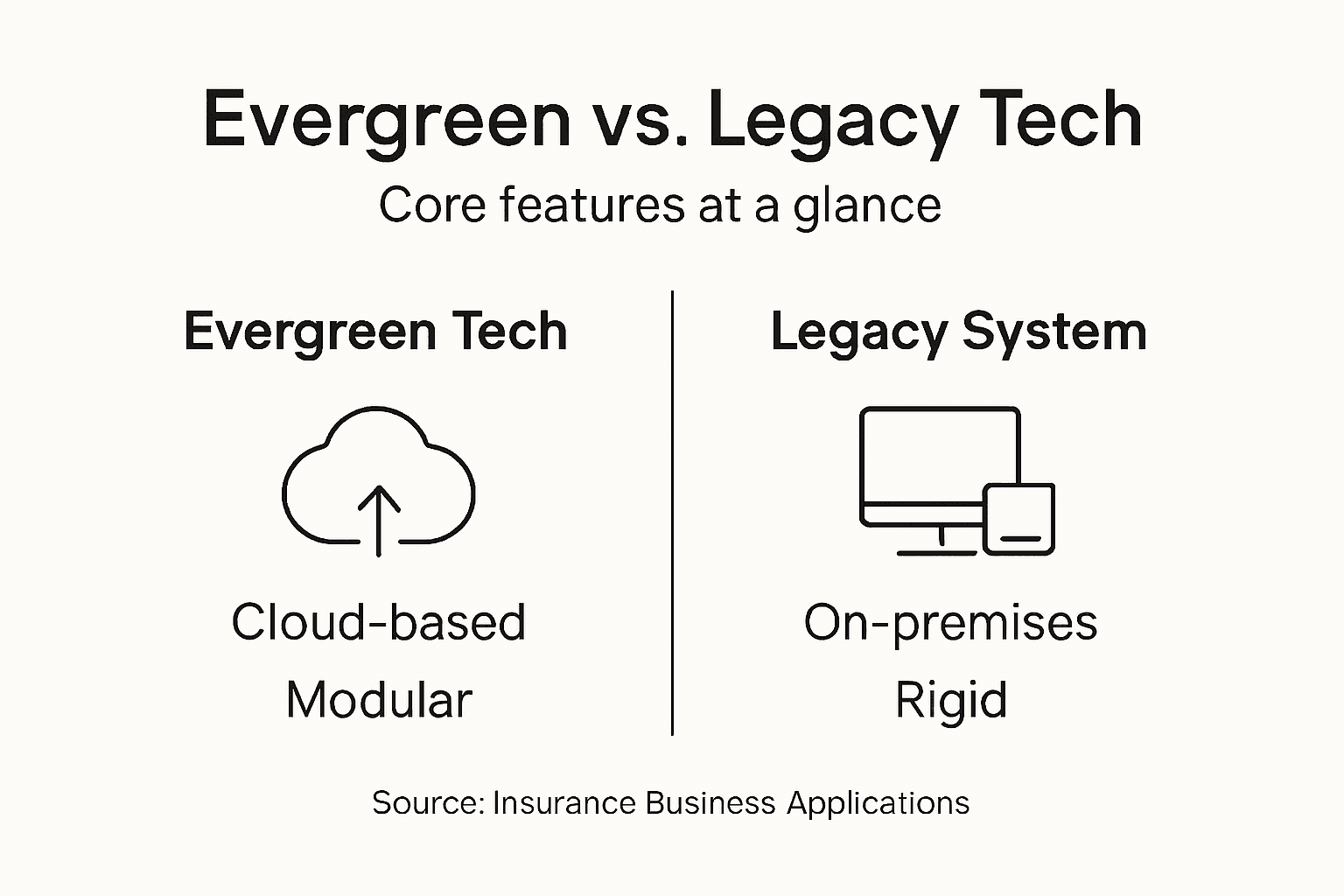
At its core, evergreen technology is characterised by several key attributes. These systems are fundamentally cloud-based, scalable, and designed with flexibility as a primary architectural principle. Unlike legacy systems that become obsolete quickly, evergreen platforms provide continuous technological enhancements without requiring complete system replacements. They integrate advanced capabilities such as artificial intelligence, machine learning, and automated workflows directly into the insurance operational ecosystem.
The primary advantages of evergreen technology extend far beyond simple technological upgrades. These systems enable insurers to achieve unprecedented operational efficiency, reduce IT complexity, and accelerate product innovation cycles. By adopting a modular, API-first approach, insurance organisations can seamlessly integrate new technologies, experiment with emerging digital services, and quickly adapt to changing regulatory landscapes without significant capital investment.
The table below summarises the distinguishing features of evergreen technology compared to legacy systems in the insurance sector:
| Attribute | Evergreen Technology | Legacy Systems |
|---|---|---|
| Upgrade Process | Seamless and continuous | Infrequent, manual, disruptive |
| Integration Capabilities | API-driven, modular, flexible | Siloed, limited, rigid |
| Cost Efficiency | Lower long-term expenditure | High maintenance costs |
| Innovation Enablement | Rapid adoption of new tools | Slow, often outdated |
Pro tip: When evaluating evergreen technology solutions, prioritise platforms that offer native cloud architecture, robust API capabilities, and a proven track record of continuous, non-disruptive updates.
Core Principles and Continuous Upgrades
The core principles of evergreen technology in insurance centre around creating dynamic, adaptable systems that evolve without disruption. Continuous system upgrades represent a fundamental shift from traditional software maintenance models, enabling insurers to integrate new capabilities incrementally and maintain technological relevance without extensive downtime or costly overhauls.
These principles manifest through several critical architectural approaches. Modular design allows insurers to update specific components of their technology stack without impacting entire systems. This approach supports granular improvements, ensuring that each technological enhancement can be implemented seamlessly. The architecture supports rapid integration of emerging technologies like artificial intelligence, advanced analytics, and machine learning, allowing insurance organisations to remain competitive and responsive to market changes.
Continuous upgrades represent more than just technological maintenance—they are strategic investments in organisational agility. By adopting platforms that support non-disruptive updates, insurers can reduce long-term IT expenditure, minimise operational risks, and create more flexible technological ecosystems. This approach enables faster product development, improved customer experiences, and the ability to quickly adapt to regulatory requirements and emerging market opportunities.

Pro tip: Prioritise insurance technology platforms that demonstrate a clear roadmap for continuous improvement and provide transparent upgrade processes that minimise operational disruption.
Seamless Integration Across Insurance Value Chain
Evergreen technology fundamentally transforms how insurers approach system integration by creating a cohesive technological ecosystem. Advanced technology integration enables property and casualty insurers to connect disparate operational processes seamlessly, breaking down traditional technological silos that have historically hindered efficiency and innovation.
The integration capabilities of modern insurance platforms extend across multiple critical domains. Technological interconnectivity allows for real-time data exchange between underwriting, claims management, distribution channels, and customer service departments. This holistic approach means that insights generated in one area of the insurance value chain can be instantaneously leveraged across other operational segments, creating a more responsive and intelligent organisational infrastructure.
Strategic integration goes beyond mere technological connectivity. By implementing platforms that support comprehensive data flows, insurers can develop more nuanced risk assessment models, personalise customer experiences, and make more informed strategic decisions. The ability to rapidly share and analyse information across different operational functions enables faster claims processing, more accurate pricing models, and enhanced fraud detection mechanisms.
Pro tip: Select insurance technology platforms that offer native API capabilities and demonstrate proven integration flexibility across multiple operational domains.
Compliance and Security in a Dynamic Market
In the rapidly evolving insurance landscape, compliance and security have become paramount concerns for property and casualty insurers. Continuous regulatory updates provide a critical mechanism for insurers to maintain technological resilience, addressing emerging legal requirements and potential security vulnerabilities with unprecedented agility.
Evergreen technology platforms fundamentally transform the approach to regulatory compliance by embedding adaptive mechanisms directly into core insurance systems. These advanced platforms continuously monitor regulatory shifts across multiple jurisdictions, automatically implementing necessary modifications to ensure ongoing adherence. This dynamic approach eliminates the traditional risk of regulatory non-compliance associated with static, legacy technology infrastructures, enabling insurers to respond proactively rather than reactively to changing legal landscapes.
The security dimensions of evergreen technology extend beyond mere compliance. By implementing sophisticated, cloud-native architectures with built-in security protocols, insurers can create robust defence mechanisms against evolving cyber threats. These platforms provide comprehensive data protection strategies, including advanced encryption, multi-factor authentication, and real-time threat monitoring. The result is a more resilient technological ecosystem that can adapt to emerging security challenges while maintaining the highest standards of data integrity and customer trust.
Pro tip: Prioritise insurance technology platforms that offer transparent, auditable compliance tracking and demonstrate a comprehensive approach to cybersecurity risk management.
Operational Benefits and Pitfalls to Avoid
Evergreen technology presents property and casualty insurers with transformative operational advantages, but successful implementation requires strategic navigation. Strategic technology adoption demands meticulous planning to capitalise on potential benefits while mitigating inherent implementation risks.
The primary operational benefits include enhanced organisational agility, dramatically reduced IT infrastructure costs, and accelerated product development cycles. Insurers can leverage modular, cloud-native platforms to rapidly experiment with new services, adapt to market changes, and streamline complex operational processes. However, these advantages are contingent upon avoiding critical implementation pitfalls such as insufficient change management, inadequate staff training, and poorly conceived migration strategies that can disrupt existing business workflows.
Successful evergreen technology adoption requires a nuanced approach that balances technological innovation with practical organisational constraints. Insurers must develop comprehensive migration roadmaps that prioritise incremental implementation, continuous staff education, and robust risk management protocols. This approach enables organisations to progressively modernise their technological infrastructure without overwhelming existing systems, ensuring a smooth transition that maintains operational continuity and minimises potential disruptions to core business functions.
Here is a summary of operational pitfalls insurers should avoid when implementing evergreen technology:
| Pitfall | Potential Consequence | Suggested Mitigation |
|---|---|---|
| Insufficient change management | Staff resistance, workflow chaos | Develop clear communication strategy |
| Inadequate training | Poor adoption, system misuse | Provide comprehensive, ongoing training |
| Rushed migration | Business disruption, data loss | Use phased, incremental rollout |
Pro tip: Develop a phased implementation strategy that includes pilot programmes, comprehensive staff training, and continuous feedback mechanisms to ensure successful technology transformation.
Unlock Continuous Growth with Evergreen Insurance Technology
Facing the challenges of outdated legacy systems and costly IT disruptions is a common hurdle for property and casualty insurers today. The article highlights how evergreen technology offers seamless, continuous upgrades, enhanced integration, and robust compliance controls that are vital to staying competitive and agile in a fast-changing market. If your organisation seeks to reduce complexity, accelerate product innovation, and maintain regulatory alignment without the risk of operational downtime then embracing modern, flexible platforms is essential.
At Insurance Business Applications (IBA), we understand these pain points deeply. Our cloud-native IBSuite platform is designed with an API-first architecture to provide the very evergreen updates, modular integrations, and security features demanded by progressive insurers. Supported by AWS, IBSuite covers your full insurance value chain efficiently from underwriting to claims management. Ready to transform your core systems and deliver customer-focused innovation faster explore how IBSuite can help you achieve lasting operational excellence.
Discover a smarter path to digital transformation by booking a demo today at IBA. Experience firsthand how continuous upgrades and seamless integration can empower your organisation to thrive amid ever-evolving insurance landscapes.
Frequently Asked Questions
What is evergreen technology in insurance?
Evergreen technology refers to a cloud-based, scalable approach that allows property and casualty insurers to modernise their core systems with continuous updates, eliminating the need for disruptive IT overhauls.
How does evergreen technology improve operational efficiency for insurers?
By providing seamless integration, modular design, and rapid adoption of new tools, evergreen technology helps insurers reduce IT complexity, enhance innovation cycles, and improve customer experiences, leading to greater operational efficiency.
What are the key benefits of adopting evergreen technology in the insurance sector?
The primary benefits include lower long-term costs, enhanced organisational agility, continuous compliance with regulations, and reduced operational risks through non-disruptive updates.
What potential pitfalls should insurers avoid when implementing evergreen technology?
Insurers should be wary of insufficient change management, inadequate staff training, and rushed migrations, as these can lead to workflow disruptions and challenges in technology adoption.
Recommended
- Opportunities and Challenges for P&C Insurers: Embracing Insurtech – Digital Insurance Platform | IBSuite Insurance Software | Modern Insurance System
- Evergreen SaaS vs. Core Insurance Systems: Complete Guide – Digital Insurance Platform | IBSuite Insurance Software | Modern Insurance System
- Insurance Market Trends 2026: Accelerating P&C Innovation
- Automation and Artificial Intelligence in P&C Insurance – Digital Insurance Platform | IBSuite Insurance Software | Modern Insurance System