06.12.25
From Legacy to Cloud-Native: Insurance Transformation Roadmap

Many insurance companies still rely on legacy systems that stifle innovation and slow response times and they are identifying technology limitations as a leading barrier to growth. The urgency for core insurance system transformation is clear. Understanding what drives successful modernization can help organizations overcome complexity, improve customer experience, and stay competitive in a rapidly evolving market.
Table of Contents
Key Takeaways
| Point | Details |
| Core System Transformation is Fundamental | It involves a comprehensive redesign of technology infrastructure to enhance agility and customer responsiveness beyond mere upgrades. |
| Legacy System Assessment is Essential | A thorough evaluation of existing systems is crucial to identify bottlenecks and inform a targeted transformation strategy. |
| Cloud-Native Architectures Offer Flexibility | Implementing cloud-native solutions allows for scalable and agile insurance systems that rapidly respond to market changes. |
| Effective Governance and Compliance are Critical | Robust frameworks ensure alignment with regulations and organizational goals, facilitating smooth digital transformation. |
Defining Core Insurance System Transformation
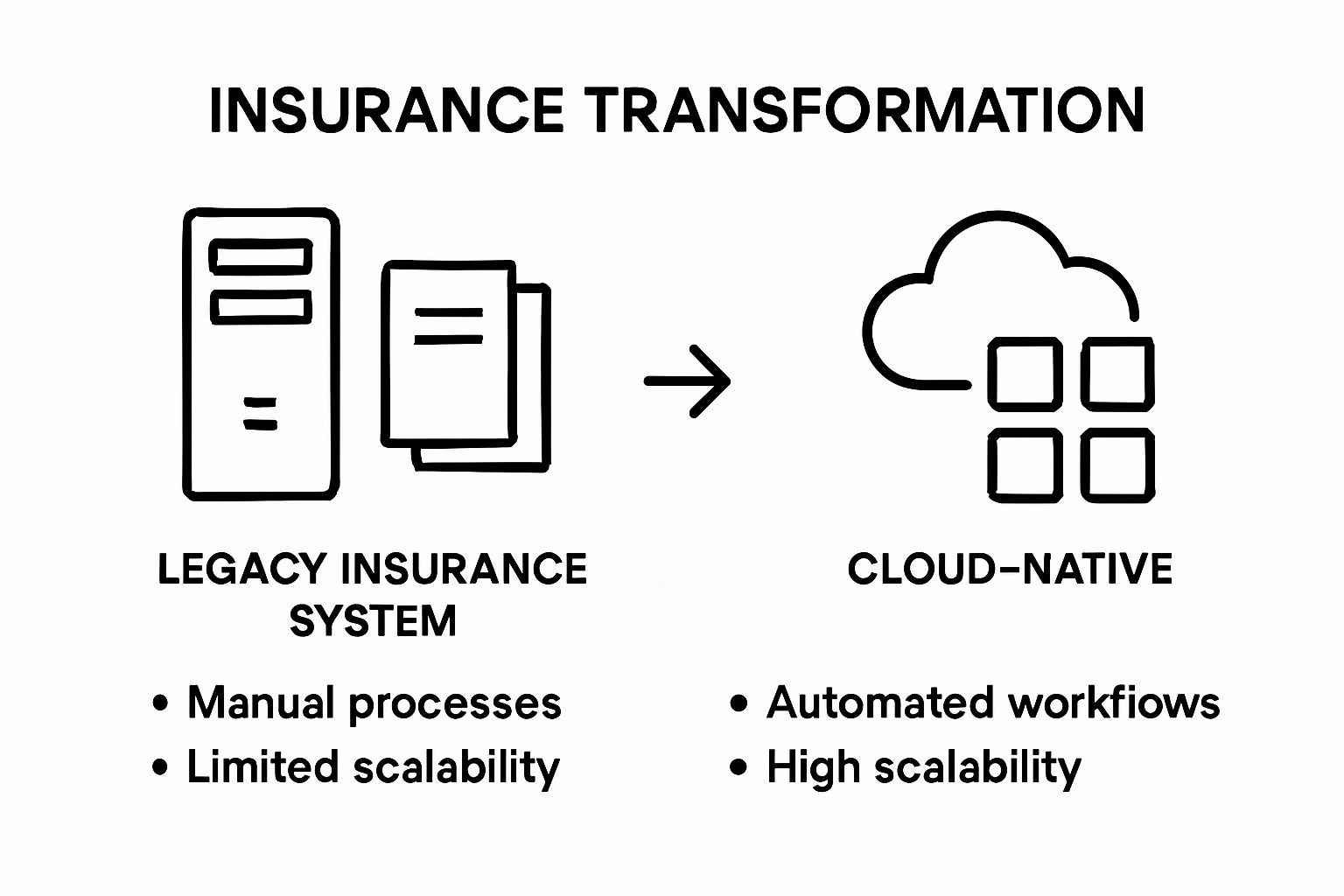
Core insurance system transformation represents a strategic reimagining of technology infrastructure that goes far beyond simple system upgrades. At its essence, this process involves fundamentally redesigning how insurers leverage technology to deliver more agile, responsive, and customer-centric services. Modern transformation efforts focus on replacing monolithic legacy platforms with flexible, cloud-native architectures that can rapidly adapt to changing market dynamics.
The complexity of core system transformation stems from multiple interconnected technical and organizational challenges. Insurance companies increasingly recognize that their existing systems create significant operational bottlenecks which limit their ability to innovate, introduce new products, and meet evolving customer expectations. These legacy platforms often feature rigid data structures, limited integration capabilities, and slow processing speeds that directly impede business performance.
Successful transformation requires a holistic approach that addresses technological, cultural, and strategic dimensions. Key elements include:
-
Comprehensive system architecture evaluation
-
Cloud migration strategy
-
API-first design principles
-
Modular software development
-
Robust data migration and integration frameworks
Ultimately, core system transformation is not merely a technology upgrade but a fundamental business reengineering process. The real cost of maintaining outdated systems can significantly outweigh the investment required for modernization, making strategic transformation an imperative for insurers seeking long-term competitive advantage.
Assessing Legacy Insurance Systems and Readiness
Assessing legacy insurance systems represents a critical first step in digital transformation, requiring a comprehensive and strategic evaluation of existing technological infrastructure. Insurers must conduct a thorough diagnostic process that goes beyond surface-level analysis, diving deep into system capabilities, performance bottlenecks, and potential modernization opportunities. Understanding the intricacies of existing core systems becomes paramount in developing an effective transformation roadmap.
The assessment process typically involves multiple critical dimensions of evaluation. Technical infrastructure analysis includes examining current system architecture, data integration capabilities, scalability limitations, and technological debt. Organizational readiness assessment focuses on cultural preparedness, change management capacity, technological skill sets, and leadership alignment. Key evaluation criteria encompass:
-
Current system performance metrics
-
Integration complexity
-
Technological flexibility
-
Security and compliance capabilities
-
Operational cost structures
Successful system readiness evaluation requires a multidimensional approach that balances technical, operational, and strategic considerations. European insurers increasingly recognize the internal challenges associated with system modernization, making a comprehensive and nuanced assessment crucial. By systematically analyzing technological capabilities, insurers can develop targeted transformation strategies that minimize disruption while maximizing long-term operational effectiveness and competitive advantage.
Choosing Cloud-Native Architectures for Insurers
Cloud-native architectures represent a transformative approach for insurers seeking to modernize their technological infrastructure. These architectures fundamentally reimagine how insurance systems are designed, deployed, and managed, moving beyond traditional monolithic approaches to more flexible, scalable solutions. Insurers can leverage cloud-native platforms to access unprecedented value and operational efficiency, enabling rapid innovation and market responsiveness.
The core principles of cloud-native architectures for insurers include microservices design, containerization, and event-driven processing. Microservices architecture enables insurers to break down complex systems into modular, independently deployable components, which dramatically improves system flexibility and technological agility. Key architectural considerations include:
-
Decoupled service components
-
API-first integration strategies
-
Scalable infrastructure design
-
Continuous deployment capabilities
-
Robust security and compliance frameworks
Successful cloud-native transformation requires a holistic approach that balances technological innovation with strategic organizational capabilities. Insurance technology platforms increasingly demonstrate the potential of microservices to enhance scalability and regulatory compliance, providing insurers with a powerful mechanism to modernize legacy systems. By embracing cloud-native architectures, insurers can create more responsive, efficient, and adaptable technological ecosystems that support rapid product development and superior customer experiences.

Designing Effective Migration and Implementation Plans
Designing a comprehensive migration strategy is crucial for insurers transitioning from legacy systems to cloud-native architectures. The migration process requires meticulous planning, strategic decision-making, and a nuanced understanding of technological and organizational constraints. Successful migration strategies involve careful pre-migration assessment and infrastructure optimization, ensuring minimal disruption and maximum operational continuity.
Effective implementation plans typically encompass multiple migration approaches, including:
-
Rehosting: Moving existing applications with minimal modifications
-
Replatforming: Making targeted optimizations without changing core application architecture
-
Refactoring: Restructuring and optimizing applications for cloud-native environments
-
Retiring: Decommissioning legacy systems that no longer provide strategic value
-
Retaining: Maintaining specific systems that cannot be immediately migrated
The migration roadmap must balance technical complexity with business continuity. Zero-downtime migration strategies enable insurers to transition systems without interrupting critical business operations, allowing for seamless transformation. By adopting a systematic, phased approach that prioritizes risk management and incremental improvements, insurers can successfully modernize their technological infrastructure while maintaining operational resilience and customer service quality.
Evolving Operating Models and Driving Change
Evolving operating models represents a critical strategic imperative for insurers navigating digital transformation. These organizational shifts demand comprehensive reimagination of technological capabilities, workforce skills, and strategic frameworks. Transformation strategies must carefully address the complex dynamics of changing insurance operating models, recognizing that successful change extends far beyond technological implementation.
Key dimensions of operating model evolution include:
-
Cultural transformation: Developing agile, innovation-focused organizational mindsets
-
Skill recalibration: Upskilling workforce with digital and technological competencies
-
Process reengineering: Redesigning workflows to leverage cloud-native capabilities
-
Governance adaptation: Creating flexible decision-making frameworks
-
Technology integration: Aligning technological capabilities with strategic objectives
Advanced business process automation powered by artificial intelligence can dramatically accelerate organizational change, enabling insurers to enhance operational efficiency and scalability. By embracing a holistic approach that integrates technological innovation with strategic organizational development, insurers can create adaptive, responsive operating models capable of rapidly addressing market challenges and customer expectations.
Governance, Compliance, and KPI Success Tracking
Effective governance and compliance frameworks are critical foundations for successful digital transformation in insurance. These mechanisms ensure that technological modernization aligns with regulatory requirements, organizational objectives, and risk management strategies. Advanced compliance approaches increasingly leverage sophisticated technologies to enhance data security and transparency, creating robust frameworks that protect both organizational and customer interests.
Key components of a comprehensive governance and compliance strategy include:
-
Regulatory alignment: Ensuring continuous adherence to industry standards
-
Risk management: Developing proactive compliance monitoring systems
-
Data protection: Implementing advanced security protocols
-
Audit trail maintenance: Creating transparent documentation processes
-
Continuous improvement: Establishing feedback loops for ongoing optimization
Migration to cloud-native architectures requires carefully designed governance mechanisms that track critical performance indicators and ensure strategic alignment, enabling insurers to measure transformation success with precision. Embracing next-generation compliance platforms allows organizations to create adaptive, transparent governance models that support continuous innovation while maintaining rigorous regulatory compliance.
Unlock Your Insurance Transformation with IBSuite
Legacy insurance systems create operational bottlenecks and hinder rapid innovation as the article highlights. If you are facing challenges with rigid infrastructure, slow migration processes, and the need to adopt cloud-native architectures that support microservices, API-first integration, and zero-downtime transition, you are not alone. Modernizing core systems requires a robust, flexible platform designed for insurers seeking agility and customer-centric service.
Insurance Business Applications (IBA) offers IBSuite, a proven cloud-native core insurance platform tailored to accelerate your digital transformation journey. IBSuite supports the entire insurance value chain with seamless integration, Evergreen updates, and compliance built-in, helping you reduce IT complexity and launch products faster. To explore how you can overcome legacy system limitations and embrace a scalable, modular architecture, book a personalized demo today. Discover the power of core insurance system transformation and learn how to implement a zero-downtime migration strategy that ensures business continuity.
Take the first step now to future-proof your insurance business. Visit book a demo and start transforming your operating model with proven technology designed for today’s demands.
Frequently Asked Questions
What is core insurance system transformation?
Core insurance system transformation involves a comprehensive redesign of an insurer’s technology infrastructure, replacing outdated legacy systems with agile, cloud-native architectures that enhance customer-centric services and operational efficiency.
Why is assessing legacy insurance systems important before modernization?
Assessing legacy insurance systems is crucial as it identifies performance bottlenecks, technological limitations, and opportunities for modernization, enabling insurers to develop effective transformation roadmaps that minimize disruption and enhance operational effectiveness.
What are the key principles of cloud-native architectures for insurers?
Key principles include microservices design, containerization, event-driven processing, decoupled service components, API-first integration, scalable infrastructure, and continuous deployment capabilities, which together enhance flexibility and responsiveness.
How can insurers ensure a successful migration to cloud-native architectures?
Insurers can ensure successful migration by planning meticulously, adopting systematic and phased approaches, employing zero-downtime strategies, and balancing technical complexity with business continuity to minimize disruptions during the transition.