04.01.26
API Strategy for Insurers: Driving Digital Impact

Many British and European insurers face overwhelming complexity as they build API strategies to keep pace with digital transformation. In Central Europe, over 65 percent of property and casualty insurance firms are investing in advanced API governance and compliance protocols to meet strict regulatory demands. This article addresses the urgent needs of chief digital officers and IT architects by highlighting proven, compliant API approaches that drive efficiency and align with evolving European frameworks.
Table of Contents
- Defining API Strategy for Insurers
- Types of Insurance APIs and Key Functions
- Critical Features of an API-First Approach
- Regulatory Framework and Compliance Obligations
- Risks, Costs, and Common Implementation Pitfalls
Key Takeaways
| Point | Details |
|---|---|
| Critical API Strategy | Developing a robust API strategy is essential for insurers to enhance operational efficiency and drive innovation. |
| Regulatory Compliance | Insurers must navigate complex regulatory landscapes while developing APIs that meet data protection and privacy standards. |
| Holistic Implementation | Successful API integration requires a collaborative approach that aligns technological advancements with organisational objectives. |
| Proactive Risk Management | Anticipating potential risks and challenges is crucial for effective API strategy execution and long-term success. |
Defining API Strategy for Insurers
In the rapidly evolving digital insurance landscape, developing a robust API strategy is no longer optional but a critical pathway to competitive advantage. The Open Insurance framework represents a transformative approach where insurers can leverage technology-enabled data sharing mechanisms to reimagine their operational capabilities.
At its core, an API strategy for insurers involves creating a systematic approach to integrating digital interfaces that enable seamless data exchange, collaboration, and service delivery. This strategy goes beyond mere technological implementation—it represents a fundamental shift towards becoming a more agile, responsive, and customer-centric organisation. Key components of this strategy include:
- Establishing clear governance frameworks for API development
- Defining precise technical and security standards
- Creating mechanisms for controlled data access and sharing
- Developing scalable integration architectures
The regulatory landscape in Europe adds another critical dimension to API strategy. European insurers must navigate complex compliance requirements while simultaneously driving innovation. This means designing APIs that not only facilitate business objectives but also adhere to stringent data protection and privacy regulations.
Pro tip: Start by conducting a comprehensive audit of your existing digital infrastructure to identify precise API integration opportunities and potential transformation pathways.
Types of Insurance APIs and Key Functions
The evolution of digital insurance technologies has led to the development of sophisticated API ecosystems that transform operational capabilities across the insurance value chain. Insurance APIs empower organisations with advanced automation and real-time data integration capabilities, enabling more dynamic and responsive business models.
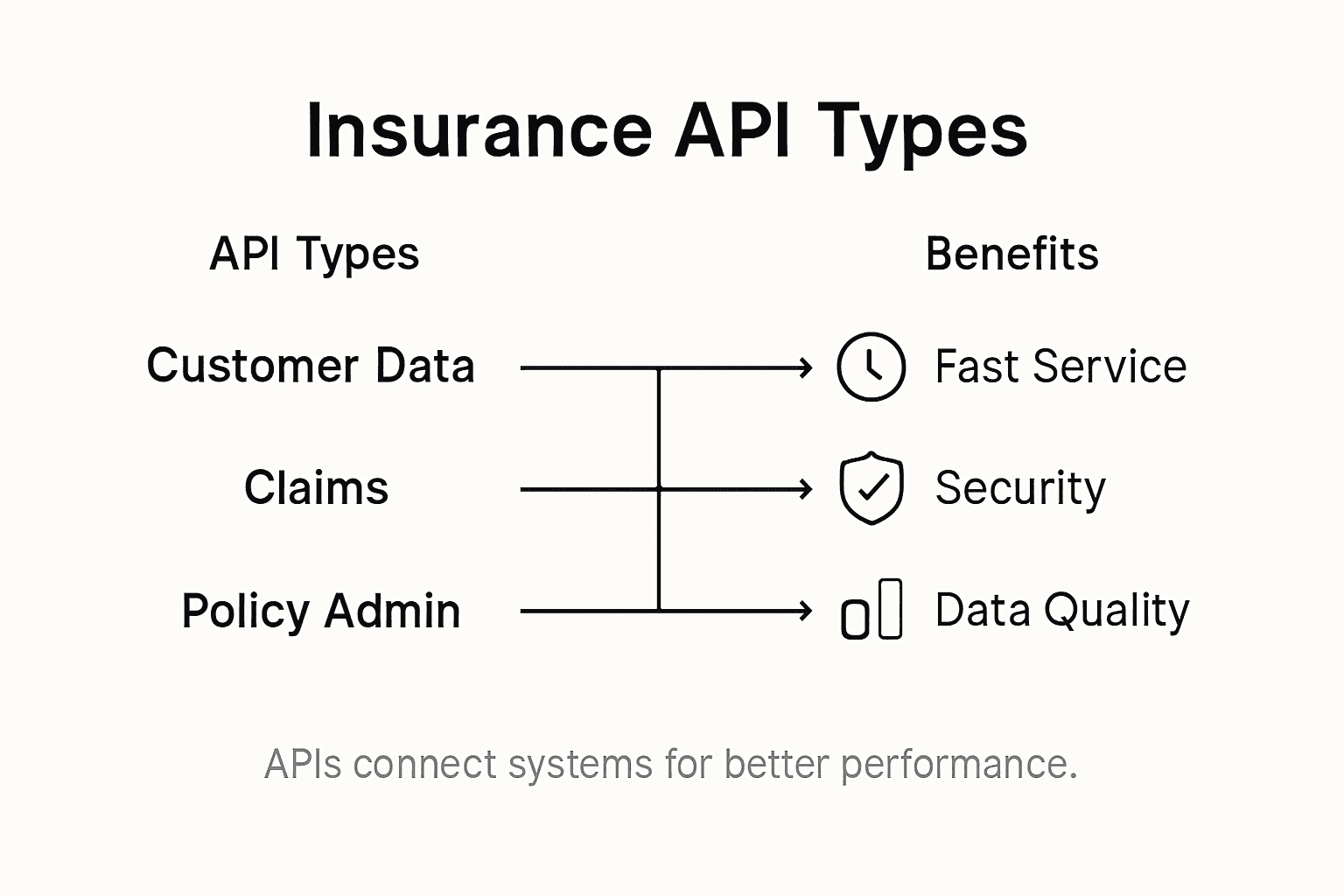
Insurers can leverage multiple specialised API types, each serving distinct functional requirements:
- Customer Data APIs: Facilitate seamless customer information management and profile synchronisation
- Policy Management APIs: Enable comprehensive policy lifecycle tracking and administration
- Claims Processing APIs: Support streamlined claims submission, assessment, and settlement workflows
- Pricing and Rating APIs: Provide dynamic risk assessment and premium calculation mechanisms
- Underwriting APIs: Allow rapid risk evaluation and decision-making processes
These API categories work collaboratively to create an interconnected digital ecosystem. By implementing strategic API architectures, insurers can enhance operational efficiency, reduce manual interventions, and create more personalised customer experiences. The modular nature of these APIs allows for flexible integration across different technological platforms and systems.
Here’s a summary of insurance API types and their strategic business value:
| API Type | Typical Use Case | Business Impact |
|---|---|---|
| Customer Data | Data synchronisation across apps | Improved client service |
| Policy Management | Automated policy lifecycle admin | Efficient policy handling |
| Claims Processing | Real-time claims updates | Faster settlements, less errors |
| Pricing and Rating | Dynamic risk and premium setting | Competitive, adaptive pricing |
| Underwriting | Automated risk assessment | Quicker, consistent decisions |
Moreover, modern insurance APIs are designed with robust security protocols and compliance frameworks, ensuring that data exchanges remain protected while enabling innovative service delivery models. This approach transforms traditional insurance operations from siloed, static systems to dynamic, responsive digital platforms.
Pro tip: Conduct a comprehensive API capability assessment to identify potential integration points and prioritise API development initiatives based on strategic business objectives.
Critical Features of an API-First Approach
In the rapidly evolving digital insurance landscape, embracing an API-first strategy has become a critical imperative for forward-thinking insurers. Organisations are increasingly recognising that designing APIs as foundational architectural elements can dramatically transform their technological capabilities, enabling more responsive and innovative business models.
The core characteristics of a comprehensive API-first approach encompass several pivotal dimensions:
- Architectural Flexibility: Creating modular, adaptable technology infrastructures
- Scalability: Designing systems that can easily expand and integrate new functionalities
- Rapid Deployment: Enabling faster time-to-market for new digital services
- Enhanced Interoperability: Facilitating seamless communication between diverse technological platforms
- Regulatory Compliance: Ensuring robust security and data protection mechanisms
Beyond technical specifications, an API-first approach represents a fundamental philosophical shift in technological strategy. It transforms technological infrastructure from a rigid, monolithic system into a dynamic, responsive ecosystem that can quickly adapt to changing market demands, regulatory requirements, and emerging technological opportunities.
Moreover, this approach empowers insurers to create more personalised customer experiences, leverage real-time data insights, and develop innovative service models that differentiate them in an increasingly competitive market landscape. By prioritising API design as a strategic foundation, insurers can build more agile, intelligent, and customer-centric technological architectures.

Pro tip: Develop a comprehensive API governance framework that balances technical innovation with stringent security protocols and regulatory compliance requirements.
Regulatory Framework and Compliance Obligations
The European insurance landscape is undergoing a profound transformation, driven by increasingly complex regulatory frameworks that demand sophisticated approaches to data management and digital innovation. Emerging regulations like the Financial Data Access (FIDA) framework are fundamentally reshaping how insurers conceptualise data strategy and customer consent, particularly in Central European markets.
Key regulatory compliance dimensions for insurers include:
- Data Protection: Strict adherence to General Data Protection Regulation (GDPR) principles
- Consent Management: Transparent mechanisms for customer data usage and sharing
- Security Governance: Robust cybersecurity protocols for API interactions
- Audit Trail Maintenance: Comprehensive logging of data access and transactions
- Interoperability Standards: Ensuring seamless yet secure data exchange mechanisms
European Commission research highlights the critical intersection between technological innovation and regulatory compliance, emphasising that insurers must develop nuanced governance models that balance technological advancement with rigorous legal obligations. This requires a holistic approach that views compliance not as a constraint, but as a strategic enabler of digital transformation.
Navigating this complex regulatory landscape demands a proactive, adaptive strategy. Insurers must invest in flexible technological architectures that can rapidly evolve alongside emerging regulatory requirements, ensuring they remain both compliant and competitive in a rapidly changing digital ecosystem.
Pro tip: Establish a cross-functional regulatory compliance team that combines legal expertise, technological understanding, and strategic foresight to anticipate and adapt to evolving regulatory landscapes.
Risks, Costs, and Common Implementation Pitfalls
Navigating the complex landscape of API implementation requires a nuanced understanding of potential challenges and strategic mitigations. Insurers must carefully assess the multifaceted risks associated with API strategy development, recognising that technological transformation is not without significant potential pitfalls.
Key risks and implementation challenges include:
- Governance Fragmentation: Decentralised API development leading to inconsistent standards
- Security Vulnerabilities: Potential exposure through inadequately secured API endpoints
- Resource Misallocation: Inefficient investment in disconnected technological initiatives
- Scalability Limitations: Architectural constraints hindering future growth
- Compliance Complexity: Navigating intricate regulatory requirements across different jurisdictions
Cost considerations extend beyond mere monetary investment, encompassing organisational bandwidth, technological infrastructure, and potential opportunity costs. Insurers frequently underestimate the comprehensive expenses related to robust API ecosystem development, including ongoing maintenance, security monitoring, and continuous technological adaptation.
Successful API implementation demands a holistic approach that transcends technical execution. This requires cultivating a culture of collaborative innovation, where technological teams work in concert with business strategists to create APIs that are not just functional, but strategically aligned with broader organisational objectives.
To help anticipate implementation challenges, here’s a comparison of common API strategy risks and effective mitigation strategies:
| Risk Type | Example Scenario | Mitigation Strategy |
|---|---|---|
| Governance Fragmentation | Teams build APIs with differing rules | Centralised governance model |
| Security Vulnerabilities | Exposed endpoints exploited by attackers | Deploy layered security controls |
| Resource Misallocation | Funding APIs with low ROI | Prioritise high-impact projects |
| Scalability Constraints | Systems cannot handle extra demand | Design for modular scalability |
| Compliance Complexity | Regulations create integration delays | Establish legal-technical teams |
Pro tip: Conduct a comprehensive pre-implementation risk assessment that maps potential technological, financial, and regulatory challenges before initiating your API transformation strategy.
Transform Your API Strategy with IBA’s API-First Insurance Platform
The article emphasises key challenges insurers face in adopting a strategic API approach such as maintaining regulatory compliance, ensuring security, and building scalable, interoperable systems. If you find yourself struggling with governance fragmentation, complex integration, or slow digital transformation, you are not alone. Insurers today need an agile, end-to-end platform that supports the entire insurance value chain while delivering rapid product innovation and customer-centric experiences.
Insurance Business Applications offers IBSuite, a cloud-native, API-first core platform built on AWS, designed to overcome these exact pain points. With IBSuite, you gain modular scalability, robust security controls, and seamless integration capabilities that align perfectly with the demands of today’s regulatory frameworks and customer expectations. Accelerate your digital impact and reduce IT complexity as you modernise your operations.
Ready to see how a comprehensive API strategy can revolutionise your insurance business? Discover how IBSuite can support your transformation by booking a personalised demo today at Book a Demo. Take the first step to streamline your API ecosystems with Insurance Business Applications and unlock faster product launches, enhanced regulatory compliance, and improved customer engagement.
Frequently Asked Questions
What is an API strategy for insurers?
An API strategy for insurers involves a systematic approach to integrating digital interfaces that enable seamless data exchange, collaboration, and service delivery, ultimately transforming operational capabilities into more agile and customer-centric models.
How can APIs improve operational efficiency in insurance companies?
APIs enhance operational efficiency by automating processes such as claims submission, policy management, and customer data handling, which reduces manual interventions and speeds up service delivery.
What are the key types of insurance APIs?
Key types of insurance APIs include Customer Data APIs, Policy Management APIs, Claims Processing APIs, Pricing and Rating APIs, and Underwriting APIs, each serving specific functional requirements within the insurance value chain.
What considerations should insurers keep in mind for regulatory compliance when implementing APIs?
Insurers should ensure compliance with data protection regulations like GDPR, establish transparent consent management processes, implement robust cybersecurity measures, maintain audit trails, and adhere to interoperability standards for secure data exchange.
Recommended
- Understanding Digital-First Insurance Strategies – Digital Insurance Platform | IBSuite Insurance Software | Modern Insurance System
- Complete Guide to Digital Insurance Trends 2025 – Digital Insurance Platform | IBSuite Insurance Software | Modern Insurance System
- Enhancing Customer Experience with Digital Transformation – Digital Insurance Platform | IBSuite Insurance Software | Modern Insurance System
- 3 Ways to Leverage APIs in the Insurance Industry – Digital Insurance Platform | IBSuite Insurance Software | Modern Insurance System
- Supply Chain Digitalization: Transforming Global Logistics – Worldwide Express, Inc.