05.01.26
Insurance Claims Transformation: Digital Impact 2026

Most british insurance companies in Central Europe are finding that outdated claims workflows drain resources and frustrate customers. With over 60 percent of insurers now investing in advanced automation and artificial intelligence, the pressure to modernize has never been greater. If you manage claims operations, this article breaks down the realities and misconceptions of insurance claims transformation, guiding you through the latest technologies, compliance challenges, and best practices shaping the future of efficient digital claims.
Table of Contents
- Insurance Claims Transformation Defined And Debunked
- Digital Workflows And Automation In Claims
- Current Regulatory Landscape In Central Europe
- Key Technologies Driving Efficient Claims
- Operational Risks And Compliance Pitfalls
- Customer Experience And Process Innovation
Key Takeaways
| Point | Details |
|---|---|
| Claims Transformation | Insurance claims are shifting from traditional manual processes to intelligent, automated systems that enhance efficiency and customer satisfaction. |
| Technological Integration | The integration of technologies such as AI, machine learning, and blockchain is crucial for optimising claims processing. |
| Regulatory Compliance | Insurers must navigate an evolving regulatory landscape by focusing on consumer protection and ethical AI frameworks. |
| Customer Experience Focus | A strong emphasis on customer experience is essential, requiring insurers to adopt a more empathetic and responsive service model. |
Insurance Claims Transformation Defined and Debunked
Insurance claims transformation represents a fundamental reimagining of how insurance organisations process, manage, and resolve customer claims. At its core, this strategic evolution moves beyond traditional manual workflows towards intelligent, data-driven systems that leverage advanced technologies. Modern claims management now integrates artificial intelligence, machine learning, and sophisticated analytics to streamline complex processes.
The transformation is not merely about technological upgrades but a comprehensive reimagining of claims operations. According to KPMG’s 2024 research, insurers are increasingly viewing claims functions as strategic assets capable of driving customer satisfaction, operational efficiency, and organisational growth. Key technological interventions include automated damage assessment, predictive analytics for fraud detection, and real-time communication platforms that provide transparency throughout the claims journey.
However, transformation is not without significant challenges. Legacy system integration, data privacy concerns, and algorithmic bias represent substantial obstacles. Successful implementation requires a nuanced approach that balances technological innovation with human expertise. Insurance organisations must invest in robust training programmes, develop ethical AI frameworks, and maintain a customer-centric perspective throughout digital modernisation efforts.
Pro tip: Prioritise incremental technological adoption over wholesale system replacement to manage risk and maintain operational continuity.
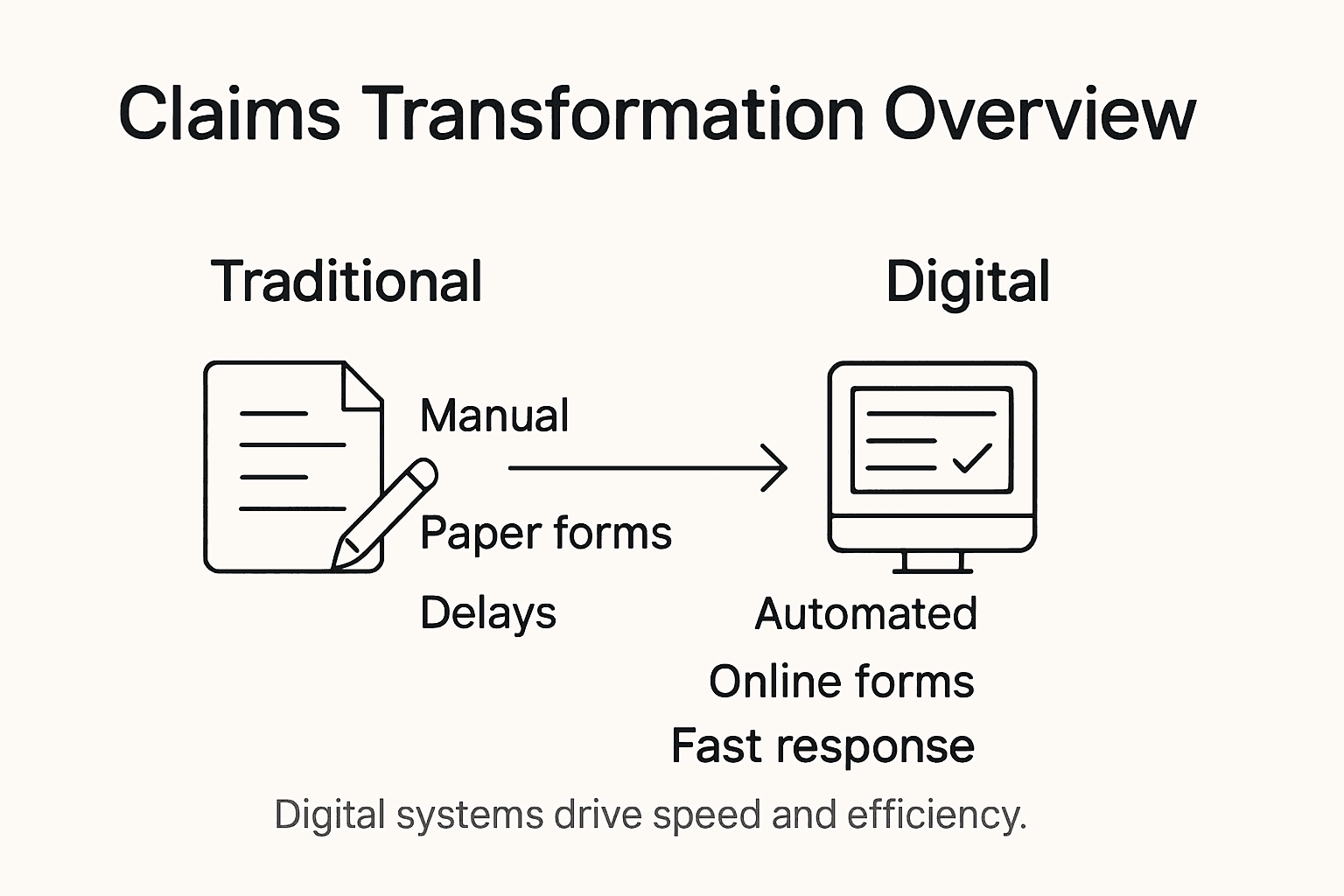
The following table compares traditional and transformed insurance claims processes:
| Aspect | Traditional Approach | Transformed (Digital) Approach |
|---|---|---|
| Claims Handling | Mainly manual, paper-based | Data-driven, automated workflows |
| Processing Speed | Often slow, prone to delays | Rapid, with real-time decision-making |
| Error Rate | Higher risk due to manual entry | Lowered by automation and AI checks |
| Customer Experience | Inconsistent, limited transparency | Transparent, multi-channel engagement |
Digital Workflows and Automation in Claims
Digital workflows and automation are revolutionising the insurance claims landscape, transforming traditionally complex and time-consuming processes into streamlined, intelligent systems. Role of automation in claims processing has become increasingly sophisticated, enabling insurers to handle complex scenarios with unprecedented efficiency and accuracy. By integrating advanced technologies like robotic process automation (RPA), artificial intelligence, and machine learning, insurance organisations can dramatically reduce processing times and minimise human error.

Hyperautomation techniques detailed by KPMG Netherlands demonstrate how comprehensive digital workflows can transform each stage of claims management. These approaches combine intelligent document processing, predictive analytics, and automated decision-making to create end-to-end solutions that can instantly assess claim validity, detect potential fraud, and accelerate settlement processes. Key technological interventions include automated damage assessment, real-time data verification, and intelligent routing of complex cases to human experts.
Despite the significant potential, successful implementation requires careful strategic planning. Insurance organisations must address challenges such as data quality, algorithmic bias, and seamless integration with existing legacy systems. This necessitates a balanced approach that leverages technological capabilities while maintaining human oversight and maintaining robust ethical frameworks. Continuous staff training, iterative technology implementation, and a commitment to transparency will be crucial in realising the full potential of digital claims workflows.
Pro tip: Develop a phased automation strategy that starts with low-complexity claims to build technological confidence and demonstrate tangible operational benefits.
Current Regulatory Landscape in Central Europe
The regulatory landscape for insurance claims in Central Europe is undergoing significant transformation, driven by complex technological and ethical considerations. Insurance Europe’s 2024–2025 Annual Report highlights pivotal shifts in supervisory frameworks, emphasising sustainable finance, consumer protection, and digital innovation as key strategic priorities for regulatory bodies across the region.
EIOPA’s regulatory initiatives are increasingly focused on addressing the challenges posed by emerging technologies in insurance claims processing. The regulatory approach now encompasses comprehensive governance frameworks for artificial intelligence, emphasising transparency, algorithmic fairness, and robust risk management. Central European insurers must navigate intricate compliance requirements that balance technological advancement with stringent consumer protection standards, including detailed guidelines for data privacy, algorithmic decision-making, and ethical AI deployment.
Critical regulatory focus areas include cyber resilience, sustainable risk management, and enhanced supervisory mechanisms. Insurers must implement sophisticated compliance strategies that integrate advanced technological capabilities with rigorous governance protocols. This involves developing comprehensive internal controls, continuous staff training on regulatory requirements, and implementing adaptive technological systems that can meet evolving regulatory expectations.
Pro tip: Establish a dedicated regulatory compliance team with cross-functional expertise in technology, legal frameworks, and insurance operations to effectively navigate the complex Central European regulatory landscape.
Key Technologies Driving Efficient Claims
Advanced technologies are fundamentally reshaping insurance claims processing, delivering unprecedented efficiency and strategic capabilities for insurers. The convergence of artificial intelligence, data integration platforms, and intelligent automation is creating a transformative ecosystem that dramatically enhances claims management performance and customer experience.
Emerging InsurTech innovations are driving substantial operational improvements across multiple technological domains. Key technologies such as artificial intelligence, machine learning, Internet of Things (IoT), and blockchain are enabling more sophisticated risk assessment, predictive analytics, and automated decision-making processes. These technologies facilitate real-time data analysis, fraud detection, and rapid claims settlement, allowing insurers to move beyond traditional reactive approaches towards proactive, intelligence-driven claims management strategies.
The integration of these technologies requires a holistic approach that balances technological capabilities with human expertise. Machine learning algorithms can process vast datasets instantaneously, identifying patterns and potential risks with remarkable accuracy. IoT devices provide real-time contextual information, while blockchain technologies ensure transparent, immutable record-keeping. However, successful implementation demands robust data governance, continuous staff training, and adaptive technological infrastructure that can evolve alongside emerging regulatory and technological landscapes.
Here is a summary of key technologies shaping modern insurance claims processing:
| Technology | Main Function | Business Impact |
|---|---|---|
| Artificial Intelligence | Enables automation and decision support | Faster, more consistent claim resolutions |
| Machine Learning | Analyses patterns in vast claim data | Improved fraud detection and risk scoring |
| Internet of Things (IoT) | Provides real-time contextual data | More accurate and timely claim validation |
| Blockchain | Secures and verifies claim records | Enhanced trust and transparency |
Pro tip: Develop a comprehensive technology adoption roadmap that prioritises incremental implementation, focusing on technologies that directly address specific operational challenges in claims processing.
Operational Risks and Compliance Pitfalls
Compliance challenges in insurance claims processing represent a complex landscape of technological, regulatory, and operational risks that demand strategic navigation. Insurance organisations must develop sophisticated risk management frameworks that anticipate and mitigate potential vulnerabilities across multiple domains, including technological infrastructure, data governance, and regulatory adherence.
Insurance Europe’s 2024-2025 Annual Report highlights critical operational risks emerging in the insurance sector, particularly emphasising digital transformation challenges. Cybersecurity vulnerabilities, data privacy concerns, and algorithmic bias represent significant compliance pitfalls that can undermine organisational integrity. Insurers must implement comprehensive risk assessment mechanisms that continuously evaluate technological systems, ensuring alignment with evolving regulatory requirements and maintaining robust governance protocols.
Successful risk management requires a holistic approach that integrates technological capabilities with human expertise. This involves developing adaptive compliance frameworks that can rapidly respond to regulatory changes, investing in continuous staff training, and implementing sophisticated monitoring systems. Key strategies include establishing cross-functional compliance teams, developing transparent algorithmic decision-making processes, and maintaining rigorous documentation practices that demonstrate regulatory adherence.
Pro tip: Create a dynamic compliance risk register that tracks technological, regulatory, and operational risks, updating it quarterly to ensure proactive risk management.
Customer Experience and Process Innovation
Customer experience has emerged as the critical differentiator in modern insurance claims processing, transforming how insurers approach service delivery. The traditional transactional model is rapidly giving way to a more holistic, empathetic approach that prioritises policyholder satisfaction through seamless digital interactions, transparent communication, and personalised support.
Claims management innovation is fundamentally reshaping customer expectations, with technological advancements enabling more responsive and intelligent service models. Generative AI, predictive analytics, and intelligent automation are creating unprecedented opportunities for insurers to deliver faster, more accurate claims resolutions while maintaining human-centric empathy. These technologies allow for real-time updates, proactive communication, and personalised guidance throughout the claims journey, significantly reducing policyholder anxiety and frustration.
Successful process innovation requires a strategic approach that balances technological capabilities with genuine human understanding. This involves developing adaptive digital platforms that can provide contextual support, implementing multi-channel communication strategies, and creating intuitive user interfaces that simplify complex insurance processes. Insurers must invest in continuous user experience research, maintain agile technological infrastructures, and cultivate a culture of customer-centricity that permeates every aspect of claims management.
Pro tip: Implement regular customer journey mapping workshops to continuously identify and eliminate friction points in the claims experience.
Accelerate Your Insurance Claims Transformation with IBSuite
The journey to a fully digital insurance claims process involves overcoming legacy system hurdles, maintaining regulatory compliance, and enhancing customer experience through intelligent automation and data-driven workflows. As discussed, challenges like algorithmic bias, integration complexity, and operational risks can stall progress and impact customer satisfaction. At Insurance Business Applications (IBA), we understand these pain points and have developed IBSuite—an end-to-end cloud-native core insurance platform designed to streamline claims management and support your organisation’s transformation efforts.
With IBSuite, insurers gain a secure, API-first solution built to accelerate digital innovation while ensuring compliance with evolving regulatory landscapes across Central Europe and beyond. You can leverage real-time data processing, automated workflows, and intelligent decision support to reduce errors and speed up claims resolution. To explore how you can modernise your claims operations and deliver a seamless customer experience aligned with the latest industry standards, book a personalised demonstration today. Discover the power of modern claims management combined with proven technology delivering rapid value.
Ready to lead your organisation’s transformation journey and turn operational challenges into opportunities for growth Visit book a demo and take your first step towards effortless digital claims excellence.
Frequently Asked Questions
What is insurance claims transformation?
Insurance claims transformation refers to the fundamental reimagining of how insurance organisations process, manage, and resolve customer claims by integrating advanced technologies to move beyond traditional workflow methods.
How does digital workflow automation improve insurance claims processing?
Digital workflow automation improves insurance claims processing by streamlining complex procedures, reducing processing times, and minimising human error through technologies like robotic process automation and artificial intelligence.
What are the key technologies driving change in insurance claims?
Key technologies driving change in insurance claims include artificial intelligence, machine learning, the Internet of Things (IoT), and blockchain, which collectively enhance risk assessment, fraud detection, and decision-making processes.
What challenges do insurance companies face during claims transformation?
Insurance companies face challenges such as integrating legacy systems, ensuring data privacy, managing algorithmic bias, and maintaining compliance with evolving regulatory standards while implementing new technologies.
Recommended
- Enhancing Customer Experience with Digital Transformation – Digital Insurance Platform | IBSuite Insurance Software | Modern Insurance System
- Complete Guide to Digital Insurance Trends 2025 – Digital Insurance Platform | IBSuite Insurance Software | Modern Insurance System
- Insurance Digital Transformation Guide for Effective Change – Digital Insurance Platform | IBSuite Insurance Software | Modern Insurance System
- How European Insurers Use Data & Automation in 2025 – Digital Insurance Platform | IBSuite Insurance Software | Modern Insurance System
- Can you claim for dental implants? – Albania Dental Implants