05.06.26
The role of agile insurance platforms in P&C

Agile insurance platforms are technology frameworks that enable property and casualty insurers to update products, processes, and integrations independently, without the disruption and cost of replacing entire core systems. The ACORD 2026 Insurance Digital Maturity Study confirms that only 7% of the world’s largest insurers reach the highest digital maturity tier, and those that do outperform peers through execution, not technology spend alone. For P&C executives, this distinction matters enormously. Definity built a full digital core in under 12 months using an API-first approach, while ICON Agility Services helped a national insurer cut claims modernisation time by 35% in six months. These results are not accidents. They are the product of deliberate platform design, and this article explains exactly how that design works.
What is the role of agile insurance platforms?
Agile insurance platforms, often discussed under the broader industry term adaptive core systems, are modular, API-connected technology environments built to support continuous change across the insurance value chain. Their role is not simply to replace legacy systems. Their role is to give insurers the structural capacity to respond to regulatory shifts, launch new products, and integrate AI capabilities without triggering expensive, organisation-wide disruption.
The drivers of digital transformation in insurance have accelerated significantly. Regulatory complexity, customer expectations, and the arrival of agentic AI have all raised the bar for what a core platform must deliver. A platform that cannot be updated in parts, connected to external data sources, or audited in real time is not simply outdated. It is a strategic liability.
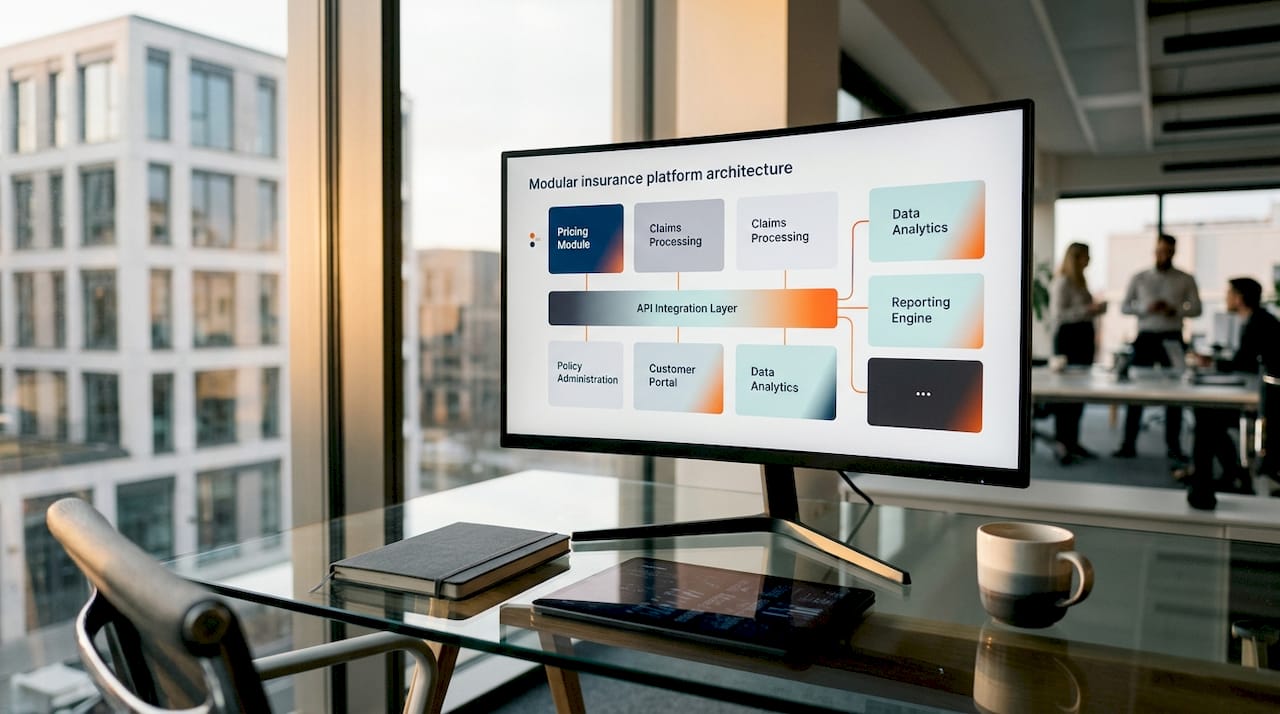
The importance of agile insurance solutions becomes clearest when you compare what insurers can do with them versus without them. With a modular, API-first platform, a P&C insurer can update its pricing logic for a new product line without touching claims or billing. Without one, that same change requires months of testing across interdependent systems, significant IT resource, and considerable regulatory risk.
How does modular architecture enable platform agility?
Modular architecture is the structural foundation of any genuinely agile insurance platform. It divides the core system into discrete, independently deployable components, each responsible for a specific domain such as underwriting, rating, policy administration, or claims. Modular system design allows insurers to update pricing, reporting, and digital workflows independently, removing the costly monolithic upgrades that have historically slowed P&C carriers.
The contrast with monolithic architecture is significant. The table below illustrates the operational difference between the two approaches.
| Dimension | Monolithic architecture | Modular architecture |
|---|---|---|
| Update scope | Full system deployment required | Component-level updates only |
| Regulatory change cost | High, cross-system testing needed | Isolated, lower risk and cost |
| AI integration | Difficult, tightly coupled code | API-connected, domain-specific |
| Time to launch new products | Months to years | Weeks to months |
| Audit and compliance | Embedded in monolith, hard to isolate | Event-driven, traceable by design |
Practitioner guidance stresses the importance of separating platform coordination from module ownership in microservices environments. When each domain owns its logic and communicates through event-driven interfaces, integration gaps during critical periods such as renewals or claims audits are far less likely. This is not a theoretical benefit. It is the difference between a platform that holds together under pressure and one that requires emergency patches.
Pro Tip: When defining modular boundaries, align them with business domains rather than technical functions. A boundary drawn around “underwriting” is more durable than one drawn around “database layer”, because business domains change more predictably than technical implementations.
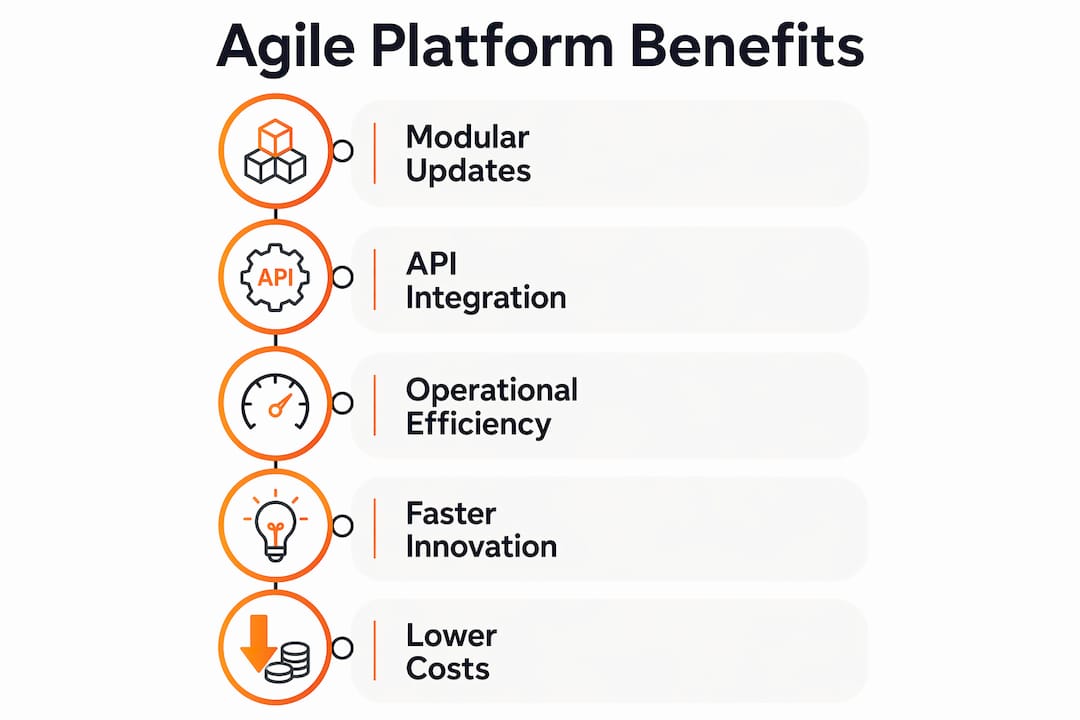
The benefits of modular insurance platforms extend beyond speed. Insurers that adopt this architecture report lower operating costs during regulatory change cycles, because updates are scoped and tested within a single module rather than across the entire system.
Why are API integration layers critical for agile ecosystems?
An API integration layer is the connective tissue of an agile insurance platform. Without it, modular components remain isolated, and the platform cannot support the ecosystem partnerships, AI capabilities, or real-time data flows that modern P&C operations require. The API-first approach in insurance is now a prerequisite for any insurer serious about AI adoption, because AI systems require structured, accessible data to function at scale.
The practical impact of a well-designed API layer spans the entire insurance value chain:
- Underwriting: External data sources such as geospatial risk feeds, telematics providers, and credit reference agencies connect directly, enriching risk assessment without manual data entry.
- Claims: Third-party repair networks, fraud detection services, and document verification tools integrate in real time, reducing cycle times and improving accuracy.
- Policy servicing: Broker portals, customer self-service applications, and distribution partners connect through standardised APIs, reducing IT overhead for each new channel.
- AI and automation: Agentic AI systems require API access to trigger actions, retrieve policy data, and update records autonomously. Without a governed API layer, these capabilities cannot be deployed safely.
Definity’s API-first approach was central to their ability to build a digital core in under 12 months and subsequently deploy AI agentic systems at scale. The API layer was not an afterthought. It was the architectural decision that made everything else possible.
Pro Tip: Establish API governance standards before onboarding third-party integrations. Define versioning policies, authentication requirements, and rate limits centrally. Retrofitting governance onto an ungoverned API estate is significantly more costly than building it in from the start.
Real-world results: what agile platforms deliver in practice
The case for agile insurance platforms is strongest when examined through measurable outcomes. Three examples from recent industry experience illustrate the range of benefits available to P&C insurers.
| Organisation | Initiative | Outcome | Timeframe |
|---|---|---|---|
| ICON Agility Services client | Claims modernisation with AI-Native ValueOps | 35% faster claims delivery, compliance on time, improved customer satisfaction | 6 months |
| Definity | Digital core rebuild with API-first architecture | Full digital core operational, AI agentic systems deployed, operational resilience improved | Under 12 months |
| ACORD Solutions Group | MCP-enabled architecture for AI readiness | Agentic AI-ready platform, standardised data and workflows, compliant automation at scale | Ongoing |
The ICON Agility Services result deserves particular attention. A 35% improvement in claims modernisation speed within six months is not a marginal gain. It represents a structural shift in how quickly an insurer can respond to claims volume spikes, regulatory updates, and customer experience demands. The combination of AI-native diagnostics and agile restructuring produced an outcome that neither approach would have achieved independently.
The ACORD Solutions Group MCP architecture takes this further. By making digital insurance solutions fully AI agent-ready through standardised data and workflow structures, ACORD has created a model where autonomous AI interactions with insurance transactions are both possible and auditable. This matters for P&C insurers operating under European regulatory frameworks, where auditability is not optional.
The digital embedded microinsurance strategy literature reinforces a consistent finding: converting digital capabilities into measurable outcomes requires coordinated execution across technology, process, and governance. Technology alone does not produce these results.
Governance and culture: the factors that determine agile platform success
Technology is the enabler of agile insurance platforms, but governance and culture determine whether that technology delivers value. Agile modernisation fails when it is treated as a series of disconnected projects rather than a coordinated transformation. Shared standards, aligned operating models, and clear prioritisation frameworks are what separate digital leaders from the majority.
Four governance and cultural factors consistently distinguish successful agile platform implementations:
-
Operating model alignment. Technology modernisation and operating model change must proceed together. An insurer that deploys a modular platform but retains a siloed organisational structure will not realise the speed benefits the platform makes possible. Business and IT teams must share ownership of outcomes, not just deliverables.
-
Event-driven auditability. Event-driven, replayable workflow platforms embed auditability as a design feature rather than a compliance afterthought. Discrete events with full audit trails simplify regulatory validation and reduce the cost of responding to supervisory enquiries. For P&C insurers, this is a material operational advantage.
-
Fusion teams bridging business and technology. The most effective agile implementations use cross-functional teams that include underwriters, claims managers, compliance officers, and engineers working on the same sprint cycles. This structure eliminates the translation delays that slow traditional IT delivery models.
-
Continuous improvement as standard practice. Agile platforms are not one-time deployments. They require ongoing investment in capability, governance, and integration. Insurers that treat platform adoption as a project with an end date consistently underperform those that treat it as a permanent operating model.
The compliance through next-generation platforms framework demonstrates how agentic AI and standards-based integration can produce compliant, auditable workflows when governance is embedded from the design phase.
How should P&C insurers approach agile platform adoption?
Successful adoption of agile insurance software follows a recognisable pattern across European P&C carriers. The sequence matters as much as the individual steps.
- Assess digital maturity before committing to architecture. A maturity assessment identifies where legacy constraints are most costly and where modular replacement will deliver the fastest return. Without this baseline, platform investments are frequently misaligned with operational priorities.
- Prioritise API-first infrastructure from the outset. API layers must be designed before integrations are built, not retrofitted afterwards. Insurers that delay API governance consistently face higher integration costs and longer deployment timelines.
- Embed compliance and auditability in the platform design. Regulatory requirements in European P&C insurance are not static. Platforms designed with event-driven audit trails adapt to new requirements far more efficiently than those where compliance is added as a layer on top of existing architecture.
- Build cross-functional teams with shared accountability. Technology delivery teams that include business domain experts produce better outcomes than purely technical teams working from requirements documents. This is not a cultural preference. It is a delivery model with a measurable track record.
- Select vendors with a continuous improvement commitment. Platform vendors that provide Evergreen updates and maintain regulatory compliance as part of their service model reduce the internal resource burden on insurers significantly. The digital transformation strategies literature consistently identifies vendor partnership quality as a key differentiator in long-term platform performance.
Key takeaways
Agile insurance platforms deliver measurable operational advantage when modular architecture, API governance, and aligned operating models are implemented together rather than in isolation.
| Point | Details |
|---|---|
| Modular architecture reduces change cost | Independent component updates lower the risk and cost of regulatory and product changes significantly. |
| API layers unlock AI and ecosystem value | A governed API-first design is the prerequisite for deploying agentic AI and third-party integrations at scale. |
| Real-world results are measurable | ICON Agility Services achieved 35% faster claims delivery in six months through agile restructuring and AI diagnostics. |
| Governance determines outcome quality | Shared standards and aligned operating models separate digital leaders from the majority, per the ACORD 2026 study. |
| Auditability must be designed in | Event-driven, replayable workflows produce natural audit trails that simplify regulatory compliance in P&C insurance. |
Where agile platforms are heading: a personal view
The conversation about agile methodologies in insurance has shifted considerably in the past two years. When I first began working closely with P&C insurers on platform strategy, the primary concern was speed to market. Today, the question I hear most often from senior executives is: “How do we make our platform AI-ready without creating new governance risks?”
That question reflects a genuine maturity in how the industry thinks about flexible insurance solutions. The early adopters who moved fast and broke things are now dealing with ungoverned API estates and AI deployments that cannot be audited. The insurers who are winning are those who treated governance as a design constraint from the beginning, not a compliance exercise at the end.
What concerns me about the current moment is the gap between ambition and execution. The ACORD data showing only 7% of large insurers at the highest digital maturity tier is not surprising to anyone who has worked inside these organisations. The technology is available. The barrier is almost always organisational: misaligned incentives, siloed ownership, and a tendency to treat platform modernisation as an IT project rather than a business transformation.
My advice to P&C executives is straightforward. Do not evaluate agile insurance platforms on their feature lists. Evaluate them on how well they support your operating model, your compliance obligations, and your ability to deploy AI safely. The platforms that will define the next decade of P&C insurance are not the ones with the most capabilities. They are the ones that make your organisation genuinely capable of using them.
— Tuna
Modern platform solutions for agile P&C insurers
Ibapplications builds IBSuite specifically for P&C insurers who need to move faster without accumulating technical debt. IBSuite’s policy administration system supports modular product configuration, enabling insurers to launch and adjust products independently across lines of business. For claims teams, the claims management platform accelerates processing cycles and embeds compliance controls directly into workflow design. Both are built on AWS with API-first architecture and Evergreen updates, meaning your platform evolves with regulatory requirements rather than falling behind them. If you are evaluating agile platform options for your P&C operation, IBSuite is worth a close look.
FAQ
What is an agile insurance platform?
An agile insurance platform is a modular, API-connected core system that allows insurers to update individual components, such as rating, underwriting, or claims, without disrupting the entire technology estate. The term is often used interchangeably with adaptive core systems in industry literature.
How does modular architecture improve operational efficiency?
Modular architecture allows insurers to update pricing, reporting, and digital workflows independently, reducing the cost and risk of regulatory changes. This removes the need for full-system deployments every time a product or compliance requirement changes.
Why is API governance important for agile insurance software?
API governance defines how integrations are built, versioned, and secured across the platform. Without it, insurers accumulate ungoverned connections that create security risks and make AI deployment unsafe. Definity’s experience shows that a governed API-first approach is what enables AI agentic systems to operate reliably at scale.
How long does agile platform adoption typically take?
Timelines vary by scope, but Definity built a full digital core in under 12 months using an API-first approach. ICON Agility Services delivered a 35% improvement in claims modernisation speed within six months. Both results required governance and operating model changes alongside the technology work.
What role does auditability play in agile insurance platforms?
Auditability is a design requirement, not a feature. Event-driven, replayable workflow platforms produce natural audit trails that simplify regulatory validation in P&C insurance. Insurers that embed auditability from the design phase face significantly lower compliance costs when regulatory requirements change.
Recommended
- Modern Insurance Platforms: What to look for – Digital Insurance Platform | IBSuite Insurance Software | Modern Insurance System
- Modern Insurance Platform Benefits – Digital Insurance Platform | IBSuite Insurance Software | Modern Insurance System
- Embracing Compliance through Next-Generation Insurance Platforms – Digital Insurance Platform | IBSuite Insurance Software | Modern Insurance System
- Rapid Product Innovation Insurance: Driving Agility for P&C Insurers – Digital Insurance Platform | IBSuite Insurance Software | Modern Insurance System