27.05.26
The role of ecosystems in insurance: 2026 guide

The insurance industry is undergoing a shift that goes well beyond digital upgrades. The role of ecosystems in insurance is now central to how forward-thinking insurers compete, grow, and retain customers. Rather than operating as isolated product sellers, insurers are embedding themselves into interconnected networks where data, technology, and partnerships define the customer experience. For insurance professionals and decision-makers in Europe, understanding this shift is no longer optional. It is the foundation of future relevance.
Table of Contents
- Key takeaways
- The role of ecosystems in insurance defined
- Operational efficiency and customer engagement
- Ecosystem-driven product innovation
- Environmental factors and sustainability
- Practical steps for ecosystem engagement
- My take: ecosystems are not optional
- How IBSuite supports ecosystem participation
- FAQ
Key takeaways
| Point | Details |
|---|---|
| Ecosystems redefine insurer roles | Insurers must choose between orchestrator, enabler, or participant to align their strategy with ecosystem participation. |
| Embedded insurance drives growth | Embedded insurance is growing at 26% CAGR through 2033, making digital partnerships a high-priority strategic lever. |
| Environmental factors reshape risk | Natural ecosystems reduce damage from floods and storms but remain under-valued in most insurer risk models. |
| Product innovation accelerates | Parametric and nature-related products are emerging rapidly, with 75% of parametric schemes launched in the last three years. |
| Technology underpins participation | API-first platforms enable the integrations and co-creation capabilities that ecosystem participation demands. |
The role of ecosystems in insurance defined
Before choosing a path forward, it helps to understand exactly what an insurance ecosystem is. It is not simply a partnership or a distribution arrangement. Ecosystems redefine value across connected sectors including home, mobility, health, wealth, and small business, using shared data and APIs to deliver continuous customer engagement. The insurer becomes one node in a broader network rather than the sole provider of a product.
Within that network, insurers adopt three roles: orchestrator, enabler, or participant. Each requires a different level of investment, capability, and appetite for control.
| Role | Responsibilities | Key benefits |
|---|---|---|
| Orchestrator | Owns the customer relationship and governs the ecosystem | Maximum influence over customer journey and data |
| Enabler | Provides infrastructure, APIs, or capacity to other platforms | Scalable revenue without direct distribution cost |
| Participant | Joins existing ecosystems as an insurance product provider | Fast market access with lower investment required |
The orchestrator role suits large insurers with strong brand recognition and digital capabilities. A European insurer building a connected home platform, for example, could orchestrate partnerships with smart device manufacturers, home maintenance services, and financial advisers. The enabler role works well for insurers with strong underwriting expertise who want to power other platforms without owning the customer. The participant role suits those entering ecosystem distribution quickly, such as embedding travel cover within a booking platform.
Pro Tip: Before committing to a role, audit your current API capabilities and partner relationships. Many insurers overestimate their readiness to orchestrate and underestimate the value of being a well-integrated participant.
The choice of role is not permanent, but early clarity on it determines which investments to prioritise and which partnerships to pursue. As the ecosystem era takes hold, the lone insurer model is effectively ending.
Operational efficiency and customer engagement
The practical case for ecosystem participation comes down to two things: doing more with less, and serving customers better. Both are achievable through shared data, API integrations, and embedded insurance models.
When underwriting, claims, and policy administration systems connect to ecosystem partners via APIs, manual processes drop significantly. A motor insurer connected to a vehicle telematics platform, for instance, can automate risk assessment at the point of sale rather than relying on static declarations. Claims can be triggered by verified data feeds rather than customer-initiated processes. The result is faster, more accurate decisions at lower operating cost.

Embedded insurance in digital ecosystems increases customer retention and average revenue per user. When cover is offered at the moment a customer books a flight, purchases a device, or takes out a mortgage, the purchase decision is contextual and frictionless. Customers do not need to seek out insurance separately, and insurers gain access to distribution channels they could not build alone.
Key operational benefits of ecosystem participation include:
- Reduced cost per policy through automated data exchange with partners
- Faster claims settlement via real-time third-party data feeds
- Higher conversion rates through contextual, embedded product placement
- Richer customer data supporting more accurate pricing and risk segmentation
- Lower customer acquisition costs through partner-owned distribution channels
Embedded insurance is projected to grow at approximately 26% CAGR through 2033. For European P&C insurers, that trajectory represents both an opportunity and a competitive threat. Insurers partnering with fintech and e-commerce platforms gain stronger customer loyalty and revenue growth. Those who delay cede ground to platforms that will source cover from more agile competitors.
Pro Tip: When evaluating digital partnerships, prioritise platforms with large existing customer bases in your target segments. The distribution value of a well-chosen partner often exceeds what years of direct marketing can achieve.
For a deeper look at how digital ecosystems increase customer loyalty and revenue for insurers, the drivers of digital transformation are worth reviewing in the context of your own growth strategy.
Ecosystem-driven product innovation
Ecosystems do not just change how insurance is distributed. They change what gets built. When insurers co-create products with platform partners who have direct customer insight, the result is products that fit real customer needs rather than actuarial constructs.
Parametric insurance is one of the clearest examples. Rather than indemnifying a loss after the fact, parametric products pay out when a defined trigger is met, such as rainfall exceeding a threshold or wind speeds crossing a set level. This model depends on ecosystem integration with weather data providers, satellite services, and agricultural platforms. Without those data connections, parametric products cannot function at scale.
The pace of innovation in this space is notable. 75% of parametric schemes were established in the last three years, reflecting how quickly ecosystem partnerships enable new product launches when the infrastructure exists.
| Product type | Ecosystem dependency | Recent growth driver |
|---|---|---|
| Parametric insurance | Weather and satellite data providers | Climate risk and agricultural demand |
| Nature-related insurance | Environmental monitoring organisations | Regulatory pressure and sustainability goals |
| Embedded microinsurance | E-commerce and fintech platforms | Digital distribution and low-income market access |
| Connected home insurance | Smart device manufacturers and IoT platforms | Prevalence of smart home technology |
Beyond parametric, microinsurance products are gaining traction through ecosystem distribution. Short-term, low-premium cover that would be uneconomical to sell through traditional channels becomes viable when embedded within a digital platform that already handles billing and customer communication. The economics change entirely when distribution cost approaches zero.
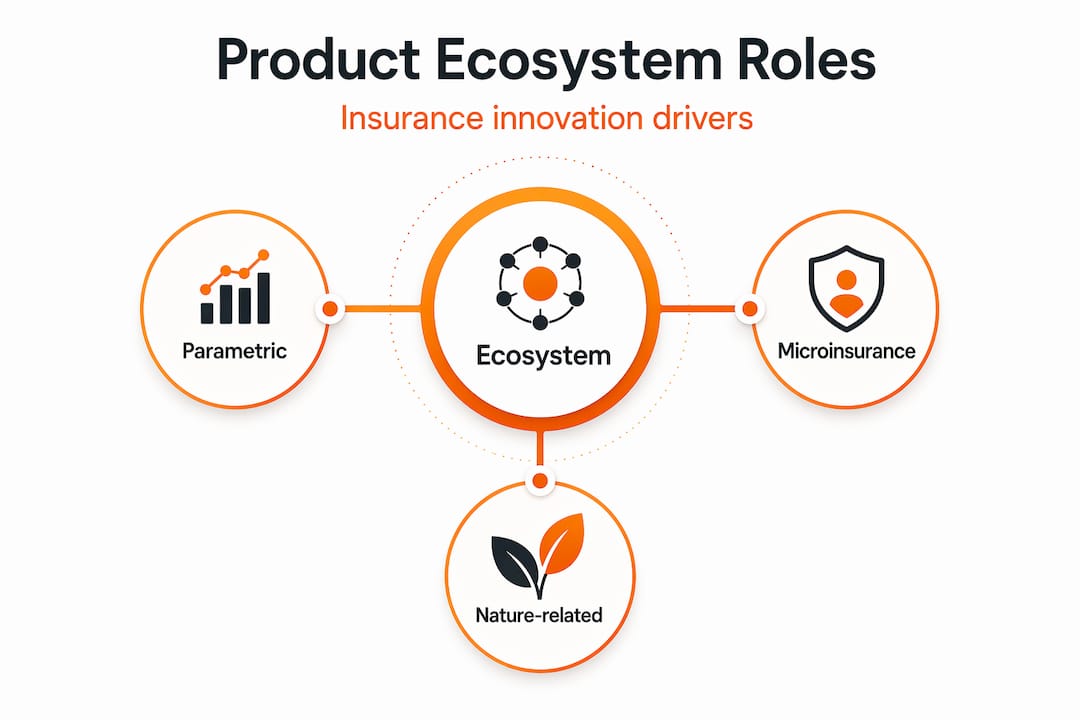
Nature-related insurance products are also expanding, with 64% using indemnity-based triggers. These products address risks linked to biodiversity loss, ecosystem degradation, and climate events. They represent a meeting point between commercial insurance logic and the growing demand from regulators and investors for sustainability-aligned risk transfer.
Environmental factors and sustainability
The impact of ecosystems on insurance extends beyond digital platforms into the natural world itself. Natural ecosystems, wetlands, forests, and coastal barriers, function as risk mitigators. Coastal wetlands protect billions in storm damage annually, yet most insurance risk models fail to account for their presence or degradation.
This gap creates both a risk and an opportunity. As natural buffers disappear, insured losses rise. Insurers who can model ecosystem services in their pricing have a genuine competitive advantage. Those who cannot will find their loss ratios deteriorating without a clear explanation in their data.
“The insurance industry is at a turning point where the health of natural ecosystems and the sustainability of insurance products are becoming inseparable.” — WWF, Climate change, nature loss, and the insurance crisis
Integrating environmental factors in insurance pricing and product design requires collaboration with environmental organisations, government bodies, and data platforms that monitor ecological conditions. This is itself an ecosystem dynamic. No single insurer can build the monitoring infrastructure required. It has to be shared.
| Benefit | What it means for insurers |
|---|---|
| Improved risk modelling | Ecosystem data inputs allow more accurate flood, storm, and drought pricing |
| Regulatory alignment | Nature-related financial disclosures are tightening across European markets |
| Product differentiation | Nature-based cover attracts ESG-focused corporate and institutional clients |
| Loss prevention | Incentivising policyholders to maintain or restore natural buffers reduces claims |
Less than one-third of nature-related products currently incorporate explicit risk reduction alongside insurance coverage. That gap is significant. Products which combine risk transfer with active risk reduction, such as rewarding landowners for maintaining flood-absorbing vegetation, represent the next frontier in sustainability and insurance. European regulators are watching this space closely, and early movers will have a clear advantage when disclosure requirements tighten.
Practical steps for ecosystem engagement
Knowing the strategic value of ecosystems is one thing. Deciding where to start is another. The following steps provide a practical sequence for insurance professionals looking to move from awareness to action.
- Assess your current API and data capabilities. Ecosystem participation requires integration. Understand what your core systems can support today and what would need to change.
- Define your role clearly before approaching partners. Whether you aim to orchestrate, enable, or participate, your role shapes every negotiation and investment decision that follows.
- Map the customer journeys you want to influence. Shifting focus to customer outcomes rather than isolated products is the defining characteristic of successful ecosystem participants.
- Select partners strategically, not opportunistically. A partner with aligned customer demographics and complementary data assets is worth far more than one with a large audience but no relevance to your product.
- Pilot before scaling. Test a single embedded product with one partner before committing infrastructure investment to a broader ecosystem build.
- Measure the right things. Track customer acquisition cost per ecosystem channel, retention rates for embedded products versus direct, and claims performance on ecosystem-sourced policies.
Common failure points in ecosystem engagement include treating partners as vendors, underinvesting in integration capability, and trying to control more of the customer journey than your capabilities justify. Early role definition is consistently cited as the single strongest predictor of ecosystem success.
Pro Tip: Build your ecosystem strategy around the customer problem you are solving, not the product you want to sell. Partners and customers alike respond better when the value proposition starts with their need.
My take: ecosystems are not optional
I have worked alongside insurers at various stages of digital transformation, and the pattern I see repeatedly is this: the companies that treat ecosystem participation as a future priority are already behind. The market is not waiting.
What surprises me most is how many insurers still evaluate ecosystem opportunities as distribution experiments rather than structural changes to their business model. The difference matters. An experiment can be shelved when results are mixed. A structural shift requires commitment, investment, and a willingness to redefine what the organisation is for.
The contrarian view I hold is that not every insurer should aim to be an orchestrator. The instinct to own the customer relationship is understandable, but orchestration is expensive, complex, and demands capabilities most carriers are still building. A well-executed enabler or participant strategy can generate better returns with lower risk, particularly for mid-sized European P&C insurers who are not resourced to build platform businesses from scratch.
What I have learned is that the insurers succeeding in ecosystems are not necessarily the ones with the most technology. They are the ones who defined their role early, chose partners who genuinely complemented their strengths, and measured outcomes rather than activity. The temptation to over-engineer this is real. Resist it.
— Tuna
How IBSuite supports ecosystem participation
IBSuite, developed by Ibapplications, is built to support insurers at every level of ecosystem engagement. Its API-first architecture means integrating with fintech partners, e-commerce platforms, and data providers is a technical reality rather than a roadmap aspiration. For insurers taking on an orchestrator role, IBSuite’s policy administration module provides the governance and management layer needed to run multi-partner product portfolios efficiently. For those embedding products within partner platforms, the platform’s modular design enables rapid product configuration without rebuilding core systems.
IBSuite also supports claims management in ecosystem contexts, where third-party data feeds and automated triggers are becoming standard. If you want to understand how IBSuite fits your ecosystem strategy, the best starting point is a conversation with the Ibapplications team.
FAQ
What is the role of ecosystems in insurance?
Ecosystems connect insurers with digital platforms, data providers, and service partners to deliver integrated customer experiences. They shift the insurer’s role from isolated product seller to active participant in broader customer journeys.
What are the three roles insurers can take in an ecosystem?
Insurers can act as orchestrators, who govern the ecosystem and own the customer relationship; enablers, who provide infrastructure and capacity to partners; or participants, who embed products within existing platforms.
How do ecosystems improve operational efficiency for insurers?
Shared data and API integrations reduce manual underwriting and claims processes, lower acquisition costs through partner distribution, and improve pricing accuracy through richer real-time data inputs.
How do environmental factors affect insurance through ecosystems?
Natural ecosystems such as wetlands and forests reduce insured losses by mitigating flood and storm damage. Insurers who incorporate ecosystem services in insurance risk models can price more accurately and develop nature-related products aligned with European sustainability requirements.
Why is parametric insurance linked to ecosystem participation?
Parametric insurance relies on real-time data from weather stations, satellites, and environmental monitors. These data feeds are sourced through ecosystem partnerships, making the product model structurally dependent on digital integration with specialist data providers.
Recommended
- Modern Insurance Platforms: What to look for – Digital Insurance Platform | IBSuite Insurance Software | Modern Insurance System
- Complete Guide to Digital Insurance Trends 2025 – Digital Insurance Platform | IBSuite Insurance Software | Modern Insurance System
- How Insurers Can Unlock Growth with Ecosystem APIs – Digital Insurance Platform | IBSuite Insurance Software | Modern Insurance System
- Insurtech Ecosystem: How It Shapes P&C Insurance