29.01.26

Cloud Scalability in Insurance: Enabling Rapid Growth
Choosing the right approach to cloud scalability can feel overwhelming when complex data volumes and unpredictable peaks are the new normal for Central European insurance companies. The need to efficiently handle soaring claims, regulatory shifts, and evolving customer expectations places real pressure on technology leaders. This article explains cloud scalability as it truly applies to insurance, offering practical guidance to help you build adaptable systems that deliver performance while simplifying operational hurdles.
Table of Contents
- Defining Cloud Scalability In Insurance
- Types Of Cloud Scalability For Insurers
- Essential Features Of Scalable Cloud Platforms
- Compliance, Security And Regional Regulations
- Risks, Cost Factors And Common Mistakes
- Best Practices For Efficient Scaling
Key Takeaways
| Point | Details |
|---|---|
| Cloud Scalability is Essential | It allows insurance platforms to adapt rapidly to changing workloads and market demands, ensuring consistent performance. |
| Adaptable Scalability Models | Insurers should consider vertical, horizontal, and diagonal scaling to address their specific operational needs effectively. |
| Regulatory Compliance is Crucial | A dedicated compliance monitoring team helps insurers navigate evolving regional regulations while protecting data integrity. |
| Proactive Risk Management | Regular audits and strategic oversight can prevent cost overruns and security vulnerabilities, enhancing overall cloud infrastructure resilience. |
Defining cloud scalability in insurance
Cloud scalability represents a transformative capability for modern insurance platforms, enabling organisations to dynamically adapt computing resources in response to changing business demands. At its core, cloud scalability refers to the system’s ability to efficiently handle increasing workloads, user volumes, and data complexity without compromising performance or user experience.
In the insurance sector, scalability goes beyond simple infrastructure expansion. It encompasses the strategic capacity to support complex distributed systems that can rapidly adjust to market fluctuations, customer expectations, and technological innovations. This means insurance platforms must be designed with flexible architectures that can:
- Automatically increase computational resources during peak claim periods
- Dynamically allocate storage and processing power
- Maintain consistent performance under variable workloads
- Support seamless integration of new digital services
The significance of cloud scalability becomes particularly evident when examining how insurers manage increasingly complex data ecosystems. Modern insurance platforms require robust systems capable of processing massive datasets, supporting personalised product offerings, and delivering real-time digital experiences. Cloud computing revolutionises operational agility by providing the technological foundation for these advanced capabilities.

Pro tip: Design your cloud infrastructure with modularity and flexibility as primary considerations, ensuring your insurance platform can effortlessly scale without architectural constraints.
Types of cloud scalability for insurers
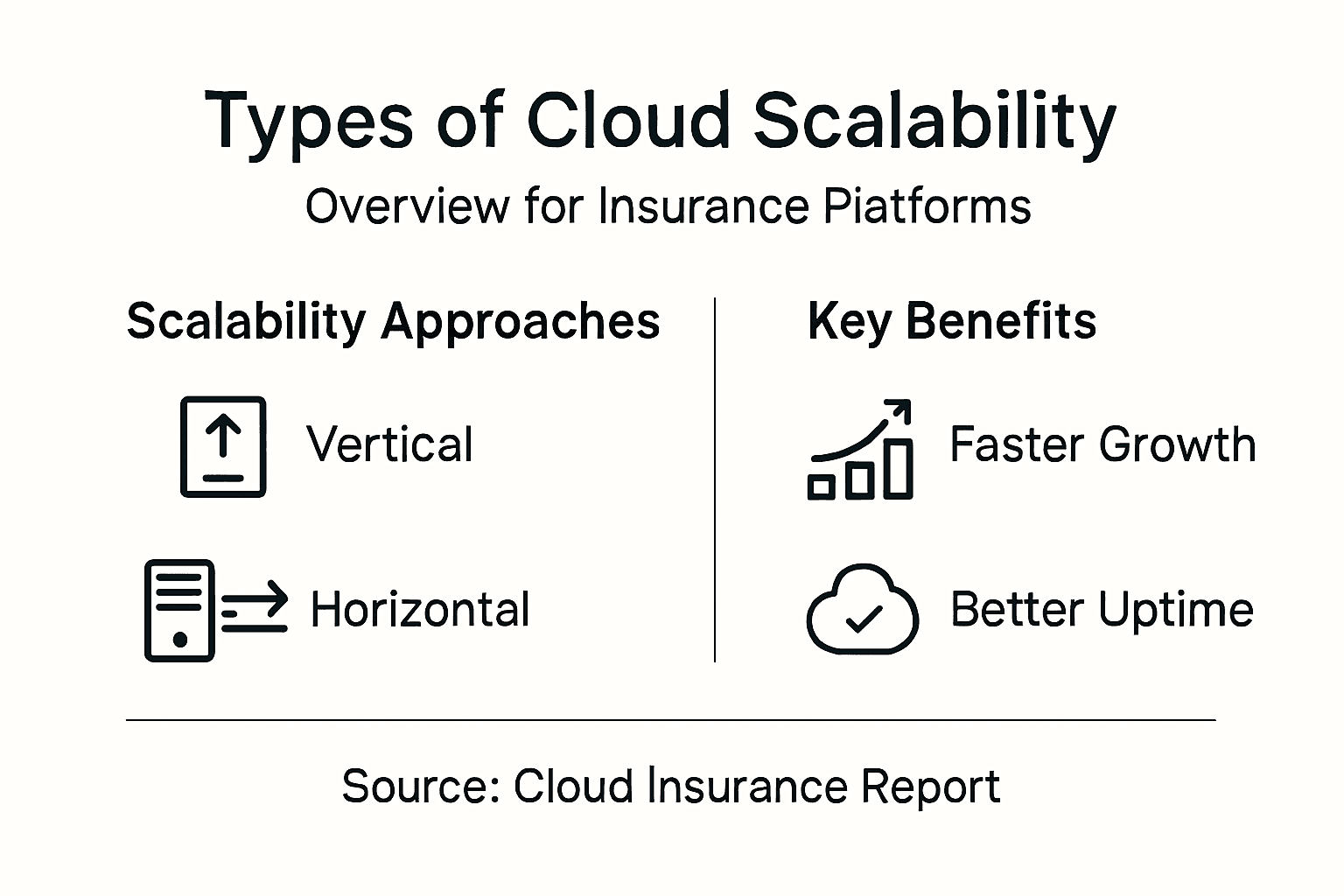
Cloud scalability in insurance is not a one-size-fits-all approach, but a nuanced strategy involving multiple scaling techniques designed to meet complex operational requirements. Technical studies reveal distinct scalability models that insurance organisations can leverage to enhance their technological infrastructure.
The primary types of cloud scalability for insurers include:
- Vertical Scaling: Increasing computational capacity within a single machine
- Involves upgrading RAM, processor speed, or storage capabilities
- Best for applications with predictable, steady workloads
- Horizontal Scaling: Distributing workloads across multiple machines
- Adds additional servers to manage increased demand
- Ideal for handling variable insurance workloads like claims processing
- Diagonal Scaling: Combining vertical and horizontal approaches
- Offers maximum flexibility and performance optimization
- Allows simultaneous machine upgrades and network expansion
Workload Considerations play a critical role in selecting the appropriate scalability approach. Insurance platforms must assess factors such as data processing requirements, customer interaction volumes, and seasonal fluctuations in service demand. Horizontal scaling proves particularly advantageous for insurers managing complex, distributed computing environments that require rapid resource allocation and high availability.
Here is a comparison of cloud scalability models and their suitability for insurance use cases:
| Scalability Model | Ideal Use Case | Strengths |
|---|---|---|
| Vertical Scaling | Core policy admin systems | Simplicity, predictable loads |
| Horizontal Scaling | Claims surge, customer portals | High availability, flexibility |
| Diagonal Scaling | Digital transformation projects | Combines capacity and agility |
Effective cloud scalability transforms infrastructure from a potential bottleneck into a strategic business enabler.
Pro tip: Conduct regular performance assessments to determine which scalability model best matches your specific insurance platform’s operational dynamics and growth trajectory.
Essential features of scalable cloud platforms
Scalable cloud platforms for insurance represent a sophisticated technological ecosystem designed to address complex operational challenges. Key features enable rapid adaptation and resilience across increasingly dynamic insurance landscapes.
The fundamental features of scalable cloud platforms include:
- Multi-Cloud Strategy
- Prevents vendor lock-in
- Enhances infrastructure resilience
- Provides flexible deployment options
- Advanced Integration Capabilities
- Supports seamless API connections
- Enables rapid product development
- Facilitates ecosystem interoperability
- Robust Security Frameworks
- Implements zero-trust authentication
- Provides end-to-end encryption
- Manages granular access controls
Modern insurers require platforms that can dynamically manage elastic resources while maintaining high performance and security standards. Microservices architecture plays a critical role, allowing insurers to develop modular, independently scalable components that can be quickly updated or replaced without disrupting entire system operations.
The following table summarises key cloud platform features and how they accelerate insurer competitiveness:
| Feature | Business Advantage | Strategic Outcome |
|---|---|---|
| Multi-Cloud Strategy | Greater resilience and choice | Faster adaptation to disruptions |
| Advanced Integration | Rapid partner onboarding | Faster launch of new products |
| Robust Security Frameworks | Strong customer trust | Compliance and risk reduction |
| Microservices Architecture | Scalable, modular system updates | Continuous innovation |
Scalable cloud platforms transform technological infrastructure from a rigid constraint into a strategic business accelerator.
Pro tip: Prioritise platforms with comprehensive monitoring and automated scaling capabilities to ensure consistent performance and cost efficiency.
Compliance, security and regional regulations
Cloud technologies in the insurance sector demand meticulous attention to regulatory frameworks, particularly within the complex European landscape. Regulation of cloud services has evolved dramatically, transitioning from operational oversight to comprehensive systemic risk management across financial technologies.
Key compliance considerations for insurers include:
- Data Protection Requirements
- Full GDPR compliance
- Robust personal data encryption
- Transparent data processing policies
- Operational Resilience Standards
- Continuous security monitoring
- Incident response preparedness
- Regular risk assessment protocols
- Regional Data Sovereignty Rules
- Local data storage mandates
- Cross-border data transfer restrictions
- Jurisdiction-specific privacy regulations
European insurers must navigate complex compliance landscapes by implementing comprehensive security frameworks that address both technological and legal challenges. This involves developing sophisticated cloud infrastructure that can dynamically adapt to changing regulatory environments while maintaining uncompromised data protection and operational integrity.
Compliance is not a destination, but a continuous journey of technological and regulatory adaptation.
Pro tip: Develop a dedicated compliance monitoring team that stays current with evolving regional regulations and can proactively update your cloud infrastructure.
Risks, cost factors and common mistakes
Cloud scalability in insurance demands a nuanced understanding of potential risks and financial complexities that can significantly impact organisational performance. Cloud cost management requires strategic oversight to prevent unexpected expenditure and operational inefficiencies.
Key risks and common mistakes include:
- Cost Management Challenges
- Uncontrolled resource overprovisioning
- Fragmented departmental spending
- Limited cloud expenditure visibility
- Security Vulnerabilities
- Misconfigurated access controls
- Inadequate API security protocols
- Potential insider threat risks
- Compliance and Operational Risks
- Regulatory non-alignment
- Insufficient incident response planning
- Complex multi-jurisdiction challenges
Insurers must proactively manage cloud security risks by implementing comprehensive monitoring systems and robust risk mitigation strategies. Understanding these potential pitfalls allows organisations to develop more resilient, cost-effective cloud infrastructures that balance technological innovation with financial prudence.
Strategic risk management transforms potential cloud vulnerabilities into opportunities for organisational growth.
Pro tip: Implement quarterly comprehensive cloud infrastructure audits to identify and mitigate potential risks before they escalate into significant operational challenges.
Best practices for efficient scaling
Efficient cloud scalability demands a strategic approach that goes beyond simple technological implementation. Insurance platforms require comprehensive scaling strategies that address complex operational requirements and technological challenges.
Key best practices for achieving efficient scaling include:
- Multi-Cloud Architecture
- Distribute infrastructure across multiple providers
- Reduce vendor dependency risks
- Enhance overall system resilience
- Advanced Integration Capabilities
- Implement flexible API frameworks
- Enable rapid product development
- Support seamless ecosystem connections
- Security and Automation
- Deploy zero-trust security frameworks
- Implement continuous monitoring systems
- Automate routine operational tasks
Successful cloud scaling necessitates a holistic approach that balances technological flexibility with strategic resource management. Insurers must develop platforms that can dynamically adapt to changing market conditions while maintaining robust security protocols and operational efficiency.
Scalability is not about expanding infrastructure, but intelligently orchestrating technological resources.
Pro tip: Develop a cross-functional team that combines technical expertise with strategic business insights to drive continuous cloud infrastructure optimisation.
Unlock Seamless Cloud Scalability with IBSuite
The article highlights how insurers face critical challenges in adapting cloud scalability to manage complex workloads while maintaining performance and regulatory compliance. Issues such as fluctuating claims volumes, rising data complexity, and the need for robust security frameworks demand a flexible, scalable platform designed specifically for the insurance industry. Identifying vertical, horizontal, and diagonal scalability models as essential, it is clear insurers require a solution offering modular, automated scaling combined with advanced integration and compliance capabilities.
IBA’s IBSuite directly addresses these needs by providing a cloud-native, API-first platform built on AWS that supports rapid scaling across the entire insurance value chain. IBSuite enables you to handle peak workloads effortlessly, accelerate product innovation, and maintain regulatory standards with Evergreen updates and integrated security frameworks. Companies seeking to modernise core systems and reduce IT complexity will appreciate IBSuite’s ability to adapt quickly to market changes without compromising on compliance or performance.
Take control of your digital transformation journey today with Book a Demo and discover how IBSuite empowers you to scale your insurance operations efficiently. Learn more about how our platform’s advanced integration capabilities and modular design align perfectly with the scalability approaches discussed. Don’t let technology hold back your growth when you can explore IBSuite’s solutions tailored for dynamic insurance business environments.
Frequently Asked Questions
What is cloud scalability in insurance?
Cloud scalability in insurance refers to the capability of insurance platforms to dynamically adjust computing resources to handle increasing workloads, user volumes, and data complexity without affecting performance or user experience.
What are the main types of cloud scalability used by insurers?
The main types of cloud scalability include vertical scaling (upgrading capacity within a single machine), horizontal scaling (distributing workloads across multiple machines), and diagonal scaling (combining both vertical and horizontal approaches for maximum flexibility).
How can insurers benefit from a multi-cloud strategy?
A multi-cloud strategy prevents vendor lock-in, enhances infrastructure resilience, and provides flexible deployment options, allowing insurers to adapt more rapidly to market demands and organisational changes.
What are some common risks associated with cloud scalability in insurance?
Common risks include cost management challenges due to uncontrolled resource provisioning, security vulnerabilities from misconfigured access controls, and compliance risks related to regulatory non-alignment.
Recommended
- Insurance Platform Scalability Explained: Key Success Factors – Digital Insurance Platform | IBSuite Insurance Software | Modern Insurance System
- The Cloud: Accessing Value for Insurers – Digital Insurance Platform | IBSuite Insurance Software | Modern Insurance System
- How Insurers Can Unlock Growth with Ecosystem APIs – Digital Insurance Platform | IBSuite Insurance Software | Modern Insurance System
- Rapid Insurance Product Innovation Guide for P&C Insurers – Digital Insurance Platform | IBSuite Insurance Software | Modern Insurance System
- blog | siift | Understanding Growth Metrics for Startups Explained